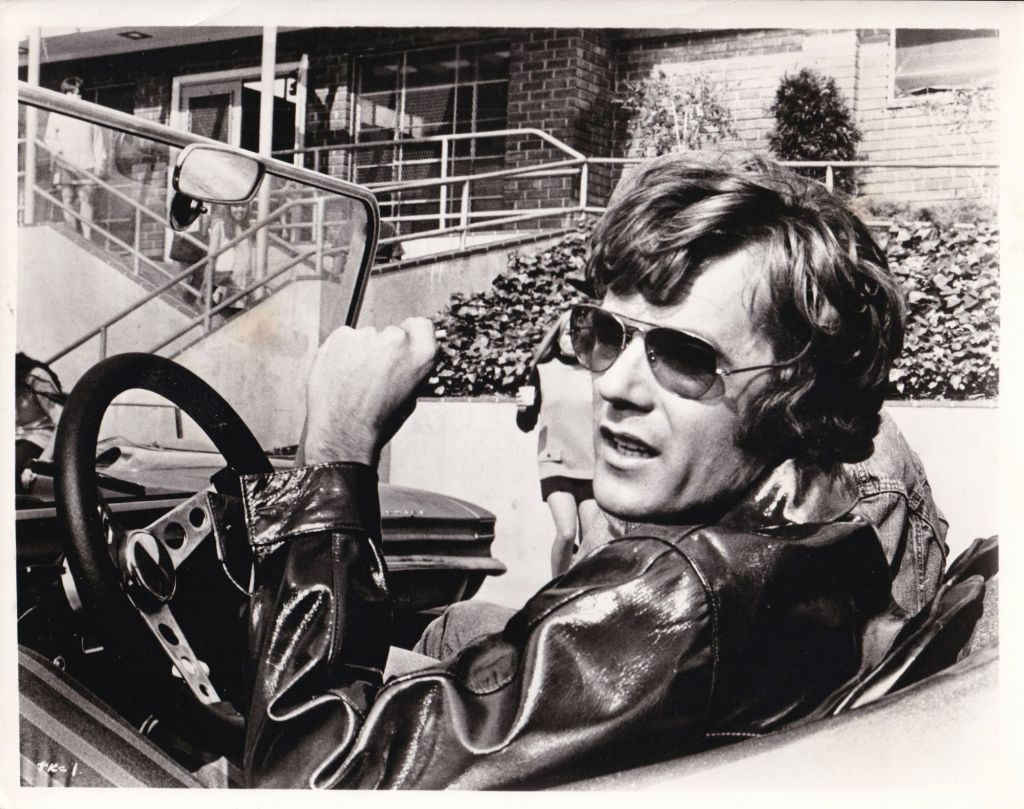
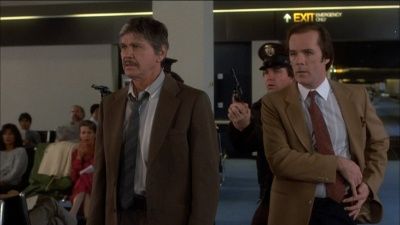
Brad reviews SHOOT OUT (1971), starring Gregory Peck & Robert F. Lyons! 


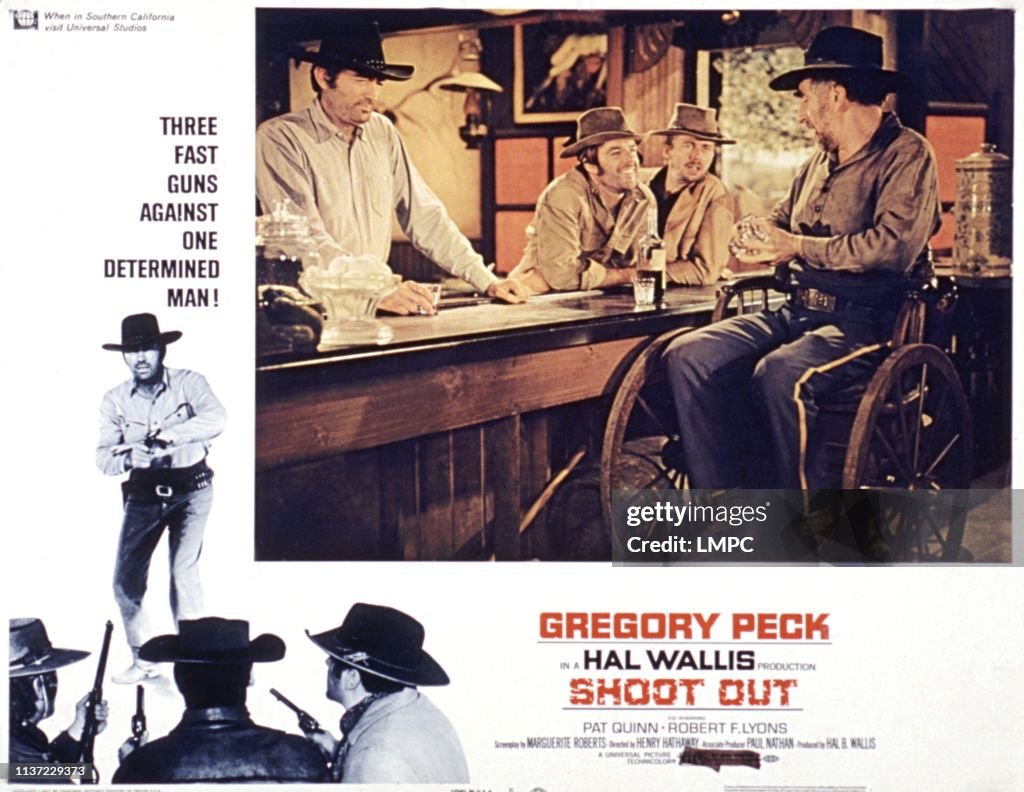
After serving a stretch at the Canon City penitentiary, Clay Lomax (Gregory Peck) gets out with only one thing on his mind… revenge on his former partner Sam Foley (James Gregory), who shot him in the back during a bank robbery, leaving him to take the rap. Foley isn’t a fool, though, so he’s hired a trio of young punks, Bobby Jay (Robert F. Lyons), Skeeter (John Davis Chandler), and Pepe (Pepe Serna) to surveil Lomax and let him know if he’s heading to his home in Gun Hill with payback on his mind. These guys are about as crazy as it gets, and they make two major mistakes. First, they kill Lomax’s friend Trooper (Jeff Corey) who lets him know where Foley is with his dying breath. Second, they kidnap the prostitute Alma (Susan Tyrell) just because they want to treat her like crap and have fun with her, which turns out to be a dumb move. Interrupting Lomax’s quest for revenge, he finds himself being forced to care for a young child named Decky (Dawn Lyn), who just may be his daughter with a lady back in Kansas City who used to be his “friend.” Looking after Decky, and then meeting and falling for the widow Juliana Farrell (Patricia Quinn), Lomax is soon facing off against his most dangerous foe, the crazed Bobby Joe, as he attempts to protect all these new people that he loves so he can move on with his life. But is it all too late?!!

I love westerns, but I must admit that I’m not the biggest fan of director Henry Hathaway’s SHOOT OUT. Hathaway has directed some of my favorite actors and movies, like Charles Bronson’s debut film with Gary Cooper, YOU’RE IN THE NAVY NOW (1951), along with the Jimmy Stewart film CALL NORTHSIDE 777 (1948) and John Wayne’s Oscar winning TRUE GRIT (1969). Unfortunately, it seems his best years are behind him, and he would only direct one more film after this, the less than excellent black action film HANGUP (1974). This isn’t exactly Gregory Peck’s best work either. Coming nine years after his Oscar winning performance in TO KILL A MOCKINGBIRD (1962), this is definitely not even close to that kind of level. Don’t get me wrong, I do enjoy his turn as Lomax when he’s the wronged outlaw looking for revenge, but I don’t really care at all for his part as the reluctant father figure trying to deal with the six-year-old Decky. I found Dawn Lyn to be more annoying than cute in the role, and this storyline distracted me from the revenge plot that I actually enjoyed. As a co-host of the “This Week in Charles Bronson Podcast,” we had the opportunity to interview Robert F. Lyons, who plays the bad guy, Bobby Jay Jones. I specifically asked him about this film and what it was like working with Gregory Peck. While he enjoyed working with Peck, his response about the film itself was telling…. “The work in there is not my work.” If you’ve watched much of the excellent actor’s work before, you can immediately understand what he means. Lyons goes so over-the-top as the spying outlaw Bobby Jay Jones, that his performance is inconsistent with the bulk of his career. Lyons told us that his performance was orchestrated by Hathaway in a way that he disagreed with, and he essentially disowns his work in the film. You can see a similar vibe with his “gang” that includes the actors John Davis Chandler and Pepe Serna. 

While I’m not a huge fan of the overall direction of the storyline or the focus of some of the main performances in SHOOT OUT, I am appreciative of the genre and the classic western stars that Hathaway cast in supporting roles. I especially enjoy seeing Jeff Corey in the small but pivotal role as the wheelchair bound Trooper, Paul Fix as the train brakeman who delivers Decky and a stack of cash to Lomax, and Arthur Hunnicutt as the ranch owner who barters with Lomax over the price of a pony. Hunnicutt is a particular favorite of mine although his role here is very small. Nominated for an Oscar for his performance in Howard Hawks’ THE BIG SKY (1952), Hunnicutt is from the small town of Gravelly, Arkansas, which is not far from where my own family is from. He even attended the same college that I graduated from, the University of Central Arkansas, which was known as the Arkansas State Teachers College when he (and my dad) went there. And then there is the setup of the revenge scenario at the beginning and the final showdown at the end, classic staples of the western genre. These are enjoyable and satisfying moments as Lomax settles his scores and the bad guys get their comeuppance.

Overall, SHOOT OUT is best enjoyed by fans of old school westerns and star Gregory Peck. It veers aways from the best storylines of the genre and wastes a lot of time with uninteresting melodrama, but it does offer us another chance to see some of our great character actors doing what they do. That means something to me. 

I’ve included our podcast episode with Robert F. Lyons below. He discusses SHOOT OUT at around the 1:00:30 mark.

Happy 86th Birthday to the excellent actor, Robert F. Lyons!! 


Every so often in life something incredible happens when you least expect it. First, a little background… back in 2021, Charles Bronson celebrated his 100th birthday in heaven. At that point in my life, I had mostly celebrated my love of Bronson movies by myself. But back in 2021, I saw a news article that stated that Bronson fans around the world were celebrating his 100th birthday on social media using the hashtag #Bronson100. Following the hashtag on Twitter, I discovered a group of people who were doing a “live tweet” of the Bronson classic DEATH WISH 3! That night I met Doug Dietz, Chris Rauch, Lisa Marie Bowman, and many others who just wanted to celebrate Bronson like I did. These folks have become so important in my life! As I continued to search the world of social media for all things Charles Bronson, this time on Facebook, I came across the THIS WEEK IN CHARLES BRONSON PODCAST, run by a man from the Philadelphia area named Eric Todd. I made my request to join the page and was happy when they let me in. Soon I was sharing my love of Bronson, and they even asked me to be part of the podcast!! I guess they thought it would be nice to have someone on the podcast who sounded like the biggest hick in America. After all these years, I had found my people!! Eric and my friends in the THIS WEEK IN CHARLES BRONSON PODCAST Facebook group have become some of my very best friends. We would talk about Bronson and his movies on the show, but we thought it would always just be a bunch of Bronson geeks talking shop. And then another strange thing happened, we started reaching out to actors and actresses who had worked with Bronson and asked if they would come on the show. Lo and behold, many of them started saying YES! Soon Juan Fernandez (KINJITE: FORBIDDEN SUBJECTS), Jordan Rhodes (MR. MAJESTYK, THE INDIAN RUNNER), and Jan Gan Boyd (ASSASSINATION) had joined us for an episode!! It was so fun hearing their firsthand stories of working with Bronson. Which brings us back to Robert F. Lyons… 

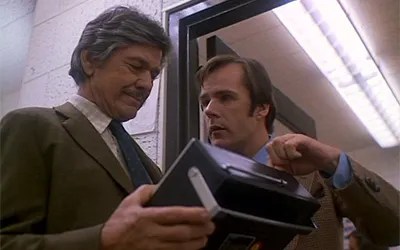
Robert F. Lyons was a hot young actor in the late 60’s and early 70’s. He was incredible in his debut film PENDULUM (1969) as the psychopath Paul Martin Anderson opposite George Peppard. Soon he was stealing scenes in movies like GETTING STRAIGHT (1970) with Elliot Gould and SHOOT OUT (1971) with Gregory Peck. Before long he was headlining his own films like the creepy THE TODD KILLINGS (1971) and the oddly titled DEALING: OR THE BERKELEY-TO-BOSTON FORTY-BRICK LOST-BAG BLUES (1972). As great as Robert F. Lyons is in these roles, his career as a leading man didn’t take off and he was soon back to character parts on movies and TV. He continued to play some really interesting parts along the way, like the awful Harrison Hancock in the Jesse Vint redneck action film BLACK OAK CONSPIRACY (1977) and the doomed vigilante Skeeter Norris in the TV horror film DARK NIGHT OF THE SCARECROW (1981). It was in the early 80’s when Robert F. Lyons, his friends call him Bobby, began working with Charles Bronson. It was also in the early 80’s when I discovered Charles Bronson. From 1982 to 1986, Bobby worked with Bronson in three of his classic Cannon films, first in DEATH WISH II (1982), followed by TEN TO MIDNIGHT (1983), and finally in MURPHY’S LAW (1986). I truly became Bronson’s biggest fan around the same time DEATH WISH 3 and MURPHY’S LAW were hitting home video. Lyons plays Bronson’s trusted partner Art Penney in MURPHY’S LAW, and I’ve watched the film at least 100 times in my life. Over the years, 10 TO MIDNIGHT has developed into my personal favorite Bronson / Cannon Films movie. If you’ve seen the film, Bobby’s in the interrogation scene where Bronson confronts the killer with his masturbation device and he’s also in the courtroom scene (spoiler alert!) where Bronson has to admit he planted the evidence against the killer. These are very memorable scenes in Bronson’s “slasher” film. Bobby, Charlie, and Jill Ireland got along great during these years, the same years I was becoming obsessed with my lifelong movie hero. In some ways, he was part of that obsession!

Later in his career, Bobby appeared on top notch TV shows like COLD CASE and CRIMINAL MINDS. He’s had a phenomenal, five-decade career as a working actor and teacher. Well, in 2024, Bobby agreed to join Eric Todd and me for an episode of the THIS WEEK IN CHARLES BRONSON PODCAST. Knowing how much I love Robert F. Lyons, Eric, who’s the host of the show, let me introduce him at the beginning. Introducing Bobby Lyons and being part of an interview with him is one of those incredible and unexpected things that have happened in my life. He’s the nicest guy, and he spent a couple of hours with us discussing Bronson, his movies, and everything else that came up. It’s one of the greatest nights of my life, and I’m sharing that podcast episode below! Please forgive me for totally fanboying out, but that’s just how it is. Happy Birthday Bobby Lyons! You’re in my film-watching Hall of Fame! 

Charles Bronson interviews the slasher in 10 TO MIDNIGHT (1983)!


Charles Bronson played a cop a bunch of times in the 1980’s, but my personal favorite is Leo Kessler from 10 TO MIDNIGHT. Kessler wants to be a better dad to his daughter Lori (Lisa Eilbacher), but first he needs to catch a psychotic killer who’s murdering beautiful young women. One of the most interesting things about 10 TO MIDNIGHT is the way it tries to fuse a badass cop film with the popular slasher films of the 1980’s. It’s arguably Bronson’s best Cannon film, and Gene Davis is a certifiable creep as the slasher, Warren Stacy. Enjoy this infamous scene where Kessler confronts Stacy about his, ummm… private sexual activities!

Made For TV Horror: Death Car On The Freeway (dir by Hal Needham)


I, for one, am tired of the stereotype that women cannot drive.

I’m a woman and I can tell you right now that I am an above average driver.  I’ve only had one major accident.  Admittedly, I did smash into a parked car but it was raining and I really couldn’t see that well because I was driving convertible and the window was fogged up.  Plus, whoever parked that car must have done a bad job and left it sitting out in the middle of the street.  For the record, my convertible flipped over on impact so the parked car did far more damage than I did.

Other than that, I usually manage to stop in time for red lights.  I’ve only driven through a few stop signs and that was just because I didn’t notice them. I’ve very rarely been given a speeding ticket.  Instead, the police have always been very polite about just giving me a warning.  And yes, it is true that I have trouble with curbs and turns and going in reverse and all that but I’ve seen plenty of men do the same thing.

The statistics show that, while women are involved in more accidents, the accidents are more likely to be fatal if a man is driving.  Men are also more prone to get upset and pull a gun during a road rage incident whereas women just give other drivers the finger.  Women are not inherently bad or dangerous drivers.  The one exception, at least down here in Texas, are middle-aged women who drive SUVs with faded Beto stickers.  You really don’t want to get stuck behind one of them in traffic.

I found myself thinking about the misogyny behind the “women-are-bad-drivers” stereotype as I watched 1979’s Death Car On The FreewayDeath Car On The Freeway features a madman who is so sick of women driving in Los Angeles that he starts using his Dodge van to cause them to have accidents.  We don’t actually see his face or really learn much about him.  What we do see are his black-gloved hands on his steering wheel, which is a nifty homage to the giallo genre.  (Giallo killers have a thing for black gloves.)  Whenever the driver does try to force a woman into a fatal accident, he pops in an 8-track of hyperactive fiddle music.  The fiddle has never sounded more menacing than it does in Death Car On The Freeway.  It’s almost like prog rock fiddling.  Imagine a country western fiddler who has just done a mountain of cocaine and you’ll get a feeling for this guy’s taste in music.

News reporter Shelley Hack thinks that the public has the right to know that there’s a man causing women to crash their cars.  Her ex-husband, played to smarmy perfection by George Hamilton, thinks that Shelley should quit her current job and come work with him.  Meanwhile, police inspector Peter Graves is concerned that the media going to start a panic and make it more difficult for him to track down the “Freeway Fiddler.”  (One gets the feeling that Graves feels this entire mess could have been avoided if women had never been allowed to drive in the first place.)  At one point, Hack meets with a defensive driver instructor and he’s played by the film’s director, Hal Needham.

Oh, how I love this film!  Seriously, it’s got car chases, car crashes, 70s outfits, George Hamilton, Peter Graves, and a genuinely frightening villain.  This is one of those films where you might be tempted to be dismissive.  Folks like Dinah Shore, Sid Haig, and Abe Vigoda show up in small roles, reminding you that this really is a 70s made-for-TV movie.  But then, that fiddling explodes on the soundtrack, that van starts tailgating someone, and Death Car On The Freeway suddenly becomes a cinematic nightmare.  It’s not a surprise that Hal Needham was able to stage some impressive driving stunts in Death Car On The Freeway.  That was Hal Needham’s thing.  But Needham also manages to craft a compelling and, at times, genuinely frightening film.  Anyone who has ever glanced into their rearview mirror and suddenly realized that another vehicle is following them will be able to relate to the fear of the Fiddler’s victims.

This is a great movie and a reminder that women are not the most dangerous drivers on the streets.  Unless, of course, they’re driving an SUV with a faded Beto sticker….

Late Night Retro Television Review: CHiPs 4.4 “The Poachers”


Welcome to Late Night Retro Television Reviews, a feature where we review some of our favorite and least favorite shows of the past!  On Mondays, I will be reviewing CHiPs, which ran on NBC from 1977 to 1983.  The entire show is currently streaming on Prime!
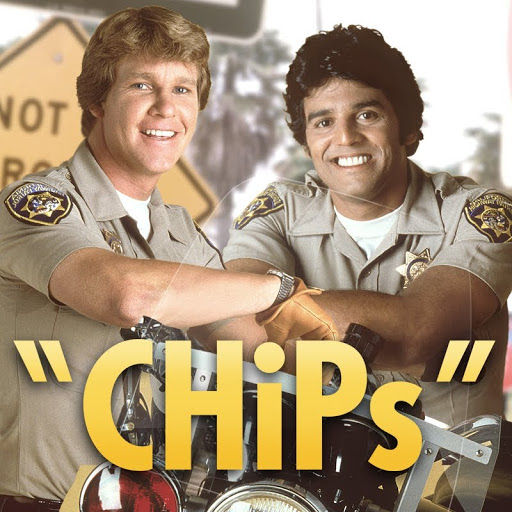
This week, Ponch brings us all closer together.

Episode 4.4 “The Poachers”

(Dir by Barry Crane, originally aired on October 19th, 1980)

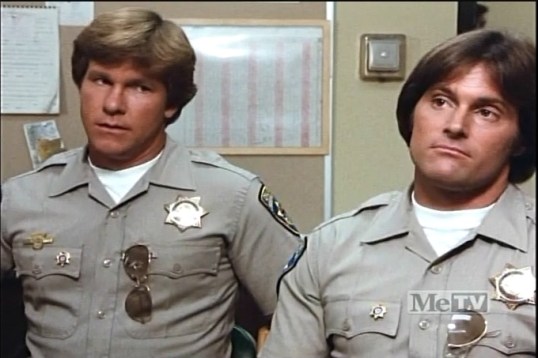
In the beautiful hills surrounding Los Angeles, Jon and Ponch (but mostly Ponch because, as of the start of season four, this is The Ponch Show) pursue two poachers (Robert F. Lyons and Michael Gwynne).  However, Ponch is not the only one after the poachers.  A Native American grandfather named Nathan (Michael Ansara) is in the hills with his grandson (Tony Raymond) and, together, they shoot arrows at the poachers.

Hey, that’s attempted murder!

Well, no matter.  No one like poachers, least of all me.

While Ponch captures the poachers and befriends the grandfather, the rest of the Highway Patrol spend their time at the drag strip and try to win races and set records.  Ponch insists that he should be the one allowed to represent the force on the track and he’s probably right because he’s Ponch and this is The Ponch Show.  Instead, Sgt. Getraer — who technically outranks Ponch but who knows how long that will last — takes to the track himself and amazes everyone with his speed.  Woo hoo!  Meanwhile, poor Baker stands in the background and perhaps remembers how, when the show started, he actually got to do stuff other than follow Ponch around.

This episode was nothing special.  It was well-intentioned with its anti-poaching storyline but it also featured even more cliches than usual.  Michael Ansara was himself not Native American.  He was born in Syria.  The actors who played his son and his grandfather were also not Native American, at least not as far as I could detect from their IMDb profiles.  In short, this was an episode about the wisdom of Native Americans that doesn’t appear to have featured any actual Native Americans.

All that said, it was nice to Robert Pine get to have some fun with the role of Sgt. Getrear.  Pine’s tough-but-fair performance as Getraer has often been this show’s secret weapon and, in this episode, he at least got to smile for once.  He earned it!

Brad reviews 10 TO MIDNIGHT (1983), starring Charles Bronson!


Charles Bronson is Leo Kessler, a veteran detective who’s seen it all and has grown sick of a system of justice that he thinks favors criminals over their victims. When girls start getting murdered, he immediately suspects the arrogant Warren Stacy, played by Gene Davis in the best role of his career. When Kessler and his partner Paul McCann (Andrew Stevens) start putting the pressure on Stacy, the killer responds by going after Kessler’s daughter Laurie (Lisa Eilbacher). Needless to say, our hero will do anything to stop the madman, ANYTHING!

10 TO MIDNIGHT is a special movie in my house because it’s my wife’s favorite Charles Bronson film, even when she didn’t have any overall appreciation for Bronson as an actor. Luckily for her, she had me to introduce her to the rest of the iconic actor’s voluminous catalog of movies. I saw 10 TO MIDNIGHT myself when I was pretty young, probably 13 or so. I remember being scared that first night after I watched the movie when I was trying to go to sleep. My wife and I watched it today on my old VHS tape that I’ve owned going back to the late 1980’s. 

There are several elements that elevate 10 TO MIDNIGHT above the average cop / slasher thrillers of the 1980’s. First, it’s Charles Bronson in the lead role. Bronson has such a strong presence on screen that his presence alone elevates almost any material. He looks great in the film, and the role gives him some good opportunities, as both a mentor to the young cop, and even more importantly, as a dad who wants to do better for his daughter. It’s a solid role that seems to fit Bronson like a glove. Second, we know from the very beginning of the movie that Warren Stacy is in fact the killer. We also know that the law seems to be working in his favor. And because of that, we’re on Kessler’s side as he goes to extreme lengths to stop his reign of terror. Finally, the script and director J. Lee Thompson go all in on the sex and violence. Examples include Stacy killing his often naked victims while he himself is in the nude. There is much talk in the film about items of a sexual nature and Stacy even has a sexual release device that almost has to be seen to be believed. It definitely adds a decadent and voyeuristic feel to the proceedings. And I haven’t even mentioned yet that it has one of the very best endings of any Bronson film, second only to THE MECHANIC, in my humble opinion.

I highly recommend 10 TO MIDNIGHT!

For a more detailed review of 10 TO MIDNIGHT, check out Lisa’s review from a couple of years back below:

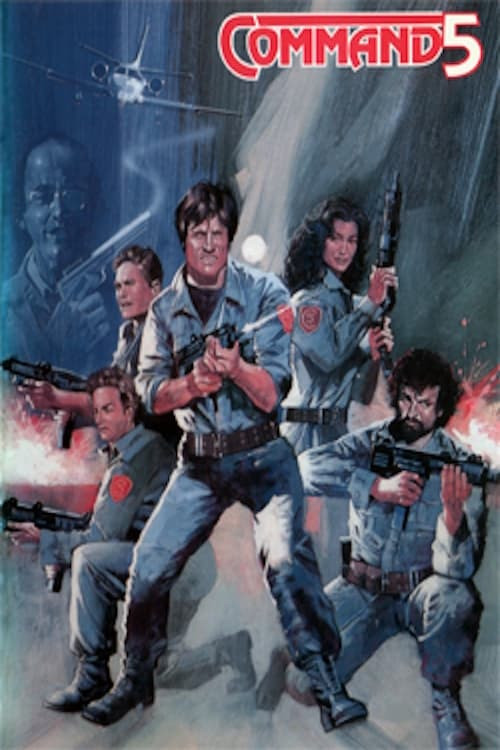
Command 5 (1985, directed by E.W. Swackhamer)


Morgan (Stephen Parr) is a mysterious government operative who puts together a special paramilitary force to take on extreme threats.  He says that only misfits are allowed to join his group because they have the edge he needs.  Smith (William Russ) is a wild Texan who drives like a maniac.  Psychiatrist Winslow (Sonja Smits) can fire an Uzi better than any man.  Kowalski (John Matuszak) is a demolitions expert who listens to Beethoven.  Jack Coburn (Wings Hauser) is a rebellious detective who is good with a throwing knife.

After a montage of their extensive training and a scene where our heroes take a look at the bullet-proof RV that they’ll be traveling the country in, the movie finally gets down to business.  A motorcycle-riding terror cult led by Delgado (Gregory Sierra) has taken an entire town hostage and is threatening to kill everyone unless they’re given a flight out of the country.  Our heroes drive their bulletproof van into town and try to defeat the bad guys.  There’s one good scene where the RV is driving down the town’s main street and getting hit nonstop with bullets.  The scene was obviously ripped off from the end of Clint Eastwood’s The Gauntlet but it’s still exciting to watch.  Otherwise, the action in this one is pretty rudimentary.

I guess Command 5 was supposed to be a pilot for television show that never went into production.  It is very much a television production.  There’s a lot of shooting but no blood.  Wings Hauser is less dangerous than usual.  The whole thing ends with Command 5 looking forward to adventures that were never to come.  Watching the pilot, you can see why it never became a show.  The characters were all thinly-written and never seemed to have much of a connection with each other and Hauser and Russ both seemed to be competing to be the loose cannon of the group.  This one is for Wings Hauser completists only.

MURPHY’S LAW – Don’t F#&k with Jack Murphy!


I became obsessed with actor Charles Bronson in 1986 after receiving a VHS copy of DEATH WISH 3 as a Christmas present. Going along with that obsession was my desire to see every Charles Bronson movie that had ever been made. As much as I enjoyed re-watching DEATH WISH 3, it was always a treat when I could rent a different Bronson film at the video store. The current Bronson movie at the video store in 1987 that appealed to me as a 13 year old boy was MURPHY’S LAW, so I wanted to rent it as often as possible. There were even a couple of times when different friends asked me to spend the night, and I had one requirement for saying yes… that we rent MURPHY’S LAW! Y’all, don’t think too bad of me for this admission. Remember, I was only 13 years old, I couldn’t drive, and I didn’t have a job so if I had to use a friend’s mom to get my Bronson fix, that’s just what I had to do! Based on the timing of my initial Bronson obsession, DEATH WISH 3 and MURPHY’S LAW are 1-2 in the films that I’ve watched the most times during my life.

In MURPHY’S LAW, Charles Bronson plays Jack Murphy, a tough cop who seems to be experiencing a series of unfortunate events:

  1. A thief named Arabella McGee (Kathleen Wilhoite) tries to steal Murphy’s car and drives it through the window of a pizzaria. We know that’s his car because he loudly proclaims, “That’s MY car!!” He even wastes money on a sack of groceries by throwing it at his car while she’s driving away. He’s able to chase her down on foot, but she kicks him in the testicles and runs off leaving him doubled over in pain, grocery-less, and clutching the family jewels!
  2. A mafia kingpin named Frank Vincenzo (Richard Romanus) wants to kill him because Murphy was forced to shoot and kill the kingpin’s brother. We know the cop and the kingpin don’t like each other, because a little before the shooting they have a slight disagreement in front of the mafioso’s mother over whether the brother is a scum-sucking pimp or a talent agent. Unable to resolve the debate amicably, the mafioso inquires as to whether or not Jack has ever heard of “Murphy’s Law, if anything can possibly go wrong it will?” Murphy responds with an alternative version of Murphy’s Law, the only law that he knows, and one that I greatly prefer. You get the feeling that this argument may be revisited later in the film.     
  3. Murphy’s now ex-wife Jan (Angel Tompkins) is performing extremely artistic striptease routines at a local club called Madam Tong’s. She’s also making love to the manager of the club. Rather than drinking at home alone until he passes out like most depressed men, Murphy hangs out at Madam Tong’s watching her shake her goodies for a bunch of horny lowlifes, before following them home and watching from outside until they turn off the bedroom lights. Very sad indeed.
  4. And here’s the worst part, on one of those typical nights where he’s obsessively stalking his wife, another mystery woman (Carrie Snodgress) knocks him in the head, shoots the slimy manager and Mrs. Murphy with his gun, and then frames him for their murders. Arrested for the murders and subsequently handcuffed to the thief who tried to steal his car, Murphy must stage a daring helicopter jailbreak in order to find out who framed him and clear his name before everything and everyone he holds dear is taken from him!

There are several reasons that I loved MURPHY’S LAW back in the eighties, and that I still enjoy it now. First, of course, is Charles Bronson. He was around 64 years old when he filmed MURPHY’S LAW, but he’s still in great physical condition in 1986. One of Bronson’s greatest strengths is his screen presence, and he still dominates each frame he’s in. Second, the film has an excellent supporting cast. Carrie Snodgress is having a ball playing the main villain in the film. I’ve seen her in quite a few movies, like PALE RIDER with Clint Eastwood, and 8 SECONDS with Luke Perry, but I’ve never seen her in a role like this. Snodgress was nominated for an Oscar for her role in a 1970 film called DIARY OF A MAD HOUSEWIFE. I’ve never seen that one before, but I should probably check it out! I love Kathleen Wilhoite as Arabella McGee, the thief who ends up handcuffed to Bronson. Her vocabulary, while probably not very realistic for the streets of LA at the time, was hilarious to me as a teenager. I enjoy calling the people I love “snot licking donkey farts” on occasion to this very day. It’s Kathleen Wilhoite singing the title song over the closing credits! And Robert F. Lyons is very special to me in his role as Art Penney, Jack Murphy’s partner. We got to interview him on the THIS WEEK IN CHARLES BRONSON podcast about his roles on DEATH WISH 2, 10 TO MIDNIGHT, and MURPHY’S LAW. He was so generous with his time, and just a hell of a nice guy! I’ve attached a link to the YouTube video of the interview with Mr. Lyons if you’re interested in the great stories he tells us about his time in Hollywood! Finally, MURPHY’S LAW was directed by J. Lee Thompson, my personal favorite director who worked with Bronson. Thompson directed Bronson in 9 different films, beginning with ST. IVES in 1976 and ending with KINJITE: FORBIDDEN SUBJECTS in 1989. No matter the material, you always knew that Thompson would deliver a film with a certain quality that made Bronson look good!

I’ll always be a fan of MURPHY’S LAW, partly for nostalgic reasons, but mainly because I think it’s an entertaining mid-80’s action film for Bronson at a time when he was one of the kings of the video store!

Retro Television Reviews: Fantasy Island 4.4 “Don Quixote/The Sex Goddess”


Welcome to Retro Television Reviews, a feature where we review some of our favorite and least favorite shows of the past!  On Tuesdays, I will be reviewing the original Fantasy Island, which ran on ABC from 1977 to 1986.  Almost the entire show is currently streaming is on Youtube, Daily Motion, and a few other sites.

This week’s journey to Fantasy Island is oddly unpleasant.

Episode 4.4 “Don Quixote/The Sex Goddess”

(Dir by Michael Vejar, originally aired on November 15th, 1980)

As always, this episode opens with “the plane, the plane” landing at Fantasy Island and Mr. Roarke and Tattoo heading out to meet their guests.  Unfortunately, as has been the case since the since the third season, Mr. Roarke and Tattoo no longer share any sort of playful banter before meeting the guests.  In fact, Roarke often seems to refuse to even look at Tattoo while speaking to him.  It’s awkward to watch because the dislike between Ricardo Montalban and Heve Villechaize is obvious whenever they share a scene.  It’s something that is easy to joke about while talking about the show but it’s far more unpleasant to actually witness.

Of course, this entire episode is rather unpleasant, which is a shame because Fantasy Island‘s greatest strength as a show was that watching it was usually a pleasant and undemanding way to spend an hour.

Take, for instance, the fantasy of Helen Hendrix (Phyllis Davis).  Helen’s fantasy is to become a “sex goddess.”  Tattoo expresses disbelief that the pretty but far from glamorous Helen could ever be a sex goddess but Roarke reminds Tattoo that, on Fantasy Island, all things are possible.  Roarke then says that Helen doesn’t realize that her fantasy could be a “a very dangerous fantasy.”

Well, Mr. Roarke, if it’s so dangerous, why did you agree to allow her to come to the Island?  In the past, Mr. Roarke has mentioned turning down many requests for fantasies.  He is apparently the final judge on whether or not someone will get their fantasy.  (Even when Tattoo granted a fantasy to someone who Roarke previously turned down, it was suggested that it was all a part of Roarke’s master plan.)  If the fantasy is so dangerous, why give it to Helen?  What is Mr. Roarke’s legal liability if someone gets killed while experiencing their fantasy?

Anyway, Mr. Roarke gives Helen a blue potion and when she drinks it, she becomes a blonde, starts wearing makeup, and gets a dress that’s far more flattering and low-cut than the borderline Amish outfit she was wearing when she first arrived at the Island.  She is now an internationally famous sex goddess, which unfortunately leads to her being kidnapped by three men (Michael Callan, Edd Byrnes, and Don Stroud) and held hostage on a neighboring island.  Eventually, Helen realizes that she’s going to have flirt her way out of captivity, which leads to a smitten Don Stroud helping her to escape.  Or, at least, he does until the potion wears off and Helen goes back being a brunette.  Stroud is shocked but, before he can strangle her, Roarke shows up and whisks Helen back to the Island.

Seriously, what a thoroughly unpleasant fantasy.  Helen comes to the island because she wants to know what it’s like to be famous and sexy and Roarke essentially allows her to be kidnapped by three men who apparently are planning on trafficking her.  Indeed, Roarke seems to suggest that this is Helen’s fault for wanting to be attractive in the first place.  Personally, I think Helen should sue Fantasy Island for all its worth.

As for the other fantasy, Paul Williams plays an eccentric Texas banker named Donald Quick.  His fantasy is to be Don Quixote.  (That’s a weird fantasy but whatever.)  Soon, Donald and his lawyer (David Doyle) are riding their donkeys across Fantasy Island while dressed up like conquistadors.  Donald saves a woman from a motorcycle gang and you have to wonder just what exactly a motorcycle gang is doing on Fantasy Island.  He saves another woman (Mary Louis Weller) from her louse of a boyfriend (Robert F. Lyons) and then he jousts with a Cadillac.  It’s silly but at least Donald finds love and David Doyle gets a few funny lines over how much he wants to sue Fantasy Island.

Honestly, this episode could have been saved if the two fantasies had intersected.  If Donald and his lawyer had turned up to battle the kidnappers and save Helen, this actually would have been an okay episode and the lawyer could have helped Helen file a lawsuit against Roarke.  But instead, the fantasies stay separate and the whole thing just feels icky.  Seriously, Mr. Roarke was not on top of his game of this week.  It might be time to give Tattoo more responsibility.

Film Review: 10 to Midnight (dir by J. Lee Thompson)


The 1983 film, 10 to Midnight, opens with LAPD detective Leo Kessler (played by legendary tough guy Charles Bronson) sitting at his desk in a police station.  He’s typing up a report and taking his time about it.  A reporter who is in search of a story starts to bother Leo.

“Jerry,” Leo tells him, “I’m not a nice person.  I’m a mean, selfish son-of-a-bitch.  I know you want a story but I want a killer and what I want comes first.”

It’s a classic opening, even if Leo isn’t being totally honest.  Yes, he can be a little bit selfish but he’s really not as mean as he pretends to be.  He may not know how to talk to his daughter Laurie (Lisa Eilbacher) but he is also very protective of her and he wants to be a better father than he’s been in the past.  He may roll his eyes when he discovers that Detective Paul McAnn (Andrew Stevens) is the son of a sociology professor but he still tries to act as a mentor to his younger partner.  Leo may complain that the criminal justice system “protects those maggots like they’re an endangered species” but that’s just because he’s seen some truly disturbing things during his time on the force and, let’s face it, Leo has a point.  When one of Laurie’s friends is murdered, Leo is convinced that Warren Stacy (Gene Davis) is the murderer and he’s determined to do whatever he has to do to get Warren off the streets.  “All those girls,” Leo snarls when he sees Warren, his tone letting us know that his mission to stop Warren is about more than just doing his job.

Warren Stacy is handsome, athletic, and he has good taste in movies.  (He’s especially a fan of Butch Cassidy and the Sundance Kid.  Just don’t try to trick him by saying Steve McQueen played the Sundance Kid.)  Warren is also a total creep, the type of guy who complains that a murder victim “wasn’t a good person,” because she trashed him in her diary.  When Leo takes a look around Warren’s apartment, he finds not only porn but also a penis pump.  (“It’s for jacking off!” Leo yells at Warren, enunciating the line as only Charles Bronson could.)  Warren is also a murderer but he’s a clever murderer, the type who sets himself up with an alibi by acting obnoxiously in a movie theater.  Warren strips nude before killing his victims, in order to make sure that he doesn’t leave behind any evidence.  (This film was made in the days before DNA testing.)

Leo knows that Warren is guilty but, as both his gruff-but-fair captain (Wilford Brimley, naturally) and the D.A. (Robert F. Lyons) point out, he has no way to prove it.  When Warren starts to stalk Laurie and her friends (including Kelly Preston), Leo decides that he has no choice but to frame Warren.  But when Warren’s amoral attorney, Dave Dante (Geoffrey Lewis, giving a wonderfully sleazy performance), threatens to call McAnn to the stand, McAnn has to decide whether to tell the truth or to join Leo in framing a guilty man.

10 to Midnight is a violent, vulgar, and undoubtedly exploitive film, one that features a ham-fisted message about how the justice system is more concerned with protecting the rights of the accused as opposed to lives of the innocent.  And yet, in its gloriously pulpy way, this is also one of Bronson’s best films.  It’s certainly my personal favorite of the films that he made for Cannon.

Director J. Lee Thompson and Charles Bronson were frequent collaborators and Thompson obviously knew how to get the best out of the notoriously reserved actor.  Bronson was not known for his tremendous range but he still gives one of his strongest performances in 10 to Midnight, playing Leo as being not just a determined cop but also as an aging man who is confused by the way the world is changing around him.  Stopping Warren isn’t just about justice.  It’s also about fighting back against the the type of world that would create a Warren Stacy and then allow him to remain on the streets in the first place.  Interestingly, though Leo doesn’t hesitate when it comes to framing Warren, he is also sympathetic to McAnn’s objections.  Unlike other Bronson characters, Leo doesn’t hold a grudge when his partner questions his methods.  Instead, he simply know that McAnn hasn’t spent enough time in the real world to understand what’s at stake.  McAnn hasn’t given into cynicism.  He hasn’t decided that the best way to deal with his job is to be a “mean son of a bitch.”  Bronson and Andrew Stevens, who had worked together in the past, have a believable dynamic.  McAnn looks up to Leo but is also conflicted by his actions.  Leo may be annoyed by McAnn’s reluctance but he also respects him for trying to be an honest cop.  Their partnership feels real in a way that sets 10 to Midnight apart from so many other films about an older cop having to deal with an idealistic partner.

One of the most interesting things about the film is Leo’s relationship with his daughter, Laurie.  Over the course of the film, Leo and Laurie go from barely speaking to bonding over liquor and their shared regrets about the state of the justice system.  When McAnn first meets Laurie, she’s offended when McAnn suggests that she takes after her father.  But, as the film progresses, she comes to realize that she and Leo have much in common.  (To be honest, I related quite a bit to Laurie, especially as I’ve recently come to better appreciate how much of my own independent nature was inherited from my father.)  Lisa Eilbacher and Charles Bronson are believable as father-and-daughter and they play off of each other well.  The scenes between Laurie and Leo give 10 to Midnight a bit more depth than one might otherwise expect from a Bronson Cannon film.  Leo isn’t just trying to protect his daughter and her roommates from a serial killer.  He’s also trying to be the father who he wishes he had been when she was younger.  He’s trying to make up for lost time, even as he also tries to keep Warren Stacy away from his family.

As played by Gene Davis, Warren Stacy is one of the most loathsome cinematic villains of all time.  Warren’s crimes are disturbing enough.  (Indeed, the surreal sight of a naked and blood-covered Warren Stacy stalking through a dark apartment is pure nightmare fuel.)  What makes Warren particularly frightening is that we’ve all had to deal with a Warren Stacy at some point in our life.  He’s the sarcastic and easily offended incel who thought he was entitled to a phone number or a date or perhaps even more.  As I rewatched this movie last night, I wondered how many Warrens I had met in my life.  How many potential serial killers have any of us unknowingly had to deal with?  Warren tries to strut through life, smirking and going out of his way to let everyone know that he knows more than they do but the minute that Leo turns the table on him, Warren starts whining about he’s being treated unfairly.  During his final, disturbing rampage, Warren yells that his victims aren’t being honest with him, blaming them for his actions.  The film deserves a lot of credit for not turning Warren into some sort of diabolical and erudite supervillain.  He’s not Hannibal Lecter.  Instead, like all real-life serial killers, he’s a loser who is looking for power over those to whom he feels inferior and for revenge on a world that he feels owes him something.  He’s a realistic monster and that makes him all the more frightening and the film all the more powerful.  Warren is the type of killer who, even as I sit here typing this, could be walking down anyone’s street.  He’s such a complete monster that it’s undeniably cathartic whenever Leo goes after him.

How delusional is Warren Stacy?  He’s delusional enough to actually taunt Charles Bronson!  At one point, Warren informs Leo that he can’t be punished for being sick.  Warren announces that, when he’s arrested, he might go away for a while but he’ll be back and there’s nothing Leo can do about it.  (The suggestion, of course, is that Warren will be back because he committed his crimes in California and all the judges were appointed by a bunch of bleeding heart governors.  Warren may not say that out loud but we all know that is the film’s subtext.  Some people may agree with the film, some people may disagree.  Myself, I’m against the death penalty because I think it’s a prime example of government overreach but I still cheered the first time that I heard Clint Eastwood say, “Well, I’m all torn up about his rights,” in Dirty Harry.)  How does Leo react to Warren’s taunts?  I can’t spoil the film’s best moment but I can tell you that 10 to Midnight features one of Bronson’s greatest (and, after what we’ve just seen Warren do, most emotionally satisfying) one-lines.

The title has nothing to do with anything that happens in the film.  In typical Cannon fashion, the film’s producers came up with a snappy title (and 10 to Midnight is a good one) and then slapped it onto a script that was previously called Bloody Sunday.  Fortunately, as long as Bronson is doing what he does best, it doesn’t matter if the title makes sense.  And make no mistake.  10 to Midnight is Bronson at his best.