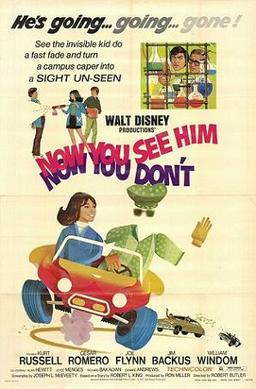
I Watched Now You See Him, Now You Don’t (1972, Dir. by Robert Butler)


Dexter Riley (Kurt Russell) is back and just in time because Medfield College is on the verge of getting closed down again.

In The Computer Wore Tennis Shoes, buying a computer was supposed to be the solution to all of Medfield’s financial problems.  I guess it didn’t work because Medfield is broke again and corrupt businessman A.J. Arnoe (Cesar Romero) is planning on canceling the school’s mortgage so that he can turn it into a casino.

There is some hope.  Dexter has accidentally created an invisibility spray.  Not only does it tun anything that it touches invisible but it also washes away with water so there’s no risk of disappearing forever.  Dexter and his friend Schuyler (Michael McGreevey) know that they can win the science fair with their invention but the science fair doesn’t want to allow small schools like Medfield to compete unless they really have something big to offer.  Dexter tells the Dean (Joe Flynn) that he has a sure winner but Dexter also refuses to reveal what it is because he doesn’t want word to leak before for the science fair.  The Dean decides to raise the money to pay off the mortgage by becoming a golfer, as one does.  Schulyer works as the Dean’s caddy while Dexter uses the invisibility spray to help the Dean cheat.  That’s a good message for a young audience, Disney!  But when Arno finds out about the spray, he wants to steal it so he can rob a bank.

This was even dumber than The Computer Wore Tennis Shoes but it was also hard to dislike it.  The comedy was too gentle, Kurt Russell and the rest of the cast were too likable, and the special effects were too amusingly cheap in that retro Disney way for it to matter that the movie didn’t make any sense.  When a bunch of college kids learn the secret of invisibility and use it to cheat at golf, you know you’re watching a Disney film.

I Watched The Computer Wore Tennis Shoes (1969, Dir. by Robert Butler)


Medfield College has a problem.  No one takes the college seriously.  Maybe if the college could win the big college quiz show, people would finally stop laughing at Medfield but the students are not academically talented.  Professor Quigley (William Schallert) thinks that the college needs to finally buy a new-fangled device called a computer.  The Dean (Joe Flynn) says that there’s no way any college can afford something as expensive as that!  Luckily, businessman and gangster A.J. Arno (Cesar Romero) is willing to donate one of his computers.  It takes several students to move the computer into the lab because the computer is huge.

Medfield finally has a computer but are the students smart enough to win that quiz show?  Popular jock Dexter Riley (Kurt Russell) happens to be in the lab during a freak thunderstorm.  When both he and the computer get struck by lightning at the same time, it leads to Dexter becoming a human computer.  He suddenly knows everything.  He can speak any language and solve any equation.  He can answer any question/  Whenever anyone shines a light into Dexter’s ear, they see circuit boards.  No one really cares that none of this makes sense.  Medfield is going to win that quiz show for sure!  But first, Dexter is going to have to escape from Arno, who fears Dexter now knows all the details about his gambling ring.

Watching this Disney film was a real eye-opener for me.  Computers are such a part of my everyday life that it was strange seeing a college making such a big deal about getting one.  The computer that Medfield got looked more like the type of computer that NASA used to go to the moon than the ones that were in my high school computer lab.  I was worried that no one seemed to care that Dexter had a circuit board in his head.  Not even Dexter seemed to care.  It was also funny to me that all he had to do was get struck by lightning while standing near a computer and suddenly, he knew how to speak every language and solve every problem.  I use a computer everyday and I can still only speak English and Spanish.  I feel like I’m getting cheated.

The whole movie was absolutely ludicrous but I did enjoy watching this movie.  It was too sweet, innocent, and good-natured not to enjoy.  There was nothing realistic about the movie but it was nice to imagine a world where everyone gets along, the bad guys are all too buffoonish to really be dangerous, and a serious knock on the head leads to thing returning to normal instead of permanent brain damage.  Kurt Russell was only 18 when he made The Computer Wore Tennis Shoes but he could already carry a movie.

Retro Television Review: Death Takes A Holiday (dir by Robert Butler)


Welcome to Retro Television Reviews, a feature where we review some of our favorite and least favorite shows of the past!  On Sundays, I will be reviewing the made-for-television movies that used to be a primetime mainstay.  Today’s film is 1971’s Death Takes A Holiday!  It  can be viewed on YouTube.

For a few days in 1971, no one dies.

The Vietnam War continues but there are no casualties.  There are natural disasters but no one loses their life.  Doctors are stunned.  World leaders start to panic.  An emergency session of the UN is called to debate what to do about living in a world where no one is dying.  One gets the feeling that the world’s leaders prefer it when people are dying in wars and disasters.

Death has taken a holiday.

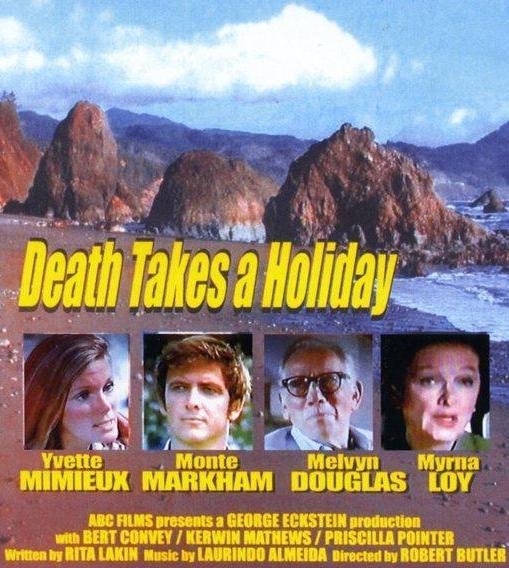
Death (Monte Markham) has become confused as to why humans so desperately want to live despite the fact that the world in which they exist is not always a happy one.  He is particularly confused by the elderly Judge Earl Chapman (Melvyn Douglas), who has suffered multiple strokes and other ailments and yet has always resisted whenever Death has come for him.  Death decides to take his holiday on the isolated beach where the Judge and his family are spending their weekend.  Though Death introduces himself as being David Smith, the Judge recognizes him.  It turns out that the Judge was always aware of death lingering around him and his family.

Death, for his part, has fallen in love with the Judge’s headstrong and rebellious daughter, Peggy (Yvette Mimieux).  In fact, Peggy was meant to die on the beach but, as soon as Death saw her drowning, he decided not to take her and instead allowed her to wash up back on the beach.  Death explains to the Judge that he can only spend so much time on vacation and that soon, people will start dying again.  Death says that he’ll be taking Peggy to the afterlife after the weekend ends.  The Judge tries to change his mind but Death is in love and he wants Peggy to be with him.

An adaptation of a play that inspired both 1934’s Death Takes A Holiday and 1998’s Meet Joe Black, the 1971 version of Death Takes A Holiday is a well-acted and intelligent made-for-television movie, one that eschews heavy-handed drama in favor of being a rather low-key meditation on what it means to both live and to die.  Melvyn Douglas and, as his wife, Myrna Loy both give poignant performances and Douglas even manages to sell the potentially maudlin moment where he explains why he has always clinged to life.  Monte Markham may not be the first actor who comes to mind when you think of someone to cast as the human form of Death but he does a good job in the role and he and Yvette Mimieux have a wonderful chemistry together.  The beach scenery is lovely and the story is an interesting one.  Clocking in at just 73 minutes, this version of Death Takes A Holiday is the best of all of them.

White Mile (1994, Directed by Robert Butler)


In this HBO movie, Alan Alda plays the biggest asshole in the world.

Alda is cast as Dan Cutler, an ad exec who books a corporate retreat to Canada’s White Mile.  He tells the nine men who accompany him, some of whom are clients and some of whom work for him, that it’s going to be a weekend of fishing and male bonding.  What he doesn’t reveal is that the trip is also going to require whitewater rafting.  Despite the fact that the majority of the men are out-of-shape and hardly any of them have any rafting experience, Dan insists that they all take part.  When their guide says that they’re going to need to take two boats, Dan refuses.  He wants everyone in one boat, the better so they can all work together to prove their manhood by conquering the river.

The trip starts out well but, when the raft hits a rock and turns over, five of the men end up dead.  Despite injuring his leg, Dan survives and, when he returns to work, he’s hailed as a hero.  However, one of the widows of the men who didn’t survive is now suing the company.  While Dan tries to cover his own ass, one of the survivors — Jack Robbins (Peter Gallagher) — is faced with a dilemma of his own.  As one of the few people who knows that Dan demanded that the guide only use one boat, will Jack testify to the truth at the trial or will he follow Dan’s orders and keep quiet about what really happened?

Based on a true story, White Mile features some brief but exciting (and harrowing) rafting scenes but the film is less about what happened in the wilderness and instead about what’s happening behind the closed doors of corporate America.  White Mile does a good job of taking Alda’s sensitive male persona and pushing it through the looking glass.  As played by Alda, Dan is the type of tyrannical boss who we’ve all had to deal with.  His friendly smile barely disguises a bullying streak.  Even after the accident leaves five of his colleagues dead, Dan is still convinced that the trip was a good idea and that everyone was having the best day of their lives until they hit that rock.  When the river guide initially finds Dan stranded on a rock, Dan makes a show of telling the guide to come back for him later and to find the others.  When Dan later comes across one of the dead men, he says, “He must have had a bad heart,” as he grasps at any way to avoid taking responsibility.  Though White Mile is dominated by Alda’s villainy, it also features good performances from Gallagher, Robert Loggia, Bruce Altman, and Jack Gilipin.  When Gilpin demands to know if anyone at the ad agency has shown any true remorse for what happened, he is speaking for the entire audience.

White Mile was an early HBO film and, because it was released before HBO became known for its original programming, it’s often unfairly overlooked.  When it was released on DVD, it was advertised as being an action-adventure film, which it definitely is not.  Instead, it’s a look at the type of head games that far too often act as a substitute for responsible and ethical management in corporate America.  It’s a good movie and you’ll never look at Alan Alda the same way again.

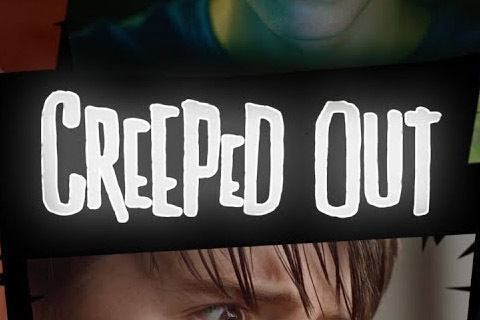
Creeped Out, S1E1, Marti, Review by Case Wright


co3

Creeped Out is a Netflix release that really isn’t.  I have noticed that Netflix will call something an original series even though they just bought the rights.  This show was originally produced by CBBC, explaining why the second episode has very hard to understand British accents.  I checked Bruce McDonald’s IMDB and yes…he’s english and wrote for the Eastenders.  Eastenders or EastEnders (sp?) is show that I believe is about poor people in London or something…I’m not investigating anymore than that.

I watched the first episode Marti with my girls (7,9).  They were quite scared by the opening and one other scene that I will get to later.  The show is a lot like the 90s show The Outer Limits.  It has a lot of spooky and technology themes that teach a morality or cautionary tale.  I was primed to like this show because I loved the Outer Limits and one of the writers is really nice: Melinda Snodgrass (follow her on twitter).

The story opens with Kim.  Kim is a pretty girl in high school who none of the boys pay attention to because that actually happens in real life.  She has nerdy friend that also is a pariah for no particular reason.  Kim is forced to hang out with her loser friend and pine for a boy who looks like Justin Bieber.  She gets a new phone and pays for it somehow.  This phone is indestructible and self-aware.

The phone’s AI calls himself Marti.  Marti is really really creepy.  He works autonomously to make Kim popular and succeeds.  Kim gets the attention of the cool kids, including Bieber.  Just when Bieber is about to go out with her, in true Lifetime MOW fashion, Marti reveals himself to be a jealous psycho boyfriend.  He threatens to destroy Kim’s new found popularity unless she agrees to be only his.  YIKES.  When Kim gets fed up, she tries to destroy the phone, it doesn’t work.  Kim tries to call customer service and a woman answer who slowly takes Marti’s side.  Then, the voice switched to Marti’s voice and my daughters both screamed.  They didn’t understand why fully it was so scary, but I finished the show alone.

Marti blackmails Kim to take him to the prom and she agrees.  It’s really creepy.  She eventually defeats Marti, but he destroys her popularity.  She entombs Marti in cement, but then considers releasing him six months later because she really liked being popular.

The show had a real Outer Limits vibe and played upon human weakness and need to be loved.  There’s always been the morality tale of giving up your soul for fame, but this is more basic.  Kim wants to be loved and our technology has never made us more isolated from real love.  Marti’s popularity is twitter popularity: fake.  Marti gave her multiple friendships that were ended as quickly as they began like muting or blocking someone.  On the other hand, Kim’s nerdy friend took the good with the bad and continued to love Kim.  It spoke to dependence and isolation because of technology and our total dependence upon instant love.