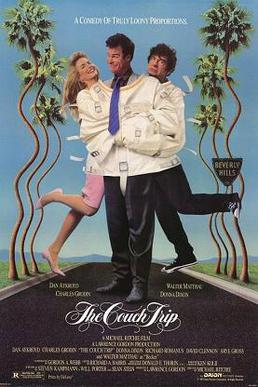
The Couch Trip (1988, directed by Michael Ritchie)


When renowned radio psychiatrist George Matlin (Charles Grodin) has a nervous breakdown, he takes a trip to Europe with his wife (Mary Gross) to both recover and also work on his marriage.  (Matlin’s breakdown was the result of an extramarital affair.)  Needing someone to host Dr. Matlin’s radio show, his producers call Dr. Lawrence Baird (David Clennon), who oversees a mental facility in Chicago.  They assume that Dr. Baird is just dumb enough that they won’t have to worry about him overshadowing Dr. Matlin while he’s guest-hosting.  However, when they call, Dr. Baird is out of his office and the phone is answered by John Burns (Dan Aykroyd), a con artist who has been pretending to be insane so that he can avoid serving time in prison.  Pretending to be Baird, Burns accepts their offer and then escapes from the asylum and heads to Beverly Hills.  The real Dr. Baird, not knowing about the offer, goes on vacation in Europe.  Though Burns had originally only been planning on doing the radio job long enough to get paid enough money to head to Mexico, he soon becomes a celebrity with his non-nonsense, blunt advice.

There’s a lot of talented people in The Couch Trip, including Walter Matthau as a former priest-turned-kleptomaniac and Aykryod’s wife, Donna Dixon, as Matlin’s colleague and Burns’s eventual love interest.  Director Michael Ritchie was responsible for some of the best films of the 70s and radio psychiatry is certainly a ripe subject for satire.  Why, then does, The Couch Trip fall flat?  Some of it is because the movie never seems to know if it wants to be wacky farce or a dramedy about a criminal who finds a new life helping people.  The other big problem is that the talented Dan Aykroyd is miscast as the type of unapologetic smartass that Bill Murray could play in his sleep.  (In a version where Murray played John Burns, Aykroyd would have been perfect casting as George Matlin.)

Aykroyd was one of the most talented members of the original Not Ready For Prime Time Players.  (His impersonations of Nixon and Jimmy Carter were second-to-none.)  Sadly, Hollywood has never figured out what to do with his off-center talent.  The Couch Trip is a prime example of that.


Cops and Robbersons (1994, directed by Michael Ritchie)


Chevy Chase is Norman Robberson, a hen-pecked suburban dad who likes to watch cop shows.  When he is informed that his next door neighbor, Horace Obsborn (Robert Davi), is suspected of being a Mafia hitman, he agrees to allow Detectives Jake Stone (Jack Palance) and Tony Moore (David Barry Gray) to use his house as their stakeout location.

Cops and Robbersons is just as terrible as its title.  Norman is basically Clark Griswold without the excuse of a vacation or the holidays to explain away his stupidity.  Jack Palance growls and looks annoyed but without the same comedic flair that he brought to City Slickers.  Dianne Wiest is wasted as Norman’s wife.  Of course, Norman’s daughter develops a crush on Tony while Norman’s son dressed up like Dracula and tries to put the bite on Stone.  Norman keeps getting in the way of the two cops and trying to conduct an investigation on his own.  There has to be an easier way to capture a hitman.  The only thing that really works is Robert Davi’s performance as the hitman.  Davi doesn’t try to be funny, which actually brings out the best in Chase whenever they share a scene.  Chase’s goofy dad shtick works best when he’s dealing with someone who isn’t trying to score laughs of his own.

How did the great Michael Ritchie end up directing movies like this?  Whoever let that happen should be ashamed.


The Unnominated: Mean Streets (dir by Martin Scorsese)


Though the Academy of Motion Picture Arts and Sciences claim that the Oscars honor the best of the year, we all know that there are always worthy films and performances that end up getting overlooked.  Sometimes, it’s because the competition too fierce.  Sometimes, it’s because the film itself was too controversial.  Often, it’s just a case of a film’s quality not being fully recognized until years after its initial released.  This series of reviews takes a look at the films and performances that should have been nominated but were, for whatever reason, overlooked.  These are the Unnominated.

“Honorable men go with honorable men.” — Giovanni Cappa

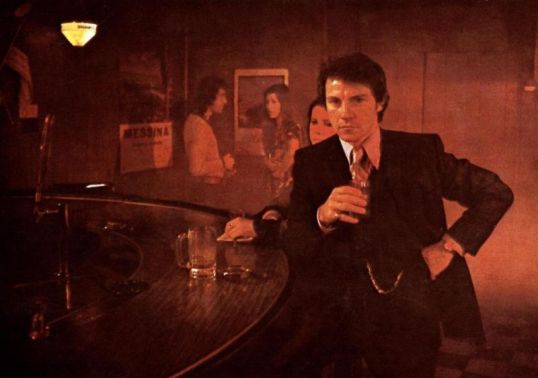
1973’s Mean Streets is a story about Little Italy.  The neighborhood may only be a small part of the sprawling metropolis of New York but, as portrayed in this film, it’s a unique society of its very own, with its own laws and traditions.  It’s a place where the old ways uneasily mix with the new world.  The neighborhood is governed by old-fashioned mafiosos like Giovanni Cappa (Cesare Danova), who provide “protection” in return for payment.  The streets are full of men who are all looking to prove themselves, often in the most pointlessly violent way possible.  When a drunk (David Carradine) is shot in the back by a teenage assassin (Robert Carradine), no one bothers to call the police or even questions why the shooting happened.  Instead, they discuss how impressed they were with the drunk’s refusal to quickly go down.  When a soldier (Harry Northup) is given a party to welcome him home from Vietnam, no one is particularly shocked when the solider turns violent.  Violence is a part of everyday life.

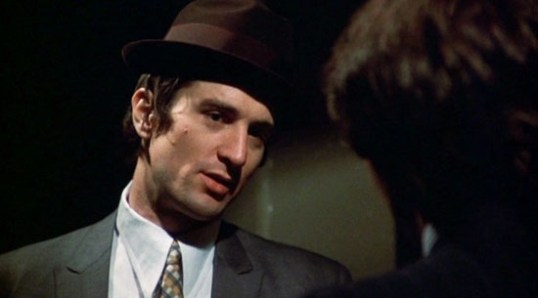
Charlie Cappa (Harvey Keitel) is Giovanni’s nephew, a 27 year-old man who still lives at home with his mother and who still feels guilty for having “impure” thoughts.  Charlie prays in church and then goes to work as a collector for Giovanni.  Giovanni is grooming Charlie to take over a restaurant, not because Charlie is particularly talented at business but just because Charlie is family.  Giovanni warns Charlie not to get involved with Teresa (Amy Robinson) because Teresa has epilepsy and is viewed as being cursed.  And Giovanni particularly warns Charlie not to hang out with Teresa’s cousin, Johnny Boy (Robert De Niro).  Johnny Boy may be charismatic but everyone in the neighborhood knows that he’s out-of-control.  His idea of a good time is to blow up mailboxes and shoot out street lamps.  Charlie, who is so obsessed with sin and absolution that he regularly holds his hand over an open flame to experience the Hellfire that awaits the unrepentant sinner, finds himself falling in love with Teresa (though it’s debatable whether Charlie truly understands what love is) and trying to save Johnny Boy.

Charlie has other friends as well.  Tony (David Proval) runs the bar where everyone likes to hang out and he seems to be the most stable of the characters in Mean Streets.  He’s at peace with both the neighborhood and his place in it.  Meanwhile, Michael (Robert Romanus) is a loan shark who no one seems to have much respect for, though they’re still willing to spend the afternoon watching a Kung Fu movie with him.  Michael knows that his career is dependent on intimidation.  He can’t let anyone get away with not paying back their money, even if they are a friend.  Johnny Boy owes Michael a lot of money and he hasn’t paid back a single dollar.  Johnny Boy always has an excuse for why he can’t pay back Michael but it’s obvious that he just doesn’t want to.  Charlie realizes that it’s not safe for Johnny Boy in Little Italy but where else can he go?  Brooklyn?

Mean Streets follows Charlie and his friends as they go about their daily lives, laughing, arguing, and often fighting.  All of the characters in Mean Streets enjoy a good brawl, despite the fact that none of them are as tough as their heroes.  A chaotic fight in a pool hall starts after someone takes offense to the word “mook,” despite the fact that no one can precisely define what a mook is.  The fights goes on for several minutes before the police show up to end it and accept a bribe.  After the cops leave, the fight starts up again.  What’s interesting is that the people fighting don’t really seem to be that angry with each other.  Fighting is simply a part of everyday life.  Everyone is aggressive.  To not fight is to be seen as being weak and no one is willing to risk that.

Mean Streets was Martin Scorsese’s third film (fourth, if you count the scenes he shot before being fired from The Honeymoon Killers) but it’s the first of his movies to feel like a real Scorsese film.  Scorsese’s first film, Who’s That Knocking On My Door?, has its moments and feels like a dry run for Mean Streets but it’s still obviously an expanded student film.  Boxcar Bertha was a film that Scorsese made for Roger Corman and it’s a film that could have just as easily been directed by Jonathan Demme or any of the other young directors who got their start with Corman.  But Mean Streets is clearly a Scorsese film, both thematically and cinematically.  Scorsese’s camera moves from scene to scene with an urgent confidence and the scene where Charlie first enters Tony’s bar immediately brings to mind the classic tracking shots from Goodfellas, Taxi Driver, and Casino.  One gets the feeling that Pete The Killer is lurking somewhere in the background.  The scenes between Keitel and De Niro are riveting.  Charlie attempts to keep his friend from further antagonizing Michael while Johnny Boy tells stories that are so long and complicated that he himself can’t keep up with all the details.  Charlie hold everything back while Johnny Boy always seems to be on the verge of exploding.  De Niro’s performance as Johnny Boy is one that has been duplicated but never quite matched by countless actors since then.  He’s the original self-destructive fool, funny, charismatic, and ultimately terrifying with his self-destructive energy.

Mean Streets was Scorsese’s first box office success and it was also the film that first brought him widespread critical acclaim.  However, in a year when the totally forgotten A Touch of Class was nominated for Best Picture, Mean Streets did not receive a single Oscar nomination, not even for De Niro’s performance.  Fortunately, by the time Mean Streets was released, De Niro had already started work on another film about the Mafia and Little Italy, The Godfather Part II.

Previous entries in The Unnominated:

  1. Auto Focus 
  2. Star 80
  3. Monty Python and The Holy Grail
  4. Johnny Got His Gun
  5. Saint Jack
  6. Office Space
  7. Play Misty For Me
  8. The Long Riders

MURPHY’S LAW – Don’t F#&k with Jack Murphy!


I became obsessed with actor Charles Bronson in 1986 after receiving a VHS copy of DEATH WISH 3 as a Christmas present. Going along with that obsession was my desire to see every Charles Bronson movie that had ever been made. As much as I enjoyed re-watching DEATH WISH 3, it was always a treat when I could rent a different Bronson film at the video store. The current Bronson movie at the video store in 1987 that appealed to me as a 13 year old boy was MURPHY’S LAW, so I wanted to rent it as often as possible. There were even a couple of times when different friends asked me to spend the night, and I had one requirement for saying yes… that we rent MURPHY’S LAW! Y’all, don’t think too bad of me for this admission. Remember, I was only 13 years old, I couldn’t drive, and I didn’t have a job so if I had to use a friend’s mom to get my Bronson fix, that’s just what I had to do! Based on the timing of my initial Bronson obsession, DEATH WISH 3 and MURPHY’S LAW are 1-2 in the films that I’ve watched the most times during my life.

In MURPHY’S LAW, Charles Bronson plays Jack Murphy, a tough cop who seems to be experiencing a series of unfortunate events:

  1. A thief named Arabella McGee (Kathleen Wilhoite) tries to steal Murphy’s car and drives it through the window of a pizzaria. We know that’s his car because he loudly proclaims, “That’s MY car!!” He even wastes money on a sack of groceries by throwing it at his car while she’s driving away. He’s able to chase her down on foot, but she kicks him in the testicles and runs off leaving him doubled over in pain, grocery-less, and clutching the family jewels!
  2. A mafia kingpin named Frank Vincenzo (Richard Romanus) wants to kill him because Murphy was forced to shoot and kill the kingpin’s brother. We know the cop and the kingpin don’t like each other, because a little before the shooting they have a slight disagreement in front of the mafioso’s mother over whether the brother is a scum-sucking pimp or a talent agent. Unable to resolve the debate amicably, the mafioso inquires as to whether or not Jack has ever heard of “Murphy’s Law, if anything can possibly go wrong it will?” Murphy responds with an alternative version of Murphy’s Law, the only law that he knows, and one that I greatly prefer. You get the feeling that this argument may be revisited later in the film.     
  3. Murphy’s now ex-wife Jan (Angel Tompkins) is performing extremely artistic striptease routines at a local club called Madam Tong’s. She’s also making love to the manager of the club. Rather than drinking at home alone until he passes out like most depressed men, Murphy hangs out at Madam Tong’s watching her shake her goodies for a bunch of horny lowlifes, before following them home and watching from outside until they turn off the bedroom lights. Very sad indeed.
  4. And here’s the worst part, on one of those typical nights where he’s obsessively stalking his wife, another mystery woman (Carrie Snodgress) knocks him in the head, shoots the slimy manager and Mrs. Murphy with his gun, and then frames him for their murders. Arrested for the murders and subsequently handcuffed to the thief who tried to steal his car, Murphy must stage a daring helicopter jailbreak in order to find out who framed him and clear his name before everything and everyone he holds dear is taken from him!

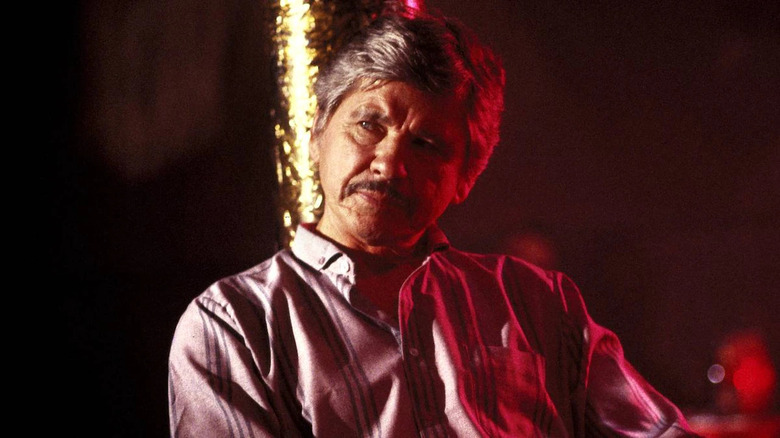
There are several reasons that I loved MURPHY’S LAW back in the eighties, and that I still enjoy it now. First, of course, is Charles Bronson. He was around 64 years old when he filmed MURPHY’S LAW, but he’s still in great physical condition in 1986. One of Bronson’s greatest strengths is his screen presence, and he still dominates each frame he’s in. Second, the film has an excellent supporting cast. Carrie Snodgress is having a ball playing the main villain in the film. I’ve seen her in quite a few movies, like PALE RIDER with Clint Eastwood, and 8 SECONDS with Luke Perry, but I’ve never seen her in a role like this. Snodgress was nominated for an Oscar for her role in a 1970 film called DIARY OF A MAD HOUSEWIFE. I’ve never seen that one before, but I should probably check it out! I love Kathleen Wilhoite as Arabella McGee, the thief who ends up handcuffed to Bronson. Her vocabulary, while probably not very realistic for the streets of LA at the time, was hilarious to me as a teenager. I enjoy calling the people I love “snot licking donkey farts” on occasion to this very day. It’s Kathleen Wilhoite singing the title song over the closing credits! And Robert F. Lyons is very special to me in his role as Art Penney, Jack Murphy’s partner. We got to interview him on the THIS WEEK IN CHARLES BRONSON podcast about his roles on DEATH WISH 2, 10 TO MIDNIGHT, and MURPHY’S LAW. He was so generous with his time, and just a hell of a nice guy! I’ve attached a link to the YouTube video of the interview with Mr. Lyons if you’re interested in the great stories he tells us about his time in Hollywood! Finally, MURPHY’S LAW was directed by J. Lee Thompson, my personal favorite director who worked with Bronson. Thompson directed Bronson in 9 different films, beginning with ST. IVES in 1976 and ending with KINJITE: FORBIDDEN SUBJECTS in 1989. No matter the material, you always knew that Thompson would deliver a film with a certain quality that made Bronson look good!

I’ll always be a fan of MURPHY’S LAW, partly for nostalgic reasons, but mainly because I think it’s an entertaining mid-80’s action film for Bronson at a time when he was one of the kings of the video store!

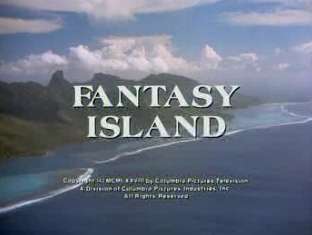
Retro Television Review: Fantasy Island 5.7 “The Perfect Husband/Volcano”


Welcome to Retro Television Reviews, a feature where we review some of our favorite and least favorite shows of the past!  On Tuesdays, I will be reviewing the original Fantasy Island, which ran on ABC from 1977 to 1984.  Unfortunately, the show has been removed from most streaming sites.  Fortunately, I’ve got nearly every episode on my DVR.

Yay!  It’s finally time to return to the Island.

Episode 5.7 “The Perfect Husband/Volcano”

(Dir by Philip Leacock, originally aired on November 21st, 1981)

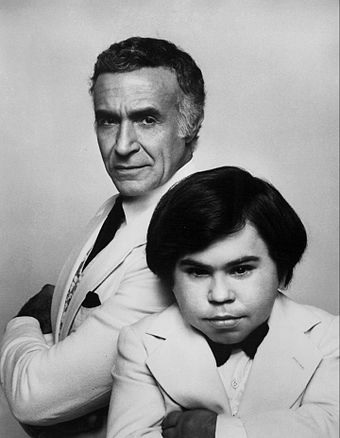
This week, it’s Tattoo’s turn to serve as Roarke’s sidekick while Julie is sent off to deal with two weddings and a tour for “the seniors.”

On the one hand, it’s incredibly awkward for Roarke to have two sidekicks and it’s pretty obvious that Julie was only hired to serve as insurance in case Herve Villechaize walked off the set.

On the other hand, it is kind of nice to be reminded of the fact that there’s a lot happening on Fantasy Island.  Fantasy Island is not just a mystical nation that is ruled over by the enigmatic Mr. Roarke.  It’s also a resort that hosts vacations and retirement homes.  Apparently, you don’t have to have a fantasy in order to spend some time on Fantasy Island.  Instead, you can just come to Fantasy Island for a nice tropical vacation.  That’s kind of nice.

But, that said, the fantasies are why we’re here.  We’ve got two good ones this week.

Dorothy Nicholson (Susan Sullivan) is a newspaper publisher who has been feeling unfulfilled ever since her husband was killed by a drunk driver.  She want to find the perfect husband, a man without any flaws whatsoever.  After giving her his customary “You may not like what you find,” warning, Roarke sends her to Paradise Cove.  Operated by the sinister Anton Jagger (Rossano Brazzi), Paradise Cover is a resort where wealthy women are assigned the perfect companion.  Dorothy’s perfect man is Gilbert (Lyle Waggoner).  Gilbert is handsome, suave, charming, and attentive.  Unfortunately, like all of the perfect men at Paradise Cove, he’s also a robot and a part of Jagger’s scheme to cheat women out of their money!  Dorothy figures out the truth after Gilbert doesn’t even flinch after his hand catches on fire.  Can she defeat Jagger’s plans and rescue the real Gilbert?

(Of course, she can.  It’s Fantasy Island!)

Dr. Hal Workman (George Maharis) thinks that he’s figured out a way to detect when a volcano is going to erupt.  He wants to go to Fantasy Island’s own active volcano to test out his methods.  Roarke agrees, even though he worries that Dr. Workman only cares about science and not about people.  (Honestly, who cares?  A volcano detection system sounds like it would be a good thing, regardless of the motives of the man who created it.)  Workman is led to the volcano by a disillusioned former priest named Lauria (Richard Romanus).  However, Workman and Lauria are not the only people at the volcano.  There’s also a shady tycoon, Joseph Butler (Norman Alden), and his girlfriend, Terri (Misty Rowe).  You can probably guess what happens.  Workman falls in love with Terri.  Lauria finds his faith.  And Butler presumably dies when the volcano erupts and a deluge of what appears to be very thin tomato sauce comes pouring down the mountain.

Both of these fantasies were cheerfully ridiculous, which made them a lot of fun.  You may wonder why Roarke would send one of his guests to a resort that’s being run by a madman and that’s a legitimate question.  But the important thing is that the viewer gets a montage of all of the robots malfunctioning at once.  And you may wonder at the wisdom of allowing someone to go to an active volcano but the important thing is that we get a scene of George Maharis and Richard Romanus running away from the least realistic lava flow ever caught on film.  Fantasy Island is a lot of fun when it goes over the top and embraces its beautiful absurdity and that’s exactly what this episode did.

What a wonderful trip to the Island!

Horror On The Lens: Night Terror (dir by E.W. Swackhamer)


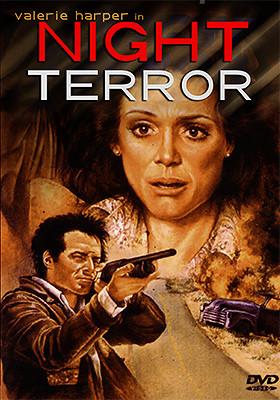
Today’s horror on the lens is a surprisingly violent and grim made-for-TV movie from 1977, Night Terror! 

In Night Terror, Valerie Harper plays a woman trying to drive to Denver, overnight.  Unfortunately, she catches the attention of The Killer (played by Richard Romanus), a mute psychopath who spends his time driving up and down the highway, killing random people.  This is a pretty well-done and suspenseful made-for-television movie, featuring good performances from both Harper and Romanus.  I wrote a more in-depth review of the film back in May so give it a read after you watch the movie.

(Or before you watch the movie.  I’m not going to tell you how to do things.)

Drive carefully!

https://www.youtube.com/watch?v=hahgGBOHLSg


Film Review: Night Terror (dir by E.W. Swackhamer)


“There’s a killer on the road.

His brain is squirming like a toad.”

So sang Jim Morrison in the song Riders on the Storm. Now, whatever you may think of Jim Morrison and the Doors (personally, I think the music was good, Jim was pretentious as Hell, and I look cute in my Doors t-shirt), this is a perfect description of the character who is at the center of the 1977 film, Night Terror. He’s played by Richard Romanus and, in the credits, he’s simply called The Killer. The Killer spends his times driving up and down the highway, killing people seemingly at random. We never learn why exactly the Killer does what he does, though the film does offer up a few hints. For one thing, he has no voice. He carries an electrolarynx with him and holds it up to his throat whenever he wants to speak. Of course, he only does this two times in the film and, both times, it’s to basically howl with rage. In another scene, he can clearly be seen to be wearing military-style dog tags. Given when this film was made and the unfortunate popularity of the “deranged Vietnam vet” trope in the 70s and 80s, it’s easy to pick up on what exactly the film is implying.

Night Terror follows one night in the life of both The Killer and Carol Turner (Valerie Harper). Carol is just trying to get to Denver, where her son is in the hospital. When she sees a police officer pulling over a sports car for speeding, Carol decides to ask the cop for directions. Unfortunately, the sports car belong to The Killer and, as soon as the cop turns his back on him, out comes the shotgun. Carol slams down on the accelerator and speeds off, with the Killer pursuing her in own his vehicle. Unfortunately, Carol’s station wagon (which comes with wood paneling because, again, this is a movie from 1977) is nearly out of gas. What follows is a fairly tense game of cat-and-mouse, as Carol tries to hide from the Killer while the Killer stalks the highway, relentlessly searching for her. Along the way, a few familiar character actors pop up. John Quade is a homeless man living in a gas station. The great Nicholas Pryor is another motorist, one who proves to be not much help. Making things all the more dangerous for Carol is that the Killer knows what she looks like but she has no idea what the Killer looks like.

Night Terror owes an obvious debt to Steven Spielberg’s Duel and a host of other 70s car chase films. While Night Terror really can’t compare to the Duel, it does do a good job of creating and maintaining suspense. Fortunately, the film never makes the mistake of tying to turn Carol into some sort of badass action girl. She’s just an average person who has found herself in a terrifying situation and, as played by Valerie Harper, she’s never less than relatable. Richard Romanus, meanwhile, makes for a terrifying killer. The fact that he occasionally flashes a rather child-like smile only serves to make his single-minded pursuit of Carol all the more frightening. We never learn much about what’s led The Killer to becoming what he is but Romanus gives such an intense performance that we don’t need to understand him in order to be scared of him. He’s a nightmare come to life.

Night Terror ends on a somewhat awkward note, as if the filmmakers suddenly remembered that they were making a made-for-TV movie as opposed to a feature film. But, that said, Night Terror is an effectively scary and suspenseful road film. It can currently be viewed on YouTube.

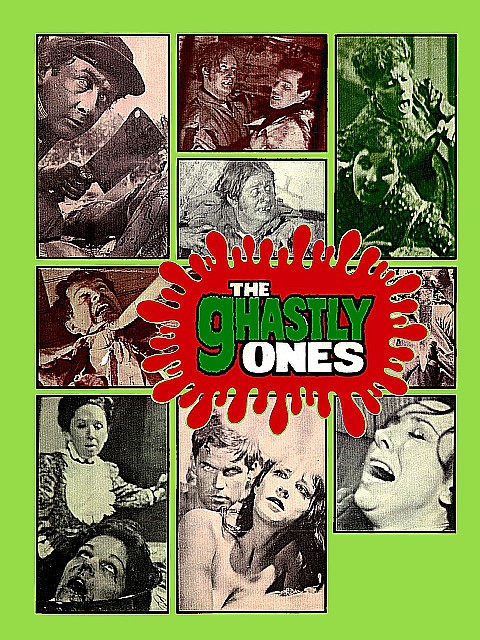
The TSL’s Horror Grindhouse: The Ghastly Ones (dir by Andy Milligan)


A young couple — both of whom are dressed in clothes that appear to come from the 1890s — enjoys a romantic and sunny excursion to an isolated island.  Unfortunately, their day is ruined when they’re discovered by a buck-toothed hunchback named Colin (played by Hal Borske).  Death and dismemberment follows.

Somewhere in New York, three sisters are informed that their father has died but that neither they nor their husbands can receive a cent of their inheritance until they fulfill one very specific requirement.  According to their father’s impossibly elderly attorney (played by Neil Flanagan, who is made up to look like an old witch from a community theater production of MacBeth), the sisters and their husbands must spend three nights in their father’s mansion.  Of course, the sisters agree.

Upon arriving at the mansion, they discover that the mansion is being looked after by two maids and a hunchbacked, buck-toothed handyman named …. COLIN!  Within a few minutes of meeting everyone, Colin eats a live rabbit while everyone watches.  Later the remains of the rabbit shows up in one of the sister’s bed, along with a note that reads, “Blessed are the meek for they shall inherit!”

Speaking for myself, I would probably leave as soon as I saw the handyman eating a live rabbit.  I mean, none of the sisters appear to be struggling financially but then again, greed is a powerful force.  Instead, everyone settles in for their three-night stay, which leads to 1968-style sex scenes and a lot of footage of people sitting around and talking about nothing.  For a low-budget grindhouse film, this is an extremely talky movie.

Anyway, eventually people start dying.  Someone gets pitchforked.  Another person is found hanging by his ankles.  There’s a rather bloody disembowelment and someone else loses their head.  Bloody X’es are left on doorways.  Who is doing the killing?  Hmmm …. well, Colin is the obvious suspect since we already saw him kill two people for absolutely no reason.  But, it turns out that Colin has a little help.  That’s right!  The Ghastly Ones comes with a twist ending that you’ll see from miles away.

So, what exactly is The Ghastly Ones?  It’s an extremely low-budget film, full of unlikable people dying in various grotesque ways.  It’s an oddly moralistic film, with everyone dying because their greed prevents them from doing the sensible thing and leaving the house.  It’s also apparently a period piece, with everyone dressed like they belong in the 1890s even though you can clearly hear the sound of cars in the background of a few scenes.

In short, this is another Andy Milligan film!  Filmed on Staten Island and featuring a largely amateur cast (though one of the husbands is played by Richard Romanus, who went on to appear in Martin Scorsese’s Mean Streets and has since had a respectable career as a character actor), The Ghastly Ones is just as bad and weirdly hypnotic as you would expect any Andy Milligan film to be.  Milligan even makes a cameo of sorts in the film.  Listen closely and you can occasionally hear him off-camera, feeding the actors their lines and, at one point, telling one of the sisters to “roll over.”

It’s a terrible movie and yet, it’s also strangely fascinating.  I think that’s because Milligan’s ineptness was matched only by his anger and that anger (along with a lot of pressimism) courses through the entire film.  Every frame of the film drips with Milligan’s sincere disdain for the greedy and selfish characters who appear throughout the movie and, as you watch, it becomes obvious that Milligan had more sympathy for Colin than for any of his victims.  (Of course, two of Colin’s victims were just two innocent people in love who were trying to have a nice picnic so perhaps it’s for the best not to dwell too much on what that might mean.)  Milligan directs this story with an intensity that doesn’t quite make up for the lack of talent involved but, at the very least, it does keep things vaguely interesting.  “Who are the Ghastly Ones?”  Andy Milligan seems to be asking.  “We all are.”

By the way, between this and Guru, The Mad Monk, I have now watched two Andy Milligan films in one week.  Pray for me.

A Movie A Day #177: Murphy’s Law (1986, directed by J. Lee Thompson)


What is Murphy’s Law?

Let’s ask LAPD Detective Jack Murphy.

“Don’t fuck with Jack Murphy.”

Normally, having a law named after you would be pretty cool but it appears that this is just a law that Jack came up with himself.  Having to come up with your own law is kind of like having to come up with your own nickname.  Dude, it’s just lame.  Since Jack Murphy is played Charles Bronson, we can cut him some slack.

Murphy’s Law was one of the many film that, towards the end of his career, Bronson made for Cannon Films.  He played a detective in almost all of them.  Jack Murphy is Dirty Harry without the fashion sense.  He is also an alcoholic who cannot get over his ex-wife (Angel Tompkins) and her decision to become a stripper.  Not only has Murphy managed to piss off his superiors with his bad attitude but the mob is out to get him.  Everyone has forgotten Murphy’s Law.  Everyone is fucking with Jack Murphy.

Jack’s main problem, though, is Joan Freeman (Carrie Snodgress).  Years ago, Murphy sent Joan to prison for murder but, because it’s California and Jerry Brown appointed all of the judges, Joan gets out after just a few years.  Joan starts to systematically murder everyone that Murphy knows, framing Murphy for the murders.  Murphy’s arrested by his fellow cops, all of whom need a refresher on Murphy’s Law.  Though handcuffed to a young thief (Kathleen Wilhoite), Murphy escapes from jail and set off to remind everyone why you don’t fuck with Jack Murphy.

Murphy’s Law is a typical Cannon Bronson film: low-budget, ludicrously violent, borderline incoherent, so reactionary than it makes the Dirty Harry films look liberal, and, if you’re a fan of Charles Bronson, wildly entertaining.  Bronson was 65 years old when he played Jack Murphy so he cannot be blamed for letting his stunt double do most of the work in this movie.  What’s interesting is that, for once, Bronson is not the one doing most of the killing.  Instead, it is Carrie Snodgress, in the role of Joan Freeman, who gets to murder nearly the entire cast.  There is nothing subtle about Snodgress’s demonic performance, which makes it perfect for a Cannon-era Bronson film.  In fact, Carrie Snodgress gives one of the best villainous performances in the entire Bronson filmography.  There is never any doubt that Snodgress is capable of killing even the mighty Charles Bronson, which makes Murphy’s Law a little more suspenseful than most of the movies that Bronson made in the 80s.

Whatever else can be said about Murphy’s Law, it does feature one of Bronson’s best one liners.  When Joan threatens to send him to Hell, Murphy replies, without missing a beat, “Ladies first.”  Only Bronson could make a line like that sound cool.  That’s Bronson’s Law.

What could have been: The Godfather


I don’t know about you but I love to play the game of “What if.”  You know how it works.  What if so-and-so had directed such-and-such movie?  Would we still love that movie as much?  Would so-and-so be a star today?  Or would the movie have failed because the director was right to reject so-and-so during preproduction?

I guess that’s why I love the picture below.  Taken from one of Francis Ford Coppola’s notebooks, it’s a page where he jotted down a few possibilities to play the roles of Don Vito, Michael, Sonny, and Tom Hagen in The Godfather.  It’s a fascinating collection of names, some of which are very familiar and some of which most definitely are not.  As I look at this list, it’s hard not wonder what if someone like Scott Marlowe had played Michael Corleone?  Would he had then become known as one of the great actors of his generation and would Al Pacino then be fated to just be an unknown name sitting on a famous list?

(This page, just in case you happen to be in the neighborhood , is displayed at the Coppola Winery in California.)
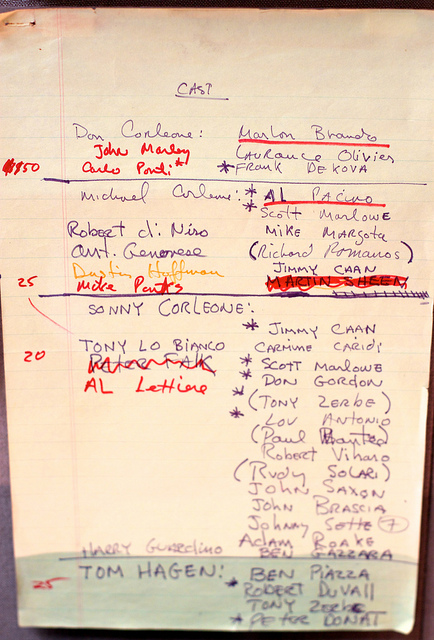
The production of the Godfather — from the casting to the final edit — is something of an obsession of mine.  It’s amazing the amount of names — obscure, famous, and infamous — that were mentioned in connection with this film.  Below is a list of everyone that I’ve seen mentioned as either a potential director or a potential cast member of The Godfather.  Consider this my contribution to the game of What If….?

Director: Aram Avankian, Peter Bogdonavich, Richard Brooks, Costa-Gravas, Sidney J. Furie, Norman Jewison, Elia Kazan, Steve Kestin, Sergio Leone, Arthur Penn, Otto Preminger, Franklin J. Schaffner, Peter Yates, Fred Zinnemann

Don Vito Corleone (played by Marlon Brando): Melvin Belli, Ernest Borgnine, Joseph Callelia, Lee. J. Cobb, Richard Conte, Frank De Kova, Burt Lancaster, John Marley, Laurence Olivier, Carlo Ponti, Anthony Quinn, Edward G. Robinson, George C. Scott, Frank Sinatra, Rod Steiger, Danny Thomas, Raf Vallone,  Orson Welles

Michael Corleone (played by Al Pacino): John Aprea, Warren Beatty, Robert Blake, Charles Bronson*, James Caan, David Carradine, Robert De Niro, Alain Delon, Peter Fonda, Art Genovese, Dustin Hoffman, Christopher Jones, Tommy Lee Jones, Tony Lo Bianco, Michael Margotta, Scott Marlowe, Sal Mineo, Jack Nicholson, Ryan O’Neal, Michael Parks, Robert Redford, Burt Reynolds, Richard Romanus, Gianni Russo, Martin Sheen, Rod Steiger**, Dean Stockwell

Sonny Corleone (played by James Caan): Lou Antonio, Paul Banteo, Robert Blake, John Brascia, Carmine Caridi, Robert De Niro, Peter Falk, Harry Guardino, Ben Gazzara, Don Gordon, Al Letteiri, Tony LoBianco, Scott Marlowe, Tony Musante, Anthony Perkins, Burt Reynolds***, Adam Roarke, Gianni Russo, John Saxon, Johnny Sette, Rudy Solari, Robert Viharo, Anthony Zerbe

Tom Hagen (played by Robert Duvall): James Caan, John Cassavettes, Bruce Dern, Peter Donat, Keir Dullea, Peter Falk, Steve McQueen, Richard Mulligan, Paul Newman, Jack Nicholson, Ben Piazza, Barry Primus, Martin Sheen, Dean Stockwell, Roy Thinnes, Rudy Vallee****, Robert Vaughn, Jerry Van Dyke, Anthony Zerbe

Kay Adams (played by Diane Keaton): Anne Archer, Karen Black, Susan Blakeley, Genevieve Bujold, Jill Clayburgh, Blythe Danner, Mia Farrow, Veronica Hamel, Ali MacGraw, Jennifer O’Neill, Michelle Phillips, Jennifer Salt, Cybill Shepherd, Trish Van Devere

Fredo Corleone (played by John Cazale): Robert Blake, Richard Dreyfuss, Sal Mineo, Austin Pendleton

Connie Corleone (played by Talia Shire): Julie Gregg, Penny Marshall, Maria Tucci, Brenda Vaccaro, Kathleen Widdoes

Johnny Fontane (played by Al Martino): Frankie Avalon, Vic Damone*****, Eddie Fisher, Buddy Greco, Bobby Vinton, Frank Sinatra, Jr.

Carlo Rizzi (played by Gianni Russo): Robert De Niro, Alex Karras, John Ryan******, Sylvester Stallone

Virgil “The Turk” Sollozzo (played by Al Letteiri): Franco Nero

Lucas Brasi (played by Lenny Montana): Timothy Carey, Richard Castellano

Moe Greene (played by Alex Rocco): William Devane

Mama Corleone (played by Morgana King): Anne Bancroft, Alida Valli

Appollonia (played by Simonetta Steffanelli): Olivia Hussey

Paulie Gatto (played by John Martino): Robert De Niro*******, Sylvester Stallone

—-

* Charles Bronson, who was in his mid-40s, was suggested for the role of Michael by the then-chairman of Paramount Pictures, Charlie Bluhdorn.

** By all accounts, Rod Steiger – who was then close to 50 – lobbied very hard to be given the role of Michael Corleone.

*** Some sources claim that Burt Reynolds was cast as Sonny but Brando refused to work with him.  However, for a lot of reasons, I think this is just an cinematic urban legend.

**** Despite being in his 60s at the time, singer Rudy Vallee lobbied for the role of the 35 year-old Tom Hagen.  Supposedly, another singer — Elvis Presley — lobbied for the role as well but that just seems so out there that I couldn’t bring myself to include it with the “official” list.

***** Vic Damone was originally cast as Johnny Fontane but dropped out once shooting began and announced that the project was bad for Italian Americans.  He was replaced by Al Martino.

****** John P. Ryan was originally cast as Carlo Rizzi but was fired and replaced with Gianni Russo.  Ryan went on to play the distraught father in Larry Cohen’s It’s Alive.  Russo went on to co-star in Laserblast.

******* Robert De Niro was originally cast in this role but dropped out to replace Al Pacino in The Gang That Couldn’t Shoot Straight.  Pacino, incidentally, had to drop out of that film because he was given the role of Michael in The Godfather.