Holiday Film Review: Jingle All The Way (dir by Brian Levant)


Whatever else one may want to say about it, 1996’s Jingle All The Way is a cute film.

It’s necessary to point that out because Jingle All The Way has a terrible reputation and, if we’re going to be honest, it deserves a lot of the criticism that it has gotten over the years.  In many ways, it epitomizes the way a Hollywood studio can take an interesting idea and then produce a film that seems to have no understanding of what made that idea so interesting in the first place.  Arnold Schwarzenegger plays Howard Langston, an overworked mattress store manager who waits until Christmas Eve to try to buy his son a Turbo Man action figure.  (In the film, they call it a “doll,” which is one of the film’s false moments.)  The only problem is that the Turbo Man action figure is the most popular gift of the year and everyone is looking for one.  What starts out at as a satire of commercialism ultimately becomes a celebration of the same thing as Howard ends up dressed up as Turbo Man and taking part in his town’s Christmas parade.   The film becomes a comedy without any sharp edges.

That said, it’s a cute film.  It’s not cute enough to really be good but it is cute enough that it won’t leave you filled with rage.  Arnold Schwarzenegger is in True Lies mode here, playing a seemingly boring and suburban guy who is secretly a badass.  (In True Lies, Schwarzenegger was secretly a spy who had killed man people, though all of them were bad.  In Jingle All The Way, he’s just a parent who has waited too long to go Christmas shopping.)  Schwarzenegger’s main strength as an action star — even beyond his physique — was that he always seemed to have a genuine sense of humor and he’s the best thing about Jingle All The Way.  This film finds him acting opposite actual comedic actors like Jim Belushi and Phil Hartman and holding his own.  (The film also features Sinbad as another dad trying to get the Turbo Man action figure but Sinbad comes across as being more of a stand-up comedian doing bits from his routine than an actual character.)  The film’s set pieces grow increasingly bizarre and surreal as Howard searches for his Turbo Man and the film actually becomes less effective the stranger that it gets.  A scene of Howard fighting a crowd in a toy store works far better than a later scene where Howard battles a bunch of men dressed as Santa Claus and his elves.  (It doesn’t help that, after an intelligent and well-edited opening thirty minutes, the film seems to lose all concept of comedic timing.)  But there’s a sincerity to Schwarzenegger’s performance that keeps you watching.

Of course, today, Jingle All The Way feels like a relic from a different age.  All the kids want a Turbo Man and you’re so busy at work that the stores are closed by the time you get home?  Fine.  Hop on Amazon at three in the morning and order one.  Christmas shopping is a lot easier nowadays.

It’s just not as much fun.
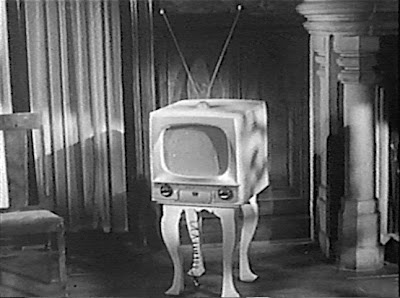
Horror On TV: The Last Halloween (dir by Savage Steve Holland)


For tonight’s Halloween on television, we have the story of four aliens who came to Earth on Halloween and search for candy for their planet.  After an initial misunderstanding, two kids help the aliens in their search.  It’s sweet!

This was directed by Savage Steve Holland of Better Off Dead fame and it originally aired on October 28th, 1991.


Retro Television Review: Fantasy Island 6.22 “Love Island/The Sisters”


Welcome to Retro Television Reviews, a feature where we review some of our favorite and least favorite shows of the past!  On Tuesdays, I will be reviewing the original Fantasy Island, which ran on ABC from 1977 to 1984.  Unfortunately, the show has been removed from most streaming sites.  Fortunately, I’ve got nearly every episode on my DVR.

Today, the sixth season of Fantasy Island comes to a close and so does Tattoo’s time on the show.

Episode 6.22 “Love Island/The Sisters”

(Dir by Philip Leacock, originally aired on May 14th, 1983)

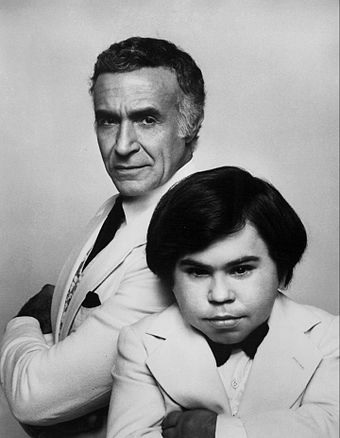
This is it.  This is not only the finale of season 6 but it’s also the final episode to feature Tattoo as Mr. Roarke’s assistant.

Why did Herve Villechaize leave Fantasy Island after the end of the sixth season?  The story that you always hear is that Villechaize wanted more money to continue working on the show.  He felt that he deserved to be paid as much as Ricardo Montalban.  The show’s producers disagreed.  To them, Montalban was not only the star of the show but also someone who has just appeared in a hit movie, Star Trek II: The Wrath of Kahn.  They felt that they could keep the show going without Villechaize and …. well, it turns out they were totally and completely wrong about that.

I have not seen much of the seventh season, in which Villechaize was replaced by Christopher Hewett.  And, due to the vagaries of my DVR, there’s a lot of season 7 that I won’t be able to review.  What I do know is that the show went from being #39 to bring ranked #47 in the ratings after Villechaize left.  Obviously, being the 39th ranked show was nothing to brag about but it was still a helluva lot better than #47.  Villechaize left and a lot of the audience left with him.

I’ve made a lot of jokes about Roarke and Tattoo’s relationship.  Especially during the early seasons, Roarke and Tattoo sometimes did seem to be friendly rivals.  (That was when Roarke was a far more enigmatic fellow and Tattoo always seemed to be trying to figure out a way to make some extra money on Fantasy Island.)  Remember when Tattoo ran against Mr. Roarke in an Island election?  That said, Roarke and Tattoo’s relationship really was the heart of the series.  The fantasies themselves were often forgettable.  How many times can you get excited about seeing a member of the Brady Bunch as a guest star?  The thing that people really remember about Fantasy Island is the relationship between Roarke and Tattoo.  Regardless of what went on behind the scenes, Montalban and Villechazie had a good on-camera chemistry.  It was fun to watch them interact.  I always enjoyed the episodes that allowed Villechaize to reveal Tattoo’s sensitive side.  (In real life, Villechaize was an advocate for abused children, often taking the time to personally visit with children who had been rescued from abusive households.)

This is all my long-winded way of saying that they should have just agreed to pay Herve Villechaize more money.

At the very least, they should have given him a proper goodbye episode.  The sixth season ends with a rather basic episode, with no mention made of Tattoo leaving or even thinking of leaving.  Instead, we get Maureen McCormick going to a mysterious mansion to rescue her old sister (Britt Ekland) from an abusive man (played by Peter Mark Richman).  And then we get Bob Denver and Paul Kreppel as two wannabe womanizers who end up in prehistoric times, trying to romance a cavewoman while dealing with dinosaurs.  The dinosaur effects were cheap but likable but they were also the only thing that really made either of their fantasies stand-out.

And so, season 6 ends, not with a bang but a whimper.  Tattoo waves goodbye one last time.  I’m going to miss him.

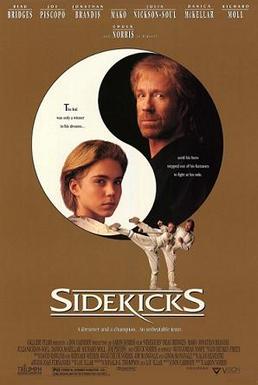
Sidekicks (1992, directed by Aaron Norris)


Barry Gabrewski (Jonathan Brandis) is a teenager living in Houston with his father (Beau Bridges).  Barry has asthma and has a hard time at school, being picked on by everyone from the school bully (John Buchanan) to the athletics coach (Richard Moll) to the clueless principal (Gerrit Graham).  Barry has only one ally and his name is Chuck Norris!  Whenever Barry is having a hard time, he imagines taking part in an exciting mission with Chuck Norris.  In his imagination, he and Chuck recreate scenes from all of Chuck’s movies even though Barry is really too young to be watching anything that violent.

Barry wants to learn karate but is turned down by an arrogant dojo owner (Joe Piscopo, channeling Martin Kove).  Barry finally finds a teacher (Mako) who uses Barry’s love of all things Chuck Norris to train him.  Barry enters the local karate tournament and wouldn’t you know it, there’s Chuck!  He’s attending as a guest and he’s hoping to see Joe Piscopo taught a lesson in humility.  When Barry and his sensei are told that they don’t have enough members for their team, Chuck volunteers to fight with them.  No one objects to the world’s most famous martial artist deciding to take part in a local, largely amateur karate tournament.  Can Barry win the tournament with the help of his hero?

Chuck Norris famously turned down a role in The Karate Kid.  Some sources say that he was offered the John Kreese role while others say that Norris was offered the sensei role that eventually become Mr. Miyagi.  Chuck has always said that his agent turned down the script and he didn’t even know it had been offered to him until years later but Sidekicks sticks so close to the Karate Kid plot that it does sometimes feel like it was made so that we could see what Karate Kid would have been like if Chuck Norris had accepted a role.  The movie follows the Karate Kid formula while lacking the edge that made Karate Kid stand out.  Karate Kid was a coming-of-age movie with a lot of karate.  Sidekicks is a blatant celebration of Chuck Norris.

Fortunately, Chuck Norris has always had the moves to back up his high self-regard and, in this film, he actually seems to be relaxed and having fun playing a version of himself.  Sidekicks is predictable and ego-driven but it has a likable energy and Chuck shows a willingness to poke fun at his earlier movies.  Whatever else you might say about Sidekicks, there were a lot of bullied kids would have loved to have had a friend like Chuck Norris.  Sidekicks is also the only place where you can see Chuck Norris fight Joe Piscopo and there’s something to be said for that.

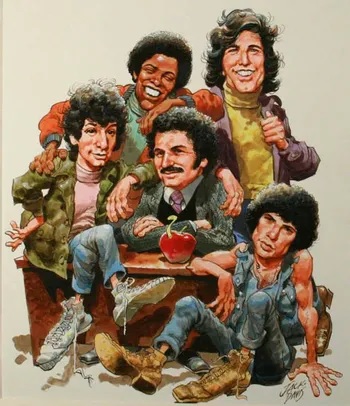
Retro Television Review: Welcome Back, Kotter 4.6 “Beau’s Jest”


Welcome to Retro Television Reviews, a feature where we review some of our favorite and least favorite shows of the past!  On Saturdays, I will be reviewing Welcome Back Kotter, which ran on ABC  from 1975 to 1979.  The entire show can be purchased on Prime.

This week, we learn how Beau became a Sweathog.

Episode 4.6 “Beau’s Jest”

(Dir by Norman Abbott, originally aired on October 16th, 1978)

There’s a new student at Buchanan High!  His name is Beau DeLaBarre (Stephen Shortridge).  He’s handsome.  He’s blonde.  He’s charming.  He’s from New Orleans and speaks with a Southern accent.  He’s got a great smile.  He looks like he’s about 26 years old but that’s okay.  Most of his classmates look like they’re in their 30s.

Beau is a transfer student from New Orleans.  He comes to Buchanan after being kicked out of a series of different schools.  He’s a troublemaker!  Why, he might even become a Sweathog!  Unfortunately, he and Epstein take a dislike to each other.  Beau goes out with a girl Epstein likes.  Epstein staples Beau’s underwear and pants to the wall.  Beau walks down the hall wearing just a towel and the audience goes crazy.  (“Oh!” Horshack exclaims.)  Beau sets Epstein up with a dental hygienist and then tells Epstein that she’s married and her husband is looking to kill Epstein.  Why would a married woman be dating a remedial high school student?  It probably helps that Epstein looks like he’s about 40.

Anyway, after a stern talking to from Julie (who is working in the front office and who now has a really unflattering haircut), Beau realizes he was in the wrong.  He tells Epstein the truth.  But the hygienist’s boyfriend (Richard Moll) shows up and demands to see “Juan Epstein.”

“I’m Juan Epstein!” Beau declares.

Beau gets punched but he also wins the friendship of the Sweathogs….

If this all seems strange, it’s because it’s already been established, in the episode where the Sweathogs checked out Vinny’s new apartment, that Beau is a member of the Sweathogs.  That episode also established that both Gabe and Julie know Beau.  Obviously, Beau’s Jest was originally meant to air at the start of the season but the folks at the network decided it would be smarter to start the season with John Travolta instead of Stephen Shortridge.  I don’t blame them.

(Interestingly enough, the version of this episode on Prime includes a prologue where Beau and the Sweathogs are hanging out and Epstein says something like, “Remember when we first met?” and the rest of the episode plays out like a flashback.  When this episode was on Tubi, that prologue was not included.  So, who knows?  Maybe the prologue was something that was included for syndication or maybe when the episode aired in reruns.)

This episode …. ugh.  Barbarino is nowhere to be seen.  Gabe only appears for a few seconds.  There’s way too much of Julie acting like the “That’s Not Funny” meme.  Stephen Shortridge was not a bad actor and he was pleasant on the eyes but his character does not belong on a show about New York juvenile delinquents.  Apparently, the show wanted Barabrino’s replacement to be the opposite of Barbarino, in order to avoid people comparing the new guy to Travolta.  That wasn’t a bad idea but the show went too far in the other direction.

One final note: Welcome Back, Kotter is no longer on Tubi.  It’s available on Prime.  I had to pay two dollars to watch this.  I probably would have cut this episode a little more slack if I had watched it for free.  But for two bucks, I expect to at least feel like I got my money’s worth.

Late Night Retro Television Review: Monsters 2.8 “The Demons”


Welcome to Late Night Retro Television Reviews, a feature where we review some of our favorite and least favorite shows of the past! On Wednesdays, I will be reviewing Monsters, which aired in syndication from 1988 to 1991. The entire series is streaming on YouTube.

This week, Monsters gives us the story of several Arthurs.  Unfortunately, it’s not a very good story.

Episode 2.8 “The Demons”

(Dir by Scott Alexander, originally aired on November 19th, 1989)

On an alien planet, an alchemist named Arturus (Richard Moll) is desperate to get more of something that he calls “Drast.”  He decides that the best way to do this would be to summon a demon and demand that the demon give the Drast to him.  However, when Arturus tries to cast the spell, he makes a mistake and he ends up summoning a human insurance agent named Arthur (Jeff Silverman).  It takes a while but Arthur eventually figures out that he is Arturus’s human equivalent and that “Drast” is actually gold.  Arthur lies and tells Arturus that he has to go back to Earth to get the Drast.

Once he returns to Earth, Arthur decides to cast his own spell and summon a demon to help him break free from Arturus.  Since Arthur uses the same spell the Arturus used, he makes the same mistake and he ends up summoning Arturo (Eddie Deezen), a nerdy, red-skinned, dog-faced creature from another dimension who, it turns out, is just as obsessed with insurance as Arthur is.  Arthur sends Arturo to take care of Arturus, which Arturo does.  For some reason, Arturo taking care of Arturus largely takes place off-screen.  Having the main villain thwarted off-screen really does leave one wondering just what exactly the point of the story was in the first place.

Most of the previous episodes of Monsters had elements of humor to them.  This is the first episode to actually be a straight-out comedy and it doesn’t work at all.  Richard Moll and especially Eddie Deezen do manage to be amusing but the majority of the episode is centered around Jeff Silverman’s Arthur.  Silverman spends a lot of time frantically running around his house and yelling.  It gets to be a bit annoying.  The episode is so determined to convince you that it’s hysterically funny that it ends up beating the audience over the head with every punchline and basically begging the viewer to laugh.  There’s a desperation to the show’s humor and it quickly wears out its welcome.  Even potentially interesting ideas — like both Arturus and Arthur screwing up the same spell in the same way — ultimately fall flat.  Watching this episode, I was very much aware of the feeling of wanting to like what I was seeing considerably more than I actually did.

As I mentioned earlier, Eddie Deezen is really the only consistently funny thing about this episode.  The combination of his nerdiness and his fearsome appearance made me laugh more than I was expecting.  Sadly, I know Eddie Deezen has recently had to deal with some pretty serious health issues.  I’m hoping the best for him.

Next week’s episode will hopefully be a bit better.

October Positivity: Under Arrest (dir by William Field)


Welcome to the past …. kind of.

I say “kind of” because, even though the 1983 film Under Arrest takes place in the 20s, 30s, and 40, it’s obvious that the production didn’t have the budget necessary to really splurge on getting all the period details correct.  All of the characters wear slightly old timey clothing but they’ve all got haircuts that come from straight from the 70s and 80s.  One or two vintage cars make an appearance but otherwise, Under Arrest takes place in a world where the characters tend to a lot of walking.  To be honest, if not for the film’s narration, the viewer could easily assume that the film was supposed to be taking place in 1974.

It starts out as something of a gangster film.  We’re told that Phil Thatcher (played by Paul Martin) was one of California’s most notorious criminals.  Having watched the film, I can only guess that California had an extremely elastic definition of “notorious.”  Phil does commit some crimes.  He steals a lot of things.  He carries a gun with him, though he does mention that he’s never used it.  That said, he’s hardly John Dillinger or Clyde Barrow or Pretty Boy Floyd.  He does manage to escape from a few reform schools but, for the most part, he’s a passive participant in these escapes.  Everyone else does all the work and Phil just kind of goes along for the ride.  For the most part, Phil is a well-mannered thief who had a bad habit of trusting the wrong people.

At one point, Phil mentions that jail felt more like home than his actual home did.  It’s hard not to blame him for feeling that way because every prison in the film is surprisingly clean and pleasant.  Phil does meet one cruel loan shark, a man called Patrino (Richard Moll).  And Phil is forced to break rocks in the sun, though he also gets to hang out with all of his friends while doing so.  Halfway through the film, Phil has a moral reawakening when he reads a bible that was sent to him by his mother.  This leads to Phil abandoning all of his plans to escape from prison and instead, he writes letters to everyone that he’s stolen from and promises to repay them.  Phil says that he’s prepared to finish out his sentence and accept his punishment but has he really changed or has he just realized that the prison is the nicest place in California?

When he’s released on parole, the newly religious Phil is told that he has to find a job or he’ll be sent back to Folsom.  Good luck with that!  Actually, the film brings up an important point about why it’s so hard for some people to stay out of prison.  Making employment a condition of parole and/or probation may sound like a good idea but it’s extremely difficult for someone who has a record to find a job.  That was true in Phil’s day and it’s still true today.  Will Phil be able to find a job or will he be sent back to prison?

Under Arrest is based on a true story.  The real Phil Thatcher not only found a job but also started a prison ministry.  It’s not a bad story but the film itself suffers from low production values and amateurish acting.  As so often happens with films like this, good intentions could not make up for poor execution.  Still, the film does make an important point.  What’s the point of a society locking people up if it’s going to just abandon them once they’re released?

Cleaning Out The DVR: Wicked Stepmother (dir by Larry Cohen)


Weird movie, this one.

The 1989 film, Wicked Stepmother, was Bette Davis’s final film.  She was cast as Miranda, an enigmatic woman who meets and marries a man named Sam (Lionel Stander).  Sam’s daughter, Jenny (Colleen Camp) and her husband, Steve (David Rasche), are stunned to come home from a vacation just to discover Miranda living in their house.  Miranda chain-smokes, despite Jenny and Steve asking her not to.  Miranda cooks and eats meat, despite Jenny being a vegetarian.  Miranda brags about her sex life which freaks Jenny out even though I suppose really old people do occasionally have sex.  When it becomes apparent that Miranda is a witch who seduces and shrinks her victims, Jenny decides that something must be done.

Wicked Stepmother was not only Bette Davis’s last starring role but it was also the last production that she ever walked out on.  Early on in filming, she announced that she didn’t like the script, she didn’t like the way she was being filmed, and that she didn’t like the director, venerable B-move maestro Larry Cohen.  For his part, Cohen said that Davis left the movie because she was in bad health but she didn’t want to announce that to the world.  In Cohen’s defense, Davis does appear to be rather frail in the movie and often seems to be having trouble speaking.  (Davis has a stroke a few years before appearing in Wicked Stepmother.)  Davis died just a few months after Wicker Stepmother was released so I tend to assume that Cohen was correct when he said that the main reason Davis left the film was because of her health.  That doesn’t mean the script wasn’t bad, of course.  But, in the latter part of her career, Davis appeared in a lot of badly written movies.  She did Burnt Offerings, afterall.

Regardless of why she left, Davis’s absence did require that Wicked Stepmother work around her character.  But how do you do that when Bette Davis was literally the title character?  This film’s solution was to bring in Barbara Carrerra as Priscilla, Miranda’s daughter.  It turns out that Miranda and Priscilla both inhabit the body of a cat but only one of them can use the body at a time.  So, when Priscilla is in the cat, Miranda is among the humans.  When Miranda is in the cat, Priscilla is …. well, you get the idea.  In the film, Priscilla leaves the body of the cat and then refuses to reeneter it because “I’m having too much fun.”  So, whenever we see the cat glaring in the background, we’re meant to assume that we’re actually seeing Miranda in the background.

Got it?

Now, believe it or not, the whole thing with the cat is probably the least confusing thing about Wicked Stepmother.  Jenny can’t convince Steve that Miranda and Priscilla are actually witches.  Steve actually has sex with Pricilla and is shocked when Priscilla starts to turn into a cat but the whole incident is never mentioned again and Steve quickly goes from being an adulterous jerk to a loyal husband.  Sam goes on a game show and, with Priscilla’s help, wins a lot of money even though the questions that he answered were so simple that he shouldn’t have needed the help of a witch’s spell.  (“Who won the election of 1876?” is one question.  The correct answer, by the way, is Rutherford B. Hayes.  Screw you, Samuel Tilden.)  Jenny gets some help from a cop, a private detective, and a priestess of some sort.  The whole thing ends with a big magical battle that involves Barbara Carrera mouthing pre-recorded Bette Davis dialogue.

None of it makes any sense.  The special effects are incredibly cut-rate.  It’s hard not to regret that Bette Davis didn’t go out on a better film.  And yet, when taken on its own terms, Wicked Stepmother itself is oddly likable.  Colleen Camp is sympathetic as Jenny, which is saying something when you consider that Jenny is written to be a humorless vegetarian.  Lionel Stander appears to be having fun as Sam.  Larry Cohen was a good-enough director that, even though he couldn’t save the film from its own bad script and miniscule budget, the movie itself is never boring.  It’s cheap and stupid but its watchable in the same way that Michael Scott’s Threat Level Midnight was watchable.  It may not be particularly good but you just can’t look away.

Horror Film Review: House (dir by Steve Miner)


Yesterday, I didn’t get to watch or review any horror films because the air conditioner at the house stopped working.  While I know that a lot of people up north think that AC is a luxury that’s going to destroy the world, I live in Texas and an air conditioner is a necessity down here.  So, if that leads to glaciers melting and me getting a lecture from some obnoxious little brat …. well, fine.

Anyway, we were able to get the air conditioner fixed.  It took a while but it’s now working again.  Once the AC was again blowing cool air into the house, I started to think about how it could be worse.  I mean, the house could be haunted.  We always tend to assume that ghosts are going to be nice but really, there are some nasty ghosts out there.

Take the 1986 film, House, for instance.  House stars William Katt as Roger Cobb, a horror author who needs a best seller.  Cobb is dealing with a lot.  He’s wife (Kay Lenz) has left him.  His son has vanished.  His aunt has recently committed suicide, leaving behind her house.  On top of all that, Cobb is still haunted by his experiences during the Vietnam War, when he was forced to leave behind a gravely wounded soldier named Big Ben (Richard Moll).  Cobb wants to write about his Vietnam experiences but his agent is aghast.  No one wants to talk about the war!

So, Roger moves into his aunt’s old house.  He was originally planning on selling it but, for whatever reason, he thinks living in an abandoned house that drove its last owner to suicide will be a good idea.  Roger thinks that living in the house will help him finish his book.  The House has different ideas.

Soon, Roger finds himself dealing with a series of incidents that feel as if they were lifted from other, more cohesive horror movies.  In a scene that feels like it was inspired by the Evil Dead, his wife turns into an otherworldly creature and tries to attack him.  Weird gremlin creatures, which could have come from Troll or Ghoulies, keep showing up and trying to kidnap an obnoxious neighbor child.  Roger’s neighbor (George Wendt) thinks that it’s possible that Roger is a murderer and that he’s buying his victims out in the backyard.  Even worse, a decaying and pissed off Big Ben starts to show up.

House is an occasionally likable attempt to mix horror and comedy.  Most of the comedy comes from Roger’s attempts to keep anyone else from noticing just how crazy things have gotten in the house.  (Disposing of a demon’s body turns out to be not as easy as one might imagine.)  William Katt does a good job with selling the comedy, though he never quite convinces you that he’s a best-selling horror author.  That said, the horror aspect is far more interesting, if just as a metaphor for Roger’s PTSD.  At its best, the film suggests that the house is feeding off of the lingering trauma of Roger’s war experiences.  It’s an interesting idea but not one that’s really explored as much as you might like.  Unfortunately, the film struggles to balance the horror and the comedy.  Just when it really starts to scare you, it remembers that it’s supposed to be a comedy.  Sam Raimi would have been the ideal director for House.

That said, House is entertaining, if a little bland.  If nothing else, watching it made me feel better about my own house.  My air conditioner may have gone down for a few hours yesterday but at least it didn’t open a portal to Hell.

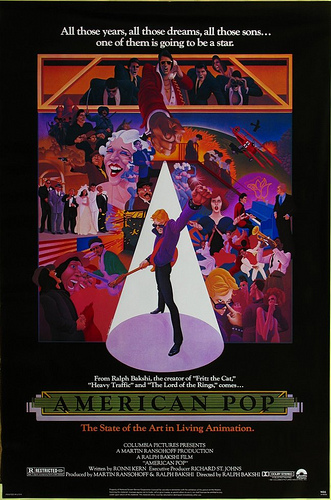
Film Review: American Pop (1981, directed by Ralph Bakshi)


American PopLong before South Park, The Simpsons, and Pixar, there was Ralph Bakshi.  At a time when animation was considered to only be good for children, Bakshi shocked audiences and critics with animated films that dealt with mature themes and were definitely meant for adults.  His first two films, Fritz the Cat (1972) and Heavy Traffic (1973), was the also the first two animated films to receive an X-rating.  Bakshi satirized racism in the controversial Coonskin (1975) and Bakshi’s adaptation of The Lord Of Rings (1978) beat Peter Jackson’s by 23 years.  It was after the critical and commercial disappointment of the heavily flawed but interesting Lord of the Rings that Bakshi decided it was time to make a film that would be more personal to him.  The end result was American Pop.

American Pop tells the story of four generations of a family of Jewish immigrants and how music affects their lives.  In typical Bakshi fasion, this animated film deals with issues of violence, sexuality, drug abuse, and poverty.  American Pop may be animated but it is definitely a film meant for adults.

In the 1890s, Zalmie (Jeffrey Lippa) and his mother escape from Russia after Zalmie’s father, a rabbi, is killed by the Cossacks.  Zalmie grows up in New York and after his mother is killed in the Triangle Shirtwaist Factory fire, he is raised by a vaudeville comedian named Louie (Jerry Holland).  Zalmie wants to be a singer but is shot in the throat during World War I.  His voice ruined, Zalmie marries a stripper named Bella (Lisa Jane Persky) and manages her career.  His partnership with the mobster Nicky Palumbo (Ben Frommer) leads to Bella dying and Zalmie going to prison.

Zalmie’s son, Benny (Richard Singer), is a jazz pianist who, as a favor to his father, marries Nicky’s daughter.  Benny has a son named Tony and tries to pursue his career without using his father’s influence.  Then World War II breaks out.

Benny enlists in the army, seeking redemption from the crimes of his father and father-in-law.  Serving in Europe, he misses his piano and, when he finds one in a bombed-out house in Nazi Germany, he plays a few bars of As Time Goes By.  When a Nazi walks in on Benny, Benny plays Lili Marleen.  For a few seconds, Benny and the Nazi share the common bond of music.  “Danke,” the Nazi says before shooting Benny dead.

Growing up without his father, Tony (Ron Thompson) becomes a beatnik and eventually runs away from home.  He ends up in Kansas, where he has a one-night stand with a waitress and becomes a songwriter for Frankie Hart (Marya Small), a stand in for Janis Joplin.  Both Tony and Frankie start using heroin and Frankie dies of an overdose right before she is supposed to open for Jimi Hendrix.  Abandoned by Frankie’s band, Tony ends up as an addict and dealer in New York.  Accompanying him is his son, Pete, the result of his hookup with the waitress.

After being abandoned by his father, Pete (also played by Ron Thompson), follows in his footsteps and becomes a successful drug dealer.  He is dealing cocaine to all of the big rock bands but, after discovering punk rock, he realizes that he wants something more out of his life.

After announcing that he will no longer sell anyone cocaine unless he is given a chance to record a demo, Pete is given a band and a recording studio.  With the drug-craving record company execs watching, this tough and cocky punk grabs the microphone and sings…

…BOB SEGER’S NIGHT MOVES!?

The use of Night Moves, which is one of the least punk songs ever written, is one of the few false notes in American Pop.  Otherwise, this is one of Ralph Bakshi’s best films.  The majority of the film’s animation was done through rotoscoping, a technique in which animation is traced over live action footage.  (For the gang war scenes, scenes from The Public Enemy were rotoscoped, as was footage of the Nicholas Brothers used in the Sing Sing Sing With A Swing montage.)  Seen today, the technique is crude but effective at showing the contrast between the fantasy of music and the grim reality of life.  Though it has its flaws (*cough* Night Moves *cough*), American Pop is an engaging look at the history and development of American music.

American_Pop