Lisa Reviews An Oscar Nominee: Sound of Metal (dir by Darius Marder)


What’s it like to lose the thing that you felt was the most important part of your life?  That’s one of the many questions that Sound of Metal left me considering.

The story opens with Ruben (Riz Ahmed) and Lou (Olivia Cooke) traveling the country in a cluttered RV.  Lou is a singer.  Ruben is a drummer.  They perform under the name Blackgammon.  Their life is about traveling from gig to gig, playing their own unique music.  It’s not exactly a glamorous life but, as the first few minutes of Sound of Metal makes clear, it’s a life that they both love.

Or, at least, they do until Ruben starts to lose his hearing.  (When Ruben goes to see a doctor, he’s told that he’s basically only picking up on 20% of the sounds around him and that it’s only going to get worse.)  At first, Ruben tries to keep Lou from discovering what’s happening but it doesn’t take long for Lou to realize that something’s wrong.  Ruben argues that he can still play the drums by memory, even if he can no longer hear what he’s playing.  Lou is more concerned that Ruben is going to slip back into his previous bad habits and once again start using heroin.

Eventually, the two of them go their separate ways.  Lou returns to her family in Belgium and reinvents herself as an artist.  Meanwhile, Ruben ends up at a center specifically for deaf recovering addicts.  The center is run by Joe (Paul Raci), a kind but no-nonsense man who lost his hearing in Vietnam and who is a recovering alcoholic.  At first, Ruben is bitter and angry and refuses to accept that his old life is over.  When Joe order Ruben to spend hours sitting in a room and writing down whatever pops into his head, it takes Ruben a while to see that Joe is helping him to come to terms with living in a world without sound.  Even as Ruben starts to accept his new reality, he still finds himself wanting to reunite with Lou.  He finds himself tempted to get a cochlear implant, despite Joe explaining that doing so will mean that Ruben will have to leave his new home.

In the hands of a lesser director and a lesser cast, Sound of Metal could have become mawkish or overly sentimental, the type of film that tries so hard to be uplifting that it ends up condescending instead.  However, director Darius Marder emphasizes the gritty details of his story, showcasing Ruben’s emotional growth while also acknowledging that Ruben will never truly be at peace with his hearing loss.  This is a film that acknowledges what Ruben’s gained from his new circumstances while never ignoring the pain of losing his former life.  The film’s soundtrack is designed so that we hear exactly as much or as little as Ruben can hear.  We feel his frustration and his fear as sound fades away while, at the same time, we also come to appreciate everything that he finds in the silence.

The Academy has rightfully nominated Riz Ahmed for best actor for his performance in Sound of Metal.  That was expected as Ahmed’s been honored by several critics groups and probably the only thing that will keep Ahmed from winning thr Oscar is the Academy’s understandable desire to honor the legacy of Chadwick Boseman.  Ahmed does a wonderful job capturing all of Ruben’s emotions, from his fear to his anger to finally his reluctant acceptance.

Olivia Cooke was not nominated for her role, though I think she should have been.  It’s perhaps understandable why Cooke wasn’t nominated as she’s actually off-screen for a good deal of the film but she still does a great job capturing both Lou’s love for Ruben and also portraying the way the Lou grows as both a person and an artist in his absence.

That said, the best performance in the film comes from Paul Raci.  I have to admit that I cheered a little when I heard that the Academy had nominated Raci for Best Supporting Actor.  The previously unknown Raci, who has been acting for years but who had never had a film role as big or as important as this one, is the son of deaf parents and he brings a tough but heartfelt authenticity to the role of Joe.  As played by Raci, Joe sincerely cares about Ruben but, at the same time, he’s also not going to let Ruben get away with self-pity.  Raci gives a quietly authoritative performance as Joe, rarely raising his voice but still turning the character into the film’s moral center.

Sound of Metal was one of my favorite films of 2020.  It was nominated for Best Picture, along with 5 other nominations.  Personally, while I know the film probably won’t beat Nomadland for the main prize, I’m still hoping that Paul Raci will be able to pull off an upset and take home the Oscar that he definitely deserves.


Spring Breakdown: Top Secret! (dir by Jim Abrahams, David Zucker, and Jerry Zucker)


“How silly can you get?” Val Kilmer sings in the 1984 film Top Secret! and the answer would appear to be very silly.  Extremely silly.  Nonsensically silly.  Unbelievable silly.  So silly that it transcends all formerly known types of silliness.  In other words, this is a very silly film but that’s okay because it’s meant to be silly.

Some people, I know, would probably argue that Top Secret! doesn’t really qualify as a Spring Break film but I have to disagree.  Like any good Spring Break film, a good deal of Top Secret! takes place on the beach and Val Kilmer plays Nick Rivers, a singer who is obviously meant to be a parody of the type of singers who used to regularly appear in the beach party movies of the 60s.  Nick’s number one hit song is Skeet Surfin, which celebrates the sport of skeet shooting while on a surf board.  The movie opens with hundreds of handsome young men jumping on surf boards while holding rifles.  I honestly don’t know whether skeet surfing was every an actual sport but I certainly hope that it was because it looks like it would have been a lot of fun.  Certainly, it would perk up the Olympics.

Of course, Nick is not the only person in the film whose life is connected to the beach.  Hillary Flammond (Lucy Gutteridge) spent much of her youth shipwrecked on a beach with Nigel (Christopher Villiers).  Unfortunately, one day, Nigel went out to sea to search for help and he never returned.  Hillary was eventually rescued.  That’s certainly a sadder trip to the beach than Nick’s but still, a beach is a beach.

Hillary and Nick’s paths cross when Nick is invited to perform at a cultural festival in what, in 1984, was known was East Germany.  Hillary is a member of the Resistance while her father, Dr. Paul Flammond (Michael Gough), is being held prisoner by the government and is being forced to design the type of secret weapons that are always at the heart of espionage adventures like this one.  When Nick and Hillary meet, it’s love at first sight.  Nick gets involved in the plan to save Hillary’s father and to thwart the insidious plans of the East German government.  He also finds the time to sing a lot of songs.

The plot of Top Secret! isn’t really easy to describe.  That’s largely because there really isn’t a plot in a conventional sense.  Instead, there’s just one joke after another.  The dialogue is purposefully nonsensical.  The visuals are full of odd details.  The jokes are frequently hilarious and, because they’re so fast and relentless, they’re also next to impossible to adequately describe.  Much of the visual humor simply has to be seen to be understood and appreciated.  For instance, it may sound slightly humorous to say that a scene features a stern-looking army officer answering a giant phone but you have to actually see the film to truly understand just how brilliantly Top Secret! pulls off the gag.

Of course, what really makes the film is work is Val Kilmer, who is young, handsome, and incredibly likable in the role of Nick.  Kilmer delivers every bizarre line with a straight face and an enthusiastic earnestness that makes him the perfect center for all the craziness raging around him.

How silly can you get?  Watch Top Secret! and find out!

Spring Breakdown: The Beach Girls and the Monster (dir by Jon Hall)


Happy Spring Break!

Spring Break is one of the things that I really miss about high school and college.  Despite the fact that I don’t drink, I don’t swim, and I generally hate crowds, I always made it a point to celebrate Spring Break by going to the beach.  Spring Break was more than just a week’s vacation from “preparing for the future” and everything else that I occasionally pretended college was about.  Spring Break was a ritual.  It was a tradition.  Celebrating Spring Break was as much a required activity as dressing up for Halloween or going to fireworks on the 4th.

For the next two weeks, we’re going to celebrate Spring Break on the Shattered Lens.  I know that some people are saying that no one should be celebrating the Spring Break this year.  To be honest, there were people saying that before the pandemic broke out and there were be people saying that once the pandemic is under control.  Wear your mask indoors.  Social distance.  Do whatever needs to be done and yes, definitely make sure that you know what’s going on in the world.  But don’t ever let the professional killjoys tell you that you don’t have a right to enjoy your life.

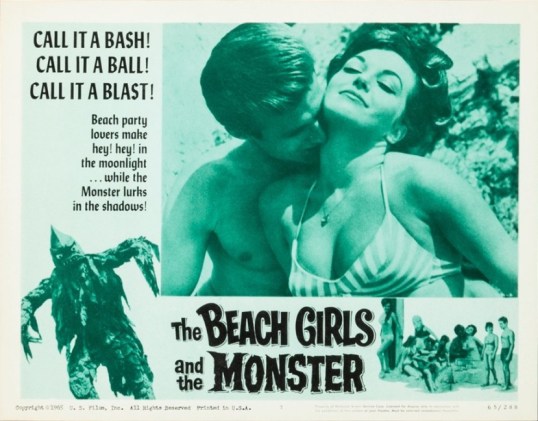
If you want to check out a professional killjoy, just check out the scientist who is at the heart of the 1965 film, The Beach Girls and the Monster.  Dr. Otto Lindsay (Jon Hall, who also directed) is an oceanographer who totally resents the fact that teenagers are partying on the beach.  I mean, he’s even more obnoxious than that jackass lawyer who spent last year wandering around the beach of Florida while dressed up as the Grim Reaper.  Obviously, some of Otto’s bad attitude can be explained by the fact that he’s old but it’s hard not to feel that there’s something bigger fueling his resentment.  Maybe he’s angry that his young wife, Vicky (Sue Casey), doesn’t seem to be particularly happy with their marriage.  Maybe he’s annoyed that there’s a sculptor named Mark (Waler Edmonston) living in his house.  Mark is a friend of Otto’s son, Richard (Arnold Lessing).  Richard was planning on following his father into the field of oceanography but then he discovered surfing.  Now, the only thing that Richard wants to do is surf and hang out on the beach.

It’s a popular beach, though perhaps a little bit less popular now that people are being randomly killed on the sand.  Who is killing off of all of the surfers and the beach girls?  Richard thinks that it’s a maniac but Otto believes that it’s a prehistoric sea creature, come back to life and seeking revenge on all of the irresponsible young people who ruining the beach.  Judging from the fact that the killer looks like some sort of humanoid-fish hybrid, we can only assume that Otto is right.  But is he?

You’ll have to watch the film to find out and, fortunately, it’ll be pretty easy for you to do just that.  The Beach Girls and The Monster is in the public domain and it’s been uploaded to YouTube about a dozen times.  And you know what?  You should watch it because this is an entertainingly dumb little movie.  It’s not exactly a good movie, of course.  The acting is …. not impressive.  The killer fish is …. less impressive.  But so what?  This is a fast-paced and fun movie with a silly monster, a lot of beach parties, and just enough dancing to hold my attention.  It’s nonsense but, in the best tradition of Spring Break, it’s entertaining nonsense.

The TSL’s Grindhouse: Schizoid (dir by David Paulsen)


The 1980 film, Schizoid, is all about the things you can do with scissors.

For instance, in the days before email, text messages, and social media, scissors could be used to cut words out of a magazines.  Those words could then be carefully pasted onto construction paper and then sent to an advice columnist like Julie Caffret (Marianna Hill).  Julie is pretty upset when she starts getting the notes, largely because they promise an anonymous reign of terror and murder.  The police, however, say that the notes probably don’t meant anything.  They’re probably just a hoax.  I mean, it’s true that several members of Julie’s therapy group have recently been murdered but the letters all talk about committing murder with a gun.  Whereas the members of the therapy group are being murdered by someone wielding …. SCISSORS!  (Cue that dramatic music.)

Of course, Julie has other things to worry about.  For instance, her ex-husband, Doug (Craig Wasson), is still in her life.  He’s putting up wallpaper in her office.  Or, at least, that’s what he says he’s doing.  It’s hard not to notice that he doesn’t seem to be making much progress with the job.  Plus, he apparently sleeps in the office, which just seems odd.  Then, there’s the building’s creepy maintenance man, Gilbert (Christopher Lloyd), who specializes in making people uncomfortable on elevators.  And then there’s the fact that Julie’s therapist, is played by Klaus Kinski!

Seriously, if you were looking for a therapist, would you go to Klaus Kinski?

From the minute Klaus shows up, it’s pretty obvious that the film wants us to assume that he’s the killer and really, it’s hard not to make that assumption.  We’re so used to seeing Klaus Kinski play evil and villainous characters and, even 30 years after his death, there are so many stories out there about how difficult Klaus Kinski could be to work with in real life that our natural reaction is to believe any character he plays must have a sinister motivation.  In this film, Klaus’s character has an out-of-control teenage daughter (Donna Wilkes) who tries to commit suicide by locking herself in the garage with a running car.  When Klaus takes an axe to the garage door, we’re left to seriously wonder if he’s planning on killing her or if he’s actually trying to save her life.  That said, Schizoid actually makes good use of Kinski’s menacing persona and Kinski himself gives a performance that elevates the entire film.  Kinski actually does manage to keep you guessing as to whether or not the therapist is a monster or if he’s just kind of a jerk.

Schizoid is usually classified as a slasher film, though it actually has more in common with the classic Italian giallo films that it does with any of the Friday the 13th sequels.  The killer’s identity is masked through POV shots and, in typical giallo fashion, the killer wears black gloves while committing his crimes.  We spend a good deal of the film following the police investigation, which is a typical element of the giallo genre but which is usually treated as an afterthought in post-Friday the 13th slasher films.  Much like Fulci’s The New York Ripper, Schizoid is a violent journey into the heart of darkness, a look at a world with no morality and no safety.  Also like Fulci’s film, it’s so shamelessly sleazy that it’s easy to miss the fact that it’s actually rather well-directed and acted.

Schizoid turned out to be a better film that I was expecting.  That said, I still have to wonder why anyone would select Klaus Kinski to be their therapist.

Film Review: The Boston Strangler (dir by Richard Fleischer)


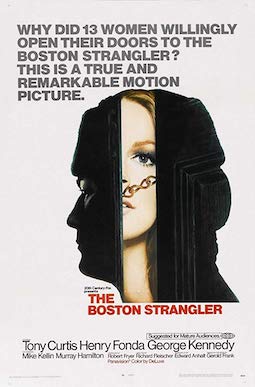
Between June 14, 1962 and January 4, 1964, 13 women between the ages of 19 and 85 were murdered in the Boston area.  It was felt that they had all been killed by the same man, a monster known as The Boston Strangler.  Though the police investigated many suspects, they never made an arrest.  (One should remember that this was before the time of DNA testing or criminal profiling.  The term “serial killer” had not even been coined.  Today, sad to say, we take the existence of serial killers for granted.  In the 60s, it was still an exotic concept.)

In October of 1964, a man named Albert DeSalvo was arrested and charged with being “the Green Man,” a serial rapist who pretended to be a maintenance man in order to gain access to single women’s apartments.  After he was charged with rape, detectives were surprised when DeSalvo confessed to being the Boston Strangler.  When confessing to the murders, DeSalvo got a few minor details wrong but he also consistently included other details that the police hadn’t released to the general public.  Even when put under hypnosis, DeSalvo’s recalled those previously unreleased details.  Because DeSalvo was already going to get a life sentence on the rape charges and because there wasn’t any physical evidence that, in those pre-DNA, could have conclusively linked DeSalvo to the crimes, he was never actually charged with any of the murders.  Still, with his confessions, the cases were considered to be closed.

In 1966, before DeSalvo was even sentenced for the Green Man rapes, Gerold Frank wrote The Boston Strangler, a book about the murders, the investigations, and DeSalvo’s confessions.  It was one of the first true crime books and, in 1968, it was adapted into one of the first true crime films.

Directed by Richard Fleischer (whose filmography somehow includes not only this film but also Dr. Dolittle, Fantastic Voyage, 20,000 Leagues Under the Sea, Conan The Destroyer, and Red Sonja), The Boston Strangler is really two films in one.  The first half deals with the crimes and the police (represented by Henry Fonda, George Kennedy, Murray Hamilton, and James Brolin) investigation.  This half of the film is pulpy and crudely effective, full of scenes of the cops rounding up every sex offender who they can find.  There’s a scene where Henry Fonda talks to a prominent man in a gay bar that’s handled with about as much sensitivity as you could expect from a 1960s studio film.  (On the one hand, the man is portrayed with respect and dignity and he’s even allowed to call out the patron saint of 1960s mainstream liberal piety, Henry Fonda, for being close-minded.  On the other hand, everyone else in the bar is a stereotype and we’re meant to laugh at the idea that anyone could think that Henry Fonda could be gay.)  Director Richard Fleischer makes good use of split screens, creating an effective atmosphere of paranoia.  The scene where a woman tries to keep an obscene caller on the phone long enough for the police to trace his location made my skin crawl and served as a reminder that perverts predate social media.  Another scene where a flamboyant psychic tries to help the police goes on for a bit too long but, at the same time, you’re happy for a little relief from crime scenes and terrified, elderly women discovering that their neighbors have been murdered.

The second half of the film features Tony Curtis as Albert DeSalvo.  Curtis is effective as DeSalvo, playing him as being a self-loathing brute who is incapable of controlling his impulses.  (Before committing one of his crimes, DeSalvo watches the funeral of John Kennedy, his face wracked with pain.  Is the film suggesting that DeSalvo murdered to deal with the stress of life in America or is it suggesting that the hate that killed Kennedy was a symptom of the same sickness that drove DeSalvo?  Or is the film just tossing in a then-recent event to get an easy emotional reaction from the audience?)  As one might expect from a mainstream film made in 1968, The Boston Strangler takes something of a wishy washy approach to the question of whether DeSalvo’s crimes were due to sickness or evil.  Yes, the film says, DeSalvo was bad but it’s still society’s fault for not realizing that he was bad.  It’s the type of approach designed to keep both the law-and-order types and the criminal justice reformers happy but it ultimately feels a bit like a cop out.  Still, the shots of DeSalvo isolated in his padding cell have an undeniable power and Curtis is both pathetic and frightening in the role.  In its more effective moments, the second half of the film works as a profile of a man imprisoned both physically and mentally.

Watching the film today, it’s hard not to consider how different The Boston Strangler is from the serial killer films that would follow it.  DeSalvo is not portrayed as being some sort of charming or interesting Hannibal Lecter or Dexter-type of killer.  Instead, he’s a loser, a barely literate idiot who struggled to articulate even the simplest of thoughts.  The cops aren’t rule-breakers or renegades.  Instead, they’re doing their jobs the best that they can.  Though the film ends with a title card saying that it’s important for society to make more of an effort to spot people like DeSalvo before they kill, The Boston Strangler has a surprising amount of faith in both the police and the law and it assumes that you feel the same way.  It’s a film that takes it for granted the audience respects and trusts authority.  It’s portrayal of the police is quite a contrast to the rebel cops who dominate pop culture today.

After the film came out, DeSalvo recanted his confessions and said that he had never killed anyone.  He was subsequently murdered in prison in 1971, not due to his crimes but instead because he was independently selling drugs for prices cheaper than what had been agreed upon by the prison’s syndicate.  After his death, many books were written proclaiming that DeSalvo was innocent and that the real Boston Strangler was still on the streets.  Others theorized that the actual Strangler was DeSalvo’s cellmate and DeSalvo, knowing he was going to prison for life regardless, confessed in return for money being sent to his family.  That said, in 2013, DNA evidence did appear to conclusively link DeSalvo to the murder of 19 year-old Mary Sullivan.  Of course, that doesn’t mean that DeSalvo necessarily committed the other 12 murders.  In fact, from what we’ve since learned about the pathology of serial killers, it would actually make more sense for the murders to have been committed by multiple killers as opposed to just one man.

Regardless of whether DeSalvo was guilty or not, The Boston Strangler is an uneven but ultimately effective journey into the heart of darkness.

Music Video of the Day: Artifacts by Karate, Guns & Tanning (2021, dir by Andrew Knives)


You run and you run and you run and where do you end up?  You just end up still running.  This video appeals to my existential side, which is probably why I like it so much.  The whole grainy retro feel, combined with the run through the universe makes this entire video feel like sort of existential daydream.  Keep running because who knows where you’ll eventually end up.

Enjoy!

Lisa Reviews An Oscar Nominee: One Foot In Heaven (dir by Irving Rapper)


I have to admit that One Foot In Heaven is a film that I probably never would have watched if not for the fact that it received an Oscar nomination for Best Picture.

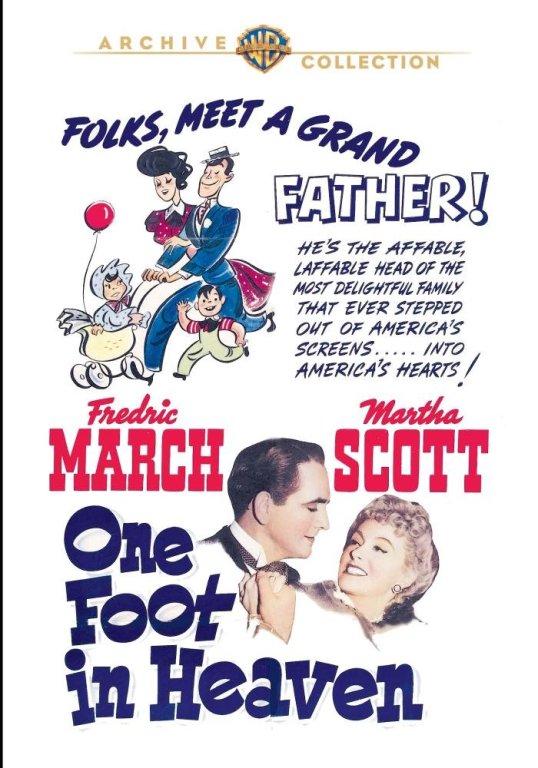
This film from 1941 tells what I presume to be a true — or, at the very least, a true-ish — story.  Fredric March plays William Spence.  The film opens in 1904 with Spence explaining to his future in-laws that he’s spontaneously decided to drop out of medical school because he feels that he’s been called to become a Methodist minister.  Though no one is happy or particularly encouraging about William’s decision to abandon the financial security of medicine to work as a minister, William feels that it’s what he was meant to do.

We follow William and his wife, Hope (Martha Scott), as they move from town to town, living in dingy parsonages and barely paying the bills by doing weddings.  Though Hope is frustrated by the constant moving and the less-than-ideal living conditions, she remains supportive of William.  They start a family and William goes from being a stern and somewhat judgmental man to becoming an inspiring minister.  He even changes his opinion about the sinfulness of going to the movies.  (All things considered, that’s probably for the best.)  Eventually, William, Hope, and the family end up ministering to a congregation in Colorado.  Determined to finally give his wife the home that she deserves, William tries to rebuild both the church and the parsonage.  It turns out to be more difficult than he was expecting.

That’s pretty much the film.  There’s not really much conflict to be found, until the final 30 minutes or so when William struggles to convince a bunch of snobs to help him achieve his dream of building a new church.  The film opens with a title card thanking the Methodists for their help in the production of the film, which should tell you everything you need to know about the film’s attitude towards Protestantism.  William does debate an agnostic at one point but it’s not much of a debate.  William, after all, is played by the authoritative Fredric March while the agnostic’s name isn’t even listed in the credits.  It’s a well-made film, in that sturdy way that many 1941 studio productions were, but — unless you’re just crazy about the history of Methodism — it’s not particularly interesting.

On the plus side, Fredric March gives a good performance as William Spence.  March was one of the best actors of Hollywood’s Golden Age and he gives a sympathetic performance as a stern but well-meaning man who respects tradition but who is still willing to admit that he has much to learn.  Probably the film’s most effective scene is when William reluctantly watches a movie with his son.  March captures William’s transformation from being a disapproving father to an entertained filmgoer.  It’s one of the few moments when the film really feels alive.

So, how did One Foot In Heaven receive a Best Picture nomination in the same year that saw nominations for films like Citizen Kane, The Little Foxes, Suspicion, and The Maltese Falcon?  One Foot In Heaven is well-made and totally uncontroversial.  It’s the type of film that, if it were made today, it would probably be directed by Ron Howard and it would star someone like James Marsden or Garrett Hedlund.  One Foot In Heaven is not particularly memorable but there’s nothing particularly terrible about it either and it probably felt like a “safe’ film to nominate.  Still, it’s probably significant that One Foot In Heaven didn’t receive any nominations other than one for Best Picture.  It lost that Oscar to another film about family, How Green Was My Valley.

Music Video of the Day: You Get In My Way by Ali Barter (2021, dir by Bryce Padovan)


When I first saw this, I have to admit that I misread the title as being “You got in my way” and, since I suck at understanding lyrics, I assumed that this song was about a hit-and-run accident or something like that.  Like maybe Ali was explaining that it was unfortunate that she ran you over but she was driving home at four in the morning and she was a little distracted and then you just happened to step off the curb.  Seriously — what were you thinking!?

Actually, though, this is song is abut Ali singing about a boy who seems to be perfect but who still kind of cramps her style.  She’s got the stability of a relationship but sometimes, that stability gets in the way of her just doing what she wants to do.  Is she sacrificing her freedom?  It’s a legitimate question and one to which I think any former or current wild child can relate.

As for the video, I like it.  It’s simple but fun.

Enjoy and stay out the way!

Music Video of the Day: Nyx by Laurence-Anne (2021, dir by Joey Desjardins)


Hi, everyone!  I’m in charge of “music video of the day” for this week so let’s get things started with this trippy little video from Laurence-Anne.

Basically, you remember those big bulky computers that everyone used to have?  Well, judging from this video, it’s a pretty good thing that we got rid of the because they’ll cause you to sucked into a maze and then melt away.  Seriously, everyone …. melting is just not worth it.  While I personally don’t know anyone who has melted, I imagine that it would be a pretty difficult thing to come back from.  You melt and you can pretty much say goodbye to whatever future plans you may have had.

With that in mind, enjoy!