The TSL’s Grindhouse: Space Mutiny (dir by David Winters)


“Arggggh!”

— Dave Ryder (Reb Brown) in Space Mutinty (1988)

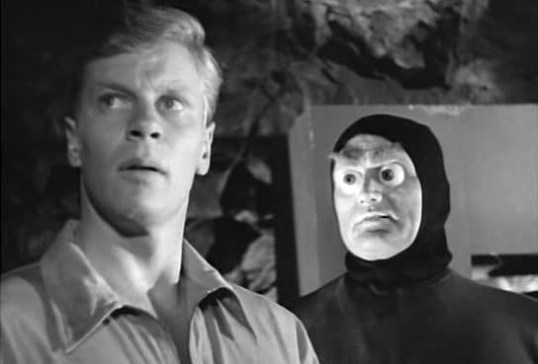
Space Mutiny, a sci-fi epic from 1988, is full of dialogue about all sorts of political and philosophical concerns but none of it is quite as memorable as the quote above.  Dave Ryder says, “Argggggh!” a lot over the course of Space Mutiny.  He’s the newly appointed head of security for the Southern Sun, a gigantic spaceship that has spent the last 260 years traveling from Earth to a new planet.  Being head of security is important because there are some people on the Southern Sun who are plotting a mutiny.  Dave Ryder decides that the most effective way to battle the mutineers is to yell loudly and frequetly.  “ARGGGGGH!’ Ryder yells whenever he’s being shot at.  “ARGGGGGGGH!” he screams when he finds himself on a very slow and gradual collision course with the head of the mutineers.

When Dave isn’t saying stuff like, “Argggggh!,” he’s saying stuff like, “Go!  Go!  Go!”  When the bad guys open fire on him and his men, it’s time for them to “Go!  Go!  Go!”  When the mutineers are being chased, Dave is quick to tell everyone to “Go!  Go!  Go!”  He’s like the physical fitness trainer from Hell.  He never actually yells “Feel the burn!” but you can be damn well sure that he’s thinking it.  In fact, there’s a point in the movie where “Feel the burn!” actually would have been a good line.  Dave and his girlfriend, Lea (Cissie Cameron), set a mutineer on fire.  It’s actually a bit of a sadistic scene and it doesn’t come across as being the big hero moment that it’s obviously meant to be.  But, then again, Dave isn’t yelling because he’s a nice guy.  He’s yelling because he’s played by Reb Brown.  Reb Brown yelled all the way through Strike Force Commando.  Why wouldn’t he do the same for Space Mutiny?

Of course, Dave isn’t the only person barking out orders on the Southern Sun.  Cameron Mitchell plays the ship’s captain, a wise old man who looks like Santa Claus.  John Phillip Law is Kalgon, the main mutineer.  He laughs a lot.  Cissie Cameron is the captain’s daughter.  She falls for Ryder, despite the fact that she appears to be old enough to be Ryder’s mother.  (In real life, Reb Brown and Cissie Cameron are married and Cissie is only a few years older than Reb.  In Space Mutiny, she’s stuck with an unflattering hair style and is made up to look like an aging cheerleading coach.)  There’s also a woman who works on the ship’s bridge.  She’s killed in one scene, just to mysteriously turn up alive in the scene that follows.  In space, no one can hear the script supervisor.  Finally, there’s a group of alien witches who board the ship and spend the entire movie dancing in front of a ball of electricity.  Since they don’t actually interact with any of the main characters, it’s obvious that they were added to pad out the film’s running time.

One of the more interesting things about Space Mutnity is that Kalgon actually has a point.  It does seem kind of stupid to spend several hundred years traveling to just one planet when there’s other planets nearby that the ship could just as easily reach.  Indeed, the mission of the Southern Sun never makes that much sense and the Captain seems to be delusional in his insistence that it does.  The Captain’s unending faith and his long-flowing beard makes him come across like a minor biblical prophet, the type who always had to ask a major prophet to interpret his visions for hm.  The Captain does not come across like someone who really knows what he’s doing.  I don’t care how much Ryder screams, Kalgon had a point!

Today, Space Mutiny is best known for being featured on an episode of Mystery Science Theater 3000 and for later being taken apart by the Rifftrax crew.  Space Mutiny, though, is such an extremely silly movie that you really don’t even need any professionals to help you snark your way through it.  The film offers up such a treasure trove of material then even the most humorless among your friends will be a comedic genius by the time it ends.  It’s a fun movie, made even more so by the fact that the filmmakers apparently meant for the film to be taken seriously.  There’s a lot of talk about important issues like freedom, duty, and faith.  In the end, what you’ll remember is the screaming.

The Films of 2021: God’s Not Dead: We The People (dir by Vance Null)


Here’s the story so far:

In 2014, a film called God’s Not Dead was released.  Produced by PureFlix Entertainment, it was a big, messy, and often confusing movie about a college student who challenged the claim of an atheist professor that God never existed.  While the student was debating the professor, countless other characters were wandering around campus and having their own faith-related dramas.  The main theme of God’s Not Dead appeared to be that only bitterness could explain disbelief and that everyone on the planet secretly wants to be a Christian.  It was not a particularly good movie but it was a surprise hit at the box office.  After spending years being ridiculed in nearly every mainstream film ever released, hardcore evangelicals finally had a movie that ridiculed the other side.

In 2016, God’s Not Dead 2 came out.  God’s Not Dead 2 was so heavy-handed that it actually managed to make the original film appear balanced and fair.  As opposed to the previous film, God’s Not Dead 2 was overtly political, telling the story of a teacher who is put on trial for encouraging a student to pray.  Again, it wasn’t a very good film but it did have two things going for it: a sincere lead performance from Melissa Joan Hart and an amazingly over-the-top villainous turn from Ray Wise as the prosecutor.  Most prosecutors would be smart enough to just argue that the teacher’s actions violated the law and perhaps offer a deal so that they wouldn’t have to waste their time with a lengthy trial.  Instead, Wise’s prosecutor practically cackles that he’s going to prove to the jury that “God is dead.”  Not surprisingly, the jury responded with “That’s a little above our paygrade.”

After all of that, 2018’s God’s Not Dead: A Light In The Darkness was a surprisingly low-key affair.  Largely eschewing the overt political content of the previous installment, the third God’s Not Dead film returned the story to campus and followed the efforts of Rev. David Hill (played by David A.R. White, the franchise’s producer) to keep his church from being closed down.  Of all the films, the third God’s Not Dead probably comes the closest to being a conventional film.  It even admits that not all atheists are evil and acknowledges that there is a legitimate constitutional argument to be made for not having a church on campus.  Because it didn’t feature any villains as memorable Ray Wise, A Light In The Darkness is also probably the most boring of all the films.  It also underwhelmed at the box office, a sign that the novelty of seeing a Christian film in a theater had worn off for even the film’s target audience.

And that brings us to God’s Not Dead: We The People, which had a three-day exclusive theatrical engagement in October of 2021.  As you can probably guess from the title, the fourth God’s Not Dead returns to the political themes of the second film.  Congress is thinking about infringing on the rights of parents to homeschool their children.  Rev. Hill and a group of parents (one whom is played by Antonio Sabato, Jr.) head to Washington D.C. so that they can testify in front of a Congressional hearing that’s being chaired by a smug liberal played by legitimate actor William Forsythe.  Isaiah Washington appears as a congressman who supports homeschooling and who thinks the education system needs to be reformed.  (“He’s that Congressman from Texas!” one character exclaims.)  Judge Jeanine Pirro plays a judge who is originally against homeschooling but who changes her mind after her daughter argues with her because, in the world of God’s Not Dead, not a single atheist or skeptic has any sort of firmly held conviction that can’t be overturned by an argument that would be more appropriate for a community college Intro to Philosophy class.  The film ends with the reverend giving an impassioned speech while Forsythe glowers and Washington stares on in beatific appreciation.

As you can probably guess, God’s Not Dead: We The People is total and complete propaganda, full of strawman arguments and moralizing.  Speaking as someone who is not a fan of the government or its tendency to try to interfere in people’s lives, even I watched the film and thought, “Okay, this is just a little too heavy-handed for me.”  Director Vance Null takes a vaguely Oliver Stone-style approach to the film, editing in random shots of American flags and patriotic monuments while the film’s characters discuss how the founding fathers felt about religion.  To be honest, when it comes to how its presented, the film’s propaganda is not that different from the type of propaganda that regularly appears in more mainstream films.  The film’s flashy editing and one-sided view of the world isn’t that much different from Adam McKay’s post-Big Short filmography.  Ending the film with a passionate speech that leaves all of the main character’s opponents with nothing to say in response may be a cliché but it’s a cliché that Aaron Sorkin knows well.  All of the cameos from the characters who appeared in the previous film may feel a bit random but it’s not that much different from when Marvel used to sneak Robert Downey, Jr. into every film they made.  If nothing else, the people behind the God’s Not Dead franchise have learned the first rule of business: watch what the successful do and copy them.

All of that aside, God’s Not Dead: We The People is not a particularly interesting film.  The editing may be flashy but the pace is still slow and the final hour of the film is basically just people testifying in front of a congressional committee.  The film is less concerned with converting the skeptical and more about rallying the faithful to vote in 2022.  That’s always been my main problem with the propaganda films of both the left and the right.  It’s always less about making a case and more about vanquishing any shred of doubt from those who already largely agree with the film’s message.  Ideological purity tests do not make for enlightening or memorable entertainment.

TV Review: Dexter: New Blood 1.10 “Sins of the Father” (dir by Marcos Siega)


I’ve been thinking about the finale of Dexter: New Blood for about three days now.  I’m going to guess that if you’re a Dexter fan, you’ve already seen it so I’m going to just talk about what happened without posting any spoiler warnings.  I hate spoiler warnings anyways.

Harrison shot and apparently killed Dexter.  Now, I have to admit that, when Harrison first showed up during the first episode, my initial thought was that Harrison was going to end up killing Dexter for the same reason that Dexter had killed so many others.  And, as other have pointed out, the entire show was pretty much leading up to either Harrison killing Dexter or Dexter being forced to kill Harrison.  So, really, I guess I should be happy that the show followed its storyline to its only logical conclusion.  I can certainly respect the show for staying true to itself but respect and happiness don’t always go together.

To be honest, even though I knew that it should happen, I really thought there was no way that the show would actually do it.  I was so used to Dexter being able to get out of any situation that I just naturally assumed that he would be able to do it again.  And if Dexter had managed to escape from the jail without killing Logan in the process, I think Dexter probably could have pulled it off.  But, by killing Logan, Dexter broke Harry’s code.  Dexter revealed that the code was really just a part of his own sociapathic ritual.  It wasn’t something that he truly obeyed,  Instead, it was something that he used to justify his dark urges.

Harrison realized what Dexter had done and, as a result, Harrison shot him.  I didn’t necessarily buy the idea that Dexter would just stand there and encourage his son to kill him.  That was a bit convenient and it required Dexter to have a conscience, which is something that we all know he didn’t have.  Even Dexter’s comment that he had never felt love until the minute Harrison pulled the trigger felt like another case of Dexter what he knew the audience wanted to hear.

My main issue with the episode wasn’t so much Harrison shooting Dexter as it was what happened next.  Allowing Harrison to escape and agreeing to cover up what he did was totally out-of-character for Angela.  Angela, who has shown that she’s willing to arrest anyone in town regardless of how close she may be to them, had no problem wiping Harrison’s prints off the gun and tossing him some money for his journey.  It didn’t make any sense.  Angela barely knows Harrison.  How does she know that Harrison didn’t help Dexter with the murders?  Also, after Angela discovered that Dexter was a murderer, did it not occur to her that there might be something strange about the stabbing at the school?  Is Angela okay with Harrison driving off to freedom while the kid that Harrison tried to murder is destined to always be remembered as a potential school shooter?  I can accept Harrison shooting Dexter.  I can even respect it.  But I cannot accept that Angela would let him get away with it.

There were other loose ends that bothered me.  Why was Edward Olsen such an important character in the first few episodes?  Why did he mysteriously vanish?  Why did the show seem to building up to a twist about Audrey’s parentage, just to abandon the whole thing an episode later?  How did Kurt manage to capture Molly, who was more or less aware that Kurt was a killer and certainly wouldn’t go anywhere willingly with him.  Considering that this episode appeared to be the definitive end of Dexter’s story, those loose ends are frustrating.

That said, it was a well-directed episode.  Michael C. Hall was riveting and genuinely frightening in the scenes where he manipulated Angela and Logan.  The final montage of the faces of everyone innocent person who died as a result of Dexter’s actions was an emotional moment and I’m glad to see that Doakes was included with Deb, Rita, LaGuerta, Lundy, and all the rest.  Doakes always got a raw deal.

Dexter: New Blood was a success.  Even the fact that I have mixed feelings about how it ended is proof of how well executed this revival was.  (Trust me, I could have hardly cared less when Dexter sailed into that hurricane, so fed up was I with the show at the time.)  And, between you and me, I’m not convinced that Dexter’s dead.  Yes, he was shot.  Yes, he didn’t look good.  But Harrison drove away before the paramedics arrived.  Dexter’s survived a lot.

At the very least, Ghost Dex would be amusing….

Music Video of the Day: The Night Chicago Died by Paper Lace (1974, dir by ????)


Paper Lace was a British band.  None of them were from Chicago.  None of the had ever been to Chicago.  Certainly none of them had a father who was a cop in Chicago or a mother who cried and prayed the night that Chicago died.

In fact …. CHICAGO DIDN”T EVEN DIE!

Well, it came close once.  There was that whole fire that was caused Mrs. O’Leary’s cow.  I’ll be honest, though.  I think the cow was innocent.  I think Mrs. O’Leary just forgot to turn off the stove and she was too embarrassed to admit it.  So, the cow got blamed.

But that’s not what this song is about.  The song is about a huge gunfight between the police and the members of Al Capone’s gang.  However, the Chicago police never got into a gunfight with the Chicago Outfit, largely because Capone owned the cops.

I would also point out that, according to a friend of mine from the area, Chicago doesn’t even have an east side!

So, maybe the song isn’t historically accurate.  Listen, I’m from Dallas.  I know what it’s like when people assume that they know everything that they need to know about your city.  I know how annoying it is. I can’t tell you how many movies I’ve seen that supposedly take place in North Texas but which have big mountains in the background or people exploring caves.  There are no mountains in North Texas!  There is no east side in Chicago.

But, on the plus side, The Night Chicago Died has a killer bass line and you can sing along with it.  That’s always a good thing.  Plus, the drummer looks like he might have been a magician in his spare time.

Enjoy!

My daddy was a cop on the east side of Chicago
Back in the U.S.A. back in the bad old days


In the heat of a summer night
In the land of the dollar bill
When the town of Chicago died
And they talk about it still
When a man named Al Capone
Tried to make that town his own
And he called his gang to war
With the forces of the law


I heard my mama cry
I heard her pray the night Chicago died
Brother what a night it really was
Brother what a fight it really was
Glory be!
I heard my mama cry
I heard her pray the night Chicago died
Brother what a night the people saw
Brother what a fight the people saw
Yes indeed!


And the sound of the battle rang
Through the streets of the old east side
‘Til the last of the hoodlum gang
Had surrendered up or died
There was shouting in the street
And the sound of running feet
And I asked someone who said
“‘Bout a hundred cops are dead!”


I heard my mama cry
I heard her pray the night Chicago died
Brother what a night it really was
Brother what a fight it really was
Glory be!
I heard my mama cry
I heard her pray the night Chicago died
Brother what a night the people saw
Brother what a fight the people saw
Yes indeed!


And ther was no sound at all
But the clock upon the wall
Then the door burst open wide
And my daddy stepped inside
And he kissed my mama’s face
And he brushed her tears away


The night Chicago died
Na-na na, na-na-na, na-na-na-na-na
The night Chicago died
Brother what a night the people saw
Brother what a fight the people saw
Yes indeed!


The night Chicago died
Na-na na, na-na-na, na-na-na-na-na
The night Chicago died
Brother what a night it really was
Brother what a fight it really was
Glory be!


The night Chicago died
Na-na na, na-na-na, na-na-na-na-na
The night Chicago died
Brother what a night the people saw
Brother what a fight the people saw
Yes indeed!

Novel Review: 1988 by Richard D. Lamm and Arnold Grossman


From my aunt’s paperback collection, comes 1988!

1988 is a novel about the 1988 Presidential election. It was published in 1986 so, when it first came out, it was meant to be a look at a possible future. But read today, it’s more like a work of alternate history. What if, the book asks, the 1988 election had been disrupted by a third party candidate?

That candidate is Stephen Wendell, who is the governor of Texas. You can tell that this book was written a long time ago because Wendell is described as being a Democratic governor of Texas. There hasn’t been a Democrat elected statewide in Texas for a while and that’s probably not going to change anytime soon. (Sorry, Beto, but it’s true.) Wendell is also a conservative Democrat, which is yet another reminder that we’re dealing with an old book. With neither the Republican nor the Democratic candidate exciting the country, Wendell sees an opening for his populist, anti-immigration message.

Jerry Bloom is a former 60s radical who now works as a campaign consultant. At first, he resists Wendell’s attempts to hire him but Bloom finally gives in. Some of it is because Wendell seems to be more reasonable than Bloom originally assumed. A lot of it is because Bloom wants the challenge. As a result of Bloom’s hard-hitting and frequently viscous commercials, Wendell starts to rise up in the polls.

Bloom’s conscience is bothered, however. He used to believe in stuff but now he finds himself as just a political mercenary, turning the country against itself. Plus, Bloom comes across evidence that there’s a secret conspiracy behind Wendell’s campaign, one that could put the future of the Republic at stake!

1988 is an okay political thriller. The plot isn’t particularly surprising and you’ll figure out what’s going on long before Bloom does but, for the most part, it’s a well-written book and Jerry Bloom is an interesting character. I do think that the book overestimates that power of Bloom’s commercials. For the most part, they sound like the type of stuff that The Lincoln Project posted throughout 2020, commercials that would speak to the already converted while turning off the undecided voters. Bloom’s commercials sound like they would be popular with Wendell’s base but they don’t sound like the sort of thing that would make him a potential president.

The book also makes the mistake of including a character named Harrison Chase, who I guess is supposed to be some sort of Edward R. Murrow type. He gives commentaries on the evening news and 1988 devotes page after page to Harrison Chase bitching about the election. Most of the commentaries come across as being pompous and self-important, which might be the most realistic part of the book. But it still doesn’t make them particularly interesting to read. They slow down the action and they also contribute to the book ending on an annoying ambiguous note.

Political junkies will enjoy counting up all of the real-life politicians who are mentioned in the book. (Joe Biden gets a shout-out because he’s been around forever.) Some may also find it interesting that one of the book’s co-authors was governor of Colorado at the time that he wrote the book. One has to wonder how much of that experience contributed to the book’s portrait of the electorate as being easily led and intellectually vapid.

1988 is okay. It goes a little heavy on the “political consultants are bad” angle. It’s not a bad message but it’s hardly a revolutionary. Still, it’s always interesting to read older political books and see how much things have changed and also how much they’ve remained the same.

Music Video of the Day: Love Me by Yvonne Elliman (1976, dir by ????)


For the past few days, I have been driving everyone around the TSL Compound crazy by continually playing and re-playing the Saturday Night Fever soundtrack.  Though no one will admit it, I’m sure that they’ve all got the lyrics of I Can’t Have You memorized by now.  We could probably start a Bee Gees cover band if we wanted to.  And really, there’s no reason why we shouldn’t!  Leonard can play bass, I’ll sing, Jeff can drum, Erin can play the sitar, it’ll be great!

Well, today, I thought maybe that we would take a break with another Bee Gees song that was covered by Yvonne Elliman, Love Me.  While the Bee Gees version of the song didn’t get much attention, Yvonne Elliman’s cover was a huge hit and it probably played a role in the Bee Gees later writing How Deep Is Your Love for her.  Of course, the Bee Gees later ended up performing How Deep Is Your Love for Saturday Night Fever while Yvonne recorded If I Can’t Have You.  It can be difficult to keep track but the important thing is that everyone got recorded eventually.

Enjoy!

Love me; just a little bit longer
Love me

I remember times my love when we really had it all
You were always there to make me smile, help me when I fall
Ooh, I can’t believe you’re leaving me
When there’s so much more to say – I can’t let you go
Ooh, every time I look at you I still can feel the glow
Let it be, let it grow

Love me please, just a little bit longer
Together we can make it
Our love is much too young to break it
Love me please, just a little bit harder
Together we can make it
Our love is much too young to break it

Ooh, all I ever wanted was to have you to myself
Then I see you standing there in the arms of someone else
Ooh, you know a girl can stand so much
And it’s more then I can bear – I can’t let you go
Ooh, every time I look at you I still can feel the glow
Let it be, let it grow

Love me please, just a little bit longer
Together we can make it
Our love is much too young to break it
Love me please, just a little bit harder

Never even try to see things my way
It’s hard on a woman when love ain’t no love at all
And when you walk away – you probably will
You’re gonna be sorry, I’m begging you; please

Love me please, just a little bit longer
Together we can make it
Our love is much too young to break it
Love me please, just a little bit harder
Together we can make it
Our love is much too young to break it
Love me please, just a little bit longer
Together we can make it
Our love is much too young to break it

Book Review: Alright, Alright, Alright: The Oral History Of Richard Linklater’s Dazed and Confused by Melissa Maerz


There are a lot of different ways that I could praise this 2020 book about the 1993 high school film, Dazed and Confused.

I could point out that it is the definitive history about the making of one of my favorite films, told by the people who were there.

I could point out that it’s a book that captures a very important time in the development of modern independent film.

I could point out that anyone who is a fan of Richard Linklater should read this book to discover the struggles that Linklater went through while directing his second feature film.  Linklater learned a lot during the filming.  He’s also an endlessly fascinating interview subject, a filmmaker who has figured out how to balance the needs of art with the needs of commerce.

If you’re a Texan, you definitely have to read this book because Dazed and Confused is a part of our culture.

I would also point out that this book is about more than just went on while the movie was being shot.  It’s also about how the movie effected and continued to effect the lives of the people who were in it and who have seen it..  Some cast members, like Matthew McConaughey, Ben Affleck, Parker Posey, and Renee Zellweger (even though she’s only visible for a second and isn’t actually credited in the film), became big stars.  Others, like Anthony Rapp and Adam Goldberg and Nick Katt, have emerged as strong characer actors, the type of people who you love to see in any movie.  Others had a bit less success and most of them do not hold back on discussing why stardom did or did not come calling.

Featuring interviews with just about everyone who was involved in the film, Alright Alright Alright begins with Richard Linklater finding arthouse success with Slacker and then moving on to Dazed and Confused.  As many people in the book point out, Linklater’s first few films helped to define both Austin and the entire Texas film scene.  At a time when most Texas films were about cowboys and oilman, Linklater revealed that there was a lot more going on.  And yet, when Linklater went on to find his own quirky brand of mainstream success, many of his former colleagues in Austin felt left behind.  Linklater acknowledges their feelings while also making no apologies for not spending the rest of his life remaking Slacker.

The full production of Dazed and Confused, from casting to the film’s release, is covered.  We learn about some of the people who tried out for the film but, ultimately, weren’t cast.  (Linklater seems to feel almost guilty for not casting Vince Vaughn in a role.)  We learn how Matthew McConaughey almost randomly found his way into the cast and then subsequently transformed Wooderson from being a minor character into being the heart of the film.  We follow Wiley Wiggins as he comes of age on the film set.  Just about everyone is interviewed and no one holds back.  It was a frequently wild set, with a young cast who, to a certain extent, recreated high school while the film was being shot.  I was sad to learn that Michelle Burke did not get along with Parker Posey and Joey Lauren Adams.  I was happier to read that Jason London was apparently as cool off-camera as he was when he was playing Randall “Pink” Floyd.  And, considering the way that his character just vanished from the film, I have to say that I wasn’t surprised to discover that no one seemed to get along with Shawn Andrews.

Shawn Andrews, of course, played Kevin Pickford.  Pickford was originally meant to be an almost shamanistic character, though the concept of the character started to change once filming actually started.  (“There’s a reason we called him Prickford,” Rory Cochrane says, at one point.)  Two chapters are devoted to everyone in the cast taking about how much they disliked working with Shawn Andrews.  No one really seems to hold back, which I have to admit almost made me feel sorry for the guy.  Like many young actors, he went a bit too far trying to be method.  Nick Katt compared him to Jared Leto at his worst.  The otherwise easy-going Jason London talks about nearly getting into a fistfight with him.  Linklater attempts to be diplomatic while discussing what happened but even he admits that Andrews didn’t gel with his vision for the film.  Pickford was originally meant to be a major character.  He was meant to be on the football field with Randall and Dawson.  He was also originally meant to be the one heading out to get Aerosmith tickets.  However, with more and more actors basically refusing to deal with the actor who was playing him, Pickford was replaced in scene after scene by Matthew McConaughey’s Wooderson.  (Andrews, apparently, felt that Pickford should die in a dramatic car accident towards the end of the film.)  Perhaps not surprisingly, Andrews was one of the few actors to decline to be interviewed for the book.

The final few chapters of the book are a bit sad, as some members of the cast discuss their careers after Dazed and Confused.  We read about a cast reunion that occurred in Austin that turned a bit awkward when the actors who had become big stars reunited with the actors who hadn’t.  Jason London, who dealt with a great personal tragedy shortly after the filming of Dazed and Confused, talks about the experience with a wistfulness sadness that is actually a bit heart-breaking.  One gets the feeling that London’s mixed feeling weren’t so much about not becoming a Matthew McConaughey or Ben Affleck-style star as much as they were an acknowledgement that the past is the past.  The unstated theme running through the book is that, as good a time as everyone had while making Dazed and Confused, everyone’s older now and that moment can never be recaptured.

(Kind of like high school!)

The book does end with some speculation about a Dazed and Confused sequel.  Linklater seems to have given it some thought, though he also says that it will never happen.  Personally, I think that’s the right decision.  Dazed and Confused is perfect as it is.  Alright, Alright, Alright is the book that helps us to understand why that is.

Music Video of the Day: Boogie Shoes by K.C. and the Sunshine Band (1978, dir by ????)


I’m sure you’ll remember this song from the soundtrack of any film that’s set during the 70s.  I’ll always associate with John C. Reilly showing Don Cheadle a card trick in Boogie Nights.  I guess that’s appropriate since it’s Boogie Shoes and Boogie Nights.  “Don’t you worry about the evil spirits?” Cheadle asks Reilly shortly before Reilly runs off to help Dirk Diggler launch his musical career.

Apparently, this band was started in a record store.  The man who would eventually be known as KC worked at the store and I guess the band was made up with either his customers or his co-workers.  Either way, they came together to form The Sunshine Band and they spread happiness and cheer all throughout the cocaine-heavy 70s.  They’re still doing it, playing the nostalgia circuit.  Good for them.  Disco is forever.

(That said, the best band to form in a record store remains the Empire Records band.  SUGAR HIGH!)

This is another one of those videos that was originally a performance for a television show.  In this case, the show was American Bandstand. 

Dance and enjoy!

Lisa Marie’s Week In Television 1/2/22 — 1/8/22


As the first week of 2022 comes to a close …. I have yet to watch the fourth season of Cobra Kai!  What’s up with that?  Oh well, I’ll watch it next week.  This week, I was busy.  Next week, I’ll ignore everything else I need to do and watch TV.  How is that not a good plan?

Anyway, here’s what I watched this week:

Allo Allo (Sunday Night, PBS)

After being gone for a month due to pledge programming, Allo Allo returned to the PBS line-up on January 2nd.  Having escaped from the hospital, Rene returned to the café and dealt with Michelle’s latest scheme to get the airmen out of France.  It involved hiding them in a hollow bomb that would be dropped over England.  The only problem is the Resistance needed a place to hide the bombs.  Michelle, of course, volunteered Rene’s cafe.

While I continue to laugh at Crabtree’s mangled French, I also find myself looking forward to the every scene involving LeClerc and his attempts to disguise himself.  “It is I, LeClerc.”

The Amazing Race 33 (Wendsenday Night, CBS)

I wrote about the premiere of The Amazing Race here!

The Bachelor (Monday Night, ABC)

Big goofy Clayton is the new Bachelor.  Big goofy Jesse Palmer is the new host.  Honestly, we need more of a break between installments of this franchise.  Anyway, Monday’s episode featured Clayton meeting the girls and, of course, sending one of them home on the first night because she wasn’t there for the right reasons (plus, she was like sloppy drunk).  It was such an obvious set up.

Dexter: New Blood (Sunday Night, Showtime)

I reviewed the latest episode of Dexter: New Blood here!

Joe Millionaire (Thursday Night, Fox)

On this dating reality show, a group of women are competing to end up with one of two men.  One of the men is a millionaire.  The other isn’t!  The twist is that the women don’t know which is which.  Unfortunately, the viewers do know and that takes a lot of the fun out of the show.  It would be a lot more enjoyable if we were guessing along with the women.  Instead, we know that the farmer is actually very wealthy and the dude who looks like a European prince is actually a construction worker.

(To be honest, this show seems more like a parody of a reality show than an actual show.)

The first episode of this new edition of Joe Millionaire aired on Thursday.  One of the women was sent home because she followed one of the men on social media.  The show handled this development as if it was the most serious thing ever.  I guess sending one random person home on the first day is going to be a new dating show ritual.  Anyway, Joe Millionaire was pretty stupid.  The men were boring.  The women were boring.  The host is also the butler at the mansion where everyone is staying.  There was a lot of nonsense over whether or not everyone was there for the right reason.  (What is the right reason when it comes to stuff like this?)  Who cares?

I’ll probably watch it, though.  I just won’t talk about it on twitter.  It’ll be our little secret, my dear readers.  Sound good?

The Love Boat (Sunday Evening, MeTV)

The Love Boat and its enthusiastic crew completed their cruise to Alaska.  Everyone learned an important lesson about being too competitive and the importance of following one’s heart.  Yay!  Needless to say, it was a pretty silly show but sometimes, it’s good to watch something silly.

And Love …. won’t hurt anymore….

The Office (All The Time, Comedy Central)

I watched a few episodes from the fourth season on Thursday.  Michael hanging out in New York with Ryan was good.  The dinner party remains a classic.  I had to change the channel once we got to the one where Jim was playing golf with the client and, for some stupid reason, he brought along Kevin and Andy.  It never felt right whenever the show featured Jim actually working.

Open All Hours (Sunday Night, PBS)

After being off the air for the month of December due to pledge programming, Open All Hours has returned to the PBS lineup.  On Sunday’s episode, Arkwright longed for Nurse Gladys Emmanuel while Granville continued to stew in resentment.  I don’t blame Granville.  It couldn’t have been easy being a 40 year-old stockboy.  I always find myself wondering what Granville did to get sold into indentured servitude in the first place.

Shipping Wars (Tuesday Morning, A&E)

A&E is now showing the old, original episodes of Shipping Wars in the morning and new episodes at night.  I have yet to watch any of the new episodes, mostly because the old episodes got so annoying after Roy died that I can’t imagine that the new episodes could be any better.

Anyway, on Tuesday, I mostly had the show on for background noise.  I did notice that one episode featured a bunch of people pointing guns at Roy.  It was presented as being a very dramatic situation but if Roy was really going to be shot, I kind of doubt that Shipping Wars film crew would be allowed to just hang out while it was happening.  Eventually, it all turned out to be an elaborate prank.

Another episode featured Jen basically destroying a butter sculpture that she had been hired to deliver.  Apparently, this was no prank.  On the original Shipping Wars, Jen ruined nearly every delivery she was supposed to make.  It’s kind of odd that people kept hiring her.

The Twilight Zone (Sunday, SyFy)

SyFy completed its Twilight Zone marathon on Sunday.  I caught two of the marathon’s final episodes, both of which were from the season when the show had an hour running time instead of 30-minute.  The hour-long Twilight Zones tend to be uneven.  The first episode I watched was about a ship that came across as possibly haunted submarine.  It would have been an enjoyably creepy 30-minute episode but, at an hour, there was just too much obvious padding.  The second episode featured a young Dennis Hopper as a Neo-Nazi loser who finds success after a mysterious benefactor takes him under his wing.  The identity of the benefactor was obvious from the start (it rhymed with Jitler) but Hopper’s odd and unhinged performance made this episode memorable.

U.S. Figure Skating Championships 2022 (Saturday afternoon, NBC)

USA!  USA!  USA!

Novel Review: The Prodigal Daughter by Jeffrey Archer


First published in 1982, Jeffrey Archer’s The Prodigal Daughter is one of the many paperback novels that I recently inherited from my aunt.  It’s 485 pages long but, as I discovered earlier this week, it’s a quick read.  I got through it in a day and a half.

It tells the story of Floratyna Rosnovski, the daughter of Abel Rosnovski, a Polish immigrant who worked his way up from poverty and now owns a chain of luxury hotels.  Abel is enemies with William Kane, a WASP banker from a wealthy family.  Why are Kane and Abel enemies?  Well, it probably has something to do with the fact that they have ironic names.  Obviously, if your name is Abel, you’re going to mistrust anyone named Kane.  Beyond that, The Prodigal Daughter is a sequel to an earlier Archer novel called Kane and Abel.  I assume that Kane and Abel goes into more detail about the rivalry between the two men but all that really needs to be known, as far as The Prodigal Daughter is concerned, is that they hate each other.

Unfortunately for Abel, Floratyna grows up to fall in love with Richard Kane, the son of William.  Rejected by her father, Floratyna marries Richard and together, they make their own fortune by opening up a chain of stores.  Along the way, Floratyna is approached by a childhood friend named Edward.  Edward, who is obviously in love with Floratyna, recruits her to run for the U.S. House of Representatives.  At first, Floratyna struggles in Washington but soon, she wins the respect of her colleauges and learns to stop being such a leftist.  Eventually, she becomes a Senator and starts to look towards the White House.  But will a personal tragedy keep Floratyna from becoming the first woman to serve as President?

Reading The Prodigal Daughter, I found myself thinking about how Floratyna Kane lived an almost ludicrously charmed life.  Yes, there were some conflicts.  When she was a child, a group of her classmates made fun of her for being Polish.  She dated one jerk before she ended up with Richard.  Her wealthy father hates her husband but he still secretly helps them set up their chain of stores.  She deals with one great tragedy but she recovers from it after seeing a group of homeless veterans and realizing that at least she has a place to live.  Floratyna is a frustratingly passive character.  Her friend Edward finds her a safe congressional district to run in and essentially guides her political career.  Her subsequent success as a politician is largely the result of luck and coincidence.  The book even ends on a note of deus ex machina.  The book’s seems to suggest that the best way for a woman to become president is to passively wait for it to happen.  That’s not particularly empowering.

The Prodigal Daughter was written by Jeffrey Archer, a best-selling British author who was also a member of Parliament and who has a reputation for being a bit of a shady and disreputable character.  Archer’s prose is simple and rarely sings but, at times, his straight-forward approach to storytelling does pay off.  It makes for a quick read.  If nothing else, the book would seem to indicate that, early in his writing career, Archer understood that people with money are more fun to read about than people without.