Hell yeah, get outta the way!
No one stands in the way of an All American Girl!
Enjoy!
Hell yeah, get outta the way!
No one stands in the way of an All American Girl!
Enjoy!
Welcome to Retro Television Reviews, a feature where we review some of our favorite and least favorite shows of the past! On Sundays, I will be reviewing the made-for-television movies that used to be a primetime mainstay. Today’s film is 1971’s The Feminist and The Fuzz! It can be viewed on YouTube!

At first glance, Jane Bowers (Barbara Eden) and Jerry Frazer (David Hartman) don’t have much in common.
Jerry is a cop, though he’s attending night school with the hope of someday becoming a lawyer. Jerry is an old-fashioned law and order man. He expects the law to be followed. He’s also the type who definitely believes that there are clear differences between men and women. As he explains it, there are some thing that men are just better at. Jerry is dating Kitty (Farrah Fawcett), who works as a waitress at the local Playboy Club.
Dr. Jane Bowers is a pediatrician and a proud feminist, one who takes it personally when a cop like Jerry refuses to give her a parking ticket just because she’s a woman. She wants to be treated as an equal in all matters. She’s dating Wyatt Foley (Herb Edelman), an attorney who still lives with his mother and who constantly goes out of his way to let everyone know that he’s an ally. Jane’s best friend is Dr. Debby Inglefinger (Jo Anne Worley), who has decided that it’s time to lead a protest at the Playboy Club.
The only thing that Jerry and Jane have in common is that they both desperately need an apartment but apparently, apartments were not easy to find in San Francisco in the early 70s. Fortunately, a hippie (Howard Hesseman) has just been evicted from his apartment because the landlord (John McGiver) didn’t like the fact that he was constantly having overnight guests. Jane and Jerry both end up at the apartment at the same time, with Jane getting offended by Jerry’s refusal to give her a traffic ticket. (Jerry makes the mistake of saying that he’s going to let her off “with a warning.” He wouldn’t give a warning to a man! Seriously, though, who in their right mind would actually demand a ticket? Those things cost money.) Even though they take an instant dislike to each other, Jane and Jerry still decide to pretend to be husband and wife so that they can rent the apartment together. With their busy schedules, they figure that they’ll never have to see each other. They won’t even know the other is around.
Of course, it doesn’t work out like that. Jane allows Debby to hold a consciousness raising meeting at the apartment. (Future director Penny Marshall appears as a participant.) Meanwhile, Jerry lets a prostitute (Julie Newmar) stay at the apartment, just to keep her off of the streets for the night. The landlord is getting suspicious. So, for that matter, is Jane’s father (Harry Morgan). And, as you probably already guessed, Jerry and Jane are falling in love.
With its hippies and its militant feminists and its jokes about the Playboy Club, The Feminist and the Fuzz is a film that practically yells, “1971!” Unfortunately, script’s attempt to turn the film’s rather predictable plot into a Neil Simon-style jokefest never quite works. The “humorous” dialogue feels forced and the film’s 75-minute run time doesn’t do it any favors, as we never really have the time to get to know Jerry or Jane as human beings. Instead, they just remain “The Fuzz” and “The Feminist.” As a result, it’s not that easy to care about whether or not they actually get together. Some of the supporting performances are amusing. Barbara Eden manages to avoid turning Jane into a caricature of a humorless activist but poor David Hartman is stiff as a board and in no way convincing as a veteran cop.
The main thing I took away from this movie is that the Playboy Clubs were exceptionally tacky. Way back in 2011, NBC actually tried to air a drama series that took place at a Playboy Club in the 60s. (This was when every network was trying to come up with the next Mad Men.) The pilot started with creepy old Hugh Hefner assuring the viewers that, “Everybody who was anybody wanted to be a member of the club.” I mean, seriously? What a strange world.
No one’s having a good time in this video!
Indeed, there does have to be more to life. That was a true sentiment in 2003 and it’s a true sentiment 20 years later. People are still trying to figure out what else they can get out of life. I think the answer is different for everyone. That said, if you’re standing in your front yard while your significant other impotently yells at a repo man who is trying to take away your baby’s crib …. I don’t know if there’s really anyway to come back from something like that. You might want to find a new partner because the one you’ve got obviously isn’t holding up their end of the deal.
Enjoy!

Barry’s back!
Barry (Sunday Night, HBO)
Barry returned last Sunday with the first two episodes of season 4.
The first episode updated the viewers on what happened after Barry was arrested. Barry went to jail, where he was reunited with Fuches. Fuches briefly became an FBI informant until Barry told him that he loved him, which led to Fuches not only stepping away from the FBI but also declaring that he was going to start his own prison gang. Sally went back to Joplin and promptly got into a fight with her mother over the television show and its portrayal of Sally’s abusive ex. Gene plotted to control how the story of his relationship with Barry would appear in the media. Cristobal and NoHo Hank plotted to start a semi-legitimate business, selling sand to construction sites. Directed, as all of this season will be, by Bill Hader, the first episode was full of surreal touches and it left me feeling rather unsettled. Sitting in prison and only showing emotion when Sally briefly came by to visit and demand to know whether he had killed their dog, Barry appeared to have finally snapped. He went as far as to taunt a guard into nearly beating him to death. The show had its funny moments but, make no doubt, the first episode was all about tapping into Barry’s heart of darkness.
The second episode had a bit more of the show’s trademark bizarre humor. Cristobal and NoHo Hank attempted to convince two rival crime families to join them in their sand enterprise. In order to convince them, they arranged for a meeting at the happiest place on Earth …. Dave and Buster’s! The meeting went well, up until NoHo Hank announced that freeing Barry from prison would be a part of the plan. An upset Cristobal told NoHo Hank that his loyalty to Barry made him appear to be “soft.” However, Fuches then called NoHo Hank for prison and told him that Barry had decided to become an FBI informant. A stunned NoHo Hank announced that Barry would have to die.
While that was going on, Gene finally gave an interview about his experiences with Barry but, being Gene, he couldn’t just sit down and answer questions. Instead, he put together a one man show, one that actually turned out to be pretty good, even if Gene’s version of events was a bit self-serving. Meanwhile, Sally has returned to Los Angeles and is trying to put the pieces of her life and her career back together. Unfortunately, her career still hasn’t recovered from last season’s viral video scandal and, to top it all off, she is now known for being the girlfriend of a serial killer.
As for Barry …. well, Monroe wasn’t lying. At the end of the second episode, it appeared that Barry has decided to work with the FBI!
What a wonderful way to start the fourth season! This is the final season of Barry and I can’t wait to see how the story wraps up. I have a feeling that there won’t be many happy endings.
Beavis and Butthead (Paramount Plus)
Barry’s not the only one to have returned this week. These two morons, Beavis and Butthead, have returned as well. This week, Beavis and Butthead ruined meditation for everyone and then they went hunting with Mr. Anderson and nearly got killed. Of all the supporting characters on this show, Mr. Anderson is probably my favorite because he’s basically just a really old version of Hank Hill. His World War II flashback was wonderfully odd.
Beef (Netflix)
Unfortunately, it’s been a long week so I’ve only had time to watch the first four episodes of this miniseries. Ali Wong and Steven Yeun are both giving outstanding performances in this series about a road rage incident that spirals out of control. I’m looking forward to finishing it up during this upcoming week.
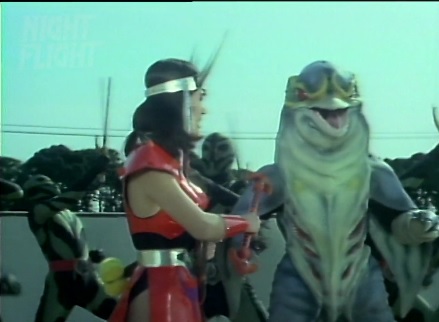
Dynaman (Night Flight Plus)
I watched an episode of this Japanese series on Saturday morning. A bunch of fish monsters were trying to take over the world. Dynaman stopped them. Sometimes, a picture is worth a thousand words so here’s a screenshot:
Farmer Wants A Wife (Wednesday Night, Fox)
The farmers are still not married.
Half Nelson (YouTube)
Hang Time (YouTube)
I have watched and written up reviews for several hours of Hang Time this week. In fact, I’m nearly done with the show. (My reviews of the show will be running through September.) Read this week’s review here!
The Love Boat (Paramount Plus)
I wrote about The Love Boat here!
Survivor (Wednesday Night, CBS)
I recapped this week’s episode for the Reality TV Chat Blog!
Tulsa King (Paramount Plus)
I finally got around to watching the second episode of Tulsa King this week and I’m afraid the show still isn’t working for me. I think it’s because Stallone’s character is a bit too aggressive. Stallone is at his best when he’s playing either a dumb but likable mook (i.e., Rocky) or when he’s fighting for his survival, like in First Blood. But when he’s the one who is actually barking out orders and intimidating innocent people, it’s just not as much fun. Plus, there’s only so many times that any show can go to the “Old people sure are confused by technology” well before the joke starts to run dry. That said, I’ve been told the show get better so I’ll stick with it and see what I think of the third episode.
Waco: The Aftermath (Sunday Night, Showtime)
This miniseries picks up where Showtime’s last Waco miniseries left off. The Branch Davidian compound has been burned down. David Koresh is dead. The main FBI negotiator (Michael Shannon) feels guilty about what happened at the compound but he also fears that the stand-off is going to embolden the militia movement. (And he’s right!) Meanwhile, the surviving Davidians are being railroaded in court and treated as scapegoats for the failures of both Koresh and the government. Things got off to a strong start on Sunday. I look forward to seeing where this show ends up going.
Yellowjackets (Sunday Night, Showtime)
This week’s episode was intriguing. I loved the scene where Shauna confessed to Callie. I’m still worried about Walter and Misty though. I can just see Walter getting on Misty’s nerves and getting poisoned as a result. I’ll also say that, as much as I enjoy this show, I’m starting to get a bit tired of the whole Taissa thing. The show need to either explain what’s going on with all that or just move on.
Welcome to Retro Television Reviews, a feature where we review some of our favorite and least favorite shows of the past! On Saturdays, I will be reviewing California Dreams, which ran on NBC from 1992 to 1996. The entire show is currently streaming on YouTube!

This week, Jake’s Dad gets a job and Sam wins an election!
Episode 5.4 “Mop n’ Pop”
(Dir by Patrick Maloney, originally aired on September 28th, 1996)
With graduation approaching and everyone feeling restless, the senior class of PCHS have all gotten caught up in the newest game, Ba-Boominator! Basically, it’s a game of elimination, where everyone carries a phallic-looking Ba-Boom gun and they shoot silly string at one another. The goal is to be the last one untouched by the milky, white string that spurts out of the end of the gun.
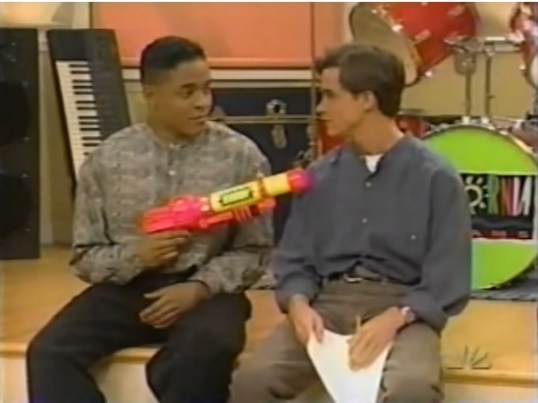
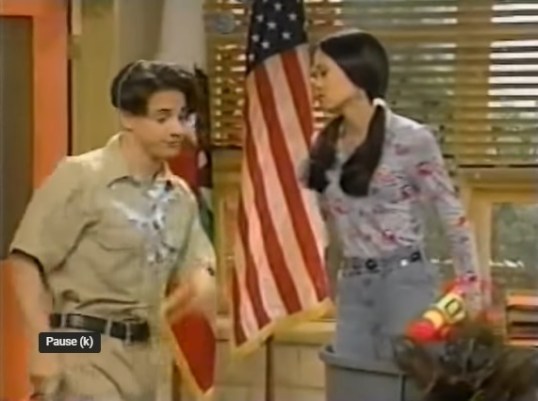
Needless to say, it’s a rather messy game. Fortunately, the school has a new janitor who is very understanding and doesn’t have any problem cleaning up after the students. Unfortunately, that janitor also happens to be Jake’s Dad. Jake’s Dad was an airplane mechanic but, after getting laid off from his job, he had to take whatever he could find and he ended up as a janitor. Jake is not particularly happy about it.
His friends are supportive about it, except for Sly who makes one too many janitor jokes and ends up getting punched in the face by Jake. Sly ends up with a black eyes and Jack’s Dad ends up quitting his job because he realizes how much it embarrasses Jake. At first, Jake is happy but after Sly yells at Jake and tells him that he should be happy just to have a father who cares about him (which is something Sly does not have), Jake realizes that he’s been a jerk.
This episode was a bit of a change-of-pace, if just because it featured Jake learning a lesson as opposed to teaching one. It was also another strong fifth season episode, highlighting just how much the cast had grown as actors over the course of the show.
Finally, the Ba-Boominator competition is won by Sam and Tony, who both decide that their love is more important than winning any game. Awwwwww!
Episode 5.5 “Diss Honored”
(Dir by Patrick Maloney, originally aired on October 5th, 1996)
Samantha has been elected President of the Honors Society! Everyone’s totally excited, even though Sly says that it’s a stupid office that nobody really cares about. In this case, I tend to agree with Sly but, apparently, it really is a big deal in the world of California Dreams. Suddenly, Sam has a lot of extra responsibilities and she can’t spend as much time with Tony. Tony fears that he’s going to lose her! To be honest, if their relationship can’t survive Sam holding a ceremonial post for a few months, maybe there are bigger issues at play.
Tony decides that he has to do get into the Honors Society so he cheats on his midterm. Unfortunately, Sam’s rival and the former president of the Society, Harvey, figures out what Tony did and publicly challenges him to some sort of weird Honors Society duel. At first, Tony lies but then he comes clean and all of his friends act like a bunch of jerks and shun him.
(Because, seriously, no one in the entire history of the world has ever cheated on a high school midterm, right?)
The main highlight of this episode was Tony being haunted by two spirits, an evil spirit that looked like Sly and a good spirit that looked like Tiff. It was a bit silly but William James Jones, Michael Cade, and Kelly Packard really threw themselves into their roles. In particular, this episode probably features Jones’s best work on California Dreams.
And feat not! Tony comes clean to Sam and everything works out in the end.
Next week: Jake appears on a reality show and we finally meet Sly’s father!
Welcome to Retro Television Reviews, a new feature where we review some of our favorite and least favorite shows of the past! On Fridays, I will be reviewing Half Nelson, which ran on NBC from March to May of 1985. Almost all nine of the show’s episodes can be found on YouTube!

This week, Rocky gets involved with a case that’s all about obsession!
Episode 1.6 “Nose Job”
(Directed by Arthur Allan Seidelman, originally aired on April 19th, 1985)
Way back in March, when I watched the pilot for Half Nelson, one thing that I immediately noticed was the chemistry between Joe Pesci and Victoria Jackson. In the pilot, it was pretty clear that Annie O’Hara (played by Jackson) had a crush on Rocky (played, of course, by Pesci) and it was actually kind of cute. The streetwise Rocky and the spacey Annie seemed like they could be an interesting couple and I was actually looking forward to seeing how that storyline developed.
Unfortunately, it didn’t develop. In the episodes immediately following the pilot, both Annie and Rocky’s boss, Chester (Fred Williamson), were sidelined so that the show could focus on Rocky interacting with Beau (Dick Butkus) and Kurt (Bubba Smith). Annie was relegated to staying at the office and answering the phone while Rocky flirted with each week’s guest star. That was definitely a missed opportunity. While Smith and Butkus both provided adequate comedy relief, it’s still hard not to feel that the show often focused so much on them that performers like Dean Martin, Fred Williamson, and Victoria Jackson were pushed to the side.
In this week’s episode, Detective Hamill (Gary Grubbs) asks Annie to go on a date with him and Rocky encourages her to accept, so I guess the potential Rocky/Annie romance is officially dead. At first, Annie doesn’t want to date Hamill because she thinks he’s “a jerk.” (Gary Grubbs, who is one of those actors that most people will immediately recognize even if they don’t know his name, has such an amiable presence that it’s hard to understand where Annie got that idea from.) However, in return for Hamill helping him out with this week’s case, Rocky convinces Annie to give Hamill a shot. Annie and Hamill are a couple by the end of the episode. Yay! Who doesn’t love a romantic ending?
As for this episode itself, it opens with Rocky, Beau, and Kurt providing security on the set of a film. The film appears to be about a revolution in Latin America. April Gray (Mary-Margaret Humes) is playing the lead role, a revolutionary who wears a red beret. (Seriously, it looks like a great film.) When April is nearly run over by an out-of-control truck, Rocky becomes convinced that someone is stalking her. When he discovers that the truck’s accelerator was rigged with surgical string, he decides that a plastic surgeon, Dr. Jonathan Gaines (Jon Cypher), is trying to kill her.
However, before he can accuse Dr. Gaines, he has to find out if April has actually had plastic surgery. As opposed to just asking her, Rocky takes her out on a date. (Beau and Kurt come along as well, so that they can check out the other actresses in the cast and see if any of them had plastic surgery as well.) The only way that Rocky can convince her to go out with him is to take her to an exclusive club. But how can Rocky get reservations!? Fear not, it’s Dean Martin to the rescue! It turns out that Dean is co-owner of the club so he puts down his martini glass for a few minutes and makes a phone call. It’s kind of nice that Dean actually got to be involved in the case this week. Dean’s appearances on this show never last for more than a minute or two and it’s obvious that he wasn’t in the best shape when he filmed them but still, it’s fun to watch him and Pesci act opposite of each other. Pesci always seem to be in awe of Dean.
Before the date, Rocky has to teach Beau and Kurt how to discreetly look for surgery scars. This leads to him showing them how to peak behind someone ears while dancing with them. With the help of Annie, he shows how pretending to lose a contact lens can provide a chance to get on the floor check out someone’s legs for scars. (Unfortunately, the scene is rather awkwardly blocked and framed and, in a few shots, it appears as if Rocky is basically looking straight up Annie’s skirt.) Beau and Kurt are impressed. Chester is less impressed, especially when he catches Rocky crawling around Annie’s legs. Chester yells at Rocky and then goes in his office. And that concludes Fred Williamson’s role in this episode.
During the date, Rocky spots the surgical scars behind April’s ears, indicating that she’s had plastic surgery. It turns out that April not only got a nose job from Dr. Gaines but she also briefly dated him. Rocky realizes that Gaines is now trying to kill her but, as always, everyone tells Rocky that he doesn’t have enough evidence to prove anything. Let’s see. Gaines was on the set when the truck went out of control. The truck’s accelerator was tied down with surgical string. Gaines was the only person on the set with a job that would give him easy access to surgical string. It’s hard not to feel that everyone’s being too quick to dismiss Rocky’s suspicions here.
In fact, Dr. Gaines is so obviously guilty that it’s also pretty obvious that there has to be someone else involved as well. About halfway through the episode, we learn that the film’s director (played by Timothy Bottoms) also used to date April! In fact, he’s the one who paid for her nose job!
Half Nelson really has not turned out to be the lost classic that I was hoping it would be. The pilot was strong but the episodes after that have struggled to really establish a consistent identity for the show. Watching this show, one gets the feeling that the show’s producers couldn’t decide if they wanted to do a comedy or a drama. As I already mentioned, the focus on the antics of Dick Butkus and Bubba Smith pretty much left the rest of the talented cast with little to do. It’s easy to see why Half Nelson did not last longer than two months.
That said, this was actually a pretty good episode. Yes, there were plenty of detective show clichés but both Jon Cypher and Timothy Bottoms were convincing as the show’s two villains and Joe Pesci’s New York persona provided a nice contrast to the sleek phoniness of Hollywood and Beverly Hills. There was even an exciting car chase, which was entertaining even if it was ultimately a bit superfluous to the plot. Plus, the episode featured Rocky throwing a bomb more seconds before it exploded. This is what the explosion looked like:
 Seriously, did Rocky just nuke L.A.!?
This was an entertainingly melodramatic episode. You could see hints of the show that Half Nelson could have been if only it could have maintained a consistent tone.
Next week, Rocky meets Marjoe Gortner!
Enjoy!
Welcome to Retro Television Reviews, a feature where we review some of our favorite and least favorite shows of the past! On Thursdays, I will be reviewing City Guys, which ran on NBC from 1997 to 2001. The entire show is currently streaming on YouTube!

Let’s check in with the neat guys.
Episode 4.16 “Jamal X”
(Dir by Frank Bonner, Originally aired on November 11th, 2000)
In this episode, we learn that Jamal has an uncle who is a fairly prominent academic and activist. This seems like something that would have come up in the past but this is the first time that he’s ever been seen or even mentioned on City Guys. When Ms. Noble invites him to give a guest lecture at Manny High, he stops by the diner to visit with his favorite nephew and to meet Jamal’s “best friend, Chris.” After initially assuming that L-Train is Chris, Jamal’s uncle is shocked to discover that Jamal’s best friend is a rich white kid.
After listening to his uncle speak on systemic racism and realizing how little his three white friends understand about what it’s like to have to deal with racism on an everyday basis, Jamal goes militant. He wears his hair in an afro. He refers to Ms. Noble as being “my Nubian queen.” And he tries to start a school club only for black students. After Ms. Noble tells him that she won’t allow a blacks-only club at the school, Jamal instead holds his meeting at the New York Diner. When Chris attempts to attend the meeting, Chris explains that he’s only there because he wants to understand what the black students are having to deal with. Despite this, Chris is kicked out by the other club members. A guilt-stricken Jamal realizes that he’s been going about things the wrong way. He apologizes to Chris and they become friends again.
This seems to be the episode of City Guys that everyone remembers from when it first aired and it’s not badly done. Wesley Jonathan, in particular, gives a good performance as Jamal. Though the episode ends with Jamal reaffirming his friendship with Chris, it also doesn’t deny the everyday realities of racism. (An early scene in the episode features a cop spotting L-Train’s new watch and baselessly accusing him of having stolen it.) If nothing else, this episode is a bit more honest about prejudice than Saved By The Bell’s infamous Running Zack episode. That said, I get the feeling that, if this episode aired today, it would be criticized for taking an All Lives Matter approach to the issue. In the end, this episode is most noteworthy as a reminder that the issues of today are many of the same issues of the 90s and all the decades before.
Episode 4.17 “Subway Confessions”
(Dir by Frank Bonner, Originally aired on November 18th, 2000)
Chris, Jamal, Al, L-Train, Cassidy, and Dawn are preparing to enter the school when they hear that Funkyfest tickets are going on sale. Convinced that they’ll be able to get the tickets and get back to school in time for Ms. Noble’s class, they leave school grounds and head for the subway. When they return 3 hours later, Ms. Noble is so angry that she sentences them to three weeks of detention. Ms. Noble also confiscates the Funkyfest tickets, which is another way of saying that Ms. Noble steals them. Seriously, just because the tickets were bought while skipping school, that doesn’t change the fact that those tickets were not Noble’s to take.
Everyone has a different story about what happened on the train to make them late. Dawn and Cassidy claim that they were giving a homeless woman a makeover. L-Train and Al claim that they were fighting Russian spies. Chris and Jamal claim that a woman in clown makeup went into labor and they had to deliver the baby. Ms. Noble doesn’t believe a word of it, even after the homeless woman shows up, introduces herself as an undercover cop, and reveals that a clown really did go into labor. (That said, she also reveals that Chis and Jamal did not deliver the baby.) Everyone still has detention for skipping school because Ms. Noble is a harsh taskmaster.
This was a funny episode, though it’s hard not to notice that it’s also an episode that’s totally dependent on every character being an idiot. Still, I’m not ashamed to admit that Al and L-Train fighting the spies made me laugh. I’ve learned not to expect too much from City Guys and, with that in mind, this episode delivered.
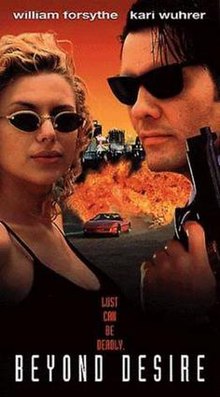
1995’s Beyond Desire tells the story of Ray Patterson (William Forsythe). He’s spent the last 14 years in jail, convicted of a murder that he says he didn’t commit. He likes to sing. He’s obsessed with Elvis. He claims that he doesn’t know how to drive because he’s been in prison for the last 14 years but he appears to be in his mid-40s so you have to kind of wonder if maybe Ray just wants other people to drive him around. After all, Elvis never drove himself.
Perhaps because everyone is sick of listening to him as he sings Amazing Grace in his cell, Ray is released from prison. Since he was serving his time in Nevada, this means that Ray now has to walk down a desert road and hope that someone gives him a ride. Fortunately, for Ray, a woman named Rita (Kari Wuhrer) pulls up in fancy red car and asks him where he’s going. Rita explains that she’s always had a fantasy about picking up someone who has just been released from prison. Ray accepts her offer of a ride and soon, they’re at a desert motel, engaging in saxophone-scored, Vaseline-on-the-lens softcore sex. Ray may have forgotten how to drive but apparently, he didn’t forget everything during those 14 years he spent in prison. If nothing else, this film reveals more of William Forsythe than most viewers probably ever thought they’d see.
Soon, Ray and Rita are head to Vegas. Of course, it turns out that Rita wasn’t quite honest about why she picked up Ray. Rita is a high-priced escort and she works for a local crime boss named Frank (Leo Rossi). Frank wants Ray to reveal the location of some stolen money. Ray, meanwhile, feels that Frank is the key to clearing his name and catching the real murderer. At first, it seems like everyone is just manipulating everyone else but Rita and Frank do eventually end up falling in love. Can their love survive bullets and hints of betrayal?
Like many 90s crime films, Beyond Desire is one of those films that was obviously made to capitalize on the success of Quentin Tarantino. The characters of Ray and Rita are such obvious copies of True Romance‘s Clarence and Alabama that the film comes close to turning into a self-parody. Ray is a big Elvis fan and occasionally quotes lyrics at inopportune times. The soundtrack itself is full of Elvis songs, though the budget apparently wasn’t big enough to actually get the rights to any of Elvis’s recordings. Instead, we get cover versions, the majority of which feel rather wan. The film emphasizes the garish glitz of the Vegas Strip but none of the quirky beauty of it. Las Vegas, an adult playground sitting in the desert, is pure Americana. That was something that was captured by Francis Ford Coppola in The Godfather, Martin Scorsese in Casino and David Lynch in Twin Peaks: The Return. The film uses Vegas as a convenient backdrop but it has nothing to say about the location itself.
Like the majority of road movies, the film tends to meander a bit. Ultimately, the road leads to nowhere. That, in itself, is not necessarily a problem. The same could be said of Tony Scott’s True Romance or any number of films directed by Wim Wenders. Unfortunately, this film wasn’t directed by Tony Scott or Wim Wenders. Instead, it was directed by the guy who did Halloween 5 and the end result is a film that, even when taken as a purely stylistic exercise, still feels rather empty. It’s a shame because William Forsythe shows off a lot of quirky, bad boy charm in the role of Ray and Kari Wuhrer make Rita into a far more complex and conflicted character than one might expect. But, unfortunately, the film itself just doesn’t live up to their performances.
Today’s music video of the day is this wonderfully atmospheric and somewhat ominous video from Cannons! My personal theory is that this video takes place in Purgatory.
Enjoy!

