If the Bowman sisters formed a band….
(Seriously, they rock!)
Enjoy!
If the Bowman sisters formed a band….
(Seriously, they rock!)
Enjoy!
Welcome to Late Night Retro Television Reviews, a feature where we review some of our favorite and least favorite shows of the past! On Thursdays, I will be reviewing Highway to Heaven, which aired on NBC from 1984 to 1989. The entire show is currently streaming on Tubi and several other services!
This week …. oh, where to begin?
Episode 4.23 “Heaven Nose, Mr. Smith”
(Dir by Michael Landon, originally aired on March 30th, 1988)
This episode was bad.
How bad?
Let me count the ways.
This just wasn’t a good episode. The story just feels unfinished.
Next week, season 4 comes to a close!
Welcome to Retro Television Reviews, a feature where we review some of our favorite and least favorite shows of the past! On Thursdays, I will be reviewing Decoy, which aired in Syndication in 1957 and 1958. The show can be viewed on Tubi!
Episode 1.13 “My Brother’s Killer”
(Dir by Stuart Rosenberg, originally aired on January 6th, 1958)
Anne (Barbara Barrie) goes to the police because her boyfriend, Victor Bernard (Bernard Kates), has been acting strangely and refuses to let her into his apartment. At first, the police point out that there’s nothing they can do about this but then Casey, in what can only be described as a miraculous feat of deductive reasoning, guesses that Victor Bernard’s last name might have originally been Bernardino and he might be the brother of wanted robber, Frank Bernardino.
A look at a picture of Victor reveals that he does look a lot like Frank. However, as Casey discovers when she goes over to Victor’s apartment, Frank is dead. But his partner, Hal Bishop (Sy Travers), is still alive. Hal promptly takes Casey and Victor hostage and heads for the Canadian border.
Once you accept that Casey’s miracle hunch (and, seriously, it takes some effort), this is an intense episode. I’m not really a fan of shows in which people are held hostage — the confined narrative tends to get tedious pretty quickly — but this episode featured a typically good performance from Beverly Garland and an absolutely terrifying one from Sy Travers. It also features what seems like a surprising amount of violence for a 1950s television show. Imagine gathering the family in front of the television in 1958 and being immediately confronted by Sy Travers as Hal Bishop pointing a gun at an innocent man’s head and pulling the trigger. A lot of people get shot over the course of this episode, including Hal Bishop himself. Casey survives but there are no smiles or celebrations. There’s just the weary look of someone who has been confronted with the worst that humanity has to offer.
First, I want to say Happy Thanksgiving to all of you who read this review! I’m so thankful for The Shattered Lens and the opportunity to share my love of movies, TV and pop culture with all of you! Now on with the show…
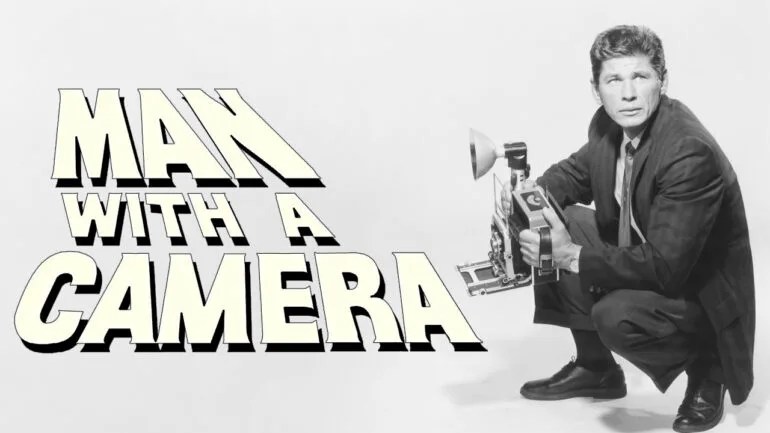
Originally airing on December 5th, 1958, “Blind Spot” opens with free-lance photographer, Mike Kovac (Charles Bronson), receiving a phone call from his best friend Terry Ross (Norman Alden), who is in Lisbon, Portugal. A very nervous Terry tells Kovac that he will be airmailing him some very important negatives for something “dynamite” that he’s working on. While they’re on the phone, an imposing man with a wide-brimmed, boater hat steps into Terry’s room and shoots him dead. Hearing the shots, Kovac is on the next plane to Lisbon to talk to the police and try to find out what happened. Apparently this is big news as the Lisbon paper even reports that Kovac is on his way. The killer, who we soon learn is named Al Alviella (Mario Alcalde), is waiting on Kovac in front of the police station and through a variety of events, is able to convince him that he was Terry’s friend and can help him in his investigation. It seems the police believe that Terry was working for an underworld espionage organization and that he got killed for it. Kovac doesn’t believe there’s any possibility that his old wartime photographer buddy could be involved in anything dirty. But with the killer Al’s false stories and leads, as well as Kovac’s discovery of Terry’s wife Renee (Chana Eden), when he didn’t even know Terry was married, Kovac begins to question how well he really knew his old friend. When the truth finally all comes to light, will Kovac be able to get out of Lisbon alive?!
After the disappointing melodrama of the previous episode, MAN WITH A CAMERA gets back on track with “Blind Spot.” First, we get a somewhat intriguing crime storyline in this episode. While we know from the beginning that Kovac’s friend was murdered and who the killer is, the story still has a few surprises up its sleeve. The final reveal and fight scenes are very well handled, with Bronson continuing to prove that no one can throw a punch quite like him. Second, the episode has an appealing theme of “friendship forged by fire,” in this case by serving together in World War II. With the circumstantial evidence mounting, Kovac begins to doubt his old friend, and it’s here that the new wife steps in and says “Terry said you were his friend… his best friend!” Kovac knows in his heart that his friend just couldn’t have done these things, no matter how bad it looks, and he keeps pushing to find out the truth. I want to have friends like that!
Finally, “Blind Spot” contains some solid performances and an interesting guest appearance. Bronson himself is quite emotional and demonstrative in this episode. He yells at the police when they tell him they believe his old buddy is dirty. He yells at the shadowy underworld “man” who tells him that his buddy was on his payroll, and then proceeds to start punching henchmen until they get the upper hand on him. And I’ve already mentioned the coolness of the final fight scenes where he clearly does his own stunts! I also found Mario Alcalde to be charismatic as the killer Al Alviella. There’s something about him, maybe it was his voice, that kind of reminds me of Andy Garcia, an actor I really like. Alcalde appeared on most of the good TV shows of the late 50’s and 60’s, but unfortunately died at the young age of 44 in 1971. One last thing about the casting that I found interesting involves character actor Frank DeKova, who has one scene here as a shadowy, Lisbon underworld figure credited only as “The Man.” DeKova would play one scene as a shadowy underworld figure known only as “The Man” 14 years later in Bronson’s action classic THE MECHANIC!
“Blind Spot” isn’t a perfect episode, as it does have a fairly slow build up after its entertaining opening scene. However, the excitement of the ending scenes, the more interesting storyline, and the good performances from its main players are more than enough to get a recommendation from me.
Welcome to Late Night Retro Television Reviews, a feature where we review some of our favorite and least favorite shows of the past! On Wednesdays, I will be reviewing 1st and Ten, which aired in syndication from 1984 to 1991. The entire series is streaming on Tubi.
Yay! Training camp is over!
Episode 2.6 “The Unkindest Cut”
(Dir by Bruce Seth Green, originally aired on September 29th, 1986)
When arrogant quarterback Johnny Valentine refuses to enter drug rehab, Diana reacts by having him traded to Buffalo. Johnny may be a superstar but he won’t be playing for the Bulls. That means that Yinessa, the player who nearly kicked off the team twice, is now the starting quarterback. Yinessa also makes up with his girlfriend (Katherine Kelly Lang) so I guess he’s having a good week.
Bubba has to lose five pounds to retain his starting position. When he goes in to be weighed, it appears that he’s only lost four pounds. Bubba quickly takes off his gold watch and he makes weight! Good for Bubba, I guess.
Finally, Rick Lampert (Marcus Allen) shows up at training camp is given a number 32 jersey by T.D. Parker (O.J. Simpson). Lampert’s like, This is your number. Parker replies that the number now belongs to Lampert. Awwww! In the role of T.D. Parker, O.J. Simpson has a way of slashing his way to the heart of the matter,
Training camp finally ended with this episode and I’m glad about that because those training camp episodes were getting really dull. I have to be honest, though. We’re halfway through the second season and I still don’t feel like I know any of these characters. Donald Gibb occasionally makes me laugh as Dr. Death. And, as T.D. Parker, OJ Simpson seems like a really nice guy. Otherwise, though, this show feels oddly hollow. Of course, that may be because I’m watching the syndicated version, which apparently edited out a lot of nudity and bad behavior on the part of the players.
Oh well. Let’s see how the team does! This episode ends with Diana saying she wants to win a championship. Does Yinessa have it in him to lead the team with victory? With OJ Simpson as his coach, he better!

BREAKING IN (1989) opens with veteran safecracker Ernie Mullins (Burt Reynolds) pulling a job at a rich guy’s house, only to be surprised when a young, amateurish thief named Mike (Casey Siemaszko) turns up at the same place to raid the fridge. Immediately taking a liking to the kid, Ernie decides to offer Mike a chance to learn his trade. Thus begins a partnership, and odd-couple friendship, where the two men pull a series of jobs together, with Ernie passing on his knowledge to his young protege who seems to be enjoying the sudden influx of cash into this life. Unfortunately, the generation gap causes some problems as Mike doesn’t necessarily take heed to Ernie’s advice to never being too greedy or flashy. Soon, Mike is renting high rise apartments and buying fancy cars with cash. When they pull a big job on the 4th of July, will Mike’s less than frugal ways drag them both down?!
Written by the excellent, independent writer and director John Sayles (MATEWAN, EIGHT MEN OUT) and directed by Scottish director Bill Forsyth (LOCAL HERO), BREAKING IN is a reminder of just how great Burt Reynolds is in the right role. In his 50’s at the time this was filmed, Reynolds gives a relaxed, lived-in, character performance that comes across as effortlessly cool, and he does it without having to rely on his trademark charm and big grin. The late 80’s were a time when Burt was no longer a box office superstar, and BREAKING IN seems to be an unjustly forgotten entry in his hugely successful career. After this, Burt would find TV success on EVENING SHADE, and he’d be nominated for an Oscar for his role in BOOGIE NIGHTS (1997), but his Ernie Mullins stands out to me as one of his last great film roles. Casey Siemaszko is good as Mike, but this is Reynolds’ show and he’s overshadowed even in a solid performance. As far as the other supporting performances, Sheila Kelley stood out to me as a sharp-tongued prostitute who Siemaszko falls in lust with. The poem she shares about a man’s “balls” is a highlight of the film as far as I’m concerned, and further illustrates the quality of Sayles’ screenplay!
I like the way that BREAKING IN feels low-key, even as the characters engage in their various criminal heists. This can be credited to director Bill Forsyth who turns what could have been a standard master / apprentice crime film into something that feels somewhat realistic. The pacing is slow as Reynolds passes on his knowledge, and for some people it may be too slow, but that’s one of the things I really liked about the movie. The two men really get to know each other. That way, when they have disagreements and blow ups a couple of times, they’re still able to respect each other and patch things up. That’s how things are in the real world, as opposed to most movies where a simple disagreement will almost certainly lead to ridiculous consequences. BREAKING IN respects its characters in a way that’s unique to most crime films.
At the end of the day, BREAKING IN is a gem that is at its best as a lighthearted character study of a professional thief whose time is passing him by. Burt Reynolds rarely got to play roles this subtle, and I think he made the most of the opportunity. As a big fan of Reynolds, I highly recommend this one.
Welcome to Retro Television Reviews, a feature where we review some of our favorite and least favorite shows of the past! On Wednesdays, I will be reviewing the original Love Boat, which aired on ABC from 1977 to 1986! The series can be streamed on Paramount Plus!
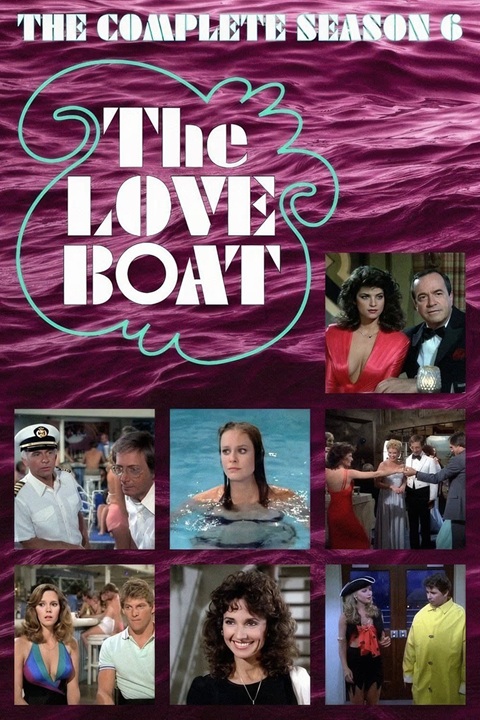
This week, the Love Boat goes a little bit country.
Episodes 6.27 and 6.28 “Country Music Jamboree”
(Dir by Richard Kinon, originally aired on April 30th, 1983)
It’s the special, two-hour country music cruise!
I have to admit that I lost interest in this episode as soon as I saw the banner in the Love Boat lobby that read “County Music Jamboree.” Country music’s not my thing. I lost even more interest when Florence Henderson showed up as country singer Annabelle Folker. Florence Henderson was a frequent guest on both Fantasy Island and The Love Boat and I can’t think of a single time that I was ever happy to see her name in the credits. Whenever she appeared, she almost always seemed like she was trying too hard. Her performances always brought to mind dinner theater and holiday special guest spots.
Annabelle was traveling with her boyfriend (Bert Convy) and the three orphans (Michael Evans, Angela Lee Sloan, and Neil Billingsley) that she was planning on adopting. The problem was that her boyfriend didn’t want to adopt the kids. But then, he changed his mind because the show was nearly over and the storyline needed a happy ending. Seriously, the kids were obnoxious as Hell.
While that went on, singer Holly Hartmann (Jessica Walter) was upset to discover that her husband (Mel Tillis) was secretly writing songs for an up-and-coming singer named C.G. Thomas (Tanya Tucker). Holly was not happy when she found out but then she sang Stand By Your Man and that solved everything.
The Love Boat chef (Pat Buttram) was upset that his kitchen implements kept disappearing. That’s because Isaac, Doc, Gopher, and Julie were stealing them so that they could form a country-western band. Meanwhile, two fat people (Kenny Price and Lulu Roman) boarded the boat and never stopped eating.
(Don’t give me that look, I didn’t write the script.)
Effie Skaggs (Minnie Pearl) sold homemade elixirs from her cabin while Doc attempted to romance her granddaughter (Misty Rowe). When Effie got sick, she refused to accept any of Doc’s strange modern medicine. No antibiotics for Effie Skaggs!
Jeannie Davis (Beth Howland) feared that her husband (Steve Kanaly) would learn that her latest piece of jewelry was given to her by a man with whom she had an affair. A jewelry appraiser (Sherman Hemsley) insisted on finding out how much the jewelry was worth. Jeannie feared that her husband would suspect something was amiss when he discovered how expensive it really was. She begged the appraiser to lie about how much it was worth. The appraiser said that he could not risk damaging his reputation but then he decided to lie anyway.
Gopher and Isaac tried to get a picture with Dottie West (a singer who played herself) but Dottie just wanted to rest.
Is that it? Is that all of the storylines or is that just all my exhausted mind can remember? Seriously, this was a busy two-hour episode. It was an annoying episode too. Maybe I’d feel differently if I was into country music. Of the guest stars, Mel Tillis and Jessica Walter gave the best performances. Of the Love Boat crew, no one came out of this episode with their dignity intact.
This was a cruise to miss.

This cruise? This cruise was a perfect 10 out of 10 on the How Coked Up Was Julie Scale.
Today’s song of the day comes from the American Anthem soundtrack.
Steve Tevere has thrown a tripus!
This is for the Molokai cops.
Enjoy!
Welcome to Late Night Retro Television Reviews, a feature where we review some of our favorite and least favorite shows of the past! On Tuesdays, I will be reviewing Pacific Blue, a cop show that aired from 1996 to 2000 on the USA Network! It’s currently streaming everywhere, though I’m watching it on Tubi.
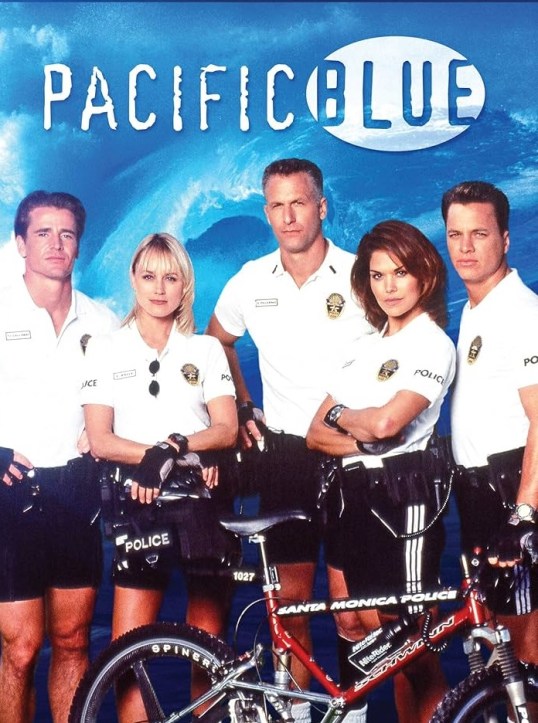
It’s a Chris epiosde. *Yawn*
Episode 3.7 “Repeat Offenders”
(Dir by Charles Siebert, originally aired on September 28th, 1997)
When this show first started, Chris Kelly was introduced as being a hotshot Navy pilot who was forced into reserve status due to her eyesight. In this episode, it’s revealed that she actually left active duty because she was involved in an accident that was the fault of her commanding officer. Rather than testify against him and run the risk of being crucified on the stand and then run out of the Navy, she instead took the blame.
Five years later, she discovers that another Navy pilot, Rebecca Santori (Liza Snyder), is facing the same dilemma. Her commanding officer — who was also Chris’s commanding officer — screwed up and Santori is being pressured to take the blame. Chris encourages Santori to fight for her right to fly. Cory suggests that Chris is pressuring Snantori because Chris feels guilty about giving up when she was in the same position. Cory suggests that Chris is putting Santori’s career at risk just to deal with her own anger and resentment. Chris says that’s not true and the show seems to expect us to take her word for it. Fortunately, things do work for Santori. She is cleared in the accident and Chris is vindicated when its determined that their commanding officer has a long history of incompetence.
This storyline had potential but Chris is just such a one-note character that it’s hard to get excited about anything involving her. Every week, it seems like Chris finds something new to get upset about and every week, anyone who suggests that Chris isn’t being totally honest about her motivations has to deal with the Chris Kelly glare of death. In order to remain sympathetic while glaring at people and telling them that they’re idiots, you have to have some shred of charisma. Chris does not and whenever she’s at the center of an episode, even when she’s in the right as with this one, I just find myself thinking about how much I would dread to have to work with her on a daily basis.
As for the other storyline, thieves are targeting foreign tourists on the boardwalk. Palermo and TC put on Hawaiian shirts and pretend to be foreign tourists. The thieves get arrested. Yay. How exciting. Bike patrol does it again.
 Through the Shattered Lens