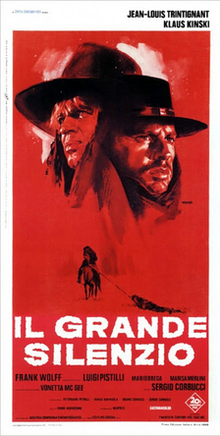
Today’s song of the day comes the soundtrack of Sergio Corbucci’s brilliant and dark western, The Great Silence. This was composed by Ennio Morricone.
Silenzio.
Today’s song of the day comes the soundtrack of Sergio Corbucci’s brilliant and dark western, The Great Silence. This was composed by Ennio Morricone.
Silenzio.
Since yesterday’s music video of the day came to us from Katharine McPhee, it only seems appropriate that today’s music video of the day should feature Taylor Hicks.
Remember the Soul Patrol?
Enjoy!
Welcome to Late Night Retro Television Reviews, a feature where we review some of our favorite and least favorite shows of the past! On Fridays, I will be reviewing Freddy’s Nightmares, a horror anthology show which ran in syndication from 1988 to 1990. The entire series can be found on Tubi!
This week’s episode is actually decent.
Episode 1.18 “The Art of Death”
(Dir by Ken Wiederhorn, originally aired on March 12th, 1989)
Jack (Carey Scott) is a talented artist and college student who has a crush on Joan (Laura Schaefer). When Joan’s jock boyfriend humiliates Jack, Jack suddenly finds himself approached by The Phantom (Judd Omen), a masked figure who claims that he can kill Jack’s enemies if Jack draws a picture of him doing it. After the jock is killed in a treadmill accident, Joan sees the picture that Jack drew and decides she doesn’t want anything to do with Jack. The Phantom suggests drawing a picture of him surprising Joan in the shower. Jack refuses, just to discover that the picture has already been drawn and the Phantom is now holding Joan prisoner in a boiler room. Jack draws a picture of the Phantom being sucked down a hole. The Phantom vanishes but …. oh no, now Jack’s wearing the mask! Jack was the Phantom all along!
As for the second story, Joan struggles to recover from the trauma. In typical Freddy’s Nightmares fashion, she has a series of hallucinations that lead to her killing her psychiatrist.
This episode actually worked! The first story was genuinely creepy. The second story was predictable but it featured a good performance from Laura Schaefer and the action moved at a decent pace. I’m going to give the majority of the credit to director Ken Wiederhorn, who previously directed one of my favorite zombie films, 1977’s Shock Waves.
This is my final Freddy’s Nightmares review for 2025. Retro Television Review is taking a break for the holidays, so I can focus on Awards Season and Christmas movies! Freddy’s Nightmares will return on January 9th.
Welcome to Retro Television Reviews, a feature where we review some of our favorite and least favorite shows of the past! On Fridays, I will be reviewing St. Elsewhere, a medical show which ran on NBC from 1982 to 1988. The show can be found on Daily Motion.
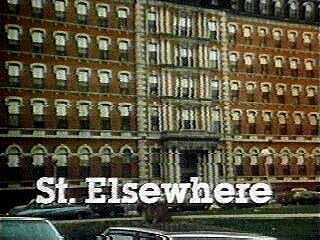
This week, the nurses go on strike. Fire all of them!, I say.
Episode 3.3 “Two Balls and a Strike”
(Dir by David Anspaugh, originally aired on October 3rd, 1984)
It’s another depressing few days at St. Eligius.
When negotiations break down, all of the nurses — except for Shirley Daniels — go on strike. Led by Nurse Rosenthal, they march out of the hospital and join a picket line in the rain. Triumphant music plays on the soundtrack Rosenthal gets on her bullhorn and announces that anyone making deliveries to the hospital will be crossing the picket line and not showing solidarity with the union. Honestly, though? Screw the union. It’s a hospital! It needs supplies. There are people dying inside of that building and they’re not even going to have the dignity of clean linen because of Nurse Rosenthal and her stupid union. And another thing …. Rosenthal is the head of union at St. Eligius. So, why isn’t she marching in the rain and carrying a sign? Why does she get to stand in the doorway and shout at people? Get out there and suffer for your union, you British commie!
Obviously, the show wanted me to be inspired by Rosenthal and the union. Whenever it switched over to the picket line, triumphant music started playing. I’m with Nurse Daniels on this one, though. Daniels didn’t vote the union so why should she have to suffer in the rain? She stays on the job. “Good luck,” Rosenthal tells her, “you’ll need it.” And all I can say to that is that at least Shirley Daniels isn’t deserting the hospital’s patients.
While the nurses are on strike, Dr. Canavero is attacked by a hulking man wearing a ski mask. Canavero is able to fight him off. Westphall and everyone else at the hospital immediately assumes that the man was Peter White but Peter has an alibi. He was in radiology when Canavero was attacked. So, is there a new ski mask rapist haunting the hospital? The first ski mask rapist storyline was pretty disturbing, especially since Peter got away with it. I’m not sure I want to go through a second one.
Dr. Craig and Ellen went to couples therapy. As usual, Dr. Craig got annoyed with the whole thing. There’s really nothing more fun than watching Dr. Craig get annoyed. No one gets annoyed better than William Daniels. Still, it seemed to do Dr. Craig and Ellen some good, with Ellen making plans to go to Hawaii and Dr. Craig acknowledging that he’s not always the easiest person to deal with.
As for Dr. Westphall …. he spent most of this episode depressed. Westphall is always depressed.
This is my final St. Elsewhere review for 2025. Retro Television Review is taking a break for the holidays, so I can focus on Awards Season and Christmas movies! St. Elsewhere will return on January 9th.
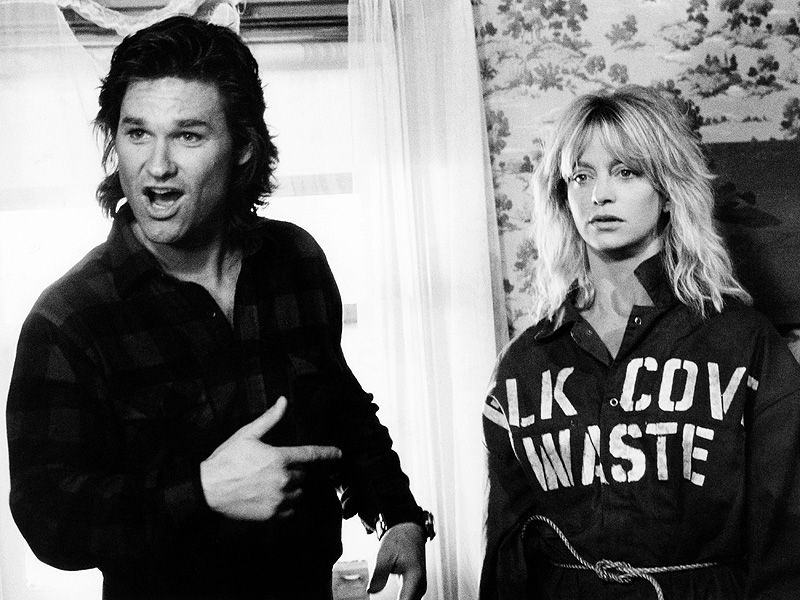
Spoiled heiress Joanna Stayton (Goldie Hawn) hires carpenter Dean Proffitt (Kurt Russell) to remodel a closet on her yacht. Unsatisfied with his work and completely unreasonable about everything, she refuses to pay him and when he presses her for the $600, she pushes him and all of his tools overboard. Needless to say, the lady’s a “bitch” (Dean’s word) and nobody can stand her, including her husband, Grant Stayton III (Edward Herrman), and their butler Andrew (Roddy McDowell). And then something interesting happens a few days later… Joanna accidentally falls off her yacht, and when she’s fished out of the ocean, she’s still difficult to deal with, but she doesn’t have a clue who she is. Unable to identity her, the hospital puts the “amnesia lady” on the news hoping someone will recognize her. Sensing a chance to get rid of the anchor around his neck, Grant Stayton III pretends he doesn’t know her and heads out of town. This is where Dean hatches up his own plot to get revenge. He heads to the hospital and through a series of happenstances and coincidences, he’s able to convince everyone, including Joanna, now dubbed as “Annie,” that she’s his wife. He takes her home with him and makes her take care of his four wild boys, cook their food, and clean his house. Dean figures she owes it to him. But wouldn’t you know it, even though “Annie” hates it at first, over time she begins to soften towards her new life, bonds with the boys, and some sparks of love start flying between her and Dean. When she unexpectedly gets her memory back, she has to decide whether to return to her life as a spoiled heiress or stay with the man and boys she’s grown to love.
I have a soft spot in my heart for OVERBOARD, because this is a movie that my mom and I both loved, and we watched it together many times in the late 80’s and early 90’s. My mom and I didn’t often have the same taste in movies, so this was kind of “our movie.” There are a couple of other notable favorites for both me and mom, and those movies are RUTHLESS PEOPLE (1986) and LETHAL WEAPON (1987). I guarantee if I called my mom right now, interrupted her Hallmark Christmas movies, and told her I was coming over with OVERBOARD, she’d say “Come on! I’ll get something together for you to eat!” That actually sounds like a pretty good idea!
Another reason I love OVERBOARD is the fact that it stars Kurt Russell. I became a big fan of Kurt Russell during my teenage years, as I was 14 when this movie came out. A couple of years earlier, Russell starred in the films THE BEST OF TIMES (1986) and BIG TROUBLE IN LITTLE CHINA (1986), and a couple of years later he would make movies like TEQUILA SUNRISE (1988), TANGO & CASH (1989), and BACKDRAFT (1991). I wanted to watch every movie that Russell was in, and all of these films are staples of my VHS years and nostalgic favorites. In OVERBOARD, Russell starts off as a gruff, grudge-holder, but as he begins to fall for “Annie,” his natural charm and likability emerge, but so does a newfound guilt for lying to her and possibly even kidnapping her. One question for the lawyers out there, is it kidnapping when her husband had a chance to claim her and chose to abandon her instead? I’m not sure if it’s a felony or not, but I’m guessing there has to be something on the law books that doesn’t jive with what happens here. Anyway, I’ll just say that it’s best not to think of these types of pesky realities when judging this fairy tale and just go along for the ride.
Along with the Russell’s fun performance, Goldie Hawn is so perfect as the horrifically spoiled snob of an heiress who transforms into a caring substitute mother and the woman of Dean’s dreams. I know she’s great in the movie, because I can’t stand her at the beginning, but I find myself falling for her too as the movie progresses. I would not really call myself a fan of Goldie Hawn, because I haven’t spent much of my life revisiting her films, but I love her here. A couple in real life, the natural chemistry between Russell and Hawn sparkles as they fall in love on screen and only the most cold-hearted cynic isn’t pulling for them to live happily ever after as the movie closes in on its ending. As far as the supporting cast, Edward Herrmann, Katherine Helmond, Mike Hagerty, and Roddy McDowall all have good moments sprinkled throughout the film.
I do have one complaint about OVERBOARD, and that’s the “Wonders of the World Miniature Golf Course,” which is the dream business of Dean and his best friend Bad Billy Pratt (Mike Hagerty). As someone who grew up in the 70’s and 80’s playing miniature golf on the courses in Branson, MO, I would never want to play their course. Its design appears over-the-top and cheesy to me, the type of course where the scores on the holes would be determined as much by luck as by skill, which is something I find offensive. However, just like the potential kidnapping storyline, I’ve had to let my disdain for the quality of the course design go as well so I could enjoy that section of the film. I will admit this one is harder for me personally, and I still struggle with it.
Overall, OVERBOARD is not high art, and its premise is about as silly as it gets, but through a magical combination of personal 1980’s nostalgia, an appreciation for the chemistry of its stars, and a complete willingness to suspend my disbelief as we head towards an irresistibly happy ending, I still love this film. I watch it just about every year, especially if I need a pick me up as I hammer away at tax returns!

Oh no! Christmas is approaching but Santa Claus is trapped on a beach in Florida! A bunch of kids try to help him move his sled but the children are useless! Maybe Santa’s friend, the Ice Cream Bunny, can help. While Santa waits for the Bunny to show up, he tells the kids a story.
It’s a bit difficult to explain the plot of 1972’s Santa and the Ice Cream Bunny. It’s even more difficult to explain why I can’t help but love this odd movie. The Ice Cream Bunny driving to the rescue is one of my favorite holiday images. Don’t ask me why he’s the Ice Cream Bunny. Don’t ask me why Santa needs the help of a giant rabbit. Don’t ask me why Santa’s on a beach in Florida in the first place.
Just enjoy this holiday oddity!
For today’s song of the day, Tony Bennett wishes all of you a swinging Christmas.
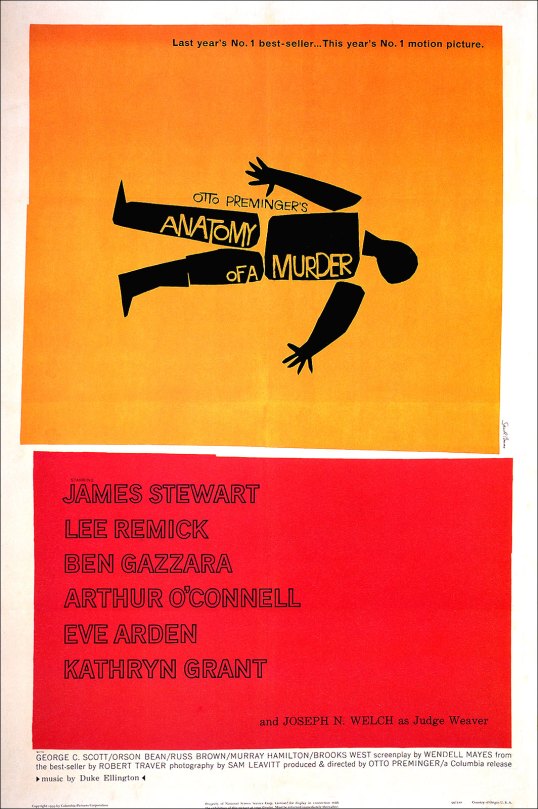
Since today is Otto Preminger’s birthday, I figured that this would be a good time to share a scene that I love from one of my favorite movies, Preminger’s 1959 film, Anatomy of a Murder.
In this scene, prosecutor Claude Dancer (played, in one of his first screen roles, by George C. Scott) cross-examined Laura Manion (Lee Remick), the wife of a man who has been accused of murder. Playing the role of the defense attorney is James Stewart. This scene is a master-class in great acting. Preminger could be a bit of an inconsistent director but his willingness to take on controversial subjects set him apart from many of his contemporaries. When he had the right material, as he did here, he could create the perfect mix of melodrama and art. Preminger’s best films, like Anatomy of a Murder, stand the test of time.
I’m still disappointed that there was never a remake of From Justin to Kelly starring Taylor Hicks and Katharine McPhee. Imagine the duet they could have done with this tune. Well, even without Taylor, this is a lovely rendition of a classic holiday song.
Enjoy!
Welcome to Late Night Retro Television Reviews, a feature where we review some of our favorite and least favorite shows of the past! On Thursdays, I will be reviewing Highway to Heaven, which aired on NBC from 1984 to 1989. The entire show is currently streaming on Tubi and several other services!
Today, season 4 comes to a close with an episode about two football teams, one struggling and one not. Care to guess which team is going to win the big game?
Episode 4.24 “The Whole Nine Yards”
(Dir by Michael Landon, originally aired on April 27th, 1988)
Charlie DuBoise (Dinah Lacey) is a twelve year-old girl who wants to play football. Vince Diller (Beau Starr) is the chauvinistic coach who refuses to allow Charlie to join his team, despite the fact that she can catch and she’s even faster then his son, quarterback Ricky Diller (Chad Allen). Instead, Charlie joins another team, the 0-5 Minnows. Who is the new coach of the Minnows? Mark Gordon, of course!
Ricky has a hard time accepting that a girl beat him in a race and, when Charlie approaches him in a totally 80s arcade, a fight breaks out. Luckily, Jonathan is there to break it up. Ricky apologizes to Charlie while Charlie has a gigantic wad of Kleenex stuck up her nose. The scene goes on for a while and Charlie never removes the Kleenex. It was awkward to watch. Seriously, that’s what nampons are for.
Eventually, Ricky gets sick of Vince and his win-at-all-costs mentality. Ricky talks back to his father and gets kicked off the team. Ricky joins the Minnows and he and Charlie defeat Vince’s team in the big game. Vince comes to realize that the game should be about fun and Ricky and Charlie go to the school dance together.
And so ends season 4 of Highway to Heaven. Shows about girls who want to play football are always weird to me because I’m a girl and I can’t ever think of circumstances in which I would want to play football. But I do think that if Charlie wants to get a head start on getting the concussions that will ruin her adult life, she should certainly be allowed to do so. The main problem with this episode was that Vince was such an ogre and such a terrible father that the show’s happy ending felt false. His son joined another team and destroyed Vince’s undefeated record. The episode ends with Vince saying he’s proud of his son but Vince has been such a monster that his words sound hollow. I’m kind of worried about what’s going to happen when Ricky goes home. Instead of putting together a football game, Jonathan and Mark should have been calling Child Protective Services.
This is my final episode of Highway to Heaven for 2025. Retro Television Reviews will be taking a break for the holidays but this feature will return! On January 8th, 2026, we’ll start our look at the final season of Highway to Heaven.
 Through the Shattered Lens