Welcome to Late Night Retro Television Reviews, a new feature where we review some of our favorite and least favorite shows of the past! On Fridays, I will be reviewing Friday the 13th: The Series, a show which ran in syndication from 1987 to 1990. The show can be found on YouTube!
This week, Micki and Ryan search for a cursed World Series ring.
Episode 2.17 “The Mephisto Ring”
(Dir by Bruce Pittman, originally aired on April 10th, 1989)
In 1982, a gambler is shot and killed by an unknown assailant.
Seven years later, that gambler’s son, Donald Wren (Denis Forest), has developed a problem of his own. Despite his mother (Doris Petrie) begging him not to follow in his father’s footsteps, Donald has become a compulsive gambler. Unfortunately, Donald is not particularly talented at picking winners and, as a result, he’s deep in debt with the mob. Donald has dangerous men after him who want to know where their money is. However, when Donald discovers his father’s ring, things start to change for him.
The ring is a 1919 World Series ring and, as you probably already guessed, it’s cursed. All Donald has to do is put the ring on someone else’s finger and, after the ring kills that person, Donald will receive a vision of how a sporting event is going to end. Donald discovers who is going to win a basketball game, a horserace, and a UFC match. As Donald continues to use the ring, he starts to lose his mind. Friday the 13th has always felt like a show that’s actually about drug addiction, with the cursed objects not only killing people but also corrupting the minds of the people who own them. Donald goes from being a wimp to being someone who laughs maniacally while watching gangsters violently die.
With Jack away, it falls to Micki and Ryan to retrieve the ring. Donald’s mother wants him to give up the ring because she saw what it did to his father. But Donald refuses to surrender the ring, even when his use of it eventually leads to evil gangster Anthony Macklin (James Purcell) abducting his mother. Donald is able to convince Macklin to wear the ring. Macklin is promptly killed but, when Donald still refuses to give up the ring, his mother ends up shooting Donald in the head. As she explains to Micki and Ryan, she had to do the same thing to Donald’s father. After putting the ring in the vault, Micki and Ryan agree to keep the mother’s history of murder a secret.
This was an okay episode. The most interesting thing about it was that Micki and Ryan, even while they were searching for the ring, were pretty much bystanders to the drama involving Donald, his mother, and the gangsters. Other than a scene where Micki pretended to be flirt with Donald in order to get him to leave a bar with her, neither Micki and Ryan really did much in this episode. Denis Forest, making his second appearance on Friday the 13th, gave a good performance as Donald and even managed to generate some sympathy for the character. The gangsters felt like they were left over from an episode of T and T. As I said, it was an okay episode but not one that made a huge impression.
Welcome to Retro Television Reviews, a new feature where we review some of our favorite and least favorite shows of the past! On Fridays, I will be reviewing St. Elsewhere, a medical show which ran on NBC from 1982 to 1988. The show can be found on Hulu!
When I started reviewing Homicide, Jeff suggested that I should also review St. Elsewhere because the two shows shared a similar sensibility and a lot of behind-the-scenes personnel. (Homicide showrunner Tom Fontana started out as a writer on St. Elsewhere.) Apparently. a few characters from St. Elsewhere would eventually cross-over to Homicide. Since I’m planning on soon reviewing two shows that were descended from Homicide — Oz and The Wire — it only seemed right to also review a show that was Homicide’s ancestor.
Though the show aired largely before my time, St. Elsewhere is definitely a show that I have heard about. Everyone who follows American pop culture has either read about or seen the show’s infamous final episode and knows about the Tommy Westphall Universe Hypothesis. Obviously, I can’t get into it now because that would be a spoiler but we’ll discuss it when the time comes!
For now, let’s start at the beginning, with the pilot!
Episode 1.1 “Pilot”
(Dir by Thomas Carter, originally aired on October 26th, 1982)
St. Eligius is a hospital in Boston that has obviously seen better days. From the outside, it looks old. On the inside, the hallways have the dim and dull look of a building that hasn’t been renovated in over ten years. As Dr. Mark Craig (William Daniels, long before he played Mr. Feeney on Boy Meets World) angrily puts it, the hospital gets no respect in Boston. It’s seen as being a “dumping ground” for patients who can’t afford anything better. Dr. Craig is world-renowned heart surgeon whose wealthy patients have donated what few improvements the hospital has seen over the past few years. (“All of our clocks now read the same time!” Dr. Craig brags at one point.) But not even Dr. Craig can change the hospital’s reputation as being secondary to Boston General.
There are actually a few good things about St. Eligius. For one thing, a young Denzel Washington is on staff, playing resident Phillip Chandler. Denzel doesn’t get to do much in the pilot but still, his presence fills the viewer with confidence. St. Eligius is also home to a world-renowned liver specialist, Dr. Daniel Auschlander (played by Norman Lloyd, who also worked with Hitchcock and Orson Welles). Auschlander has liver cancer but the hospital chief-of-staff, Dr. Donald Westphall (Ed Flanders), assures everyone that Auschlander will probably “out live us all.” (And he was right, to an extent. Norman Lloyd lived to be 106 years old before passing away in 2021. Ed Flanders died, tragically by suicide, in 1995.) St. Eligius is a teaching hospital and the residents want to make a good impression by keeping their patients alive. That’s always a good thing.
At the same time, how secure can you feel when Howie Mandel is one of the residents? Mandel plays Dr. Wayne Fiscus, who wears a baseball cap and acts …. well, he acts a lot like Howie Mandel. Like Washington, Mandel doesn’t do a lot in the pilot. He does get a subplot where he apparently has sex in the morgue with goth pathologist Cathy Martin (Barbara Whinnery) but otherwise, we don’t see him treating a patient or anything like that. Still, it’s a bit jarring to see Howie Mandel as a doctor. I would not necessarily want him for my doctor because he’s to be easily distracted. Maybe he’ll change my mind as the series progresses.
Speaking of sex, Dr. Ben Samuels (David Birney) has gonorrhea and spends most of the pilot approaching doctors and nurses and informing them of his conditions and suggesting that they might want to get tested themselves. That’s not exactly the best way to be introduced to a character but it also lets us know that this show is not just going to be about dedicated doctors who spend all of their time worrying about their patients and making amazing medical discoveries. Instead, this show is also about doctors who get venereal diseases. Has anyone checked on Fiscus in the morgue?
(That said, Dr. Samuels does get a scene where he saves the life of a woman who was injured in a terrorist bombing, as if the show does want to make sure that we know that he can do his job, even if he is spreading VD through the hospital.)
The majority of the episode follows Dr. Jack Morrison (David Morse), a first-year resident who has been working several 24-hour shifts and who complains, at one point, that he hasn’t seen his wife for days. Dr. Morrison gets upset when a surgeon wants to operate on one of his patients, a 15 year-old girl named Sandy (Heather McAdams). Morrison believes that surgeons always want to cut into somebody. Morrison gets even more upset when Sandy’s mother requests that Sandy be transferred to Boston General, which has a reputation for being a better, more modern hospital. In fact, Morrison is so upset and exhausted that he forgets to file a death certificate for a patient who dies during the night. As a result, it’s believed that the patient, who has a reputation for being violent, has gone missing and is stalking the hospital. Dr. Annie Cavanero (Cynthia Sikes) spends the entire episode looking for a dead man, which at least gives her an excuse to visit every ward and introduce the viewers to the members of the show’s ensemble cast.
Having lost my mom to cancer and now my Dad to Parkinson’s, I was hesitant about reviewing St. Elsewhere. (Actually, I was hesitant about reviewing any medical show.) When my Dad was in the hospital, I felt like I couldn’t get anyone to give me a straight answer about his condition and I often felt the doctors were talking down to me. To be honest, my worst conflicts were with the nurses, one of whom told me that I would have to “lose the attitude” before she would explain why my father had been moved to the Delirium Ward. (It didn’t help that, at the same time my Dad was in the hospital, there was a huge storm that left us without power for a week.) At the same time, there were other doctors who were helpful. The staff at the rehab center that my dad was sent to were also wonderful. I have my regrets about agreeing to hospice care but the nurse who was assigned to my Dad was very empathetic and totally understanding whenever I asked her for a cigarette. (Under normal circumstances, I don’t smoke because I have asthma but seriously, the stress was killing me.) I’m bitter and angry about a lot of what happened but I’m also thankful for the small moments of kindness.
Watching a show set in a hospital was not easy for me but the pilot of St. Elsewhere appealed to me with its mix of melodrama and humor. There was a quirkiness to it that I appreciated. William Daniels made me laugh with his annoyed rant about how little respect the hospital received. Most of all, I cared about whether or not Dr. Morrison would still be alive at the end of his shift. David Morse’s performance won me over. He’s the type of doctor that I would want to have. Well, actually, I’d probably want Denzel to my doctor but Dr, Morrison could assist. Just keep Dr. Howie Mandel away from me. Nothing against him but he seemed to be having way too much fun at the hospital….
Welcome to Late Night Retro Television Reviews, a feature where we review some of our favorite and least favorite shows of the past! On Thursdays, I will be reviewing Highway to Heaven, which aired on NBC from 1984 to 1989. The entire show is currently streaming on Freevee and several other services!
This week, season 2 comes to an end!
Episode 2.24 “Friends”
(Dir by Michael Landon, originally aired on May 7th, 1986)
Jonathan and Mark have a new assignment. They’re going to be working as substitute teachers.
“I don’t want to be a teacher!” Mark says.
It’s actually kind of interesting that Mark is never happy with any of the assignments that he and Jonathan are given. It seems like almost every assignment involves making him do something that he doesn’t want to do and also humiliating him in the process. In this episode, Mark not only has to be a teacher but he ends up teaching Sex Education. We don’t actually see Mark teaching the class. In fact, Mark is actually barely in this episode. But we certainly do hear Mark complaining about having to do it.
This episode finds Jonathan reaching out to two troubled students. Jack Mason (Darren Dalton) is only going to school because he likes playing on the baseball team and he’d like to win the state championship before his senior year ends. Otherwise, Jack doesn’t care about his grades or even graduating. He tells Jonathan that his father dropped out of school and he’s doing just fine. Jack even suggests that he personally might drop out as soon as baseball season ends.
(Jack is apparently a good baseball player but he never mentions any desire to play professionally. That would truly make him unique amongst high school jocks. It would also suggest that Jack is realistic enough to realize how difficult it is to make it as a professional athlete. Jonathan gives Jack a hard time about his attitude but Jack might be smarter than he seems.)
Because Jack is failing Algebra, Jonathan arranges for Jack to have a tutor. Jonathan selects Jenny Bates (Judy Carmen) for the job. Jenny is a lonely girl who is good at Algebra and insecure about being overweight. She desperately just wants to have a friend but hardly anyone at the school is willing to talk to her. Will she be able to help Jack improve his grades? Will Jack finally realize that his father is struggling due to his lack of a high school diploma? Will Jack’s bitchy girlfriend (Alexandra Powers) invite Judy to a party just so she can trick Judy into putting on a bathing suit so that she can be humiliated in front of everyone? Will the episode end with Jack on the way to graduating and Judy finally having made a friend? This is Highway to Heaven so I think you know the answer to all those questions.
“If I can pass Algebra,” Jack tells Judy, ‘you can lose weight!”
Now, that’s definitely not something that you would hear on a network television program today. Not in today’s age of body positivity. That said, let’s be honest. Being overweight is not necessarily healthy and, just as no one should be ridiculed for being on the heavy side, no one should be shamed for trying to lose weight if that’s what they want (or need) to do.
This episode was a bit on the predictable side, but that’s actually one of the things that people tend to like about shows like Highway to Heaven. Judy Carmen gave a poignant performance as Jenny. Darren Dalton played Jack as being a bit of an arrogant knucklehead and that made all of the scenes in which Jonathan yelled at him feel extremely satisfying. (I should note that I recently rewatched the original Red Dawn so I spent this entire episode thinking about how Dalton betrayed The Wolverines to the Russians.) This episode featured Jonathan at his most stern and it was an interesting change-of-pace from the gentle technique that Jonathan usually uses during his missions.
With this episode, the second season ends. It was a good season, overall. The show can be corny and a bit mawkish but it’s all so earnest and sincere that it’s often impossible not to be somewhat moved by it. Next week, we start season three!
Welcome to Retro Television Reviews, a feature where we review some of our favorite and least favorite shows of the past! On Thursdays, I will be reviewing Malibu CA, which aired in Syndication in 1998 and 1999. The entire show is currently streaming on YouTube!
Why do I do this to myself?
Episode 1.17 “The Game Show”
(Dir by Gary Shimokawa, originally aired on February 14th, 1999)
Scott has been promoted! His father has made Scott the new weekend manager of his restaurant, The Lighthouse. Jason is offended, even though Jason regularly comes to work late and is rude to the customers. Strangely enough, though, the other workers at The Lighthouse, the majority of whom have probably been working there longer than both Jason and Scott, are not offended that a major promotion was given to the boss’s inexperienced jerk of a son. Seriously, Scott has only been in Malibu for a few months and he’s gotten in just as much trouble with Jason. Neither one of them deserves a promotion.
Jason and Scott are selected to appear on Blind Date, a dating game show that airs on Malibu’s public access channel. (Not surprisingly, the show is hosted by Tracy.) Jason makes a $300 bet with Scott that he can win the date. Jason’s plan is to cheat by sneaking a look at the audition tape of the girl who will be selecting her date. Scott discovers that Jason is cheating so he cheats by convincing Tracy to invite a different girl on the show. During the show, Jason realizes what Scott has done and calls him out. Tracy disqualifies both of them, which means that Murray wins the date.
I got a headache just writing that paragraph.
Meanwhile, Stads puts on a fat suit so that she can research how people treat the obese. A lifeguard named Darren (Brody Hutzler) asks Stads out while she’s in disguise. Stads is excited to finally have a date but will Darren still want to date her when he finds out that Stads is thin?
Every Peter Engel-produced sitcom did at least one episode where one of the main characters found themselves being forced to either go on a date or work with a fat person. Usually, these episodes ended with the standard message of “It’s what’s inside that counts,” and then the fat character, having served their purpose, would never be seen or mentioned again. The theme of this episode of Malibu, CA seems to be that some people don’t care about physical appearances and seriously, what the Hell’s wrong with those people? Stads learns that not everyone is turned off by a few extra pounds and wow, those people are weird! It’s not a great message for a sitcom aimed at teen girls, to be honest.
As usual, this episode struggles because almost everyone on the show comes across as being a sociopath. Scott is promoted for no good reason and immediately gets an attitude. Jason breaks the fourth wall to brag to the audience about how he’s going to lie, cheat, and steal. Stads may not be a sociopath but she is remarkably shallow in this episode. It’s always strange the way that this show insists that Stads, who is blonde, pretty, and athletic, can somehow never get a date. Maybe it would help if she had a better name. Stads probably sounds a bit too much like Stabs.
Murray and Tracy are, at this point, is the only decent characters on the show, largely because they’re both open and honest about who they are and they’re not ashamed of their quirks. Brandon Brooks and Priscilla Inga Taylor both seemed to have understood that it was pointless to try to give “real” performances on this show and their willingness to full embrace the over-the-top silliness of their characters went a long way towards making them tolerable.
Welcome to Late Night Retro Television Reviews, a feature where we review some of our favorite and least favorite shows of the past! On Wednesdays, I will be reviewing Monsters, which aired in syndication from 1988 to 1991. The entire series is streaming on YouTube.
This week, Monsters takes a turn into le Carré territory.
Episode 2.21 “Refugee”
(Dir by Scott Vickrey, originally aired on Mary 13th, 1990)
Paul (Peter White) is an agent of the CIA. He lives in a run-down apartment, hiding himself from the world and apparently wracked with guilt and regret over some of the things that he did for his country. In the style of many a John le Carré protagonist, he served his country and has been left thoroughly disillusioned as a result. His former superior, Oliver (Philip Abbott), comes to Paul with a proposal. There’s a Russian scientist who is looking to defect. She has apparently spent years trying to escape from Russia. If Paul helps her cross the border and stays with her in a safehouse until the CIA can come and get her, Oliver will never ask Paul to do another thing. Paul’s service as a spy will be terminated.
A reluctant Paul agrees and he is indeed able to get Anna Solenska (Judy Geeson) across the border and into a safehouse. However, Paul realizes that two men have followed them and now want to enter the safehouse themselves. Paul assumes that they work for the KGB but actually, they’re agents of Satan! Apparently, Anna agreed to sell her soul in return for Satan helping her to escape Russia. And now, Satan has sent his people to collect….
Seriously, if you’ve ever wondered what it was like to live under a communist regime, just consider that someone was willing to sell their soul to escape! That’s one reason why I’m proud to be an American and to be a capitalist. No matter what problems we may have in this country, no one is selling their soul to escape. No one is summoning Satan and saying, “Hey, help me get to Cuba!” Capitalism for the win!
As for this episode, I liked the idea behind it. I liked the concept of mixing spy melodrama with supernatural horror. Peter White actually gave a pretty good performance as the burned-out spy and I enjoyed the opening conversation between him and his former superior. But once the episode move to the safehouse, the action started to drag. Monsters is only a 21-minute show so there’s no reason why an episode should have had me checking how much running time was left as often as this one did. British actress Judy Geeson did a good enough job playing Anna’s desperation but her Russian accent was bad enough that it actually distracted from the story. Finally, Satan’s agents were never as scary as servants of the devil should be. This show’s saving grace has usually been its monsters but, in this episode, they were just men with red skin and glowing fingertips.
Sad to say, despite an intriguing premise, this episode was just kind of boring.
Welcome to Late Night Retro Television Reviews, a feature where we review some of our favorite and least favorite shows of the past! On Tuesdays, I will be reviewing Baywatch Nights, a detective show that ran in Syndication from 1995 to 1997. The entire show is currently streaming on YouTube!
Mitch does not want to believe.
Episode 2.17 “The Servant”
(Dir by Georg Fenady, originally aired on April 12th, 1997)
There’s something strange happening at a warehouse that stores ancient artifacts. The wealthy woman (Renee Suran) who owns the warehouse claims that someone wrapped in bandages killed both a security guard and her chauffeur. She goes to Daimont Teague and, of course, Teague takes her to Ryan and Mitch.
“I want you to solve my murder,” the woman says, convinced that she’s destined to be killed by whatever it was that she saw in the warehouse.
The killer was wrapped in bandages and Mitch is stunned to discover that the killer apparently took four bullets without even slowing down. In fact, one of the bullets is found on the ground and it doesn’t have a bit of blood or bodily tissue on it. What could be going on?
Ryan and Teague suggest that the killer could be a mummy.
Mitch gets angry, saying that there’s no way a mummy has come back to life and is killing people and stealing artifacts from the warehouse. Even when Ryan tells him about an ancient curse that may have been activated by the removal of the artifacts from a tomb, Mitch says that he doesn’t believe in mummies. He’s a skeptic!
Okay, I’ve done this before but let’s do it begin. Here are just a few things that have happened to Mitch since the start of season 2.
Mitch has dealt with a huge number of sea monsters.
Mitch has dealt with space spores that caused animals to explode.
Mitch has witnessed Donna get possessed by the spirit of a serial killer.
Mitch has been transported through time and has been chased by an axe-wielding maniac from the turn of the century.
Mitch has battled a werewolf.
Mitch has battled a vampire.
Mitch has discovered that the world is secretly controlled by the Knights Templar.
Mitch has witnessed two 800 year-old Vikings come back to life and immediately resume their blood feud.
And that’s just scratching the surface! After seeing all of that, Mitch somehow cannot bring himself to believe that there is a mummy wandering around a warehouse that appears to only house cursed Egyptian artifacts. Myself, I think just the stuff with the Vikings would have convinced me to believe just about anything.
My personal theory is that, much like the protagonist of a Lovecraft short story, Mitch does believe in the mummy but he’s insisting that he doesn’t because he know that accepting it as reality will lead to him losing his mind.
Fortunately, Ryan is not as skeptical as Mitch and she’s able to discover that the mummy and the missing artifacts are all a part of a plot to open up a mystical portal. Fortunately, she and Mitch are able to thwart the plans of Dr. Kasan (Erick Avari). Seriously, if everyone had listened to Mitch, Malibu would have been invaded by hundreds of mummies.
This episode was dull. The cast was noticeably small, with regulars Griff and Donna noticeably absent from the proceedings, the warehouse and the mummy looked cheap, and the only think creating any atmosphere was an overuse of Dutch angles. Angie Harmon was great as usual but, surprisingly considering that his signature brand is overwhelming earnestness, David Hasselhoff seemed bored with the whole thing. This mummy should have been kept under wraps.
Welcome to Retro Television Reviews, a feature where we review some of our favorite and least favorite shows of the past! On Tuesdays, I will be reviewing the original Fantasy Island, which ran on ABC from 1977 to 1984. Unfortunately, the show has been removed from most streaming sites. Fortunately, I’ve got nearly every episode on my DVR.
This week, Fantasy Island reminds us why we love this show in the first place.
Episode 5.16 “The Challenge/A Genie Named Joe”
(Dir by Cliff Bole, originally aired on February 13th, 1982)
Now, this is a great episode!
Julie doesn’t appear in this episode, beyond the usual stock footage that appears at the start of every season 5 episode. In fact, Julie isn’t even mentioned in this episode. Instead, it’s Roarke and Tattoo all the way. Roarke and Tattoo greet the visitors together. Tattoo is the one who helps Roarke put the fantasies together. Roarke and Tattoo say goodbye to everyone at the end. In a way, this episode felt like a throwback to the first two seasons of Fantasy Island.
The fantasies feel like throwbacks to the first two seasons as well, with both of them featuring interesting guest stars and just enough twists to keep things interesting. We’ve got one comedic fantasy and one dramatic fantasy but the comedic fantasy is not too silly and the dramatic fantasy is not too serious. The episode manages to strike a pretty good balance between the two so, for once, neither fantasy feels rushed or short-changed.
The comedic fantasy features Kim Darby as Rebecca Walters, who wants to find a husband who is courteous and handsome. Tattoo takes her out to the magical Fantasy Island lagoon, where she meets a genie named …. well, he has a really long genie name but fortunately, he’s happy to be called Joe (Larry Linville). Joe can grant Rebecca three wishes. As always happens with genies, Rebecca wastes her first two wishes. For instance, when she says that it’s a little bit too warm for her, Joe grants her wish and temporarily turns Fantasy Island into a winter wonderland, complete with snow and Christmas music playing. (Seriously, the sight of snow on Fantasy Island was surprisingly charming, as was Tattoo’s shocked reaction.) In the end, of course, Rebecca comes to discover that she loves Joe. Joe transforms from a genie-into-a-man and they leave the Island together. It was a charming and cute fantasy. Both Darby and Linville seemed to be having fun with their roles and they had a surprising amount of chemistry together. This was a fun fantasy.
As for the dramatic fantasy, it allowed us to learn a little about the history of the Island. Apparently, centuries ago, the Island belonged to a Spanish sea captain. Ruthless tycoon Douglas Picard (Vic Morrow) came across the deed to the island after he moved into a villa that once belonged to the captain. Picard claims that the Island is legally his. Roarke points out that the deed is several centuries old and that it would take years for the legal system to sort out who owned what. Picard challenges Roarke to three challenges to decide who will own the island, challenges that will test the mind, body, and spirit of the two men. The person to win two of the matches also wins the Island. Roarke agrees.
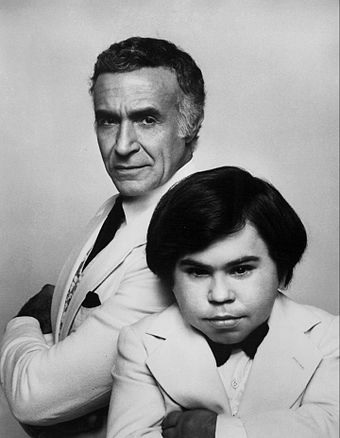
Here’s the thing that I find interesting about all of this. First off, it’s implied that the Spanish sea captain was a part of the Spanish Armada. Why would the Spanish Armada have been in the South Pacific? Even more importantly, though, was the island still capable of granting fantasies when it was owned the Captain? Are the fantasies created by the Island or by Mr. Roarke? The case for the Island being magical can be found in this very episode, in which Tattoo takes Rebecca to a lagoon inhabited by a genie. Throughout the series, there have been many such locations on the Island. But Roarke himself is clearly more than just the charming owner of a resort. Ricardo Montalban once said that he felt Roarke was a fallen angel who was doing penance on the Island. That’s an interesting idea and would certainly explain why Roddy McDowall’s Devil always seemed to want to steal Roarke’s soul. Of course, the Blumhouse film and the recently-canceled reboot both suggested that Fantasy Island has had many different caretakers but I’m not sure that I consider either one of those to be canonical. I kind of like the idea Roarke having lived on the Island for centuries, like Richard on Lost.
Anyway, the three competitions are actually pretty interesting. The first one is a chess match that is won by Roarke. The second one features Roarke and Picard arm-wrestling over a killer spider. Roarke is in on the verge of winning that one but allows Picard to have the victory rather than kill him. The third competition is to do something selfless that improves someone else’s life. (I’m not sure how the winner would be selected but we’ll just go with it.) Picard gives money to a charity that he knows little about. Roarke, however, wins because he made Picard’s sister, Eunice (Jane Powell), happy by choosing not to kill Picard. Picard is so happy to finally see Eunice happy that he decides he doesn’t need to take ownership of Fantasy Island. Everyone leaves the Island a better person than they were when they arrived. Yay!
As I said before, this episode felt like a throwback to the earlier seasons of Fantasy Island. This was a great trip to the Island!


 Through the Shattered Lens