Retro Television Review: The Love Boat 6.16 “Doc’s Big Case/Senior Sinners/A Booming Romance”


Welcome to Retro Television Reviews, a feature where we review some of our favorite and least favorite shows of the past!  On Wednesdays, I will be reviewing the original Love Boat, which aired on ABC from 1977 to 1986!  The series can be streamed on Paramount Plus!
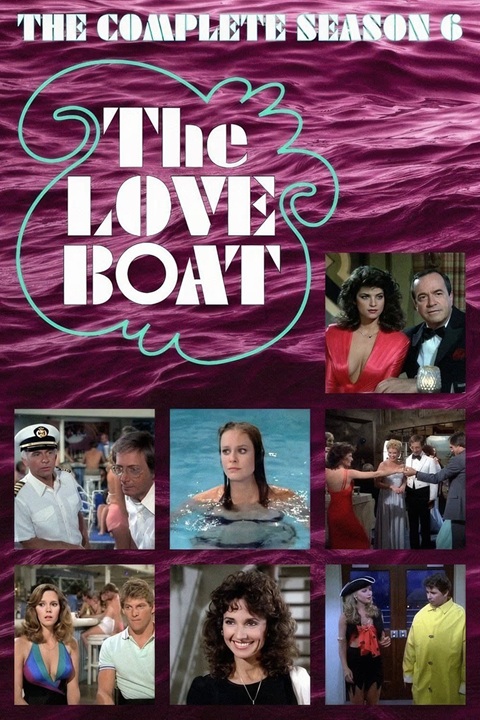
Love won’t hurt anymore….

Episode 6.16 “Doc’s Big Case/Senior Sinners/A Booming Romnace”

(Dir by Bob Sweeney, originally aired on January 22nd, 1983)

As usual, this episode has three stories.  However, this week, only one of the stories really works.

Dr. Elliott Norton (James Noble) attended medical school with Doc.  He is a world-renowned surgeon who has written a best-selling book and, as soon as he boards the boat, ol’ Doc Bricker starts to feel insecure.  It’s easy to see why.  Dr. Norton performs life-saving surgery on a daily basis.  Doc Bricker helps people recover from severe sun tan.  The fact that everyone on board wants Norton’s autograph doesn’t help.  Vicki is supposed to be writing a report on Doc but even Doc is like, “You should probably do it on Elliott.”

However, when a little girl (played by Tori Spelling, in what must have been one of the first roles that Aaron Spelling demanded she be cast in) asks Doc to diagnose what’s wrong with her doll, Bricker quickly figures out that both the doll and the girl are depressed because they’re not spending enough time with their father.  Norton may be getting the groupies but Doc Bricker gets invited to a tea party with the girl, her father, and the doll.

I’m sorry, are you smirking?

Okay, it is pretty silly.  Normally, I would smirk too but you know what?  Bernie Kopell really makes this story work.  In many ways, Doctor Adam Bricker was a bit of silly character, a supposed swinger who always came across as being rather mild-mannered and kind of conservative.  But Bernie Kopell was so likable in the role that it didn’t matter that the character often didn’t make much sense.  In this episode, Kopell does such a good job of playing up the character’s insecurities and regrets that my heart actually broke for the poor guy.  Was the tea party silly?  Yes.  But I still cheered when he was invited.

As for the other two stories, one featured Raymond St. Jacques and Theresa Merritt playing an elderly couple who were living together without being married.  Their children (played Brian Stokes Mitchell and Thelma Hopkins) were scandalized!  It was pretty boring.  The children weren’t particularly likable so I was kind of hoping the parents would just toss them overboard.

The final story …. I don’t even know how to describe it other than to say it was dumb.  Ross (Alan Young) wants to impress Kathy (Holland Taylor) and keep her from running off with Bob (Adam West, who was severely underused).  So, Ross builds a fake bomb, hides it in the engine room, pretends to discover it, and then defuses it while Kathy watches.  I mean, how am I supposed to care about someone who would do something that stupid?  And then, when Ross confesses the truth to her, Kathy laughs it off and forgives him.  I mean, it seems like he’s an obvious sociopath to me.  Run, Kathy, run!

This was an uneven episode but seriously, the story with Doc Bricker got to me.  This show was very lucky to have Bernie Kopell.
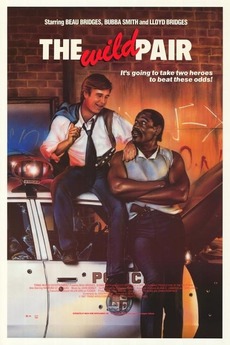
The Wild Pair (1987, directed by Beau Bridges)


A police detective named Benny Avalon (Bubba Smith) and an FBI agent named Joe Jennings (Beau Bridges) are assigned to work together to take down a drug dealer named Ivory Jones (Raymond St. Jacques).  Avalon and Jennings don’t immediately get along.  Avalon is tough and streetwise while Joe is a good example of what used to be called a yuppie.  When they discover that Ivory is connected to a white supremacist gang led by Col. Hester (Lloyd Bridges), Avalon and Jennings have to set aside their differences and work together.

The Wild Pair starts out as a standard buddy cop film until things take a sudden serious turn and it instead becomes a violent and blood-soaked revenge thriller.  It tries to mix comedy and action in the style of Beverly Hills Cop but it doesn’t work.  Beverly Hills Cop understood that you could only take the violence so far without losing the laughs.  The Wild Pair has the bad guys killing several innocent (and likable) people and also murdering Avalon’s cat.  Maybe Walter Hill could have pulled off what this film was going for.  He certainly managed to do so with 48 Hours.  But this film was the directorial debut of Beau Bridges, a good actor who, as a director, was no Walter Hill.  As for Bubba Smith, he was always more of a personality than an actor.  That served him well in the Police Academy films but here he’s actually supposed to be playing someone other than Bubba Smith and his limitations of an actor become especially glaring once the film turns serious.  Lloyd Bridges also seems miscast as the villain but that may just be because I’ve watched Airplane! and Hot Shots too many times.

The pair may be wild but they’re also forgettable.

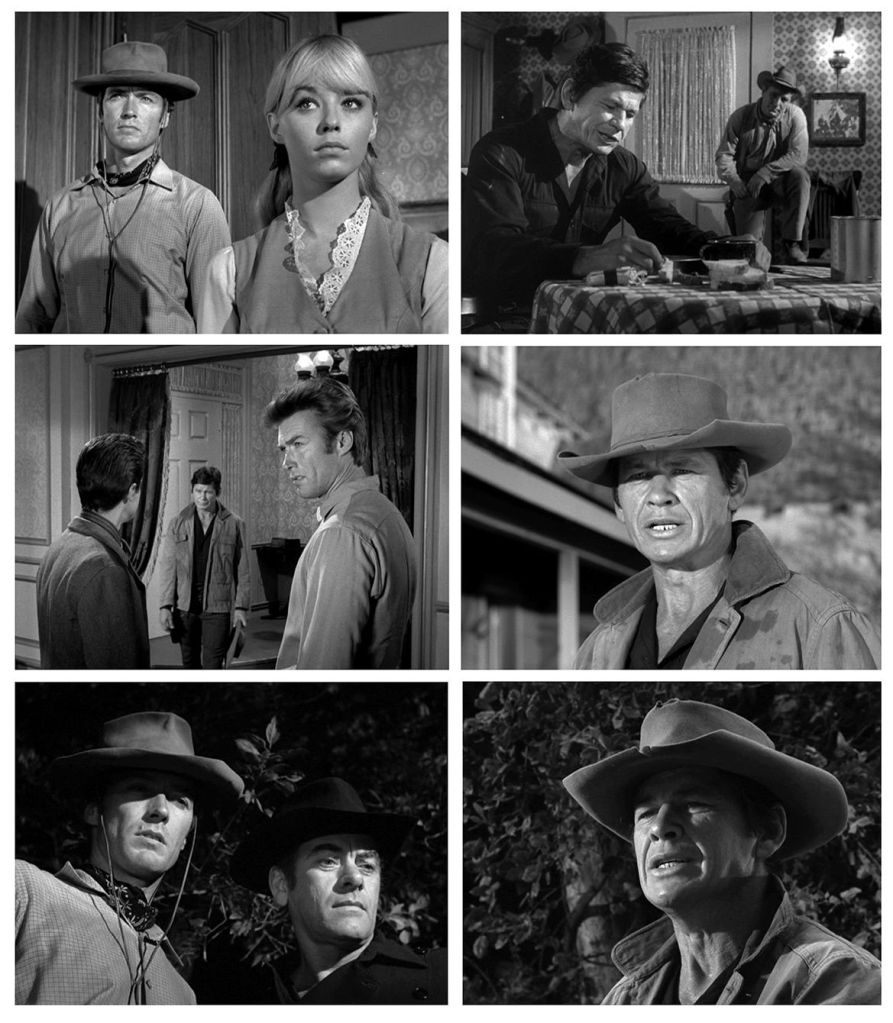
RAWHIDE (TV Series) – starring Clint Eastwood – S8, E10: “Duel at Daybreak” (Guest star – Charles Bronson)


This episode of the classic western TV series RAWHIDE opens as Rowdy Yates (Clint Eastwood) and his group of drovers agree to drive 750 head of cattle belonging to rancher Mason Woodruff (Larry Gates) to market. The deal gets off to a bad start when Roman Bedford (Brendon Boone), who’s part of Yates’ outfit, finds himself trying to romance Vicki Woodruff (Jill Haworth), the daughter of the ranch owner. Woodruff’s foreman and world class A-hole, Del Lingman (Charles Bronson) sees Roman making his move and gets pissed. You see, Del wants Vicki for himself, so he tries to bully Roman into a gunfight. Luckily for young Roman, Rowdy and Mason Woodruff are able to momentarily diffuse the situation before the cowboy can be blown away by the experienced gunman. Unable to accept the humiliation that he suffered at the hands of Del, Roman challenges him to a duel to settle the score. Roman is a good shot, but he’s not a fast draw, so a couple of the men with Yates’ crew, Jed Colby (John Ireland) and Simon Blake (Raymond St. Jacques), try to teach him some tricks that just may give him a chance against Del’s superior gunplay. To complicate matters even further, Mason Woodruff has a hidden criminal past that Roman may know about. Because of this, the rancher has another reason to want Roman dead, and Del Lingman is just the man to take care of the problem. Who will survive the duel at daybreak?!! 

As hard as it is to believe, my viewing of “Duel at Daybreak” is the only episode of RAWHIDE that I’ve ever watched, and it’s special to me for two reasons. First, the episode premiered on my mom’s 14th birthday, November 16, 1965. And second, it’s the only time that tough guy icons Clint Eastwood and Charles Bronson would appear on screen together. For historical reference, this was the last season of RAWHIDE, with only three episodes of the classic series to come after this. Eastwood was at the beginning of his legendary movie career after filming FISTFUL OF DOLLARS (1964) and FOR A FEW DOLLARS MORE (1965) for director Sergio Leone. Bronson, who was already a well-respected character actor, was two years away from making THE DIRTY DOZEN (1967) and three years away from breaking out as an international superstar by playing Harmonica in Leone’s masterpiece, ONCE UPON A TIME IN THE WEST (1968). 

For the episode itself, Charles Bronson is the true standout as Del Lingman. He’s the kind of mean SOB who would goad a man into a gunfight, kill him, and then sit down for dinner without a care in the world. Bronson has a face that makes for a good villain, and he often played the bad guy in his early TV shows and movies. He projects real menace and danger in this role. Clint Eastwood’s Rowdy Yates may be the star of the show and the trail boss, but he’s a bit more of a secondary character in this specific episode as the main tension is between Bronson and the young cowboy played by Brendon Boone. Looking back now, it’s an incredible missed opportunity that the “duel at daybreak” wouldn’t feature Eastwood versus Bronson. Eastwood mostly tries, and fails, to play peacemaker in the episode. The two legends do exchange a potentially badass back and forth when Eastwood is trying to deescalate the situation and keep Bronson from shooting the young cowboy over a little mud on his pants:

Rowdy Yates: “Putting a high price on a pair of pants, ain’t you?”

Del Lingman: “Perhaps you’d like to pay for them.”

Rowdy Yates: “Any time, mister.”

It’s a good scene, but it’s just a shame that they didn’t get a chance to mix it up at the end. 

As Charles Bronson’s biggest fan, I enjoyed seeing a couple of actors who worked with him in the 80’s. John Ireland, who plays Jed Colby in this episode, co-starred with Bronson in MESSENGER OF DEATH (1988) as Morman patriarch Zenus Beechum. It’s not one of Bronson’s best, but one of the highlights of the film is its strong cast. Ireland has roles in so many great films, including MY DARLING CLEMENTINE (1946), RED RIVER (1948), GUNFIGHT AT THE O.K. CORRAL (1957) and FAREWELL MY LOVELY (1975). He would appear in 11 episodes of RAWHIDE. Raymond St. Jacques, who plays Simon Baker in this episode, has a very memorable role in Bronson’s disturbing hitman thriller THE EVIL THAT MEN DO (1984). In a unique twist in the Bronson filmography, Jacques’ bodyguard character Randolph gets duped into thinking he’s about to get some three-way action with Bronson and Theresa Saldana only to end up dead with a knife sticking out of his throat. It’s a memorable meet and kill. I noticed he played a character named “Coffin” Ed Johnson in COTTON COMES TO HARLEM (1970). With a name like that, he’s got to be good! He would appear in 13 episodes of RAWHIDE. 

Overall, “Duel at Daybreak” is a special episode of RAWHIDE since it put Eastwood and Bronson on screen together for the only time in their careers. I wish they could have fought with fists or guns, but it wasn’t meant to be. Beggars can’t be choosers, and at this point, I’ll gladly take what we got.

Retro Television Review: Fantasy Island 6.1 “Curse of the Moreaus/My Man Friday”


Welcome to Retro Television Reviews, a feature where we review some of our favorite and least favorite shows of the past!  On Tuesdays, I will be reviewing the original Fantasy Island, which ran on ABC from 1977 to 1984.  Unfortunately, the show has been removed from most streaming sites.  Fortunately, I’ve got nearly every episode on my DVR.

Welcome to the sixth season of Fantasy Island!

Episode 6.1 “Curse of the Moreaus/My Man Friday”

(Dir by Bob Sweeney, originally aired on October 16th, 1982)

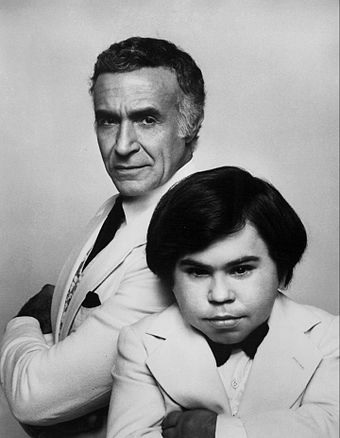
A new season has begun and the fifth season’s Julie experiment is officially over.  Mr. Roarke is back and Tattoo is once again his only assistant.  Julie is not only missing but she’s not even mentioned in this episode.  Personally, I think Julie went to college on the mainland or maybe she married Gopher from the Love Boat.  Either way, Julie is gone and Fantasy Island is back to normal.

This week’s fantasies both felt familiar.  It was another haunted house fantasy and another “secretary-becomes-the-boss fantasy.”  After spending nearly ten years as a secretary at an ad agency, Linda Whitney (Pamela Hensley) has watched as her stupid boss, Ed Turner (Avery Schrieber) has taken credit for all of her ideas and as everyone has gotten promoted but her.  Linda wants to be an executive and fortunately, Mr. Roarke knows the president of her company.  Linda has received a promotion to the executive suite.  She has 48 hours to prove herself or she’ll be “demoted” back to secretary.

(Demoted is in scare quotes because, right out of college, I worked as an administrative assistant and let me just say that a good assistant is the most important person in any office.)

What’s odd about this fantasy is that Mr. Roarke arranges for Linda’s office to be transported to Fantasy Island.  But all of Linda’s co-workers are transported to the Island as well.  In fact, the entire building seems to now be on Fantasy Island.  I mean, at this point, we all know that Mr. Roarke can pretty much do anything but even this seems a bit extreme for a fantasy that is clearly established as not being something that’s just happening in Linda’s head.  Mr. Roarke is somehow transporting office buildings now.  Were Linda’s co-workers given any warning before being transported to the Island?

It’s not easy being an executive.  Her old boss wants her to fail.  All of her former secretarial colleagues want her to fail.  Can Linda get land the big account?  Sure, she can.  Luckily, she has a male secretary named Jack Friday (James Houghton) to help out!  By the end of the episode, Linda has come to realize that she treated the handsome Jack almost as poorly and objectified Jack almost as much Ed Turner did to her.  Then again, Jack does introduce himself by saying that he likes working for women because they have “better legs.”  All that said, I liked the fantasy.  I liked that Linda kept her promotion.  I liked that she worked with Jack without falling in love with him.  I like that she left the Island on her own, satisfied with her new career.

As for the other fantasy, Jack Moreau (Stuart Whitman) is haunted by nightmares in which he kills his wife, Kathy (Barbara Rush).  Agck!  It turns out that Moreau men are cursed.  They murder their wives on their 50th birthday.  Jack failed to mention this to Kathy when they got married.  That’s probably grounds for divorce.  Anyway, Mr. Roarke sends them to spend Jack’s birthday weekend in the Moreau plantation, where they are watched by a mysterious servant (Raymond St. Jacques) who seems to be all about driving Jack to murder his wife.  Fortunately, Jack does not murder his wife.  Kathy tells Jack that she loves him and the curse is broken.  Hey, that was easy!  That said, I enjoyed this fantasy.  The Fantasy Island haunted house stories always have a lot of atmosphere to them.  They’re fun to watch.

This was a good start of the season.  It was nice to see Tattoo and Roarke joking again.  Tattoo points out that a good boss needs good people working for him and Tattoo’s absolutely right.

Retro Television Review: Fantasy Island 4.21 “Basin Street/The Devil’s Triangle”


Welcome to Retro Television Reviews, a feature where we review some of our favorite and least favorite shows of the past!  On Tuesdays, I will be reviewing the original Fantasy Island, which ran on ABC from 1977 to 1984.  Almost the entire show is currently streaming on Daily Motion.

This week is a bit uneven.  Let’s dive into it!

Episode 4.21 “Basin Street/The Devil’s Triangle”

(Dir by George W. Brooks, originally aired on May 2nd, 1981)

Pilot Clay Garrett (Joe Namath — yes, the goofy football player) and cameraman Tom Spencer (Christopher Connelly) have come to Fantasy Island with Kerry Dawson (Trish Stewart).  Kerry is the host of a show where she explores isolated locations of the world.  Clay flies her where she’s going.  Tom films her.  Throughout the episode, it is suggested that — much like the characters at the center of Cannibal Holocaust — they’ve occasionally been guilty of staging the footage that has made them famous.

Kerry wants to search for the remains of an airplane that disappeared over 40 years ago.  The plane was flown by the famed aviatrix Wilma Deitrich.  Why they don’t just admit that Wilma is a stand-in for Amelia Earhart, I have no idea.  Mr. Roarke warns Kerry that the fantasy could be dangerous but he does not stop Clay, Tom, and Kerry from boarding a plane and then flying out across the ocean.

The plane ends up in the Devil’s Triangle, which I guess is this show’s version of the Bermuda Triangle.  The plane crashes on an uncharted island.  Kerry gets bitten by a snake and Clay sucks out the poison before he and Tom set off to look for the remains of Wilma’s plane.  Clay and Tom, incidentally, are both in love with Wilma.  Will Wilma select the boring cameraman or the boring pilot who sucked snake venom out of her body?

It’s a question that would perhaps be more compelling if Kerry had the slightest bit of chemistry with either man.  But she doesn’t.  Joe Namath is as stiff here as he was in C.C. and Company.  Christopher Connelly looks bored.  Kerry does eventually pick Clay so hopefully, they’ll be happy together.

(And yes, they do get off the island.  They find the wreckage of Wilma’s plane and use it to repair their own plane.  Amazingly, Wilma’s plan is still full of operational parts despite having spent over 40 years sitting on a deserted island.)

As for the other fantasy, Charlie Raines (Cleavon Little) wants to go to turn of the century New Orleans and meet his hero, jazzman Camptown Dodd (Raymond St. Jacques).  Roarke and Tattoo give him a magic clarinet and send him to New Orleans, where he immediately finds himself auditioning for Camptown.  Camptown wants Charlie to not only join his band but also lead it after his death.

DEATH!?

Yes, death.  Camptown refuses to sell Opium in his club and, as a result, he has been targeted for assassination by a corrupt police officer.  Charlie is so upset about this that Roarke himself steps into the fantasy to let Charlie know that he can’t change the past.

Okay, so Charlie can’t save Camptown but surely, he can bring Billie Joe (Berlinda Tolbert) into the present with him, right?  Afterall, Charlie has fallen in love with her.  No, Roarke says, that’s not how it works.

Fear not, though!  Once he’s in the present, Charlie discovers that Billie Joe was actually a guest at the Island and that Roarke combined two fantasies into one.  Yay!

The jazz fantasy was predictable but it was still better than the other fantasy.  Cleavon Little, Raymond St. Jacques, and Berlinda Tolbert all actually seemed to be invested in their characters, which made them a lot more fun to watch than the stiffs on the deserted island.

This week’s trip to the Island was a bit uneven.  The jazz fantasy was occasionally entertaining.  The other fantasy was forgettable.  I don’t hold that against, Mr. Roarke.  That’s just the way it goes sometimes.

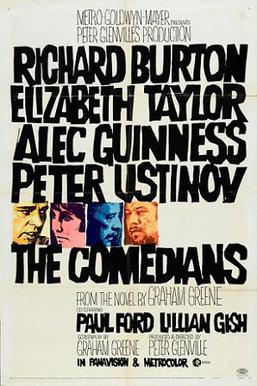
Cleaning Out The DVR: The Comedians (dir by Peter Glenville)


Not to be mistaken for the Taylor Hackford-directed, Robert De Niro-starring disaster from a few years back, The Comedians is a film from 1967 that follows several different people as they attempt to survive day-to-day life in Haiti, back when Haiti was ruled by the dictator, Papa Doc Duvalier.

Richard Burton stars Mr. Brown (Richard Burton), a deeply cynical and world-weary Englishman who owns what passes for a luxury hotel in Haiti.  Though Mr. Brown hopes to be able to sell the hotel and get out of Haiti, he is also having an affair with Martha (Elizabeth Taylor), the German wife of Pineda (Peter Ustinov), the ambassador from Uruguay.  Mr. Brown tries to avoid politics, which it turns out is not easy to do when you’re living under a murderous regime.

Complicating Mr. Brown’s life is Major Jones (Alec Guinness), a retired British army officer who has come to Haiti to do business but who is promptly imprisoned when it’s discovered that he was invited to come to the island by a minister who was subsequently declared to be an enemy of the state.  The fascist Captain Concasseur (Raymond St. Jacques) arrests Major Jones and Mr. Brown takes it upon himself to try to get Jones released.  Unfortunately, Major Jones doesn’t quite understand how serious his situation is and he’s convinced the Haitians that he’s not only a brilliant military leader but that he can also arrange for them to receive a cache of weapons, which he claims he has hidden in a Miami warehouse.

Meanwhile, Mr. and Mrs. Smith (Paul Ford and Lillian Gish) have also arrived on the island, hoping to set up a vegetarian center in Haiti.  (Mr. Smith even once ran for President of the U.S. as the candidate of the Vegetarian Party.)  In many ways, Mr. and Mrs. Smith serve as a stand-in for clueless American activists, obsessing over minor issues while ignoring the larger problems that are right in front of their faces.

From the start, The Comedians establishes Haiti as being a dangerous place, a country where the people live in fear of the brutal police and where the poor struggle to survive day-to-day while their rulers live a life of luxury.  It’s a place where political dissidents regularly disappear, though the police aren’t above murdering people in public as well.  It’s a country where the State rules supreme, controlling the citizens through both fear and a fierce cult of personality.  Rebels like Dr. Magiot (James Earl Jones) only want the country to be free but they know that, as long superpowers like America are supporting the regime, there’s little that the rebels can realistically hope to accomplish.

A major theme running through The Comedians is that the real suffering of the Haitian people is often overshadowed by the strategic concerns of the United States.  Unfortunately, pretty much the same thing happens within the film itself.  While there’s several black actors in supporting roles, the story focuses on the white characters and, as a result, it sometimes feels like the film’s message is less about the people being oppressed and more about how unfortunate it is that people like Brown, Jones, and the Smiths are being inconvenienced by it all.  Like many similarly well-intentioned political films from the late 60s, The Comedians get so bogged down in all of the personal dramas that it loses sight of what’s actually the important part of the story.  The film is often seems more interested in Brown and Martha’s affair than in the conditions that would lead to people like Dr. Magiot risking their lives to bring about change.

For the most part, it’s a well-acted film.  Richard Burton’s natural self-loathing is put to good use and Alec Guinness has a few poignant scenes as a pathological liar who doesn’t realize how much trouble he’s actually in until it’s too late.  (Guinness also has a scene where he wears blackface and pretends to be Burton’s maid.  He does this in order to escape from the secret police and the film doesn’t treat it as being a joke but it’s still rather cringey to watch.)  Elizabeth Taylor is miscast as Martha and her German accent comes and goes but Paul Ford and Lillian Gish do a good job playing clueless Americans.  Perhaps the film’s strongest performance comes from Zakes Mokae, who doesn’t say much as a member of the secret police but who exudes menace every time that he’s on screen.  Still, as well acted at it may be, the film is slowly paced and always seem hesitant about taking any position beyond a general sense that dictatorships are bad.

That said, there’s nothing wrong with reminding people that dictatorships are bad.  That’s especially an important message today.  The past few years have left me convinced that a lot of people secretly yearn for a dictatorship and would be willing to trade their freedoms for a false sense of security.  Though the film may struggle dramatically, it’s still works as a warning about what true authoritarianism actually is.


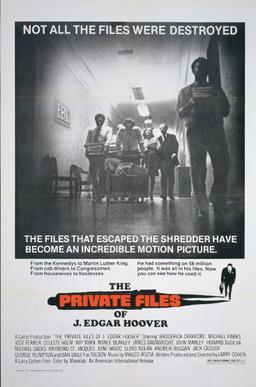
18 Days of Paranoia #3: The Private Files of J. Edgar Hoover (dir by Larry Cohen)


The 1977 film, The Private Files of J. Edgar Hoover, opens in 1972.

J. Edgar Hoover, the much-feared and long-serving director of the FBI, has just been found dead at his home and it seems like the entire city of Washington, D.C. is scrambling.  Not only are people jockeying for Hoover’s job but they’re also wondering what might be found in his secret files.  As quickly becomes apparent, Hoover had a file on everyone.  While Presidents lauded him and the press portrayed him as hero, Hoover spent nearly 50 years building up a surveillance state.  Hoover said it was to fight criminals and subversives but mostly, it was just to hold onto his own power.  Even President Nixon is heard, in the Oval Office, ordering his men to get those files.

Hoover may have known everyone’s secrets but, the film suggests, very few people knew his.  The film is narrated by a former FBI agent named Dwight Webb (Rip Torn).  Dwight talks about how he was kicked out of the FBI because it was discovered that he not only smoked but that he was having an adulterous affair with a secretary.  “You know how Hoover was about that sex stuff,” he says, his tone suggesting that there’s more to the story than just Hoover being a bit of a puritan.

We flash back to the 1920s.  We see a young Hoover (James Wainwright) as a part of the infamous Palmer Raids, an early effort by the Justice Department to track down and deport communist subversives.  Though Hoover disagrees with the legality of the Palmer Raids, he still plays his part and that loyalty is enough to eventually get him appointed, at the age of 29, to be the head of the agency that would eventually become the FBI.  Hoover may start out as a relatively idealistic man but it doesn’t take long for the fame and the power to go to his head.

Hoover (now played by Broderick Crawford) serves a number of Presidents, each one worse the one who proceeded him.  Franklin Delano Roosevelt (Howard Da Silva) is an avuncular despot while the Kennedy brothers (William Jordan as John and Michael Parks as Bobby) are two rich brats who think that they can control Hoover but who soon discover that Hoover is far more clever than they realize.  Hoover finds himself a man out-of-place in the 60s and the 70s,  Suddenly, he’s no longer everyone’s hero and people are starting to view the FBI as being not a force for law enforcement but instead an instrument of oppression.

Through it all, Hoover remains an enigma.  He demands a lot of from his agents but he resents them if they’re too successful.  Melvin Purvis (Michael Sacks) might find fame for leading the manhunt that took down Dillinger but he’s driven to suicide by Hoover’s cruel treatment.  Unlike Clint Eastwood’s film about Hoover, The Private Files of J. Edgar Hoover suggests that Hoover was not gay but that instead, that he was so repressed that he was essentially asexual.  When one woman throws herself at him, he accuses her of being a subversive and demands to know how anyone could find him attractive.  He’s closest to his mother and when she dies, he shuts off his emotions.  His own power, for better and worse, becomes the one thing that he loves.  He’s married to the FBI and he often behaves like an abusive spouse.

The Private Files of J. Edgar Hoover is an interesting film.  It’s an attempt to do a huge American epic on a less than epic budget.  At the start of the film, the low budget is undeniably distracting.  The 1920s are essentially represented by a back lot and two old cars.  The scenes of the FBI dealing with gangsters like Dillinger and Creepy Karpis feel awkward and slapdash.  But, as the film’s timeline gets closer to what was then the modern era, the film’s story tightens up and so does Larry Cohen’s direction.  (One get the feeling that Cohen was, perhaps understandably, more interested in the Hoover of the 60s and the 70s than the Hoover of the 20s and 30s.  There’s a sharpness to the second half of the movie that is just missing from the first half.)  Broderick Crawford gives a chilling performance as a man who is determined to hold onto his power, just for the sake of having it.  The scenes were Hoover and Bobby Kennedy snap at each other have a charge that’s missing from the first half of the film.  Michael Parks does a great job portraying RFK as basically being a spoiled jerk while Crawford seems to relish the chance to play up the resentful, bitter old man aspects of Hoover’s personality.  The film ultimately suggests that whether the audience previously admired RFK or whether they previously admired Hoover, they were all essentially duped.

Though the film never quite overcomes the limits of its low budget, it works well as a secret history of the United States.  In 1977, it undoubtedly took guts to make a film that portrayed Roosevelt and Kennedy as being as bad as Nixon and Johnson.  (It would probably even take guts today.  One need only rewatch something like The Butler or Hyde Park on Hudson to see the ludicrous lengths Hollywood will go to idealize presidents like Kennedy and dictators like FDR.)  While this film certainly doesn’t defend J. Edgar Hoover’s excesses, it often suggests that the president he served under were just as bad, if not even worse.  In the end, it becomes a portrait of not only how power corrupts but also why things don’t change, regardless of who is nominally in charge.  In the end the film’s villain is not J. Edgar Hoover.  Instead, the film’s villain is the system that created and then enabled him.  The man may be dead but the system remains.

Previous entries in the 18 Days of Paranoia:

  1. The Flight That Disappeared
  2. The Humanity Bureau


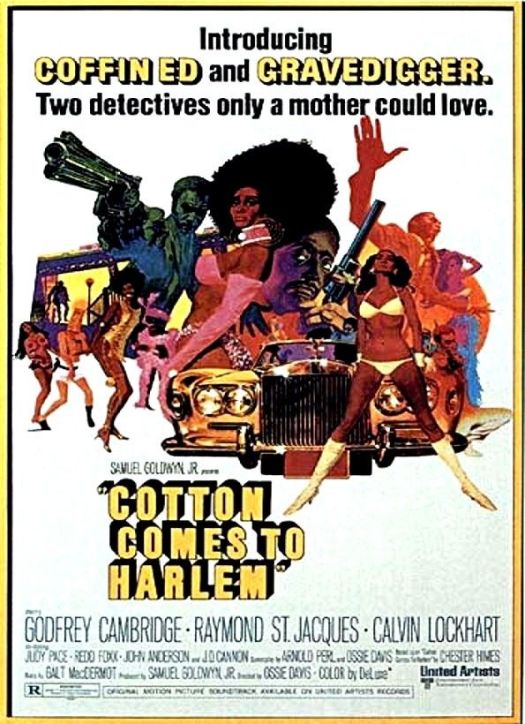
That’s Blaxploitation! 12: COTTON COMES TO HARLEM (United Artists 1970)


gary loggins's avatarcracked rear viewer


I’m not really sure if COTTON COMES TO HARLEM qualifies as a Blaxploitation film. Most genre experts point to Melvin Van Peebles’ SWEET SWEETBACK’S BADASSSSS SONG and/or Gordon Parks’s SHAFT , both released in 1971, as the films that kicked off the Blaxploitation Era. Yet this movie contains many of the Blaxploitation tropes to follow, and is based on the works of African-American writer Chester Himes.

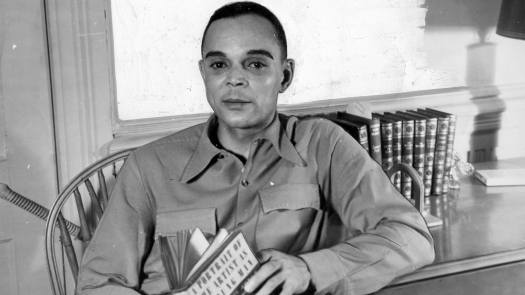
Hardboiled author Chester Himes

Himes (1909-1984) began his writing career while doing a prison stretch for armed robbery. After his short stories started being published in Esquire, he was paroled in 1936, and soon met poet Langston Hughes, who helped him get established in the literary world. Reportedly, Himes worked for a time as a screenwriter for Warner Brothers in the 40’s, but was let go when a racist Jack Warner declared he “don’t want no n*ggers on this lot” (1). His first …

View original post 591 more words

A Movie A Day #303: The Evil That Men Do (1984, directed by J. Lee Thompson)


Clement Molloch (Joseph Maher) is a doctor who uses his medical training to torture journalists and dissidents in an unnamed South American country.  Holland (Charles Bronson) is a former  CIA assassin, who is content with being retired.  But when Molloch kills a journalist who was also an old friend of Holland’s, it all becomes about revenge.  No one’s more dangerous than Charles Bronson seeking revenge.  Working with the dead journalist’s widow (Theresa Saldana), Holland heads down to South America.  Since Molloch is always surrounded by bodyguards, it is not going to be easy to get him.  But who can stop Charles Bronson?

Bronson was 62 years old when he made The Evil The Men Do and he was still the toughest, coolest killer in the movies.  The Evil That Men Do is a rarity, an 80s Bronson film that was not produced by Cannon.  It still feels like a Cannon production, even if it is a little more interesting than some of the other films that Bronson was making at that time.  Dr. Molloch was clearly based on the notorious Nazi Klaus Barbie and Joseph Maher plays Molloch as being a dignified sadist.  Molloch also has a strange relationship with his equally cruel sister (Antoinette Bower).  That Molloch is so extremely evil makes the film’s final scenes all the more satisfying.

The Evil That Men Do is one of the best of Bronson’s later films.  Charles Bronson, man.  No one got revenge better than Bronson.

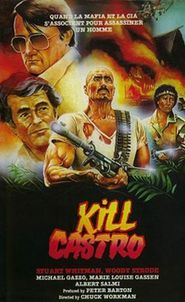
“DAMN YOU, KENNEDY!”: Assignment — Kill Castro (1980, directed by Chuck Workman)


7d9oDL3Y5kupCGgUsR6Jh5ZU1KfOne of my earliest memories of staying up late and watching cheesy movies on local television was the sight of Robert Vaughn standing on a beach and cursing, “Damn you, Kennedy!”  An echo effect kicked in, making the line: “Damn you, Kennedy Kennedy Kennedy Kennedy Kennedy!”
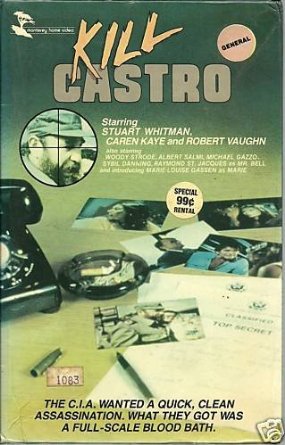
The name of the movie was Assignment — Kill Castro and sometimes it seemed like it came on every other night.  The movie started with a title crawl that was so lengthy and so set the tone for the entire film that I feel it is worth quoting in its entirety:

From 1961, the year of the Bag of Pigs to today, the Government of the United States has been embroiled in a series of events which have continually led our nation to crisis after crisis and to the brink of war.

ASSIGNMENT — KILL CASTRO, a true story is one of the most confusing and frustrating historical events that might have led to a world power showdown.  It happened yesterday!  It happened today!  It can happen again!

Names of persons and places have been changed to protect the individuals who were called upon to aid their country and in doing so placed their lives in jeopardy.

“I WILL GIVE ALL FOR THE LOVE OF MY COUNTRY … RIGHT OR WRONG! — G.W. Bell, Chief of Carribean (sic) Operations, Central Intelligence Agency”

This motion picture is dedicated to all people who desire to live in a free democratic society.

Robert Vaughn plays Hud, a former CIA agent who was involved in the original Bay of Pigs invasion.  When the mysterious Mr. Bell (Raymond St. Jacques) and a gangster named Rossellini (Michael V. Gazzo) agree to finance an operation to kill Fidel Castro, Hud recruits a Key West bar owner named Tony (Stuart Whitman) to take him to Cuba.  However, Mr. Bell and Rossellini are just using Hud to secretly smuggle heroin into Florida and, much like John F. Kennedy in 1961, they are planning on abandoning him on the beaches of Cuba.

The main problem with Assignment — Kill Castro is that we already know that Hud is not going to succeed in his mission because Fidel Castro is still alive and probably still bragging about how he sent Tony Montana to Miami.  The other problem is that the movie does not make any damn sense.  That title crawl was not kidding when it said the story was confusing and frustrating.  Everyone is so busy double-crossing everyone else that it is hard to keep track.  There has to be a simpler way to get heroin into Florida.  Surprisingly, this incoherent movie was written and directed by the legendary editor, Chuck Workman, the same Chuck Workman who puts together those montages for the Oscars.

Kill Castro does have a good cast, though none of them are at their best.  Along with Whitman, Vaughn, St. Jacques, and Gazzo, the cast includes Woody Strode, Albert Salmi, and Sybil Danning (whose last name is misspelled Daning in the end credits).  Fidel Castro plays himself and the film’s ending is provided by cannibal turtles.

Assignment — Kill Castro was just one of the many titles that this movie was released under.

51-brX2eGmL._SY445_

It was also known as Cuba Crossing,

STUART-WHITMAN-CUBA-CROSSING-MOVIE-ADVERT-FULL-PAGE

Key West Crossing, The Mercenaries, and my personal favorite, Sweet Dirty Tony.

55706564