Larry Sutton (Randolph Scott) is an engineer who has been sent to take over operations at a radium mine that is owned by the Ballard family. Previously, Larry’s bother-in-law was in charge of the mine but he has disappeared and is suspected of having murdered the foreman at the Ballard Ranch. With Jim Ballard (George F. Marion) on his deathbed and being cared for by the foreman’s wife (Caroline Dudley, credited as Mrs. Leslie Carter), Ballard’s nieces (Ann Sheridan and Kathleen Burke) and nephew (Howard Wilson) have come to the ranch to find out about their inheritance.
Soon, a cloaked figure starts to murder Ballard’s heirs, one-by-one. Working with eccentric Deputy Sheriff Tex Murdock (Chic Sale), Larry tries to discover the identity of the killer and keep the mine from falling into the wrong hands.
Rocky Mountain Mystery is unique in that it is a Randolph Scott western that takes place in what was then modern times. Even though both Larry and Tex prefer to ride horses, the murderer tries to escape in a car, people use phones, and the entire plot revolves around a radium mine. The film mixes the usual western tropes of grim heroes, eccentric lawmen, and valley shoot-outs with a dark mystery that actually holds your attention while you’re watching the film. Always ideally cast in these type of films, Randolph Scott is both tough and intelligent as Larry Sutton. He may be a cowboy but he’s a detective too. Scott gets good support from a cast of familiar faces. Ann Sheridan is especially good as the niece who knows how to handle a rifle.
These B-westerns can be a mixed bag but Rocky Mountain Mystery held my attention with a plot that was actually interesting and a strong performance from Randolph Scott. Watch it and see if you can guess who the identity of the Ballard Ranch murderer.
4 Shots From 4 Films is just what it says it is, 4 shots from 4 of our favorite films. As opposed to the reviews and recaps that we usually post, 4 Shots From 4 Films lets the visuals do the talking!
I thought I’d try one of these “4 shots” posts. It’s really hard for me not to say anything, because each of these movies mean a lot to me, and the western remains my favorite genre even if I am a little stuck in the past. I’ll probably take a stab at a review of each of these films at some point. I hope you enjoy!
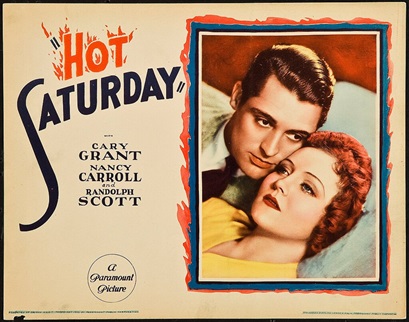
First released in 1932 and featuring Cary Grant in his first leading role, Hot Saturday is a film about gossip and love.
Ruth Brock (Nancy Carroll) is a young bank teller living in a small town. It’s the type of town where everyone knows everyone else. For instance, everyone knows that every man in town wants to date Ruth but that Ruth, for her part, is not in any hurry to settle down and get married. She’s having too much fun going to dances, drinking with her friends, and enjoying life. Everyone knows that playboy Romer Sheffield (Cary Grant) is interested in Ruth but then again, Romer appears to be interested in everyone. Romer has scandalized the town by allowing a woman named Camille (Rita LaRoy) to live at his mansion.
Ruth has a date with one of her coworkers, Conny Billop (Edward Woods), but, when Conny refuses to take no for an answer, she gets away from him and ends up at Romer’s estate. Ruth and Romer spend the night together, just talking. Still, thanks to Conny and Eva (Lillian Bond), the daughter of Ruth’s boss, the whole town is soon convinced that Ruth is Romer’s lover. The town is so scandalized that Ruth even loses her job.
Fortunately, Bill Fadden (Randolph Scott) has returned to town. Bill is a geologist. He grew up in town, with Ruth. He’s spent the last seven years on a surveying expedition but now he’s back and he wants to marry Ruth. How lucky is Ruth? She not only has two good men in love with her but one of them looks like Cary Grant and the other one looks like Randolph Scott! However, when Bill hears the rumors, will he continue to love her or will he be yet another person who gives in to the curse of small town gossip?
Hot Saturday is a film that truly took me by surprise. It’s a pre-code film and it’s one that has all of the usual tropes that one usually associates with the pre-code era. Everyone’s obsessed with sex. There’s a lot of kissing. There’s a lot of drinking. There’s an emphasis on legs and lingerie. There’s even a scene where Ruth gets into a wrestling match with her younger sister when she discovers that her sister has taken her new panties. I’m one of four sisters so I could certainly relate but it’s still not the sort of thing that one necessarily expects to find in a film from the 1930s. But that’s one reason why I love the Pre-Code era. Allowed to police itself, pre-code Hollywood made films that were more realistic and open about their subject matter than the films made under the production code but which also still had their own unique innocence to them. Hot Saturday has an ending that would have never been allowed during the Code era, one that is, dare I say it, rather empowering.
But, beyond all that, Hot Saturday is an intelligently written film that strikes a good balance between drama and character-driven comedy. Nancy Carroll is beautiful and likable in the lead role. Cary Grant and Randolph Scott are both as handsome and charming as can be. Hot Saturday is both a look at the reality and dangers of small town gossip and a touching love story. I enjoyed it.
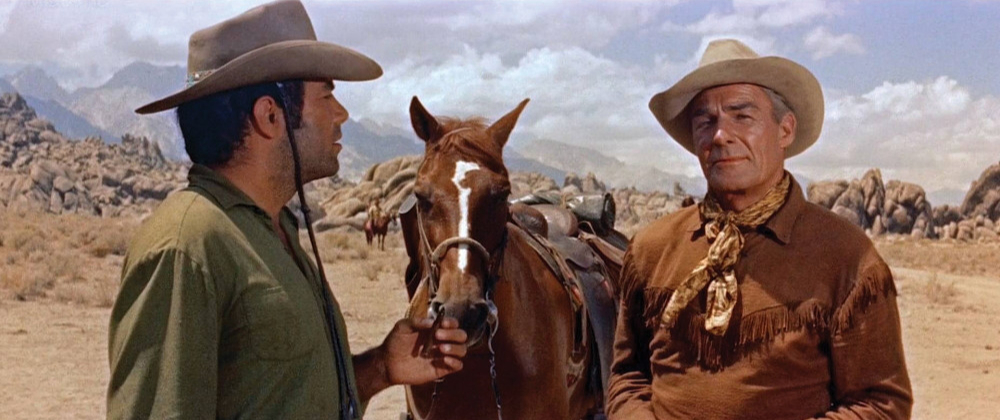
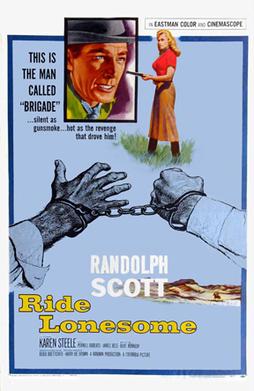
Happy Birthday in heaven to Randolph Scott, who was born on January 23rd, 1898. The picture above is from probably my favorite Randolph Scott film, RIDE LONESOME (1959). Scott made so many great movies, but my personal favorites are the series of westerns he made with director Budd Boetticher from 1956 – 1960. I highly recommend that you search those films out!
Randolph Scott made the film RIDE THE HIGH COUNTRY with director Sam Peckinpah in 1962 and then retired from acting. Through his work in film and his excellent investments, he would pass away in 1987 as one of the richest men in Hollywood. I’m so glad that my movie hero Charles Bronson was able to work with Scott in the 1954 film RIDING SHOTGUN. Rest in peace, Mr. Scott!
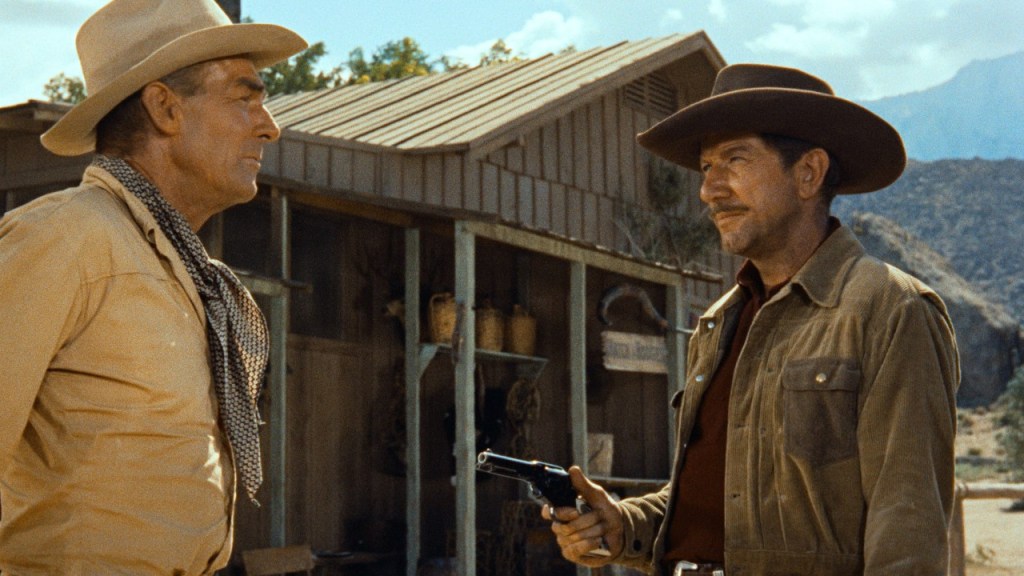
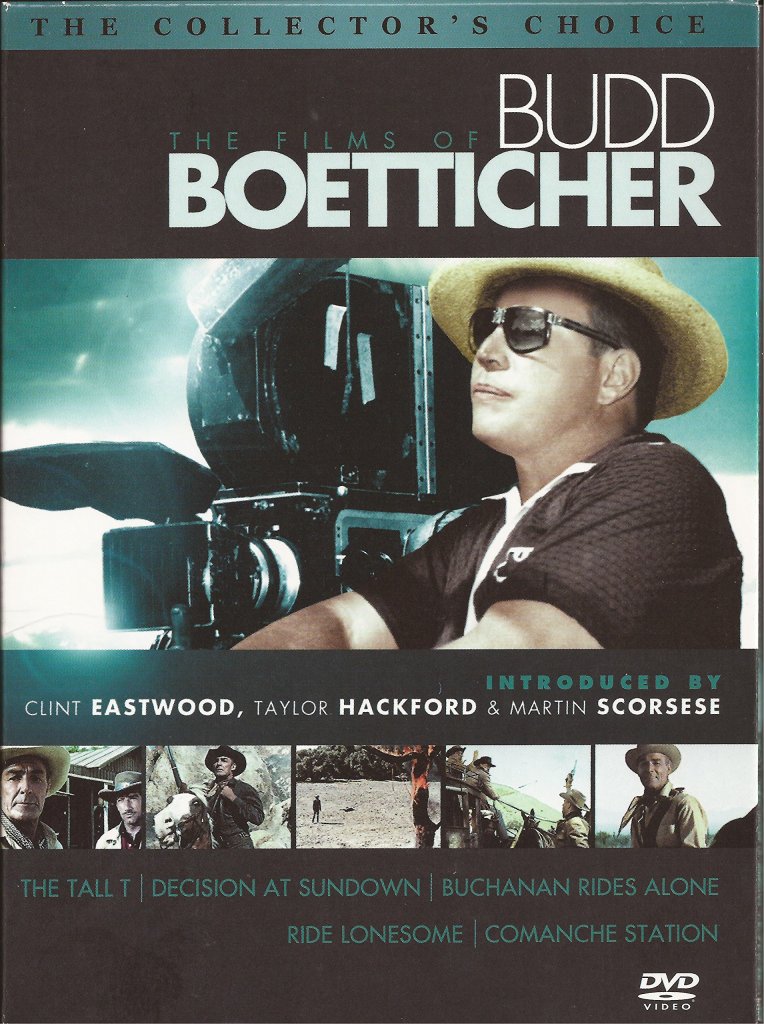
There was a time in my life, before streaming existed, where it seemed like I wanted to buy every movie that interested me in the slightest. The main ways I looked for new movie releases was to go to a store like the Hastings Entertainment Superstore and look at their inventory, or look at the new and recent releases on Amazon’s online store. I could spend hours looking for movies in either location, and I did. Sometime in 2008, I ran across a DVD box set described as “The Films of Budd Boetticher” that contained introductions by the likes of Martin Scorsese, Taylor Hackford, and Clint Eastwood. The films included on the box set were THE TALL T, DECISION AT SUNDOWN, BUCHANAN RIDES ALONE, RIDE LONESOME, and COMANCHE STATION. I remember seeing the names of these movies at various times in my life in my movie books. They had never really caught my attention, although I do remember that they would receive good reviews. This set did catch my attention, however, based on the interesting packaging and the fact that Scorsese and Eastwood were both singing the praises of the films. I did a little bit of quick research and decided to just buy the boxset. I’m glad to report that these films have turned into some of my very favorite movies, and I sing their praises to anyone who will listen.
Version 1.0.0
The earliest movie in this set is THE TALL T from 1957, which is based on Elmore Leonard’s short story, “The Captives.” The story opens with our hero Pat Brennan (Randolph Scott) stopping by the Sassabee Stagecoach Station and visiting with the owner Hank (Fred Sherman) and his son, Jeff (Christopher Olsen). Brennan seems like a good-natured guy who has a nice visit with the two and even agrees to purchase young Jeff some striped candy when he stops in the town of Contention later that day. Brennan heads on to Contention where we meet Ed Rintoon (Arthur Hunnicutt), a stagecoach driver who has been hired to take Willard and Doretta Mims (John Hubbard and Maureen O’Sullivan) to Bisbee for their honeymoon. Rintoon and Brennan are clearly old friends. As part of their various conversations, we learn that Doretta Mims is the daughter of Old Man Gateway, the man with the richest copper claim in the territory. After saying goodbye to Rintoon and buying young Jeff his striped candy, Brennan continues on to Tenvoorde’s (Robert Burton) ranch, in hopes of buying a seed bull for his own start-up ranch. For many years, Brennan had been the ramrod on Tenvoorde’s ranch, and the old man clearly wants him to come back. Tenvoorde offers Brennan a chance to get his bull for nothing, but he has to ride the bull to a stand still. If he can’t do it, then Tenvoorde keeps the bull and Brennan’s horse. Brennan takes him up on the offer, falls off the bull, dives into water trough to avoid getting stomped by the bull, and then heads back towards his ranch with nothing but his wet clothes and saddle. As he’s walking down the road, Rintoon comes by on his stagecoach with Mr. and Mrs. Mims. They pick Brennan up and give him a ride. When they stop back at the Sassabee Stagecoach Station, Hank and Jeff are nowhere to be seen. Rather, a voice from inside the station says “Drop your guns and come on down.” Frank Usher (Richard Boone) and young Billy Jack (Skip Homeier) emerge from the station with their guns drawn. When he’s getting down off the stagecoach, Rintoon goes for his shotgun and is shot down by another man, Chink (Henry Silva), whose been waiting in the shadows. These three men are waiting to rob the next stagecoach that comes along. They’ve already killed Hank and Jeff, and are planning to kill every person on this coach, when Willard tells them that his wife Doretta is from the richest family in the territory. Willard tells the three outlaws that Old Man Gateway will pay good money to get his daughter back, if they will just let them live. Usher, the leader of the bunch, likes this idea and sends Billy Jack and Willard back to Contention to request $50,000 from Gateway for the safe return of his daughter. With the endgame changed, Usher takes Brennan and Mrs. Mims to their hideout to wait to get their money from Gateway. Brennan knows that it’s just a matter of time before they are all killed, and he tells Mrs. Mims that they will need to be looking for any possible opportunity to escape.
THE TALL T is just so good. It’s amazing how much drama that director Budd Boetticher could fit into these films that all had running times of less than 80 minutes. The story is simple, but it deals with big themes like honor, cowardice, true love, sociopathic evil, and big dreams. Credit here has to be given to Elmore Leonard, the writer of the short story the film is based on. It must also be given to Burt Kennedy. Kennedy wrote the scripts for THE TALL T, RIDE LONESOME, and COMANCHE STATION. He’s not the credited writer for BUCHANAN RIDES ALONE but he did uncredited work on the script. Kennedy would go on to have a good career writing and directing his own westerns, like SUPPORT YOUR LOCAL SHERIFF, THE TRAIN ROBBERS, and HANNIE CAULDER, but his work with Boetticher is definitely some of his very best.
It’s also amazing how spare and simple everything looks in the THE TALL T. The land is just so dry, with nothing but big rocks and not a tree in sight. Growing up in Arkansas, I’m used to green fields and trees and flowers. It can almost feel like you’re choking on dust just watching this film.
The casting always seems to be perfect in Boetticher’s films. Randolph Scott is simpatico with Boetticher. His character here is a good man who will do what it takes to survive while also keeping his honor intact. Boetticher and Scott are truly a match made in heaven. Richard Boone is great as Frank Usher, the leader of the outlaws. He could have killed Scott’s character Brennan, but he is glad to have an honorable man to talk to after spending all of his time with Billy Jack and Chink. Boone somehow makes his outlaw leader into an honorable man even though he’s done many dishonorable things. It’s an impressive feat. Maureen O’Sullivan has an important role as Doretta Mims, the rich but plain woman, who married Willard because she was afraid she’d end up all alone. Her career goes all the way back to the 1930’s where she played Jane in the original Tarzan movies. She’s a good actress whose character undergoes the widest arc in the entire movie. Henry Silva’s Chink is a sociopath who is keeping score of the number of people he kills. Boone’s Usher would have been much better off if he would have gone with Chink’s advice and put Brennan and the Mims’ in the well back at the Sassabee station! Based on his nonchalant penchant for violence, you can see how Henry Silva would go on to having an amazing career playing bad guys. The last person I want to mention in the cast is Arthur Hunnicutt, who played Ed Rintoon. Hunnicutt is special to me because he comes from the hills of Arkansas, from a little town called Gravelly. He attended the same college I attended, although it was called the Arkansas State Teachers College when he was there. It was the University of Central Arkansas when I came through. Hunnicutt specialized in wise, rural characters. He was even nominated for an Acadamy Award a few years earlier for a movie called THE BIG SKY. He’d go on to be in so many good movies, including playing “Bull” in EL DORADO with John Wayne. I’m just proud of the guy for growing up in extreme rural Arkansas and then becoming a great character actor in Hollywood. I’ll watch anything he’s in.
I recommend all of these Budd Boetticher / Randolph Scott westerns, and THE TALL T is one of the very best!
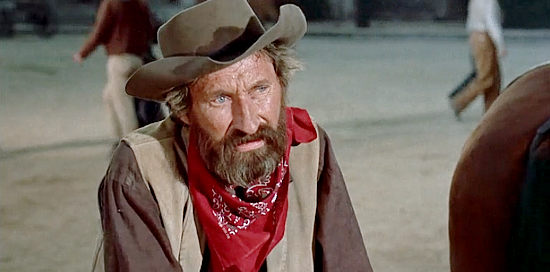
In the western Ride Lonesome, Randolph Scott plays Ben Brigade. Brigade is a bounty hunter. The only thing that really differentiates him from the outlaws that he captures is that he gets paid for what he does. When Brigade arrests a young outlaw named Billy John (James Best), he gives Billy just enough time to send word to his older brother, Frank (Lee Van Cleef). And when Brigade starts to lead Billy John back to the town of Santa Cruz, he takes his time and fails to cover his tracks, almost as if he is intentionally making time for Frank to eventually catch up to him. Along the way, Brigade meets up with three others, a woman named Carrie (Karen Steele) and two outlaws named Boone (Pernell Roberts) and Whit (James Coburn). Carrie is searching for her husband while Boone and Whit want to arrest Billy John themselves so that they can turn him in and get a pardon for their own crimes.
Ride Lonesome is one of the best of the many films that Randolph Scott made with director Budd Boetticher. Boetticher specialized in making fast-paced westerns that had deceptively simple plots. Nobody in a Boetticher western was totally good or totally bad and that’s certainly the case with Ride Lonesome, which may seem like a typical western but which is actually a character study of 6 very different people. Brigade is often only the hero by default and his actions are often as ruthless as those of the men who are tracking him. It’s only after he meets and gets to know Carrie that he starts to seriously consider that his plans could lead to innocent people getting hurt. Billy John may be a wanted killer but, underneath his bravado, he’s just someone trying to live up to his brother’s example. Meanwhile, Boone and Whit may be outlaws but they turn out to be the most morally upright characters in the film. Ride Lonesome takes a serious look at frontier justice and suggests that maybe black-and-white morality isn’t all that it’s cracked up to be.
Needless to say, the cast is great. Randolph Scott was one of the great western heroes and Karen Steele, Pernell Roberts, Lee Van Cleef, and James Best all turn in memorable performances. Best of all is James Coburn, making his film debut and showing that, even at the start of his career, he was already the epitome of cool. Ride Lonesome is one of the best of of the Boetticher/Scott westerns and a true classic of the genre.
Arizona rancher Wick Campbell (Richard Boone) is angered when he discovers that one of his servants, Maria (Donna Martell), would rather marry Howie Stewart (Skip Homeier) than be with Wick. Wick has had a long rivalry with Howie and his older brothers, John (Randolph Scott) and Adam (Lester Matthews). Determined to get rid of the Stewarts and to have Maria for himself, Wick hires notorious gunfighter Frank Scavo (Leo Gordon) to take over the town and defeat the Stewarts, one way or another.
Ten Wanted Men (the title refers to Scavo’s gang) is an above average Randolph Scott western. Scott was one of the best of the western heroes because he always seemed so authentic whenever he rode a horse, shot a gun, or even just put on a cowboy hat. Scott was also an underrated actor and, as he got older, he became Hollywood’s go-to choice whenever they needed a strong, silent lead for a western. That’s the role that he plays in Ten Wanted Men, as the patriarch of the Stewart family. He’s instinctively fair but he will do whatever has to be done to protect his brothers.
Wick Campbell is John Stewart’s opposite, an oily rancher who hires other men to bully his enemies and who abuses his servant in a way that the Stewarts never would consider. Though Richard Boone became best known for playing the hero on Have Gun–Will Travel, Wick is the type of cowardly villain who everyone will be happy to see get exactly what he deserves. As played by Leo Gordon, Frank Scavo is a brutish outlaw and, unlike Wick, he doesn’t pretend to be anything else.
Ten Wanted Men is a good western. The plot may not be surprising but the gunfights are exciting and Randolph Scott is as ideal a hero as always. Fans of the genre will enjoy it.
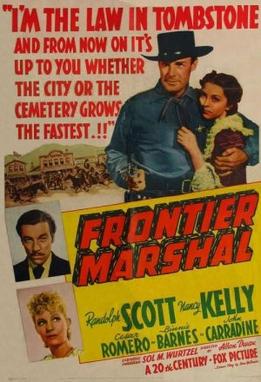
When Wyatt Earp (Randolph Scott) arrives in the town of Tombstone, he takes the law in his own hands by preventing a local outlaw named Indian Charlie (Charles Stevens) from destroying the saloon owned by Ben Carter (John Carradine). For his trouble, Earp is beaten up by Carter’s men. Earp, however, does get a job as the town’s new marshal.
After some initial weariness, Wyatt befriends an alcoholic dentist and gunfighter named Doc Holliday (Cesar Romero). While Earp keeps the peace in Tombstone, Doc is torn between two women, dancehall girl Jerry (Binnie Barnes) and his ex-girlfriend, Sarah (Nancy Kelly).
With Carter and his man planning on robbing a payroll train and also kidnapping frontier performer, Eddie Foy (played by the real Foy’s son, Eddie Foy, Jr.), it is only a matter of time before Earp takes on Carter at the legendary O.K. Corral.
Frontier Marshal was only the second sound film to be made about Wyatt Earp’s time in Tombstone and it was the first to use Earp’s name. (In the first film version of the story, also called Frontier Marshal, Earp’s name was changed to Michael Wyatt.) This was because Wyatt’s widow was offended by some of the material that was included in the biography that served as the basis for Frontier Marshal and threatened to sue anyone who wanted to make a movie out of it. In order to get her permission to make the film, 20th Century Fox agreed that no reference would be made to Wyatt’s marriage in the film. Mrs. Earp ended up suing anyways. 20th Century Fox settled.
As for the film, it’s in no way historically accurate and it pales in comparison to My Darling Clementine, Gunfight at the O.K. Corral, Tombstone, and the Star Trek episode where Kirk, Spock, and McCoy thought they were in the old west. It is, however, better than The Gunfighters episode of Dr. Who. Randolph Scott is convincing as an upright and law-abiding Wyatt Earp, quite a contrast to the real Wyatt. The movie though is stolen by Cesar Romero, who plays Doc Holliday as being pathologically self-destructive. Cesar Romero is not necessarily the first name that comes to mind when you think of a great western actor but he’s very convincing here. John Carradine is a perfect villain and keep an eye out for Lon Chaney, Jr. as one of his henchmen. Unfortunately, the final gunfight feels rushed and, for all the build up, it isn’t as exciting as it should be. Frontier Marshal will mostly be of interest to those curious to see how Doc Holliday, Wyatt Earp, Tombstone and the Gunfight at the O.K. Corral were portrayed in films before they became a sacrosanct part of the mythology of the Old West.
Frontier Marshal was later remade, as My Darling Clementine, by John Ford. Ward Bond, who played Morgan Earp in Ford’s film, plays the original town marshal in Frontier Marshal. Charles Stevens, who plays Indian Charlie in Frontier Marshal, was often falsely described by the Hollywood publicity mill as being the real-life grandson of Geronimo. He also appeared in My Darling Clementine, once again playing the role of Indian Charlie. It was one of the nearly 200 films he made before he died in 1964.
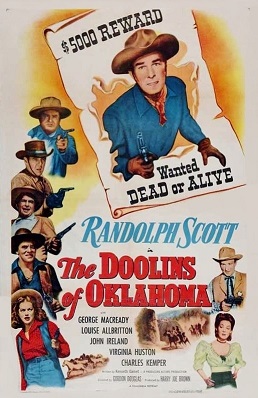
Randolph Scott stars in The Doolins of Oklahoma, a fictionalized account of the career of the real-life western outlaw, Bill Doolin.
Doolin (played, naturally, by Randolph Scott) may have once rode with the fearsome Dalton Brothers but, according to this film, he was actually just an ordinary, salt of the Earth type who wanted to settle down with the right woman and lead a normal life. It looks like he might get that opportunity after the Daltons are killed and Doolin tires of leading his own gang of outlaws. Doolin settles in a Oklahoma town, takes a new name, and falls in love with Elaine (Virginia Hutton). But when both the members of his old gang and a veteran lawman (George Macready) show up in town, Doolin learns that the past cannot be escaped.
The plot of The Doolins of Oklahoma is nothing special, though it’s portrayal of the outlaws being more honorable than law enforcement may have been surprising in 1949. The main thing that distinguishes The Doolins of Oklahoma is the cast, which is full of western veterans like John Ireland, Noah Beery Jr., Charles Kemper, Frank Fenton, and Jock Mahoney. Not surprisingly Randolph Scott is ideally cast as a weary cowboy who just wants to settle down and live the rest of his life in peace. Scott is well-matched by MacReady, as the marshal who will not let anything stand in the way doing his duty as a member of law enforcement. Gordon Douglas directs crisply and energetically and every member of the main cast gets at least one big moment in which to distinguish themselves. The Doolins of Oklahoma may not be a groundbreaking film but it will be enjoyed by fans of the western genre.
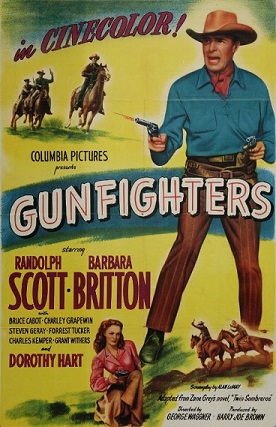
Brazos Kane (Randolph Scott) is a legendary gunfighter who has more notches on his gunbelt then he can count. His reputation is so fearsome that he can’t even enter a town without having to worry about someone drawing a gun on him in an attempt to make a name for themselves. When he’s forced to shoot his own best friend when the latter tries to outdraw him, Brazos says that he’s had enough. He tosses aside his guns and he heads to the home of his friend, Bob Tyrell. Brazos says he’s going to retire from gunfighting and just “ride the range.”
When Brazos reaches Bob’s cabin, he discovers that Bob has been murdered. When Brazos rides to the nearby Banner ranch to report the crime, he’s arrested and accused of shooting Bob. When it’s pointed out that Brazos doesn’t have a gun, corrupt Deputy Yount (Grant Withers) says that Brazos most have tossed it in the creek after he shot Bob.
With the help of Bob’s employer, a rancher named Inslip (Charley Grapewin), Brazos narrowly avoids getting hung. Both Yount and the sheriff (Charles Kemper) encourage Brazos to leave town but Brazos isn’t going anywhere until he gets justice for Bob. His investigation leads to him getting involved with two sisters (Dorothy Hart and Barbara Britton) and a young cowhand named Johnny (John Miles), who wants to become a famous gunslinger. It also leads Bob into conflict with Bard Macky (Bruce Cabot) and Hen Orcutt (Forrest Tucker), who are both determined to run Brazos out of town. Brazos finds himself tempted to go back on his word and pick up his guns yet again.
Based on a novel by Zane Grey, Gunfighters is a surprisingly mature and multi-layered western. Brazos’s refusal to carry a gun and his genuine dislike of violence makes him a far more interesting protagonist than the typical B-western hero and Randolph Scott, one of the best of the cowboy actors, is appropriately world-weary in the role. The villains are also written and played with an unexpected amount of depth, with Bruce Cabot the stand-out as Bard Macky.
Gunfighters is full of good scenes. The opening sequence, featuring the pivotal gunfight between Brazos and his best friend, is excellently directed and captures how quickly violence can erupt in the old west. Later, when Brazos first meets Johnny, the younger man is engaged in target practice and talking about how a man named Brazos Kane murdered Johnny’s best friend. Johnny is practicing so he can kill Brazos himself. Without revealing his identity, Kane gives Johnny a few pointers on how to draw and aim his gun. It’s only after Johnny has perfected the quick draw that Kane laconically introduces himself and explains that he had nothing to do with Bob’s death. Later, in a powerfully acted scene, Kane explains to Johnny just what exactly it means to be a famous gunfighter and to know that everyone you see is a potential threat.
Directed by George Waggner, Gunfighters is an intelligent and well-acted western and one of Radolph Scott’s best.
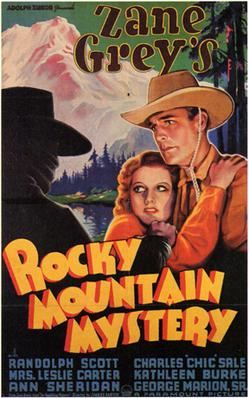 Larry Sutton (Randolph Scott) is an engineer who has been sent to take over operations at a radium mine that is owned by the Ballard family. Previously, Larry’s bother-in-law was in charge of the mine but he has disappeared and is suspected of having murdered the foreman at the Ballard Ranch. With Jim Ballard (George F. Marion) on his deathbed and being cared for by the foreman’s wife (Caroline Dudley, credited as Mrs. Leslie Carter), Ballard’s nieces (Ann Sheridan and Kathleen Burke) and nephew (Howard Wilson) have come to the ranch to find out about their inheritance.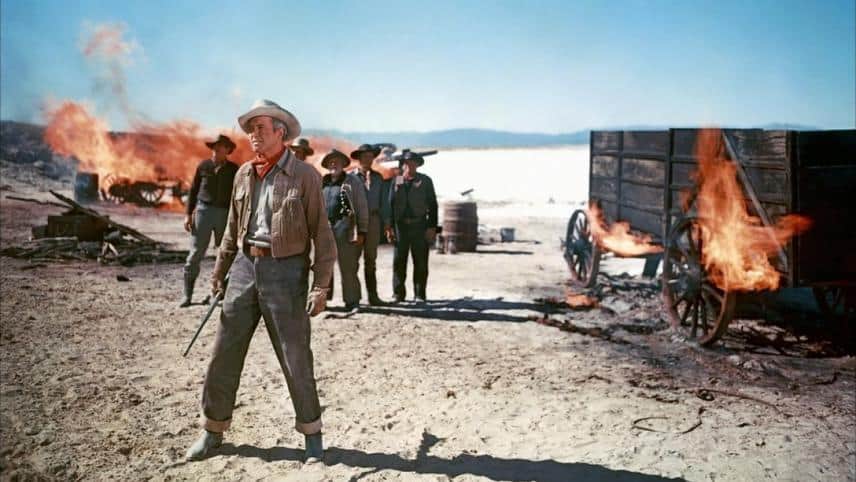
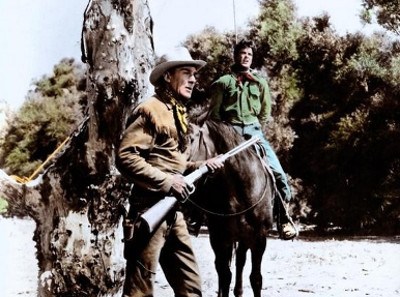
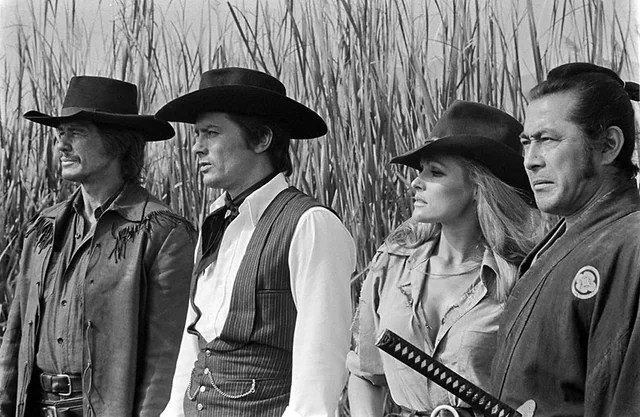

 Through the Shattered Lens