Retro Television Review: Miami Vice 4.16 “Honor Among Thieves”


Welcome to Retro Television Reviews, a feature where we review some of our favorite and least favorite shows of the past!  On Mondays, I will be reviewing Miami Vice, which ran on NBC from 1984 to 1989.  The entire show can be purchased on Prime!

This week, a man kills for his dolls.

Episode 4.16 “Honor Among Thieves?”

(Dir by Jim Johnston, originally aired on March 4th, 1988)

A serial killer named Paul Delgado (John Bowman and no, we’re not related as far as I know) is killing girls in Miami.  He believes that he’s being ordered to kill by his collection of dolls and, when he’s speaking as a doll, he uses a high-pitched voice.  He picks women up at carnivals or on the beach and he kills them by injecting them with 100% pure cocaine.  He poses their bodies with a doll beside them.

Because of the cocaine connection, homicide detective Jarrell (Dylan Baker) approaches Castillo.  Castillo explains that his best men are working deep undercover, trying to take down a drug lord named Palmo (Ramy Zada).  That’s right, this is yet another episode where Crockett pretends to be Burnett and Tubbs pretends to be Cooper and somehow, they’re able to get away with it despite the fact that their cover has been blown in almost every previous episode.

Delgado works for Palmo and things get even more complicated when it turns out that Delgado is Crockett and Tubbs’s connection inside Palmo’s operation.  When Palmo discovers that Delgado is the killer, he puts Delgado on trial.  The jury is made up of other drug dealers.  Since Crockett is pretending to be a lawyer, he’s assigned to serve as Delgado’s defense counsel.  Palmo tells Crockett that, unless he’s acquitted by the drug dealer jury, he’ll reveal that Crockett and Tubbs are working undercover….

This was a weird episode,  It didn’t really work because Delgado was a bit too cartoonish to be taken seriously.  Perhaps if the show had just made him a serial killer who killed women with cocaine, it would have worked.  But the show had to go the extra step and have him talk to his dolls in a high-pitched voice.  As well, this was yet another episode where we were forced to wonder if people in the Miami underworld just don’t communicate with each other.  After all the drug lords that have been busted by Crockett and Tubbs, you would think that word would eventually get out about “Burnett” and “Cooper.”  I mean, their cover gets blown in nearly every episode.  Frank Zappa put a bounty on Crockett’s head in season 2!  And yet somehow, Crockett and Tubbs are still able to walk into a drug lord’s mansion, introduce themselves as Burnett and Cooper, and not automatically get shot.

There were some definite problems with this episode but it was weird enough to at least hold one’s attention.  As opposed to the episodes with the aliens and the bull semen, this episode didn’t seem like it was trying too hard to be weird.  Instead, it just was genuinely weird.  It was watchable and, as far as the fourth season of Miami Vice is concerned, that definitely counts as an accomplishment.
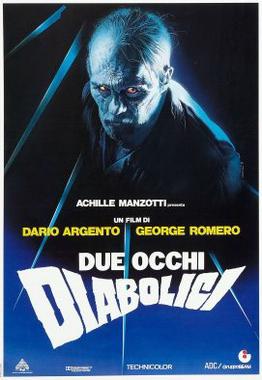
The Film of Dario Argento: Two Evil Eyes


In 1990, long-time friends George Romero and Dario Argento collaborated on Two Evil Eyes, anthology film that was based on the writings of Edgar Allan Poe.  An Italian-American co-production, Two Evil Eyes featured two stories.  The first was directed by George Romero, while the second was directed by Argento.

The Facts In The Case of Mr. Valdemar

(Dir by George Romero)

The first story is Romero’s, a modernized version of The Facts In The Case of M. Valdemar.

Jessica Valdemar (Adrienne Barbeau) is the 40 year-old wife of 65 year-old, Ernest Valdemar (Bingo O’Malley).  Jessica only married Ernest for her money and, now that he’s on his death bed, she and her lover, Dr. Robert Hoffman (Ramy Zada), have hypnotized to him to do and say whatever they tell him to say and do.  Even though Ernest is essentially comatose, the hypnosis allows them to force Ernest to sign his name to legal documents and to tell his suspicious attorney (E.G. Marshall) that he indeed wants to leave all of his money to Jessica.

When Ernest dies while under the influence of hypnosis, Jessica and Robert attempt hide his body in the basement.  But is Ernest really dead?  Jessica is convinced that she hears groaning from the basement and she wonders if the hypnosis has somehow left Ernest in limbo, between life and death.  Robert thinks that Jessica is being foolish but it turns out that she’s not.  After much paranoia and betrayal, one conspirator is dead and the other is a part of the living dead.

Usually, I like Romero’s work but this one didn’t work for me.  From the flat cinematography to the shallow performances, this film felt more like an episode of a television show than anything else.  Perhaps if it had been a stand-alone film, Romero could have found a way to make the material a bit more cinematic.  (The story’s final shot, of blood dripping on a hundred dollar bill, is the film’s strongest moment and the part that feels the most Romeroesque.)  But as a shortened chapter of an anthology film, it fell flat.

The Black Cat

(Dir by Dario Argento)

The Dario Argento segment is based on several different Poe stories.  While the majority of the story is taken from The Black Cat, it also contains elements of Annabel Lee, Telltale Heat, The Pit and the Pendulum, and Buried Alive.  Though this segment doesn’t really work, it’s obvious that Argento is a fan of Poe’s work and, for other Poe fans, there’s a lot of fun to be found in all of the Poe references that Argento sneaks into his story.

Harvey Keitel stars as Rod Usher, a crime scene photographer who loves his work a bit too much.  He’s excited about the fact that his book of photography is about to be published.  He’s less happy about the fact that his girlfriend, Annabel (Madeleine Potter), has adopted a black cat that is constantly glaring at Rod.  Rod is eventually driven mad by both the cat’s apparent hatred of him and the fact that the cat itself keeps showing up no matter how far he goes to get rid of it.  (This film features violence against a cat, which I hated.  But it also featured a cat getting revenge and I appreciated that.)  Eventually, Rod’s paranoia leads to violence and murder.

Look, this is a film about a guy who has an obsessive hatred of a cat.  Obviously, this is not a film that I’m going to enjoy because I love cats.  That said, I can still judge the film on its merits, even if it’s not for me on a personal level.  While Argento is able to build up a good deal of tension and suspense in this film, the overall film doesn’t work because Harvey Keitel, supremely talented actor that he is, was totally the wrong choice for Rod Usher.  Keitel, who reportedly did not get along with Argento during filming, gave a self-indulgent performance that featured a lot of bellowing.  It’s as if Keitel is trying to compete with the constantly moving camera.  The problem is that a star of a film like this has to be the director and Keitel’s histrionics take the viewer right out of the story.

Considering all of the talent involved, Two Evil Eyes is a disappointment.

The (Reviewed) Films of Dario Argento:

  1. The Bird With The Crystal Plumage
  2. Cat O’Nine Tales
  3. Four Flies on Grey Velvet
  4. Deep Red
  5. Suspiria
  6. Inferno
  7. Tenebrae
  8. Phenomena
  9. Opera

Dream On: After Midnight (1989, directed by Jim and Ken Wheat)


Prof. Edward Derek (Ramy Zada) teaches a class called The Psychology Of Fear.  He claims that the things that most scare us are the things that we can believe in.  (To quote the observers from the peanut gallery, “No shit, Sherlock.”)  After Prof. Derek demonstrates fear by pulling out a fake gun and pretending to kill himself, a jock ends up pissing himself and the class is suspended.  Fortunately, Prof. Derek has a backup plan.  He invites his students to his house, where he tells them three horror stories that are all designed to prove that the scariest things are the things that could actually happen in real life.

What does Prof. Derek believe to be scary?

In the first story, it’s scary when your wife decides that the perfect way to throw a surprise party would be to trick you into thinking that you’re trapped in a haunted house and you’re going to die if you don’t start chopping off some heads.

In the second story, it’s scary when a group of girls take a wrong turn, piss off the wrong gas station attendant, and end up getting chased by pack of killer dogs.

In the third story, it’s scary with an answering service operator (played by a pre-CSI Marg Helgenberger) starts getting calls from a psycho.

None of the three stories are really that scary but the first story does have a twist ending that would have made EC Comics proud.  The third story is the best, if just because it focuses on one character and that character is played by Marg Helgenberger.  There’s also the wrap-around story involving the professor and his students.  Just when that story’s getting good, it cops out with an ending that you’ll see coming from a mile away.

With the exception of Marg Helgenberger’s segment, After Midnight is a largely forgettable horror anthology film that will be best appreciated by viewers who are nostalgic for 80s fashion and cheap special effects.