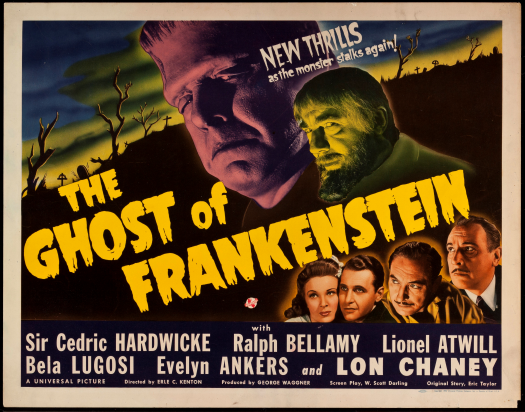
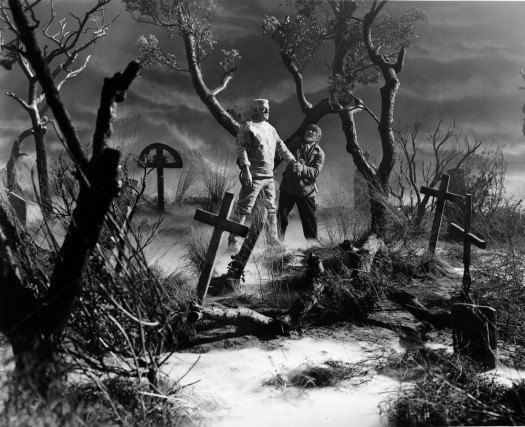
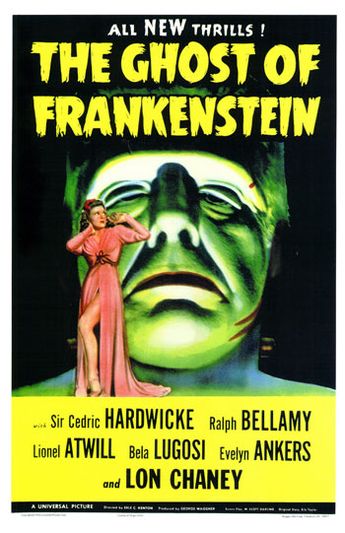
The success of Universal’s SON OF FRANKENSTEIN meant a sequel was inevitable, and the studio trotted out GHOST OF FRANKENSTEIN three years later. Horror stalwarts Bela Lugosi (as the broken-necked Ygor) and Lionel Atwill (although in a decidedly different role than the previous film) were back, but for the first time it wasn’t Boris Karloff under Jack Pierce’s monster makeup. Instead, Lon Chaney Jr., fresh off his triumph as THE WOLF MAN , stepped into those big asphalter’s boots as The Monster. But while SON OF was an ‘A’ budget production, GHOST OF FRANKENSTEIN begins The Monster’s journey into ‘B’ territory.
Old Ygor is still alive and well, “playing his weird harp” at deserted Castle Frankenstein. The villagers (including Dwight Frye! ) are in an uproar (as villagers are wont to do), complaining “the curse of Frankenstein” has left them in poverty, and storm the castle to blow it up…
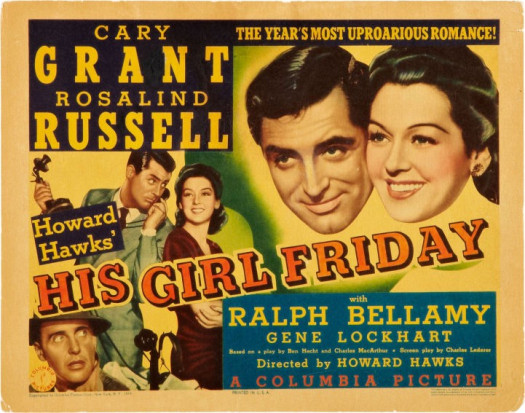
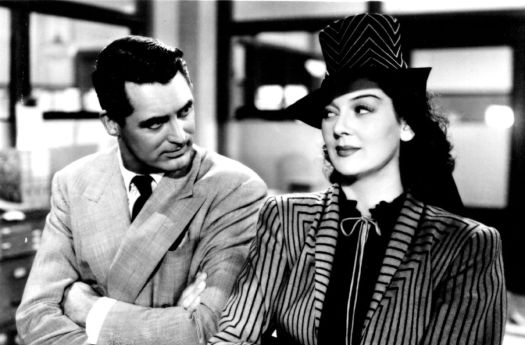
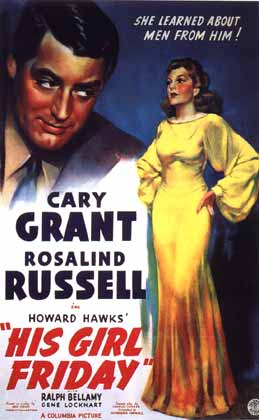
In my opinion, Howard Hawks’ HIS GIRL FRIDAY is one of the greatest screwball comedies ever made, a full speed ahead movie that’s pretty much got everything a film fan could want. A remake of the 1930 Lewis Milestone classic THE FRONT PAGE (itself an adaptation of Ben Hecht and Charles MacArthur’s Broadway smash), Hawks adds a delightful twist by turning ace reporter Hildy Johnson into editor Walter Burns’ ex-wife… and casting no less than Rosalind Russell and Cary Grant in the roles!
The two stars are in top form as the bickering ex-spouses, with their rapid fire banter nothing short of verbal dynamite. Grant in particular spouts off words quicker than a rapper (where did he get all that wind!) and his facial expressions and comic squeals (reminiscent of Curly Howard!) are simply priceless! Roz is more than his match as Hildy, with one lightning-fast zinger after another. Miss…
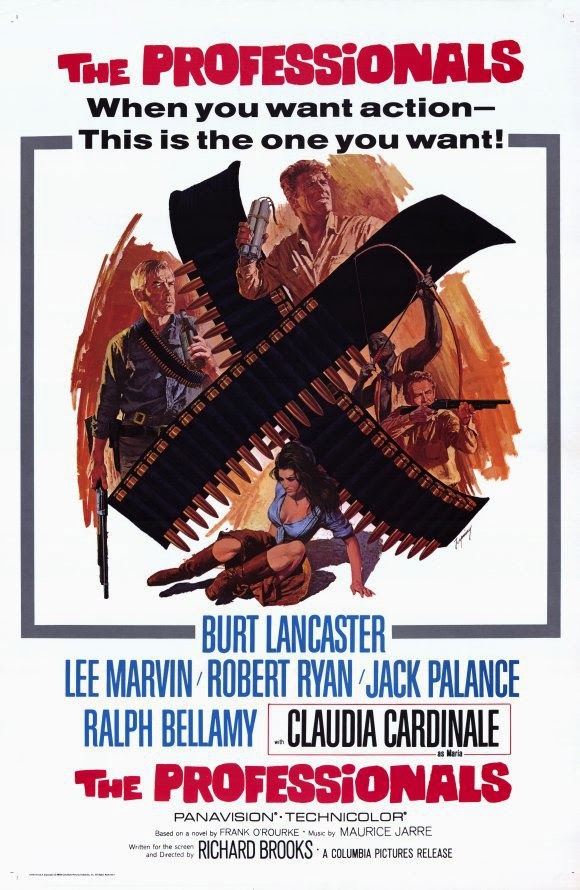
A quartet of macho mercenaries – Lee Marvin , Burt Lancaster , Robert Ryan , and Woody Strode – cross the dangerous Mexican desert and attempt to rescue a rich man’s wife kidnapped by a violent revolutionary in writer/director Richard Brooks’ THE PROFESSIONALS, an action-packed Western set in 1917. The film’s tone is closer to Sergio Leone’s Spaghetti Westerns than the usual Hollywood oater, though Leone’s trilogy wouldn’t hit American shores until a year later.
Rich rancher J.W.Grant (screen vet Ralph Bellamy ) hires the quartet to retrieve wife Maria (Claudia Cardinale) from Jesus Raza (Jack Palance ), formerly a captain in Pancho Villa’s army, now a wanted bandito. Marvin is the stoic leader, a weapons expert who once rode with Raza for Villa, as did Lancaster’s explosives whiz. Ryan plays a sympathetic part (for a change) as the horse wrangling expert, while Strode is a former scout and bounty hunter adept…
In 1942, three years after Son of Frankenstein, Universal Pictures continued the story of the Frankenstein family with The Ghost of Frankenstein!
However, The Ghost of Frankenstein was a far different film from the three that came before it. The budget was lower. The story was less complicated. The running time was much shorter. Whereas the previous films in the franchise clearly took place in Germany, the setting for The Ghost of Frankenstein is less easily defined. (Considering that the film was made during World War II, this isn’t surprising.) The biggest change is that, in The Ghost of Frankenstein, the monster is not played by Boris Karloff. Instead, the role is taken by Lon Chaney, Jr. Chaney’s hulking frame was perfect for the monster but his face is never as expressive as Karloff’s. Whereas Karloff turned the monster into as much of a victim as a victimizer, Chaney plays the monster like a … well, a monster.
Returning from Son of Frankenstein, Bela Lugosi is back as Ygor. At the start of the film, we learn that Ygor actually wasn’t killed at the end of Son of Frankenstein. Instead, he was just wounded. He’s spent the last few years hiding out in the old castle, trying to once again revive the monster. When the villagers attempts to blow up the castle, he and the monster flee.
It turns out that there’s one other Frankenstein son. His name is Ludwig and he’s played by a very dignified Sir Cedric Hardwicke. Ludwig, who has been hiding his identity and denying the family legacy, has a successful medical practice in another village. Working with his assistants, Dr. Kettering (Barton Yarbrough) and the bitterly jealous Dr. Bohmer (Lionel Atwill, who played a far different role in Son of Frankenstein), Ludwig has developed a procedure in which a damaged brain can be removed from the skull, repaired, and then stuck back inside the skull…
Uhmmm … wow, I have no idea what to say about that. That’s quite a medical breakthrough, though…
When Ygor and the monster show up in the village, searching for Ludwig, the monster ends up getting arrested. The local prosecutor (played by Ralph Bellamy, Cary Grant’s romantic rival in both The Awful Truth and His Girl Friday) asks Ludwig to examine the prisoner. Ludwig is shocked to discover that the prisoner is his father’s creation!
Ygor wants Ludwig to perform a brain transplant on the Monster. At first, Ludwig is hesitant but then he’s visited by Henry Frankenstein’s ghost. (Since Colin Clive died 5 years before Ghost of Frankenstein went into production, Hardwicke plays both Ludwig and Henry.) The ghost asks Ludwig to perfect the monster.
Ludwig finally relents and agrees to give the monster a new brain. Ludwig wants to use the brain of kindly colleague but Ygor has different plans…
The Ghost of Frankenstein is only 67 minutes long but, oddly, it still feels just a little bit draggy. Director Erle C. Kenton does a workmanlike job but, at no point, does Ghost feature the wit that distinguished James Whale’s films or Rowland V. Lee’s work on Son of Frankenstein. Chaney is not a particularly interesting monster but Bela Lugosi is a lot of fun as Ygor. With Chaney showing even less emotion than he usually did and Hardwicke appearing to be occasionally embarrassed by the whole film, it falls to Lugosi to keep the audience awake and he manages to do just that. Lugosi’s performance may be overly theatrical but that’s exactly what The Ghost of Frankenstein needed.
The Ghost of Frankenstein is occasionally entertaining but ultimately forgettable. It’ll best be enjoyed by Universal horror completists.
“Even a man who is pure in heart, and says his prayers by night;
May become a wolf when the wolfbane blooms and the autumn moon is bright.”
— Gypsy Poem, The Wolf Man (1941)
Poor Larry Talbot.
We all know his story, of course. The plot of the original Wolf Man is so iconic and has been imitated in so many other films that, even if you somehow have never seen the original 1941 film, you still know what happened.
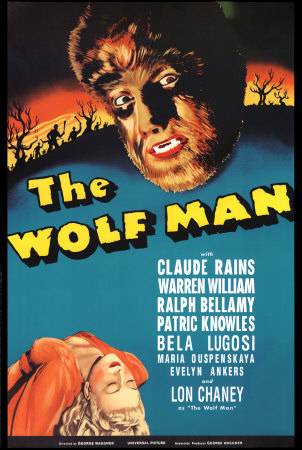
Larry (played by Lon Chaney, Jr.) is a loser. When we first meet him, he is nervously returning to his childhood home in Wales. (Chaney doesn’t sounds at all Welsh nor does he sounds like he’s from any other part of the UK for that matter, but that’s not really important.) Larry’s older brother has recently died and Larry hopes that maybe he can reconcile with his father, Sir John (Claude Rains). Larry’s brother was the favored son, the one who lived up to the Talbot name and made his father proud. Larry, on the other hand, hasn’t really succeeded at anything he’s ever done. To use the slang of the time, Larry comes across as basically being a lug. A big dumb lug.
After discovering that his father really doesn’t seem to want to have much to do with him, Larry goes for a stroll through the nearby village. He buys a silver-headed walking stick, mostly so he can flirt with the salesgirl, Gwen (Evelyn Ankers). It turns out that there’s a gypsy camp nearby. What better place to go on a date!?
Well, perhaps Larry should have just invited her to the movies. Not only does a fortune teller (Maria Ouspenskaya) see something terrible in his future but Larry ends up getting bitten by what appears to be a wolf. The good news is that Larry was bitten while saving the life of one of Gwen’s friends, which is certainly going to make him look like good boyfriend material. The bad news is that the wolf was actually the fortune teller’s son, Bela (played by none other than Bela Lugosi). It turns out that Bela was a werewolf and now, Larry’s going to be a werewolf too!
Larry, needless to say, is not happy about this. But then again, Larry wasn’t happy before he became the werewolf either. Lon Chaney, Jr. played Larry Talbot in five different movies and I don’t think he smiled once. I guess that’s understandable, seeing as how he was a werewolf. In every film in which he appeared, Larry would beg someone to kill him and put him out of his misery. And, in every sequel, Larry would somehow be brought back to life and have to go through it all over again. I guess he earned the right to be a little glum.
But still, even before he’s bitten in The Wolf Man, Larry is kind of a boring character. The only time that he’s interesting is when he’s a wolf man. And really, he’s a far more successful werewolf than human. When we first meet Larry, he apologizing to his father for never living up to his expectations. But once Larry turns into the Wolf Man, he finally manages to get things done. When he’s the wolf man, Larry has the inner drive that he lacks as a human.
To me, the heart of The Wolf Man is not to be found in Chaney’s glum performance. Instead, it’s in Claude Rains’s performance as John. When we first meet Sir John, he seems like a rather imposing figure but, over the course of this 70 minute film, John slowly lowers his guard. We discover that he’s actually a loving father and there’s something rather sweet about watching as he slowly welcomes Larry back into his life. Of course, it all ends in tragedy. These things often do.
Everything, from the set design to shadowy cinematography to the hard-working fog machine (which keeps the moors looking properly creepy) to the performances of Claude Rains and Maria Ouspenskaya, comes together to make The Wolf Man into a genuine classic of horror cinema. And, of course, I have to mention the brilliant makeup job that was done to transform Chaney into The Wolf Man.
Still, I have to wonder — why did Lugosi turn into an actual wolf while Chaney turned into this?
Oh well, it probably doesn’t matter. Just relax and enjoy the damn film, as a wise person somewhere once said. Be sure to watch The Wolf Man this holiday season!
(Once again, your Cracked Rear Viewer is taking part in the TCM Summer Under The Stars Blogathon, hosted by Kristen at Journeys in Classic Film. Just like last year, I’ll be posting on two stars of Hollywood’s Golden Age: Jean Harlow (8/7) and Boris Karloff (8/26).)
Before she became The Platinum Blonde Bombshell of 1930’s Hollywood, Jean Harlow played a pivotal role in early gangster films. She was James Cagney’s second moll in the essential THE PUBLIC ENEMY, and a slutty seductress in THE BEAST OF THE CITY. In THE SECRET SIX, Jean plays a temptress who turns on the mob in a wild Pre-Code film that represents another milestone for Miss Harlow: it’s her first of six with costar Clark Gable.
Wallace Beery plays Slaughterhouse Scorpio, who rises from the stockyards to the top of the gangster heap. He accomplishes this by brute force, bribery, and rubbing out his…
The 44th film in Mill Creek’s Fabulous Forties box set was the classic 1940 comedy, His Girl Friday.
Earlier this week, when I mentioned that Cary Grant’s Oscar-nominated work in Penny Serenade was not the equal of his work in comedies like The Awful Truth and The Philadelphia Story, quite a few people took the time to let me know that their favorite Cary Grant film remains His Girl Friday. And I can’t blame them. Not only does His Girl Friday feature Cary Grant at his best but it also features Rosalind Russell at her best too. Not only that but it’s also one of the best films to ever be directed by the great Howard Hawks. There are a lot of career bests to be found in His Girl Friday, and that’s not even counting a supporting cast that is full of some of the greatest character actors of the 1940s.
The film itself is a remake of The Front Page, that classic story of an editor trying to keep his star reporter from leaving the newspaper in order to get married. (Along the way, they not only manage to expose municipal corruption but also help to hide and exonerate a man who has escaped from death row.) The action moves fast, the dialogue is full of quips, and the whole thing is wonderfully cynical about … well, everything. The major difference between The Front Page and His Girl Friday is that the reporter is now a woman and she’s the ex-wife of the editor. When Cary Grant’s Walter Burns attempts to convince Rosalind Russell’s Hildy Johnson to cover just one last story, he’s not only trying to hold onto his star reporter. He’s also trying to keep the woman he loves from marrying the decent but boring Bruce Baldwin.
Bruce, incidentally, is played by Ralph Bellamy. Bellamy also played Grant’s romantic rival in The Awful Truth. To a certain extent, you really do have to feel bad for Ralph. He excelled at playing well-meaning but dull characters. As played by Bellamy, you can tell that Bruce would be a good husband in the most uninspiring of ways. That’s the problem. Hildy deserves more than just a life of boring conformity and Walter understands that. Not only do Walter and Hildy save the life of escaped convict Earl Williams but, in doing so, Hildy is also saved from a life of being conventional.
As we all know, it’s fashionable right now to attack the news media. Quite frankly, modern media often makes it very easy to do so. For that matter, so do a lot of a movies about the media. To take just two of the more acclaimed examples, there’s a smugness and a self-importance to both Good Night and Good Luck and Spotlightthat becomes more and more obvious with each subsequent viewing. (Admittedly, Edward R. Murrow was prominent way before my time but, if he was anything like the pompous windbag who was played by David Strathairn, I’m surprised that television news survived.) Far too often, it seems like well-intentioned filmmakers, in their attempt to defend the media, end up making movies that only serve to remind people why the can’t stand the old media in the first place.
Those filmmakers would do well to watch and learn from a film like His Girl Friday. His Girl Friday is a cheerfully dark film that is full of cynical journalists who drink too much and have little use for the type of self-congratulation that permeates through a film like Spotlight. Ironically, you end up loving the journalists in His Girl Friday because the film never demands that you so much as even appreciate them. There are no long speeches about the importance of journalism or long laments about how non-journalists just aren’t smart enough to appreciate their local newspaper. Instead, these journalists are portrayed as hard workers and driven individuals who do a good job because deliberately doing anything else is inconceivable. They don’t have time to pat themselves on the back because they’re too busy doing their job and hopefully getting results.
If you want to see a film that will truly make you appreciate journalism and understand why freedom of the press is important, watch this unpretentious comedy from Howard Hawks.
The fifth film in Mill Creek’s Fabulous Forties box set was 1944’s Guest In The House. Before I get around to actually reviewing the film, there two important things that I need to share.
First off, according to the imdb, when Guest In The House was released into theaters, it ran a total of 121 minutes. The version that was released on video — the version that I watched for this review — only runs 100 minutes. Having watched the film, it’s hard for me to guess what could have been included in those 21 minutes. There’s no major plot holes in the 100 minute version or any unanswered questions. It’s hard for me to imagine that there could be anything in those 21 minutes that would have made Guest In The House a better film than the version that I watched last night. If anything, even at just 100 minutes, the version that I saw still felt too long!
Secondly, Guest In The House was re-released several times. At one point, the title was changed to Satan In Skirts! That has got to be one of the greatest titles ever! Seriously, Guest In The House is such a boring and mundane title. But Satan in Skirts — I mean, that sounds like something that you just have to watch, doesn’t it?
Anyway, Guest In The House is about a guest in the house. Shocking, right? Evelyn (Anne Baxter, playing a character similar to her classic role in All About Eve) is a mentally unstable woman with a heart ailment and a morbid fear of birds. She has recently become engaged to Dr. Dan Proctor (Scott Proctor) but she spends most her time writing nasty things about him in her diary.
Dan takes her to visit his wealthy Aunt Martha (Aline MacMahon). Also staying at Martha’s is Dan’s older brother, an artist named Douglas (Ralph Bellamy). Douglas is married to Ann (Ruth Warrick, who also played Kane’s first wife in Citizen Kane). Also living at the house is Douglas’s model, Miriam (Marie McDonald).
(“I used to have to hire one model for above the neck and one model for below the neck,” Douglas explains as Miriam poses for him, “But you’re the whole package!”)
When Evelyn has a panic attack upon seeing a bird, Douglas calms her down by drawing a woman on a lampshade. (Yes, that’s exactly what he does.) This leads to Evelyn becoming obsessed with Douglas. Soon, she is manipulating the entire household, trying to drive away Dan and Miriam while, at the same time, try to break up Douglas and Ann’s marriage….
So, does this sound like a Lifetime film to anyone? Well, it should because Guest In The House is basically a 1940s version of almost every film that aired on Lifetime last year. Normally that would be a good thing but, unlike the best Lifetime films, Guest In The House isn’t any fun. It should be fun, considering how melodramatic the storyline is. However, Guest In The House takes a prestige approach to its story, marking this as one of those films that was made to win Oscars as opposed to actually entertaining audiences. Other than a few time when Evelyn imagines that she’s being attacked by invisible birds, the film never allows itself to truly go over-the-top.
Lovers of The Wizard of Oz might want to note that the Wicked Witch of the West herself, Margaret Hamilton, plays a maid in this film but, in the end, Guest In The House is mostly just interesting as a precursor to Anne Baxter’s performance in All About Eve.
(For those following at home, Lisa is attempting to clean out her DVR by watching and reviewing 38 films by this Friday. Will she make it? Keep following the site to find out!)
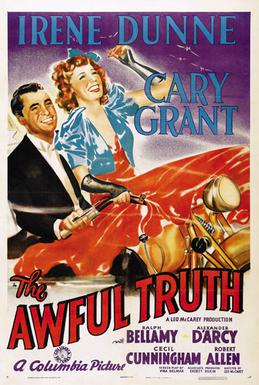
First released way back in 1937, The Awful Truth is one of the most delightful comedies that I’ve ever seen. In fact, if I could recommend one movie for you to make an effort to see, it would be The Awful Truth. This is definitely the best film to ever have the word “awful” in the title.
(Speaking of being the best, The Awful Truth is also the rare screwball comedy to receive a nomination for best picture. However, it lost to the far more serious The Life of Emile Zola.)
Jerry (Cary Grant) and Lucy Warner (Irene Dunne) are young, married, stylish, and rich. They seem to have it all but, as the result of Jerry’s lies and a misunderstanding concerning Lucy and her music teacher (Alexander D’Arcy), they end up getting a divorce. Fortunately, they still share a common bond. They both love their dog, Mr. Smith (played by Skippy, the same adorable and incredibly talented dog who played Asta in The Thin Man). Lucy wins custody of Mr. Smith and takes him with her when she moves in with her eccentric Aunt Patsy (Cecil Cunningham).
(It’s not a screwball comedy without an eccentric aunt.)
Jerry, however, has weekly visitation rights with Mr. Smith. It’s during once such visit that Jerry discovers that, with only two months to go before the final divorce decree, Lucy has become engaged to her next door neighbor, Dan (Ralph Bellamy). Dan is from Oklahoma and spends most of his time wistfully talking about tumbleweed, oil, and cattle. He also can’t wait to marry Lucy so that they can both move back to Oklahoma City. Dan is a nice guy but he’s no Cary Grant. (He’s also dominated by his judgmental mother.) Realizing that he still loves Lucy, Jerry wants to reconcile with her but complications and misunderstandings ensue.
(It’s not a screwball comedy without complications and misunderstandings.)
Eventually, in order to prove that he is over Lucy, Jerry starts to date a vacuous heiress, Barbara Vance (a hilariously shallow performance from Molly Lamont). Suddenly, Lucy finds herself in the same situation that Jerry was in with her and Dan. Now, it’s her turn to try to break up Barbara and Jerry…
Meanwhile, the day of the final divorce decree approaches…
There’s a lot of reasons to love The Awful Truth. There’s the snappy dialogue, the physical comedy (at one point, three different men are scurrying around Aunt Patsy’s apartment, two trying to hide from each other and one totally oblivious to everything going on around him), and Leo McCarey’s fast paced direction. There’s Mr. Smith, a dog so talented that even a confirmed cat person like me loved watching his performance. There’s the wonderful supporting turns of Ralph Bellamy and Molly Lamont.
But the main reason to see the film is because of the wonderful chemistry between Cary Grant and Irene Dunne. Grant is so smooth and effortless in his charm that it’s a lot of fun to watch him having to deal with the progressively strange world that he finds himself living in. The Awful Truth works best when Grant simply reacts to all the craziness around him. Grant could do more with one look than most actors could do with a Shakespearean monologue. Meanwhile, Irene Dunne … well, who wouldn’t want to get in a time machine, go back to 1937, and be Irene Dunne for a day? She’s lively, she’s beautiful, she’s witty, she’s classy, and she’s just neurotic enough to be relatable.
The Awful Truth is pure joy. If you haven’t seen it, you’re missing out. If you have seen it, watch it again.
— Rosemary Woodhouse (Mia Farrow) in Rosemary’s Baby (1968)
Yes, Rosemary, it is.
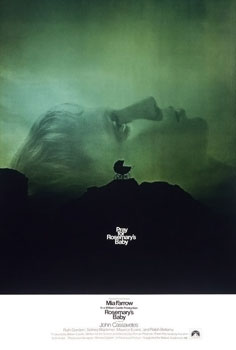
The classic 1968 horror movie Rosemary’s Baby is probably best remembered for a lengthy and wonderfully surreal “dream” sequence in which naive newlywed Rosemary Woodhouse (Mia Farrow) is raped by the Devil while a bunch of naked old people stand around her and chant. At one point, she sees her husband, Guy (John Cassavetes), saying that she’s awake and that she knows what’s going on. Their neighbor, Minnie Castevet (Ruth Gordon), tells him that Rosemary can’t hear anything and that it’s like she’s dead and then snaps at him, “Now, sing!” It’s a great sequence, one of the greatest of Roman Polanski’s career, a perfect blending of horror and dark comedy.
For me, the most interesting part of that dream sequence comes at the start. Rosemary envisions herself naked on a boat and, as she tries to cover herself, who is sitting next to her? None other than John F. Kennedy! Suddenly, Rosemary is wearing a bikini and she’s relaxing out on the deck with a glamorous group of people who I assume were meant to be Kennedy relatives. As the boat leaves the dock, Rosemary sees that her friend and protector, Hutch (Maurice Evans), is standing on the dock.
“Isn’t Hutch coming with us?” Rosemary asks.
“Catholics only,” John F. Kennedy hisses in that famous accent, “I’m afraid we are bound by these prejudices.”
“I understand,” a dazed Rosemary replies.
And it’s a wonderful little moment, though I have to wonder if I’d react as strong if my own background wasn’t Irish Catholic. But still, there’s something so wonderfully subversive about a bunch of elderly Satanists pretending to be the Kennedys.
And really, Rosemary’s Baby is a wonderfully subversive film. I imagine it was even more subversive when it was first released back in 1968. It’s been ripped off and imitated so many times that it has undoubtedly lost some of its impact. (That’s one reason why I wish I had a time machine, so I could go back in the past and see it was truly like to see a classic film for the first time.) But still, 47 years after it was initially released, Rosemary’s Baby is still a surprisingly effective horror film.
The film opens with newlyweds Rosemary and Guy moving into the Bramford, an exclusive New York apartment building. Guy is an actor who, despite having appeared in two off-Broadway shows (one of which was entitled Nobody Likes An Albatross and really, that is so true) and a few motorcycle commercials, is still waiting for his big break. There are hints that, before she married Guy, Rosemary had a very active and interesting life (when we briefly meet her old friends, they all seem to be a lot more exciting than boring old Guy) but, when we meet her, Rosemary appears to have happily settled into a life of domesticity.
Life at the Bramford is strange. For one thing, Guy and Rosemary appear to be the only young people living in the entire building. (There is a young woman named Terry but she ends up jumping out of a window.) The Woodhouses befriend elderly Minnie Castevet and her husband, Roman (Sidney Blackmer.) Roman claims to have traveled all over the world and embarrasses the Catholic Rosemary by criticizing the Pope. Minnie, meanwhile, is the noisiest person in the world. Guy makes fun of both of them and, yet, he still decides to spend his free time with Roman.
One day, Guy gets a role that he had previously lost. Why? Because another actor is struck by a sudden case of blindness. Shortly afterward, Rosemary has her “dream.” She wakes up and discovers that her body is covered with red scratches. Guy claims that he had sex with her while she was asleep and promises to cut his fingernails.
Soon, Rosemary is pregnant but the Castevets insist that she use their doctor, the firm and sinister Dr. Saperstein (Ralph Bellamy, who just 8 year earlier had played FDR in Sunrise at Campobello). Rosemary knows that something is wrong with the baby but she can’t get anyone to listen to her. It all leads to one of the best and most iconic endings in the history of horror cinema.
Rosemary’s Baby is a classic of fear and paranoia and it holds up surprisingly well. See it this October, whether you’re Catholic or not.
(However, do not see the needless 2014 remake. Seriously, what the Hell was up with that?)
(By the way, is anyone else amazed that I made it through this entire review without making a single joke about either Ronan Farrow or Mia’s lame Sharknado live tweet? I am shocked.)




![THE SECRET SIX [US 1931] WALLACE BEERY, JOHNNY MACK BROWN, JEAN HARLOW](https://unobtainium13.com/wp-content/uploads/2016/07/six2.jpg)

 Through the Shattered Lens