On Christmas Eve, a miserly businessman is visited by a series of ghosts who help him understand the true meaning of Christmas, along with showing him a frightening vision of a possible future.
And that businessman was named …. Benedict Slade!
Yeah, the name’s have been changed and the action has been updated to Depression-era New England but this is basically the story of Scrooge. Henry Winkler stars as the Scrooge character in the 1979 made-for-TV movie. His old age make-up was done by none other than Rick Baker!
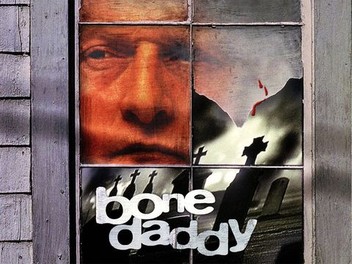
I became obsessed with the actor Rutger Hauer in the summer of 1990. I was about to go into my senior year of high school, and I was attending the Arkansas Governor’s School. I had seen Hauer before in films like THE HITCHER and WANTED: DEAD OR ALIVE, but as part of our curriculum, we all watched BLADE RUNNER and then broke up into smaller groups to analyze the film. Blown away by the film, Hauer’s powerful performance, and the opportunity to engage in a serious conversation about a movie with my peers, it was a rewarding experience, and I soon found myself seeking out every Hauer film I could find. I followed the charismatic Dutch actor’s career closely from that point forward, all the way up to his death in July of 2019. I was actually sitting on a beach in Florida when I read that he had passed away. Based on my extreme interest in every project that Hauer was associated with, I specifically remember when BONE DADDY premiered on HBO in 1998. I didn’t have HBO so I had to wait for a few months to catch it when it arrived on home video.
In BONE DADDY (1998), Rutger Hauer stars as Dr. Bill Palmer, a retired Chicago medical examiner turned bestselling author. Years earlier, Palmer investigated a series of brutal unsolved murders committed by a serial killer known as “Bone Daddy.” Retiring in frustration from not being able to solve the murders, Palmer pens the novel, “Bone Daddy,” a fictionalized account of the crimes where, unlike real life, the killer is caught and brought to justice. The book’s runaway success catapults Palmer to fame, but it also seems to pull the notorious Bone Daddy out of retirement. When his literary agent, the cocky, Rocky Carlson, is kidnapped and subjected to the killer’s signature torture, the surgical removal of bones from a living body, Palmer finds himself back on the case and teamed up with the no-nonsense police detective Sharon Wells (Barbara Williams). As the bones and the suspects pile up, Palmer is determined to make sure the killer is found and brought to justice this time around!
BONE DADDY is a pretty darn good entertainment option if you’re in the mood for an undemanding serial killer flick that’s in and out of your life in 90 minutes. It’s certainly not in the same league as SE7EN, but that doesn’t mean it can’t be enjoyed for what it is. The premise is pretty twisted, and the scenes where the killer is preparing to remove the bones of fully coherent victims is horrifying to say the least! There isn’t a lot of gore, but what’s there is pretty gross. This is B-movie territory and the lack of Hollywood gloss works in its favor. The film’s plot also has quite a bit of family drama between Dr. Palmer and his adult son Peter (Joseph Kell), who’s following in his dad’s professional footsteps in the medical field. It seems Dr. Palmer wasn’t the greatest dad and the current state of their relationship figures strongly throughout various portions of the film. This element of the story is actually handled quite well and adds some interesting tension as we move towards the end.
At the end of the day, the best thing about BONE DADDY is the presence of Rutger Hauer in the lead. He brings gravitas to the role of Dr. Palmer, a man who has had his share of successes and failures in the world. It’s his failures that continue to haunt him throughout this story and seems to put everyone around him in danger. Hauer, known for his ability to go over the top at times, plays the role completely straight with the quiet intensity and determination of a man trying to make up for past wrongs. It’s another solid performance in the career of the then-53 year old actor. I also want to give a special shout out to his nice, bushy mustache. I enjoyed it very much! The other primary performance of the film comes from Canadian actress Barbara Williams as the lead cop. In contrast to how much I enjoy Hauer, I’m just not much of a fan of Williams. She seems to be in a perpetual state of being offended in every role I’ve seen her in. She played Charles Bronson’s daughter in the FAMILY OF COPS series and her character was always on the ready to jump down someone’s throat for just about anything they said. It’s kind of the same here. I should probably try to look for some more of her work just to see if she ever smiles.
Overall, I think BONE DADDY is worth a watch, especially for fans of Rutger Hauer or movies about serial killers. The plot is predictable, and so is the identity of the killer if you’re paying attention, but you could definitely do a lot worse!
On Christmas Eve, a miserly businessman is visited by a series of ghosts who help him understand the true meaning of Christmas, along with showing him a frightening vision of a possible future.
And that businessman was named …. Benedict Slade!
Yeah, the name’s have been changed and the action has been updated to Depression-era New England but this is basically the story of Scrooge. Henry Winkler stars as the Scrooge character in the 1979 made-for-TV movie. His old age make-up was done by none other than Rick Baker!
Henry Ford changed the world, for both the better and the worst.
Starting from his own small workshop in Dearborn, Michigan, Henry Ford designed the first mass-produced automobile. He transformed cars from being a luxury item to being something that nearly every family owned. He created the concept of the assembly line. He argued that workers needed to be paid a livable wage and he also advocated for an 8-hour workday. At a time when every facet of American life was heavily segregated, he encouraged his factories an auto dealerships to hire black employees. He was a pacifist, who took part in a widely-ridiculed but apparently sincere effort to try to convince the leaders of the world to just stop fighting.
Unfortunately, Henry Ford was also something of an unhinged lunatic, a man whose skill at engineering and his empathy for his underpaid workers did not necessarily translate into a sophisticated understanding of anything else. When the workers in his factories tried to unionize, Ford employed violent strike breakers and he felt that most of the population were like a children and therefore incapable of governing themselves. He understood how to make car but he also fell for all sorts of quack science and was a believer in reincarnation.
Worst of all, he was a rabid anti-Semite, who blamed almost all of the world’s problems on “Jewish bankers” and who played a huge role in popularizing a scurrilous work called The Protocols of Elder Zion in America. Claiming to lay out the details of a Jewish plot to secretly control the world, The Protocols were a ludicrous document but many people believed them because they were promoted by Henry Ford, who was as big a celebrity in the early 20th Century as all of the social media influencers are today. All these years later, The Protocols are still cited by anti-Semites. A series of anti-Semitic editorials (which Ford later claimed to have signed off on but not actually written) were published in Germany under the title The International Jew, the World’s Foremost Problem. Hitler wrote of his admiration for Ford in Mein Kampf. Ford, it should be noted, did keep his distance from Hitler, though whether that was due to a personal distaste or the threat of an economic boycott is not known. (Jewish leaders had already organized one successful boycott of Ford in the 20s, which led to Ford closing down his newspaper and offering up an apology.) At the Nuremberg Trials, many of the Nazis said that they had first been introduced to anti-Semitism through the writings of Henry Ford. Reportedly, when Ford saw newsreel footage of the concentration camps, he was so overcome with emotion that he collapsed from a stroke.
(Two years ago, when Nick Cannon regurgitated the usual anti-Semitic conspiracy theories on a podcast, he was pretty much saying the exact same thing that Henry Ford said at the start of the 20th Century. Later, under threat of economic boycott, both Ford and Cannon would off up half-hearted apologies for their statements. Ford continued to make cars. Cannon continues to host a handful of television shows. How does that work?)
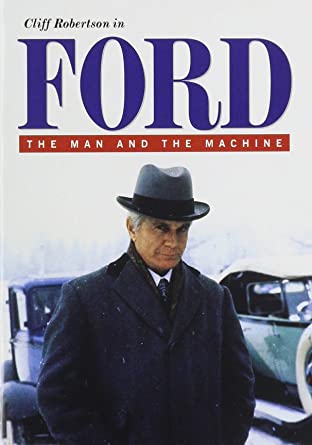
First broadcast over two nights in 1987, Ford: The Man and the Machine was a Canadian miniseries about the long and controversial life of Henry Ford. Cliff Robertson played Henry Ford. Hope Lange played his wife while Heather Thomas played his mistress. R.H. Thomson played Ford’s son, the sensitive Edsel. Michael Ironside played Harry Bennett, a sinister figure who was hired to break up union activity and who eventually became Ford’s right-hand man. If I remember correctly, I believe Canadian law actually required that Michael Ironside appear in almost every Canadian film and television show made in the 80s and the 90s. His glowering presence and menacing line delivery practically shouted out, “Don’t mess with Canada,” and he does bring a note of genuine danger to his performance here.
Ford: The Man and the Machine opens in the late 20s, with an aging Henry Ford already starting to lose control of his mental faculties. A series of flashbacks then show how Ford built his first engine, his first car, and eventually his first factory. We watch as Ford goes from being an enthusiastic, self-taught engineer to being one of the most powerful men in the world. Along the way, Ford grows arrogant. The same stubbornness that led to his early success also leads to his later problems. For all of his ability, Ford’s ego and his refusal to reconsider his conclusions leaves him vulnerable to both flattery and manipulation, whether it’s coming from the White House of Woodrow Wilson, from his own executives, or from the authoritarians who rose to power in Europe following the first World War. As portrayed in the movie, he’s a loving father who also flies into a rage when Edsel designs a car on his own. He loves his wife but he keeps a mistress. He loves his family but he’ll always prefer to spend time working on his cars than spending time with them. Henry Ford changes the world but his own hubris makes it impossible for him to change with it.
The miniseries is built around Cliff Robertson’s performance as Ford and Robertson does an excellent job in the role, convincingly playing Ford as he goes from being an enthusiastic dreamer to a paranoid millionaire to a doddering old man, a Bidenesque figuredhead who is only nominally in charge of his own company. Neither the film nor Robertson shy away from showing us Henry Ford’s flaws. Instead, both the production and the actor offer up a portrait of a complex man who transformed the way that people lived but who couldn’t escape from his own prejudices and resentments. Ford: The Man and The Machine is a history lesson but it’s a valuable one. If you’re a student of history, you’ll find much to think about in this miniseires.
For the record, I do drive a Ford and it’s a good car. However, I tell myself that it’s named after Gerald Ford.
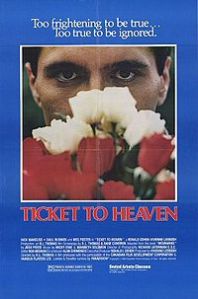
At the start of 1980’s Ticket To Heaven, we’re introduced to David (Nick Mancuso), a normal young man from an upper middle class background. David is likable enough but, when we first meet him, is still feeling depressed after breaking up with his longtime girlfriend. He handles his loneliness by meeting up with Karl, a friend from college. Karl, who is accompanied by an almost unbelievably positive young woman (played by a very young Kim Cattrall), invites David to come spend the weekend at a religious “retreat.” For reasons that have more to do with Cattrall than with any interest in religion, David agrees.
The retreat turn out to be a camp where everyone is extremely friendly and extremely positive. From the minute David arrives, everyone is smiling at him and telling him how thrilled they are to meet him. It’s such a positive experience that David doesn’t even complain when he’s given little to eat, allowed very little sleep, and forced to endure hours of talk about the great spiritual leader who set up the camp. When David does eventually decide that he’d like to leave, all of his friendly campmates are so wounded by his rejection that he changes his mind. Who wouldn’t? After all, they’re so nice and idealistic and positive.
Needless to say, David never leaves the camp. When his best friend (played by Saul Rubinek) happens to run into David on the street, he’s shocked to discover that David has become a blank-eyed zombie whose life now revolves around selling flowers in the street and making money for his new friends. However, David’s old friends aren’t quite ready to give him up and the rest of the film details the battle between the two groups for David’s mind and soul.
Ticket to Heaven is a genuinely unsettling film. As directed by Ralph Thomas, the entire film seem to ooze a very real creepiness that stays with you even after the end credits have rolled. The film is at its best when it shows, in painfully believable detail, just how easy it is for someone to become brainwashed and to set aside everything that makes them unique in the name of a “greater good.”
The film’s cast is made up of a talented group of mostly Canadian character actors and, down to the smallest role, they’re all disturbingly believable. Kim Cattrall is probably the most recognizable face in the cast, though Michael Wincott (he of the sexy, gravelly voice) also shows up in a tiny role. Nick Mancuso and Saul Rubinek are believable as best friends and Mancuso is such a likeable presence that it makes his transformation into soulless zombie all the more disturbing. Meg Foster — who looks like a thin, somewhat stable version of Kirstie Alley — gives an excellent and chilling performance as one of the cult’s leaders.
However, for me, the film’s best performance was given by an actor named R.H. Thomson. Playing a cult deprogrammer named Linc Strunc (what a great name), Thomson is only in a handful of scenes but he dominates every one of them. Speaking through clenched teeth and giving off an attitude of weary cynicism, Thomson takes a role that could have been a stereotype and makes it instead very compelling. If I choose to believe Wikipedia, Thomson is still active as an actor and, after seeing his work in Ticket to Heaven, I may have to track down his other films.
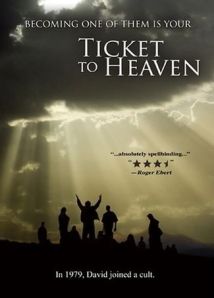
Despite having won a Genie (the Canadian version of the Oscar), Ticket to Heaven is something of an obscure film. I have to admit that I bought the DVD on something of a whim and that was mostly because I was intrigued by the words “In 1979, David joined a cult…” on the DVD’s cover. I’ve long been fascinated by cults and just how easily some people can surrender everything the makes them a unique and individual human being.
During my first semester away at college, there used to be a small handful of students who, every night, would gather together outside the student union. Since I’ve always been a night person, I’d often find myself walking by their little group and I always felt a little bit anxious whenever I saw them. They all looked perfectly normal but there was still something off about them. As my roommate Kim put it, they all looked like they had wandered out of a toothpaste commercial. There was also the fact that they obviously considered themselves to be a part of an exclusive club that the rest of us had not been invited to join.
One night, Kim and I went down to the student union to check our mail. As we were heading back to our dorm, we passed this little group and I noticed that one of them appeared to be holding a microphone. I guess he saw me looking because he held the microphone up to his lips and said, his voice booming, “HEY YOU, DO YOU KNOW THE LORD!?” At the time, Kim and I both considered ourselves to be decadent Pagans so we answered by sharing a long kiss in front of them and then laughing at the dead glares that greeted our response before we then ran, hand-in-hand, back to the dorms. In retrospect, I guess that was my invitation to join the club and I’m glad I was too busy trying to be worldly to accept it.
A few nights later, I found myself suffering from the insomnia that’s plagued me for as long as I can remember. Around 3:00 a.m., I was sitting down in the dorm’s lobby, trying to write angsty poetry. On the other side of the lobby was this guy that we’ll call “Rich.” You’ve probably known someone like Rich. He’s one of those guys who was always smiling a little bit too much, who was always almost desperately friendly. Rich was someone who, for whatever reason, was obviously lost and looking at him, you got the sense that he’d never been truly happy a day in his life. I always felt sorry for Rich but I was also a little scared of him.
That night, I was happy that he wasn’t trying to talk to me. Instead, he was just quietly sitting in a corner with a blank stare. Suddenly, he was approached by three men who greeted him by name and, visibly shaking, Rich stood up to greet them. It took me a few minutes but then I recognized that two of the guys were from that same group that always gathered outside the union. Standing in between them was a balding, bearded man who I’d never seen before or since.
The four of them sat down and they were soon leaning forward in huddled conversation. I found myself straining to hear what they were saying but I could only pick up a few words. I could see that Rich was still shaking and that he had started to cry.
Suddenly, the bearded man spoke in a voice that snapped through the entire lobby. “You little shit,” he said, “You pathetic motherfucker!”
As the two others sat there impassively, the bearded man leaned forward until his face was inches in front of Rich’s. From where I was sitting, it looked almost as if Rich’s face was being eclipsed by the back of the man’s head. The man continued to speak but now his voice was low and I couldn’t make out the exact words. But I could tell from his body language and his gestures that he was giving Rich more of the same.
After about an hour of this, Rich started nodding and, tears flowing down his face, he started to say, “Praise God! Praise God! Thank you! Praise God!”
The four of them stood up and, as I watched in disbelief, they stood there hugging each other as Rich continued with his “Praise God!” The three guys then headed out and Rich, smiling even though his face was still slick with tears, skipped out of the lobby.
Rich graduated at the end of that semester. A few years later, when I was about to graduate, I heard someone say that Rich had recently committed suicide. I don’t know if that’s true and it’s almost too obvious an ending to his story.
I thought a good deal about Rich and that night after I finished watching Ticket to Heaven.
Admittedly, Ticket to Heaven is not a “perfect film.” Strong as Mancuso’s performance is, David is still something of a sketchy character. The film does a good job showing the techniques that the cult uses to brainwash David but it’s never quite clear why David was so susceptible to those techniques to begin with. There are hints, of course. David is shown to be upset over breaking up with his girlfriend and there are hints that his safely middle class existence has left with him with little sense of having an individual existence of his own. That doesn’t change the fact that David ultimately comes across as less of a real person and more as a way for the film to preach its anti-cult message.
Indeed, the film’s biggest flaw is that it is essentially a message film. As well-acted and intelligently scripted as it often is, the movie exists to deliver a message. Fortunately, it’s a good message but that doesn’t stop the film from sometimes rather heavy-handed. This is most obvious in the movie’s final scene in which things are tied up just a little bit too neatly.
Still, flaws aside and despite having been made 30 years ago, Ticket to Heaven remains a relevent film. We live in a world that, for the most part, is made up of brainwashed people and, watching the movie, I had to wonder how much difference there really was between the overbearingly positive cultist played by Kim Cattrall and the grim-faced jihadists that currently haunt our nightmares. When you consider just how much evil is justified, on a daily basis, in the name of the greater good, its becomes obvious that the movie’s warning against becoming a living zombie is just as important today as when the film was made.
The film’s cult is based on an actual, real-life group that was apparently very active in the late 70s and who are still around today, the Unification Church. I vaguely remember them being in the news back in 2004 when the head of the church was declared to be “the prince of peace” at a ceremony that was attended by a few congressmen. Type “Unification Church” into google and you’ll end up with links to a lot of stories that would seem to suggest that the real cult is even more creepy than the fictionalized version in Ticket to Heaven.
 Through the Shattered Lens