This music video was directed by Jim Yukich, who is one of those directors who seems to have directed a video for everyone. If you have ever had a hit song or top-selling album, Jim Yukich probably directed a music video for you. He directed a lot of videos for both Genesis and Phil Collins as a solo act. But Yukich also directed videos for everyone from Iron Maiden to David Bowie, Michael Jackson, Huey Lewis, and David Hasselhoff. Going for Maiden to Hasselhoff, that’s a journey!
This song received lukewarm reviews when it was first released but, as is this case with much of Collins’s work, it has since been favorably reevaluated.
As I mentioned earlier, today is Phil Collins’s birthday so today’s song of the day is one of my favorites. From the film of the same name, here is Against All Odds (Take A Look At Me Now).
How can I just let you walk away, just let you leave without a trace When I stand here taking every breath with you, ooh You’re the only one who really knew me at all
How can you just walk away from me, when all I can do is watch you leave Cos we’ve shared the laughter and the pain and even shared the tears You’re the only one who really knew me at all
So take a look at me now, oh there’s just an empty space And there’s nothing left here to remind me, just the memory of your face Ooh take a look at me now, well there’s just an empty space And you coming back to me is against all odds and that’s what I’ve got to face
I wish I could just make you turn around, turn around and see me cry There’s so much I need to say to you, so many reasons why You’re the only one who really knew me at all
So take a look at me now, well there’s just an empty space And there’s nothing left here to remind me, just the memory of your face Now take a look at me now, cos there’s just an empty space
But to wait for you, is all I can do and that’s what I’ve got to face Take a good look at me now, cos I’ll still be standing here And you coming back to me is against all odds It’s the chance I’ve gotta take
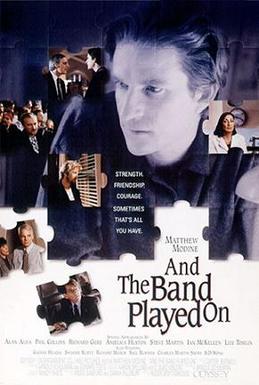
That was one of my main thoughts as I watched 1993’s And The Band Played On.
Directed by Roger Spottiswoode and featuring an all-star cast, And The Band Played On deals with the early days of the AIDS epidemic. It’s a film that features many different characters and storylines but holding it all together is the character of Dr. Don Francis (Matthew Modine), an epidemiologist who is haunted by what he witnessed during the Ebola epidemic in Africa and who fears that the same thing is going to happen in America unless the government gets serious about the mysterious ailment that is initially called “gay cancer” before then being known as “GRID” before finally being named AIDS. Dr. Francis is outspoken and passionate about fighting disease. He’s the type who has no fear of yelling if he feels that people aren’t taking his words seriously enough. In his office, he keeps a track of the number of HIV infections on a whiteboard. “Butchers’ Bill” is written across the top of the board.
Throughout the film, quite a few people are dismissive of Dr. Francis and his warnings. But we, the audience, know that he’s right. We know this because we know about AIDS and but the film also expects us to trust Dr. Francis because it’s specifically stated that he worked for the World Health Organization before joining the Center For Disease Control in Atlanta, Georgia. As far as the film is concerned, that’s enough to establish his credentials. Of course, today, after living through the excesses of the COVID pandemic and the attempts to censor anyone who suggested that it may have begun due to a lab leak as opposed to some random guy eating a bat, many people tend to view both the WHO and the CDC with a lot more distrust than they did when this film was made. As I said, we live in a cynical time and people are now a lot less inclined to “trust” the experts. To a large extent, the experts have only themselves to blame for that. I consider myself to be a fairly pragmatic person but even I now find myself rolling my eyes whenever a new health advisory is issued.
This new sense of automatic distrust is, in many ways, unfortunate. Because, as And The Band Played On demonstrates, the experts occasionally know what they’re talking about. Throughout the film, people refuse to listen to the warnings coming from the experts and, as a result, many lives are lost. The government refuses to take action while the search for a possible cure is hindered by a rivalry between international researchers. Alan Alda gives one of the best performances in the film, playing a biomedical researcher who throws a fit when he discovers that Dr. Francis has been sharing information with French scientists.
It’s a big, sprawling film. While Dr. Francis and his fellow researchers (played by Saul Rubinek, Glenne Headly, Richard Masur, Charles Martin Smith, Lily Tomlin, and Christian Clemenson) try to determine how exactly the disease is spread, gay activists like Bobbi Campbell (Donal Logue) and Bill Kraus (Ian McKellen) struggle to get the government and the media to take AIDS seriously. Famous faces pop up in small rolls, occasionally to the film’s detriment. Richard Gere, Steve Martin, Anjelica Huston, and even Phil Collins all give good performances but their fame also distracts the viewer from the film’s story. There’s a sense of noblesse oblige to the celebrity cameos that detracts from their effectiveness. All of them are out-acted by actor Lawrence Monoson, who may not have been a huge star (his two best-known films are The Last American Virginand Friday the 13 — The Final Chapter) but who is still heart-breakingly effective as a young man who is dying of AIDS.
Based on a 600-page, non-fiction book by Randy Shilts, And The Band Played On is a flawed film but still undeniably effective and a valuable piece of history. Director Roger Spottiswoode does a good job of bringing and holding the many different elements of the narrative together and Carter Burwell’s haunting score is appropriately mournful. The film ends on a somber but touching note. At its best, it’s a moving portrait of the end of one era and the beginning of another.
Welcome to Retro Television Reviews, a feature where we review some of our favorite and least favorite shows of the past! On Mondays, I will be reviewing Miami Vice, which ran on NBC from 1984 to 1989. The entire show can be purchased on Prime!
The Vice Squad goes after Phil Collins!
Episode 2.11 “Phil the Shill”
(Dir by John Nicolella, originally aired on December 13th, 1985)
Switek and Zito call in sick so that they can go to the taping of a silly game show called Rat Race. While Zito sits in the audience, Switek answers trivia questions about Elvis and competes in an obstacle course race with his spacey opponent (Emo Phillips). Hosting the show is the very effusive and very British Phil Mayhew (Phil Collins).
As we already know, Switek knows everything about Elvis. And he’s in better shape than Emo Phillips so, when it comes time for the obstacle course, he reaches and hits his buzzer first. But Switek’s buzzer doesn’t go off. Emo’s buzzer works and Emo proceeds to robotically recite a complex string of Elvis trivia.
To his horror, Switek realizes that the quiz show was fixed!
Switek and Zito decide that they want to take down Phil and reveal his con artist ways. Unfortunately, for them, the rest of the Squad doesn’t care. Crockett, in particular, is annoyed that Switek pretended to be sick to get a night off of work. However, it then turns out that Phil has hooked up with Sarah MacPhail (Kyra Sedgwick), the girlfriend and business partner of Tony Rivers (Michael Margotta), a drug dealer that Crockett has spent months trying to set up.
It’s time to call in Izzy and have him pretend to be an interior decorator so that Phil can be tricked into throwing a party that can be attended by …. SONNY BURNETT AND RICO COOPER! Listen, I know I mention that a lot but I just can’t let it go …. how are Sonny and Rico able to maintain their undercover identities when they’re constantly arresting major drug dealers and taking part in DEA busts? How come it never occurs to the criminals that dealer Sonny Burnett might have something in common with cop Sonny Crockett? Does no one ever notice that Sonny Burnett drives the same car and wears the same white suit as Sonny Crockett?
This was a bit of an odd episode. It was obviously written so that Phil Collins (whose In The Air Tonight set the mood for the entire series) could play Phil Mayhew. And while Phil Collins does not appear to have been an actor of amazing range, he still does a good job as the weaselly Phil Mayhew. The Phil scenes are played for humor while the scenes with Tony Rivers definitely are not. Tony is a violent sociopath who casually kills several people over the course of the episode. Scenes of Switek pouting about the game show feel awkward when combined with scenes of Tony machine gunning two drug dealers. Collins does a good job within his range and Michael Margotta is an energetic villain. However, the best performance in this episode actually comes from Kyra Sedgwick, who does a great job as someone who eventually turns out to be just as ruthless and dangerous her boyfriend.
This is a fast-paced and energetic episode, one that moves quickly enough that the viewer doesn’t really have time to consider the oddness of Phil Mayhew getting involved with the same drug dealer that Crockett happens to be investigating. Personally, I’m always happy when the members of the supporting cast get to do something more than just stand in the background. Switek and Zito are a good team.
The music video for Sussudio was filmed at The Princess Victoria, a London pub that, at the time, was owned by Richard Branson.
This video was directed by Jim Yukich, a frequent Collins collaborator who has basically directed videos for everyone who was anybody in the music business.
Both Sides of the Story was the lead single from Phil Collins’s fifth solo album. Collins has said that both the song and the music video were inspired by the 1991 film GrandCanyon, which featured a group of Los Angeles residents (played by Kevin Kline, Steve Martin, Danny Glover, and others) dealing with crime, racism, gangs, and income inequality.
The video was directed by Jim Yukich, who directed almost all of Phil Collins’s videos in the 80s and the 90s. The video follows the lyrics of the song, going from the poor to the rich to finally a violent confrontation in the streets. This is Phil Collins in a serious mood.
Can’t Turn Back The Years is found on Phil Collins’s fifth solo studio album, Both Sides. Like much of Collins’s output, Both Sides received lukewarm reviews when it was initially released but it has since been reevaluated.
The music video was directed by Jim Yukich, who is one of those directors who seems to have directed a video for everyone. If you have ever had a hit song or top-selling album, Jim Yukich probably directed a music video for you. He directed a lot of videos for both Genesis and Phil Collins as a solo act. But Yukich also directed videos for everyone from Iron Maiden to David Bowie, Michael Jackson, Huey Lewis, David Hasselhoff, and Debbie Gibson.
Another Day In Paradise is one of two songs that Phil Collins has recorded about the homeless. (The other was Man On The Corner.) When this song first came out, Collins was accused of being a wealthy and condescending rock star who was more interested in singing about a problem than actually doing anything to solve it. In an interview with Rolling Stone, Collins responded to the criticism with, “When I drive down the street, I see the same things everyone else sees. It’s a misconception that if you have a lot of money you’re somehow out of touch with reality.”
The video, which juxtaposes Phil singing with images of the homeless, was directed by Jim Yukich, who did the majority of Phil Collins’s and Genesis’s videos in the 80s and the 90s. The scenes of Collins singing were filmed in New York City and were completed in under an hour.
I am fairly certain that I’ve heard a version of this song in which George H.W. Bush is heard giving a speech about the homeless. I cannot find any official online confirmation that it exists but I know it’s out there somewhere.
What sets All of My Life apart from all of the other adult contemporary, “easy listening” music that Phil Collins released in the 90s is that saxophone solo at the start of the song. That sax solo almost makes up for all the bland Disney sons that Collins wrote in search of that first Oscar.
As for this video, it’s largely a performance clip but, mixed in, there are a few scenes of Phil Collins going about his everyday life. Of course, for Phil, everyday life meant a private plane and a luxury tour bus. What a likeable bloke! Personally, I don’t care how Phil Collins spent his money. As the saying goes, “If you’ve got it…”
This video was directed by Jim Yukich. Yukich was one of those video directors who, if you were a successful musical artist in the late 80s or the 90s, you would probably end up making at least one video with Yukich. Yukich directed videos for everyone from Iron Maiden to Genesis to REO Speedwagon. He got around.

 Through the Shattered Lens