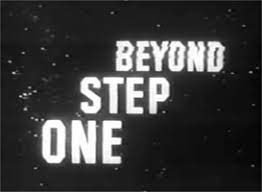
In this episode of One Step Beyond, which takes place over the course of several years, Lisa Garrick lives in fear of a chandelier in her family’s home. For her entire life, she has had a premonition that she is going to die when the chandelier comes crashing down. She refuses to stop into the room but eventually, both her father and her fiancé, insist that she conquer her fear and enter the room.
Seriously, if she doesn’t want to enter the room …. don’t make her enter the room! I love chandeliers but they do make me nervous. They always look like there about to come crashing down to me.
I like this episode because the main character is named Lisa.
This episode originally aired on March 10th, 1959.
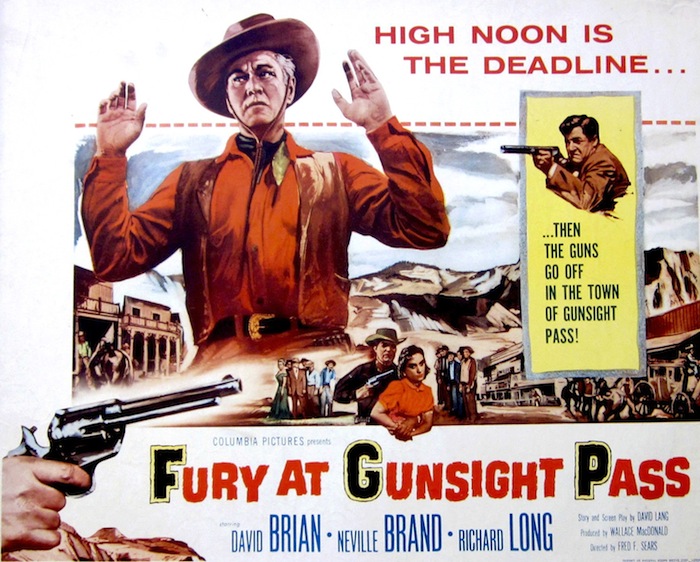
Old west outlaws Whitey Turner (David Brian) and Dirk Hogan (Neville Brand) are plotting on robbing the bank in the town of Gunsight Pass. They’ve even got an inside man to help them get away with the loot, local undertaker Peter Boggs (Percy Helton). Peter is eager to make some money and get away from his nagging wife (Katherine Warren). However, the robbery doesn’t go as planned. Whitey attempts to betray Dirk, there’s a huge shoot out, and several people are killed, including the bank president (Addison Richards). Whitey and his half of the gang are captured while Dirk barely escapes.
Because a satchel of money is missing, Dirk rescues Whitey from the posse and they return to the town of Gunfight Pass, determined to hold the entire town hostage until they get their money. While a huge dust storm blows through the town, the citizens of Gunsight Pass start to turn on each other, accusing one another of having stolen the money for themselves. The now dead bank president is accused of being a part of the robbery and it falls to his son (Richard Long) to try to not only clear his name but to also save the town from Dirk and Whitey.
Fury at Gunsight Pass is a nice discovery, an intelligent B-western that’s about more than just gunfights and money. Though David Brian and Neville Brand are both convincing as the two gang leaders, the movie is mostly about the citizens of the town and how quickly they all turn on each other. The citizens of this town make the ones from High Noon seem brave and supportive. All it takes is a little fear and greed for everyone to turn on each other. The film has such a cynical view of human nature that, in 1956, it probably couldn’t have gotten away with it if it had been anything other than a B-movie.
Fred F. Sears directed a lot of B-westerns, the majority of which were fairly undistinguished programmers. Fury At Gunsight Pass is an exception to that rule and probably the best film that Fred Sears ever directed. It’s a well-acted and well-directed movie that will take even the most experienced B-western fan by surprise.
When we first meet Carolyn Elleson Grant (Marie Windsor), she refuses to give her husband, Harlow Grant (John Archer) a divorce, despite the fact that they’ve been separated for several years and Harlow now wants to marry Louise Nelson (Nancy Gates) and Carolyn is now involved with an art critic named Wayne Vincent (Patrick Knowles). Carolyn only married Harlow for his money and, while she has other rich lovers, she just enjoys making Harlow’s life as difficult as possible. It’s hard to blame her because Harlow is kind of whiny.
However, Carolyn has grown bored with Wayne Vincent and she’s now decided that she would rather get involved with Dick Sawyer (Richard Crane), who is rich and owns a boat. However, Dick is engaged to Carolyn’s personal assistant, Betty (Jill Jarmyn). Carolyn thinks it would be perfectly amusing to not only seduce Dick but to also destroy Betty’s happiness.
Why?
As one character put it, Carolyn is “a witch!”
(Someone then adds that Carolyn is a word that “rhymes” with witch. They don’t actually say the word because this film was made in 1955 but still….)
With Carolyn casually trying to destroy everyone’s lives and happiness, is it really a shock when some unseen person shows up at her art studio late at night and shoots her?
With Carolyn dead, it falls to Detectives Colton (Louis Jean Heydt) and Wells (John Gallaudet) to figure out the identity of the murder. They immediately suspect that it had to have been Harlow Grant. Not only does he have the motive and the opportunity but his name is Harlow Grant and I defy you to find anyone named Harlow Grant who hasn’t subsequently turned out to be involved in something shady. Harlow, however, insists that he’s innocent and the investigation is about to get a lot more complicated….
Well, okay, maybe not a lot more complicated. To be honest, it’s really not that difficult to figure out who the murderer actually is No Man’s Woman but that’s okay. The investigation itself only takes the last third of this 70-minute film. No Man’s Woman is a like a low-budget version of Gosford Park. The murder is less important than all of the drama surrounding it.
And make no mistake, there’s a lot of drama! This is a fun movie, specifically because Carolyn is such a wonderfully evil character and Marie Windsor has so much fun playing her. Carolyn doesn’t really have any deep motivation for why she does the terrible things that she does. She just does them because she can and she believes that she can get away with it. A good deal of the film’s entertainment comes from just seeing how bad Carolyn can be. In fact, you’re a bit disappointed when she’s murdered because Carolyn is the most enjoyable character in the movie. She’s someone who is literally willing to do and say anything and she makes an apologies for her actions. You wouldn’t necessarily want to work with her but she’s fun to watch.
The rest of the cast is adequate. John Archer and Nancy Gates are a bit on the dull side as the “good” characters but I liked the performances of the other suspects. Richard Crane and Jill Jarmyn, in particular, are memorable as Dick and Betty. I loved how going out on someone’s boat was apparently the height of decadence in 1955.
No Man’s Woman is an entertaining mix of noir and soap opera. Find it on Prime!
The 1953 film noir, Wicked Woman, opens with a bus coming to a stop in a small town in the middle of nowhere.
Getting off the bus is Billie Nash (Beverly Michaels). From the minute she starts walking through the town, it’s obvious that Billie may not have a home and she may not have a lot of money but what she does have is total and complete confidence in herself. Nobody tells Billie Nash what to do! When she movies into a boarding house (the rent is $6 a week!), she’s leered at by her new neighbor, the diminutive Charlie Borg (Percy Helton, a character actor who will be familiar to anyone who has ever spent a week bingeing on TCM.)
It turns out to be a rather low-rent boarding house. The landlady may be found of shouting, “I run a respectable place!” but nothing about this location seems to support that claim. Billie has one room to herself. The bathroom is down the hall. A pay phone sits in the hallway. Billie actually has to spend money to make a phone call. Fortunately, Charlie Borg is always around and willing to loan her money. In fact, when Billie says that she needs twenty dollars to buy a new outfit, Charlie hands it over and asks Billie to thank him by going out to dinner with him sometime. Even though she has no intention of ever spending any lengthy amount of time with Charlie, Billie says sure. Money is money. You do what you have to do.
(Myself, I’d just like to live in a time when it only cost $20 to buy a new outfit.)
Once Billie finally manages to get Charlie to stop bugging her, she goes down to the local bar and applies for a job. It’s not much of a bar but, again, money is money. The bar is owned by Dora Bannister (Evelyn Scott), an alcoholic who asks Billie if she’s sure that she can the bar’s “rough crowd.” Billie assures her that there’s no one so rough that she can’t handle and, as played by Beverly Michaels, you never doubt that she’s telling the truth.
Soon, Billie is flirting with the bar’s handsome bartender, Matt (Richard Egan). Matt is ambitious and hard-working and, after just a few nights, he’s absolutely crazy about Billie. The only problem is that Matt is not only married but he’s married to Dora! That doesn’t matter to Billie. In fact, she’s even come up with a scheme to steal not only Matt but also the bar from Dora.
Unfortunately, for Billie, the walls at the boarding house are extremely thin and Charlie overhears her and Matt scheming. It turns out that Charlie’s not quite as clueless as he seems and soon, he’s blackmailing Billie. He really wants that date….
Wicked Woman is a wonderfully sordid, low-budget film noir, one that features just a little bit of everything. Adultery, blackmail, sex, addiction …. it’s all here and it’s impossible not to be entertained by the film’s over-the-top melodrama. While both Richard Egan and Percy Helton are memorable as the two men in her life, the film is pretty much stolen by Beverly Michaels. Whether coolly glaring at Charlie or giving a little smile after having done something particularly manipulative, there’s rarely a time that Billie isn’t in complete control of her destiny. Beverly Michaels is a force of nature in this film and she turns “wicked” into a compliment.
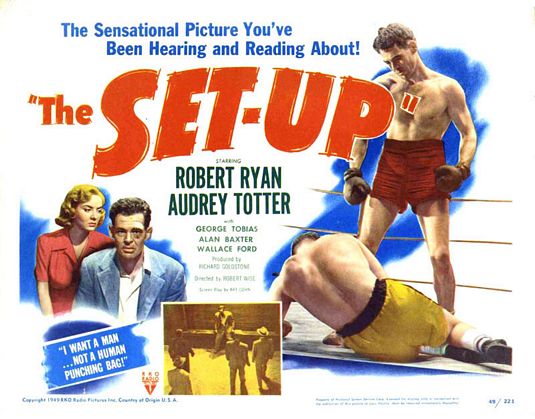
The seedy worlds of professional boxing and film noir were made for each other. Both are filled with corruption, crime, and desperate characters trapped in situations beyond their control. Movies like CHAMPION, BODY AND SOUL, and THE HARDER THEY FALL expose the dark underbelly of pugilism. One of the best of this sub-genre is THE SET-UP, Robert Wise’s last film for RKO studios. He doesn’t fail to deliver the goods, directing a noir that packs a wallop!
THE SET-UP follows one night in the life of aging, washed up fighter Stoker Thompson ( Robert Ryan ). Stoker’s 35 now, ancient in boxing terms, but still has delusions of making the big time. Wife Julie (Audrey Totter ) is tired of going from one tank town to the next, and fears for Stoker’s safety. She refuses to go to tonight’s fight, a matchup with up and coming young contender Tiger…
It’s the turn of the 20th century and the Old West is fading into legend. When they were younger, Steve Judd (Joel McCrea) and Gil Westrum (Randolph Scott) were tough and respect lawmen but now, time has passed them by. Judd now provides security for shady mining companies while Gil performs at county fairs under the name The Oregon Kid. When Judd is hired to guard a shipment of gold, he enlists his former partner, Gil, to help. Gil brings along his current protegé, Heck Longtree (Ron Starr).
On their way to the mining camp, they spend the night at the farm of Joshua Knudsen (R.G. Armstrong) and his daughter, Elsa (Mariette Hartley). Elsa is eager to escape her domineering father and flirts with Heck. When they leave the next morning, Elsa accompanies them, planning on meeting her fiancée, Billy Hammond (James Drury), at the mining camp.
When they reach the camp, they meet Bill and his four brothers (John Anderson, L.Q. Jones, John Davis Chandler, and the great Warren Oates). Billy is a drunk who is planning on “sharing” Elsa with his brothers. Gil, Judd, and Heck rescue Elsa and prepare for a final confrontation with the Hammond Brothers. At the same time, Gil and Heck are planning on stealing the gold, with or without Judd’s help.
Ride the High Country was actually Sam Peckinpah’s second film but it’s the first of his films to truly feel like a Sam Peckinpah film. (For his first film, The Deadly Companions, Peckinpah was largely a director-for-hire and had no say over the script or the final edit.) Peckinpah rewrote N.B. Stone’s original script and reportedly based the noble Steve Judd on his own father. All of Peckinpah’s usual themes are present in Ride the High Country, with Judd and, eventually, Gil representing the dying nobility of the old west and the Hammond brothers and the greedy mining companies representing the coming of the “modern” age. Ride The High Country‘s final shoot-out and bittersweet ending even serve as a template for Peckinpah’s later work in The Wild Bunch.
Much like the characters they were playing, Randolph Scott and Joel McCrea were two aging veterans on the verge of retirement. For these two aging stars, who had starred in countless westerns before this one, Ride The High Country would provide both fitting farewell and moving tribute. This would be the last chance that either of them would have to appear in a great movie and both of them obviously relish the opportunity. The best moments in the film are the ones where Judd and Gil just talk with the majestic mountains of California in the background.
Among the supporting cast, Ron Starr and Mariette Hartley are well-cast as the young lovers but are never as compelling as Gil or Judd. Future Peckinpah regulars R.G. Armstrong, L.Q. Jones, and Warren Oates all make early appearances. Seven years after playing brothers in Ride the High Country, L.Q. Jones and Warren Oates would both appear in Peckinpah’s most celebrated film, The Wild Bunch.
The elegiac and beautifully-shot Ride The High Country was Sam Peckinpah’s first great film and it might be his best.
Randolph Scott and Joel McCrea in Ride The High Country
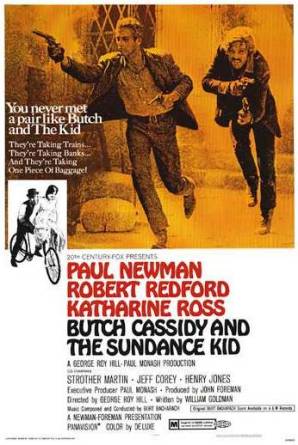
Should I start this post by ticking everyone off or should I start out by reviewing the 1969 best picture nominee Butch Cassidy and The Sundance Kid?
Let’s do the review first. I recently watched Butch Cassidy and the Sundance Kid when it aired as a part of TCM’s 31 Days of Oscar. This was actually my third time to see the film on TCM. And, as I watched Butch Cassidy and the Sundance Kid for the third time, I was shocked to discover how much I had forgotten about the film.
Don’t get me wrong. I remembered that it was a western and that it starred Paul Newman and Robert Redford as real-life outlaws Butch Cassidy and the Sundance Kid. I remembered that it opened and ended with sepia-toned sequences that suggested that Butch and Sundance represented the last gasp of the old west. I remembered that Butch won a fight by kicking a man in the balls. I also remembered that they robbed the same train twice and, the second time, they accidentally used too much dynamite. I remembered that, for some reason, Butch spent a lot of time riding around on a bicycle. I remembered that Butch and Sundance ended up getting chased by a mysterious posse. I remembered that Sundance could not swim. And I remembered that the film eventually ended on a tragic note in South America…
And I know what you’re saying. You’re saying, “It sounds like you remembered the whole movie, Lisa!”
No, actually I did not. The thing with Butch Cassidy and the Sundance Kid is that the scenes that work are so memorable that it’s easy to forget that there’s also a lot of scenes that aren’t as memorable. These are the scenes where the film drags and you’re thankful that Paul Newman and Robert Redford were cast as Butch and Sundance, because their charisma helps you overlook a lot of scenes that are either too heavy-handed or which drag on for too long. You’re especially thankful for Newman, who plays every scene with a twinkle in his wonderful blue eyes and who is such a lively presence that it makes up for the fact that Redford’s performance occasionally crosses over from being stoic to wooden. It can be argued that there’s no logical reason for a western to feature an outlaw riding around on a bicycle while Raindrops Keep Fallin’ On My Head plays on the soundtrack but Paul Newman’s so much fun to watch that you can forgive the film.
Newman and Redford both have so much chemistry that they’re always a joy to watch. And really, that’s the whole appeal of Butch Cassidy and the Sundance Kid, the chance to watch two iconic actors have fun playing opposite each other. Even though Katharine Ross appears as their shared romantic interest, the film’s love story is ultimately between Butch and Sundance (and, by extension, Newman and Redford). You can find countless reviews that will give all the credit for the film’s appeal to William Goldman’s screenplay. (You can also find countless self-satisfied essays by William Goldman where he does the exact same thing.) But, honestly, the film’s screenplay is nothing special. This film works because of good, old-fashioned star power.
Now, for the part that’ll probably tick everyone off (heh heh), I think that Butch Cassidy and the Sundance Kid is actually a pretty good pick for a future remake. All you have to do is pick the right actors for Butch and Sundance. I’m thinking Chris Pratt as Butch and Chris Evans as Sundance…


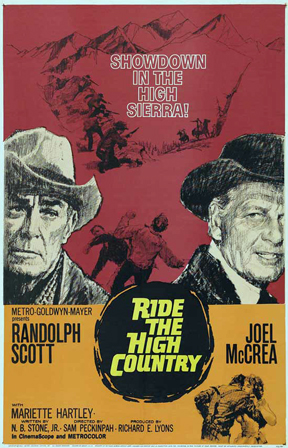 It’s the turn of the 20th century and the Old West is fading into legend. When they were younger, Steve Judd (Joel McCrea) and Gil Westrum (Randolph Scott) were tough and respect lawmen but now, time has passed them by. Judd now provides security for shady mining companies while Gil performs at county fairs under the name The Oregon Kid. When Judd is hired to guard a shipment of gold, he enlists his former partner, Gil, to help. Gil brings along his current protegé, Heck Longtree (Ron Starr).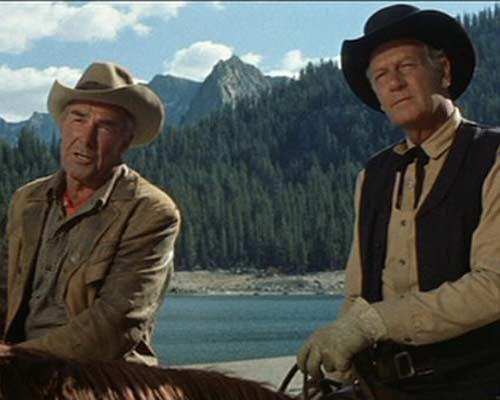
 Through the Shattered Lens