Brad’s “late night” movie review: THE NAKED CAGE (1986), starring Shari Shattuck and Angel Tompkins!


It’s a hard knock life for Michelle (Shari Shattuck). One moment she’s a hardworking teller at the local bank who loves her horse, Misty. The next moment she’s sentenced to three years in the women’s penitentiary for a crime she didn’t commit. And life is damn tough in prison. There’s the prison warden Diane (Angel Tompkins) who, when she’s not participating in lesbian dalliances with inmates, is offering Michelle protection, but only if she agrees to act as a spy for her. When Michelle says no, Diane sets her up to be brutalized by the sadistic Rita (Christina Whitaker), the bitch who’s responsible for her being in the pen in the first place! Now having to dodge the threat of rape from prison guard Smiley (Nick Benedict), as well as the constant threat of shiv-induced death at the hands of Rita, it seems Michelle may have finally received a lifeline with the arrival of a new prison guard named Rhonda (Lucinda Crosby). Rhonda seems to show some extra interest and empathy in Michelle’s plight, and she just may be in a position to help her with the wrongful conviction. That is, if Michelle can survive one more night in THE NAKED CAGE!! 

Recently, I’ve been trying to watch movies I’ve never seen before that star actors or actresses who worked with Charles Bronson. Tonight, I decided to look for a film starring Angel Tompkins, a Facebook friend, who worked with Bronson in the 1986 cop film from Cannon Films called MURPHY’S LAW. In that film she plays Jack Murphy’s ill-fated ex-wife, where she gives an uninhibited and committed performance in what would have been a throwaway role for many actresses. Not Angel… she took the role very seriously and is actually quite memorable in her couple of scenes. Paul Talbot’s book BRONSON’S LOOSE AGAIN has a chapter on the film, and he was able to interview Tompkins who told of just how much effort went into to her preparation. I recommend the book to anyone interested in Bronson or those numerous actors and actresses who worked with him in the 70’s, 80’s, and 90’s. Filmed the same year as MURPHY’S LAW, I thought it might be fun to see how committed she is in the role of the corrupt warden in Cannon’s THE NAKED CAGE. 

I’ll admit that I am not an expert on the “women in prison” genre of film. I did go through my Pam Grier phase that started with movies like COFFY (1972) and FOXY BROWN (1974), but did extend as deep as the Jack Hill “women in cages” films THE BIG DOLL HOUSE (1971) and THE BIG BIRD CAGE (1972). But those movies had Pam Grier in the cast which provided a couple of ample reasons for me to watch. THE NAKED CAGE does have some interesting things going for it. Like most of Charles Bronson’s 1980’s output, the movie was produced by Cannon Films, the international symbol of quality moviemaking from the 1980’s. And then there’s Angel Tompkins herself. She’s quite the sexy lady, having appeared in films like PRIME CUT (1972) and THE TEACHER (1974). Cannon Films and Angel Tompkins drew me in, but what about the film itself? Is it worth a watch? 

I’ll go ahead and say that for me, THE NAKED CAGE was worth the watch. This kind of movie only works for me if I like the cast. Shari Shattuck is appealing in the lead role of Michelle, a good woman, who’s wrongly convicted, but who soon finds levels of toughness she never knew she had in order to survive. I remember Shattuck starring in films like POINT OF SEDUCTION: BODY CHEMISTRY 3 (1994) with Andrew Stevens. My wife and I also watched the entire DALLAS TV series a few years ago where Shari had an extended role in season 13. She starts out here as a sweet and innocent lady, and by the end she’s wielding guns and knives like a lifelong delinquent, and I liked it! Angel Tompkins does not disappoint as the corrupt warden who seduces the inmates in order to meet her own sexual needs, as well as manipulating them into playing her larger games of control over the rest of the prison. Overall, she plays the role pretty straight, but is once again quite uninhibited when it comes to the more mature content. To me though, the most enjoyable performance comes from Christina Whitaker as the psychotic Rita. Not content with just ruining Michelle’s life, she’s determined to murder her behind the prison walls as well. From the beginning of the film where the fugitive Rita had Michelle’s estranged husband snorting cocaine off her boobs, all the way to the final frames, Whitaker chews every piece of scenery that comes into view. She’s the character I’ll remember whenever I think of THE NAKED CAGE. 

There are some things I didn’t like very much about the film. Prison guard Smiley’s sadistic rapist isn’t fun at all to watch, but his character’s fate is well deserved and somewhat satisfying when it finally occurs. Also, I didn’t care for the manipulation of the character of the drug addict Amy, played by Stacey Shaffer. She had worked very hard to beat her addiction, and in a world where many of us know people who have been lost to addiction, it’s not easy to watch her tragic fall. 

Overall, if you enjoy “women in prison” films, I think you’ll probably like this one. It’s certainly not perfect, but being a fan of Cannon Films and Angel Tompkins, I thought it was an enjoyable way to spend a Friday night while I was waiting for my wife to get home from work! 

Music Film Review: Tommy (dir by Ken Russell)


“Tommy, can you hear me?”

That’s a question that’s asked frequently in the 1975 film, Tommy.  An adaptation of the famous rock opera by the Who (though Pete Townshend apparently felt that the film’s vision was more director Ken Russell’s than anything that he had meant to say), Tommy tells the story of a “deaf, dumb, and blind kid” who grows up to play a mean pinball and then become a cult leader.  Why pinball?  Who knows?  Townshend’s the one who wrote Pinball Wizard but Ken Russell is the one who decided to have Elton John sing it while wearing giant platform shoes.

Tommy opens, like so many British films of the 70s, with the blitz.  With London in ruins, Captain Walker (the almost beatifically handsome Robert Powell) leaves his wife behind as he fights for his country.  When Walker is believed to be dead, Nora (Ann-Margaret) takes Tommy to a holiday camp run by Frank (Oliver Reed).  Oliver Reed might not be the first person you would expect to see in a musical and it is true that he wasn’t much of a singer.  However, it’s also true that he was Oliver Reed and, as such, he was impossible to look away from.  Even his tuneless warbling is somehow charmingly dangerous.  Nora falls for Frank but — uh oh! — Captain Walker’s not dead.  When the scarred captain surprises Frank in bed with Nora, Frank hits him over the head and kills him.  Young Tommy witnesses the crime and is told that he didn’t see anything and he didn’t hear anything and that he’s not going to say anything.

And so, as played by Roger Daltrey, Tommy grows up to be “deaf, dumb, and blind.”  Various cures — from drugs to religion to therapy — are pursued to no avail.  As the Acid Queen, Tina Turner sings and dances as if she’s stealing Tommy’s soul.  As the Therapist, Jack Nicholson is all smarmy charm as he gently croons to Ann-Margaret.  Eric Clapton performs in front of a statue of Marilyn Monroe.  Ann-Margaret dances in a pool of beans and chocolate and rides a phallic shaped pillow. As for Tommy, he eventually becomes the Pinball Wizard and also a new age messiah.  But it turns out that his new followers are just as destructive as the people who exploited him when he was younger.   It’s very much a Ken Russell film, full of imagery that is shocking and occasionally campy but always memorable.

I love Tommy.  It’s just so over-the-top and absurd that there’s no way you can ignore it.  Ann-Margaret sings and dances as if the fate of the world depends upon it while Oliver Reed drinks and glowers with the type of dangerous charisma that makes it clear why he was apparently seriously considered as Sean Connery’s replacement in the roles of James Bond.  As every scene is surreal and every line of dialogue is sung, it’s probably easy to read too much into the film.  It could very well be Ken Russell’s commentary on the New Age movement and the dangers of false messiahs.  It could also just be that Ken Russell enjoyed confusing people and 1975 was a year when directors could still get away with doing that.  With each subsequent viewing of Tommy, I become more convinced that some of the film’s most enigmatic moments are just Russell having a bit of fun.  The scenes of Tommy running underwater are so crudely put together that you can’t help but feel that Russell was having a laugh at the expense of people looking for some sort of deeper meaning in Tommy’s journey.  In the end, Tommy is a true masterpiece of pop art, an explosion of style and mystery.

Tommy may seem like a strange film for me to review in October.  It’s not a horror film, though it does contain elements of the genre, from the scarred face of the returned to Captain Walker to the Acid Queen sequence to a memorable side story that features a singer who looks like a junior Frankenstein.  To me, though, Tommy is a great Halloween film.  Halloween is about costumes and Tommy is ultimately about the costumes that people wear and the personas that they assume as they go through their lives.  Oliver Reed goes from wearing the polo shirt of a holiday camp owner to the monocle of a tycoon to the drab jumpsuits of a communist cult leader.  Ann-Margaret’s wardrobe is literally a character of its own.  Everyone in the film is looking for meaning and identity and the ultimate message (if there is one) appears to be that the search never ends.


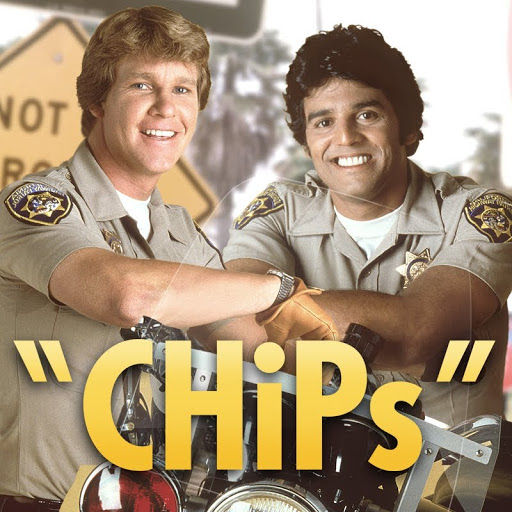
Late Night Retro Television Review: CHiPs 3.21 “Thrill Show”


Welcome to Late Night Retro Television Reviews, a feature where we review some of our favorite and least favorite shows of the past!  On Mondays, I will be reviewing CHiPs, which ran on NBC from 1977 to 1983.  The entire show is currently streaming on Prime!

This week’s episode is all about the thrills!

Episode 3.21 “Thrill Show”

(Dir by Gordon Hessler, originally aired on February 23rd, 1980)

Bonnie (Randi Oakes) has a decision to make.  Her ex-boyfriend and mentor, Ray (John McCook, of Bold and the Beautiful fame) has come to Los Angeles and is trying to convince her to quit the force and join him as a member of the Joie Chitwood Thrill Show!

The what?

I have to admit that I had no idea what the Joie Chitwood Thrill Show was but all of the police officers were really excited about it and the episode’s storylines all came to a halt for ten minutes so we could have an extended sequences of drivers doing stunts.  I assumed that the Joie Chitwood Thrill Show was a real thing and a quick check with Wikipedia confirmed that I was correct.  (In fact, Chitwood played Charlie, James Bond’s unfortunate driver in Live and Let Die.)

While Bonnie struggles with her future, Baker and Ponch pursue the members of a rock band who have been robbing tourist buses so that they can raise the money to record their first album.  Hell yeah, that’s taking control of your future!  The leader of the band was named Malcolm and he was played by Paul Nicholas, who also played Peter Frampton’s brother in Sgt. Pepper’s Lonely Hearts Club Band.  Whatever else you may think of that film, Nicholas’s performance of You Never Give Me Your Money was nicely done.

This episode seemed to primarily exist to advertise the Chitwood show but, as I’ve stated before, I’ve always liked fast cars and dramatic stunts.  What can I say?  I’m a Southern girl, it’s in my blood.  The idea of a band robbing tourists to pay for its album was actually kind of interesting, even if the episode didn’t really do much with it.  Paul Nicholas was a bit more charismatic than the typical CHiPs co-star.

In other words, this episode …. hey, it was okay!

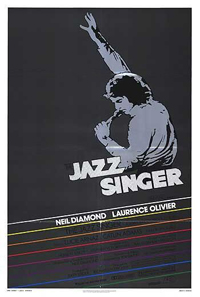
Film Review: The Jazz Singer (dir by Richard Fleischer)


In the 1980 remake of The Jazz Singer, it only takes the film seven minutes to find an excuse to put Neil Diamond in blackface.

Of course, the film was a remake of the 1927 version of The Jazz Singer, which featured several scenes of Al Jolson performing in blackface.  In fact, Al Jolson in blackface was such a key part of the film that it was even the image that was used to advertise the film when it was first released.  Back in the 20s, Jolson said that wearing blackface was a way of honoring the black artists who created jazz.  (As shocking as the image of Al Jolson wearing blackface is to modern sensibilities, Jolson was considered a strong advocate for civil rights and one of the few white singers to regularly appear on stage with black musicians.)  Regardless of Jolson’s motives, less-progressively minded performers used blackface as a way to reinforce racial stereotypes and, to modern audiences, blackface is an abhorrent reminder of how black people were marginalized by a racist culture.  You would think that, if there was any element of the original film that a remake would change, it would be the lead character performing in blackface.

But nope.  Seven minutes into the remake, songwriter Jess Robin (Neil Diamond) puts on a fake afro and dons blackface so that he can perform on stage at a black club with the group that is performing his songs.  The group’s name is the Four Brothers and, unfortunately, one of the Brothers was arrested the day of the performance.  Jess performs with the group and the crowd loves it until they see his white hands.  Ernie Hudson — yes, Ernie Hudson — stands up and yells, “That’s a white boy!”  A riot breaks out.  The police show up.  Jess and the three remaining Brothers are arrested and taken to jail.  Jess is eventually bailed out by his father, Cantor Rabinovitch (Laurence Olivier).  The Cantor is shocked to discover that his son, Yussel Rabinovitch, has been performing under the name Jess Robin.  He’s also stunned to learn that Yussel doesn’t want to be a cantor like his father.  Instead, he wants to write and perform modern music.  The Cantor tells Yussel that his voice is God’s instrument, not his own.  Yussel returns home to his wife, Rivka (Caitlin Adams), and tries to put aside his dreams.

But when a recording artist named Keith Lennox (Paul Nicholas) wants to record one Yussel’s songs, Yussel flies out to Los Angeles.  As Jess Robin, he is shocked to discover that Lennox wants to turn a ballad that he wrote into a hard rock number,  Jess sings the song to show Lennox how it should sound.  The arrogant Lennox is not impressed but his agent, Molly (Lucie Arnaz) is.  Soon, Jess has a chance to become a star but what about the family he left behind in New York?  “I have no son!” the Cantor wails when he learns about Jess’s new life in California.

I’ve often seen the 1980 version of The Jazz Singer referred to as being one of the worst films of all time.  I watched it a few days ago and I wouldn’t go that far.  It’s not really terrible as much as its just kind of bland.  For someone who has had as long and successful a career as Neil Diamond, he gives a surprisingly charisma-free performance in the lead role.  The most memorable thing about Diamond’s performance is that he refuses to maintain eye contact with any of the other performers, which makes Jess seem like kind of a sullen brat.  It also doesn’t help that Diamond appears to be in his 40s in this film, playing a role that was clearly written for a much younger artist.  Still, when it comes to bad acting, no one can beat a very miscast Laurence Olivier, delivering his lines with an overdone Yiddish accent and dramatically tearing at his clothes to indicate that Yussel is dead to him.  Olivier was neither Jewish nor a New Yorker and that becomes very clear the more one watches this film.  It takes a truly great actor to give a performance this bad.  Diamond, at least, could point to the fact that he was a nonactor given a starring role in a major studio production.  Olivier, on the other hand, really had no one to blame but himself.

Still, I have to admit that ending the film with a sparkly Neil Diamond performing America while Laurence Olivier nods in the audience was perhaps the best possible way to bring this film to a close.  It’s a moment of beautiful kitschThe Jazz Singer needed more of that.

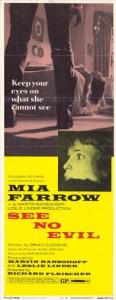
A Movie A Day #293: See No Evil (1971, directed by Richard Fleischer)


After a rain, a car drives through a puddle and splashes mud on a man’s designer boots.  The owner of the boots follows the car back to a country manor and murders everyone inside.  (Did he really kill everyone in the house because his boots get muddied?  It is never really clear.  Before his boots got splashed on, he was looking at violent comic books in a shop.  Maybe Wertham was right.)  Later, Sarah (Mia Farrow), the niece of the car’s driver, arrives at the house.  As the result of a recent horse riding accident, Sarah is blind.  She walks through the house, unaware that she is surrounded by dead bodies and unaware that the owner of the boots left behind a bracelet that he will soon be returning to retrieve.
Obviously inspired by Wait Until Dark, See No Evil is a well-done cat-and-mouse game between Sarah and her unseen stalker.  Mia Farrow is great as the blind woman and the scenes of her unknowingly walking past the dead bodies of her family while being followed are tense and suspenseful.  See No Evil has been overshadowed by Farrow’s other two horror films, Rosemary’s Baby and Full Circle, but it is definitely worth a look.

So You Want To Be A Rock’n’Roll Star: The Idolmaker, Breaking Glass, That’ll Be The Day, Stardust


So, you want to be a rock and roll star?  Then listen now to what I say: just get an electric guitar and take some time and learn how to play.  And when your hair’s combed right and your pants fit tight, it’s gonna be all right.

If you need any more help, try watching these four films:

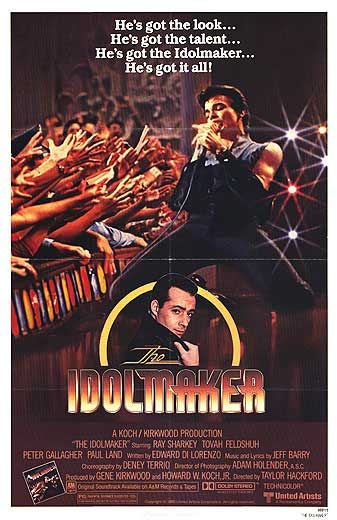
Idolmaker

The Idolmaker (1980, directed by Taylor Hackford)

The Idolmaker is a movie that asks the question, “What does it take to be a star?  Who is more interesting, the Svengalis or the Trilbys?”  The year is 1959 and Vinny Vacari (Ray Sharkey, who won a Golden Globe for his performance but don’t let that dissuade you from seeing the movie) is a local kid from New Jersey who dreams of being a star.  He has got the talent.  He has got the ambition and he has got the media savvy.  He also has a receding hairline and a face like a porcupine.

Realizing that someone who looks like him is never going to make hundreds of teenage girls all scream at once, Vinny instead becomes a starmaker.  With the help of his girlfriend, teen mag editor Brenda (Tovah Feldshuh) and a little payola, he turns saxophone player Tomaso DeLorussa into teen idol Tommy Dee.  When Tommy Dee becomes a star and leaves his mentor, Vinny takes a shy waiter named Guido (Peter Gallagher) and turns him into a Neil Diamond-style crooner named Cesare.  Destined to always be  abandoned by the stars that he creates, Vinny continually ends up back in the same Jersey dive, performing his own songs with piano accompaniment.

The Idolmaker is a nostalgic look at rock and roll in the years between Elvis’s induction into the Army and the British invasion.  The Idolmaker has some slow spots but Ray Sharkey is great in the role of Vinny and the film’s look at what goes on behind the scenes of stardom is always interesting.  In the movie’s best scene, Tommy performs in front of an audience of screaming teenagers while Vinny mimics his exact moments backstage.

Vinny was based on real-life rock promoter and manager, Bob Marcucci.  Marcucci was responsible for launching the careers of both Frankie Avalon and Fabian Forte.  Marcucci served as an executive producer on The Idolmaker, which probably explains why this is the rare rock film in which the manager is more sympathetic than the musicians.

breakglass_lrg

Breaking Glass (1980, directed by Brian Gibson)

At the same time that The Idolmaker was providing American audiences with a look at life behind-the-scenes of music stardom, Breaking Glass was doing the same thing for British audiences.

In Breaking Glass, the idolmaker is Danny (Phil Daniels, who also starred in Quadrophenia) and his star is an angry New Wave singer named Kate (Hazel O’Connor).  Danny first spots Kate while she is putting up flyers promoting herself and her band and talks her into allowing him to mange her.  At first, Kate refuses to compromise either her beliefs or her lyrics but that is before she starts to get famous.  The bigger a star she becomes, the more distant she becomes from Danny and her old life and the less control she has over what her music says.  While her new fans scare her by all trying to dress and look like her, Kate’s old fans accuse her of selling out.

http://www.youtube.com/watch?v=8ALdL8oV_sY

As a performer, Hazel O’Connor can be an acquired taste and how you feel about Breaking Glass will depend on how much tolerance you have for her and her music.  (She wrote and composed all of the songs here.)  Breaking Glass does provide an interesting look at post-punk London and Jonathan Pryce gives a good performance as a sax player with a heroin addiction.

thatll-be-the-day-poster

That’ll Be The Day (1973, directed by Claude Whatham)

Real-life teen idol David Essex plays Jim MacClaine, a teenager in 1958 who blows off his university exams and runs away to the Isle of Wright.  He goes from renting deckchairs at a resort to being a barman to working as a carny.  He lives in squalor, has lots of sex, and constantly listens to rock and roll.  Eventually, when he has no other choice, he does return home and works in his mother’s shop.  He gets married and has a son but still finds himself tempted to abandon his family (just as his father previously abandoned him) and pursue his dreams of stardom.

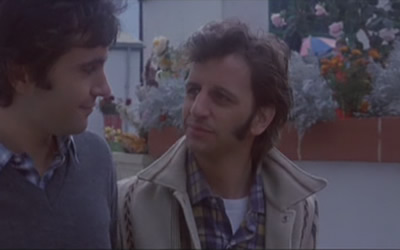
David Essex and Ringo Starr

Based loosely on the early life of John Lennon, the tough and gritty That’ll Be The Day is more of a British kitchen sink character study than a traditional rock and roll film but rock fans will still find the film interesting because of its great soundtrack of late 50s rock and roll and a cast that is full of musical luminaries who actually lived through and survived the era.  Billy Fury and the Who’s Keith Moon both appear in small roles.  Mike, Jim’s mentor and best friend, is played by Ringo Starr who, of all the Beatles, was always the best actor.

That’ll Be The Day ends on a downbeat note but it does leave the story open for a sequel.

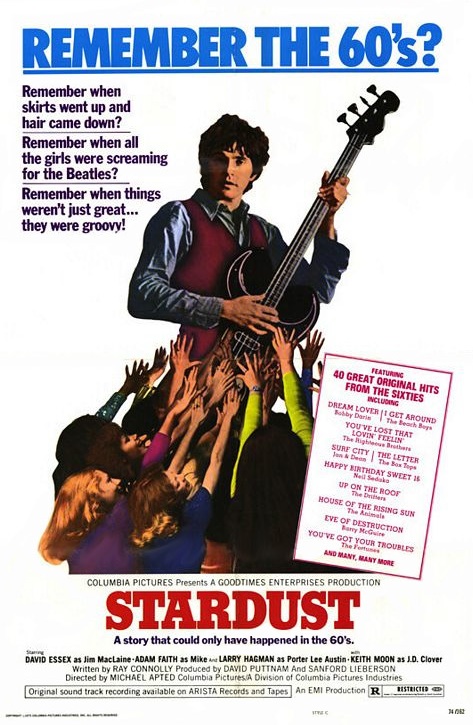
stardust-1

Stardust (1974, directed by Michael Apted)

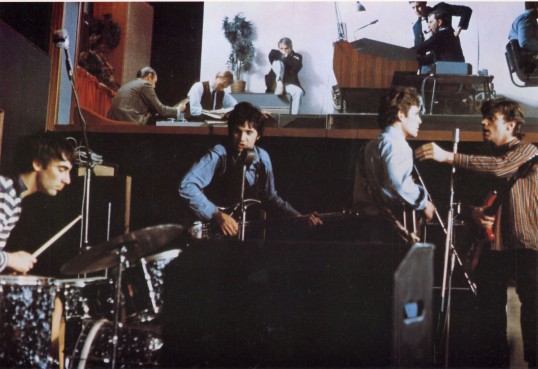
Stardust continues the story of Jim MacClaine.  Jim hires his old friend Mike (Adam Faith, replacing Ringo Starr) to manage a band that he is in, The Straycats (which includes Keith Moon, playing a far more prominent role here than in That’ll Be the Day).  With the help of Mike’s business savvy, The Stray Cats find early success and are signed to a record deal by eccentric Texas millionaire, Porter Lee Austin (Larry Hagman, playing an early version of J.R. Ewing).

When he becomes the breakout star of the group, Jim starts to overindulge in drugs, groupies, and everything that goes with being a superstar.  Having alienated both Mike and the rest of the group, Jim ends up as a recluse living in a Spanish castle.  Even worse, he gives into his own ego and writes a rock opera, Dea Sancta, which is reminiscent of the absolute worst of progressive rock.  Watching Jim perform Dea Sancta, you understand why, just a few years later, Johnny Rotten would be wearing a homemade “Pink Floyd Sucks” t-shirt.

Stardust works best as a sad-eyed look back at the lost promise of the 1960s and its music.  Watch the movie and then ask yourself, “So, do you really want to be a rock and roll star?”

21494_2