Though it may not be a Christmas song, the latest single from Ringo Starr feels appropriate for the season. Ringo sings for peace and hope in this song and he’s brought along an impressive supporting cast to help him make his case. Among those featured in the song and the video: Paul McCartney & Joe Walsh, Corinne Bailey Rae, Eric Burton, Sheryl Crow, FINNEAS, Dave Grohl, Ben Harper, Lenny Kravitz, Jenny Lewis, Steve Lukather, Chris Stapleton, and Yola.
I searched but I could not find a credited director for this video.
Beatle fans will have a blast watching THE BEATLES: EIGHT DAYS A WEEK – THE TOURING YEARS, director Ron Howard’s 2016 rock doc covering the Fab Four’s career from their earliest club days through the height of Beatlemania, until they stopped touring for good in 1966. The film features rare and classic footage of The Beatles live in concert around the globe, juxtaposing their rise with news events of the day and interviews with all four members.
Howard conducted brand-new interviews with Paul McCartney and Ringo Starr, and included archival interviews with the late John Lennon and George Harrison. Through these and behind the scenes clips and press conferences, we get a sense of what it was like to be at the center of all the Beatlemania madness. Ringo says it best: “We just wanted to play… playing was the only thing” far as these talented musicians were concerned, but…
I’m terrible with anniversaries or other things I should be aware of to make tie-in posts for. That’s why I missed the 50th anniversary of Sgt. Pepper’s Lonely Hearts Club Band. I’m sure everyone posted the music video for Strawberry Fields Forever yesterday. So let’s go with something else Beatles related.
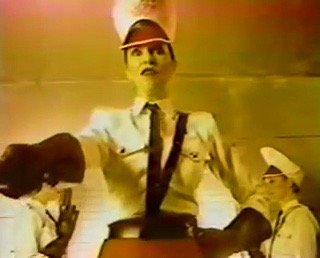
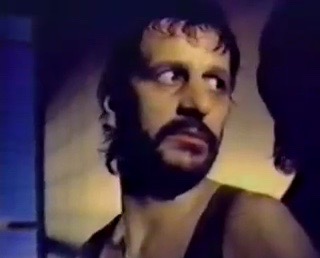
Back in 1982–or 1981 according to mvdbase–a short film was made starring Ringo Starr that is an extended music video for the songs Private Property, Sure To Fall, and Attention. From what I’ve read, this earned Lol Creme and Kevin Godley a nomination for a Palme d’Or at the Cannes Film Festival for Best Short Film. Also from what I’ve read, it not only has Ringo in it, but Paul, Linda, and Barbara Bach.
I know I’ve said on numerous occasions that when something crosses the into A Hard Day’s Night territory then I don’t include it in one of these posts, but I’m making an exception here. Besides, it’s only about 10 minutes long. It’s not like the ABC film Mantrap (1983). That is over 50 minutes long.
I’m guessing this is Barbara Bach. I’m not really sure. I have no idea where Linda is in this.
I do know that this is definitely Paul.
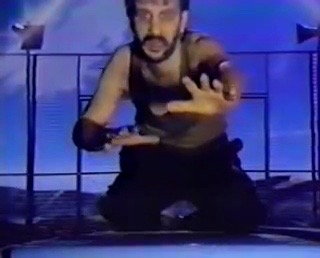
The gist is that the audience travels with Ringo as he goes through a bunch of references to prison movies like The Great Escape (1963). As we go along we see Ringo try to escape in different ways. He has to shine Ilsa: She-Wolf of the SS’ boots. He has a delusion that he is in the Old West where Paul may have also played the following cowboy:
I’m quite sure it’s him. I’m just not 100% sure.
Eventually Ringo McClane…
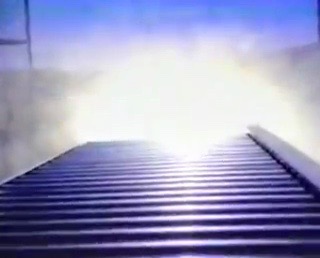
comes across what he thinks is going to be an exit, but it just takes him back to the cooler again.
Seeing as this came out in 1982, that would make this year the 35th anniversary of The Cooler. I found it to be enjoyable. It’s a nice little piece of post-Beatles work that I have to imagine has all but fallen into obscurity.
We can do one better than just that though. Since it is 2017, that means it’s also the 30th anniversary of when Ringo did commercials for Sun Country Classic Wine Cooler.
Ringo and a polar bear. I love it. I would have enjoyed it more if it were the polar bear played by Vincent Price, but I still enjoy these.
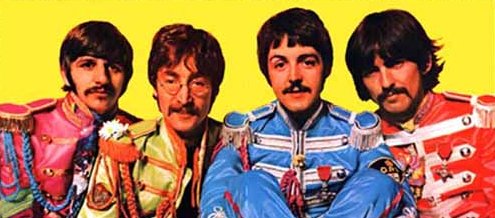
June 2, 1967. The beginning of the so-called “Summer of Love”. The underground hippie culture was grooving toward the mainstream. And those four loveable mop tops, The Beatles , released their eighth album, “Sgt. Pepper’s Lonely Hearts Club Band”, on America’s shores, ushering in the concept of “concept albums” that still reverberates in music today. The Fab Four were Fab no more, but genuine artists, with a little help from their friend, producer George Martin.
The Beatles had stopped touring the previous year, tired of the grind and the hysterical screaming that drowned their music out. They had done some experimenting in the studio with “Revolver”, their previous LP, but “Sgt. Pepper” was something different. Martin and the band members, influenced by both The Beach Boys’ “Pet Sounds” and Frank Zappa’s “Freak Out!” discs, utilized then cutting edge studio techniques (tape loops, sound effects, varying speeds) and instrumentations (sitar, harmonium, Mellotron, tubular bells, even…
(It’s a Sunday night, February 9, 1964. Everybody’s watching THE ED SULLIVAN SHOW to get a peek at this new phenomenon called Beatlemania. The adults in the room are disgusted, saying things like “They look like a bunch of girls!”, “They must be sissies!”, and “Yeah yeah yeah? What the hell kind of song is that??” They just don’t get it. But the six-year-old kid watching along does, and a lifelong obsession with rock’n’roll is born…)
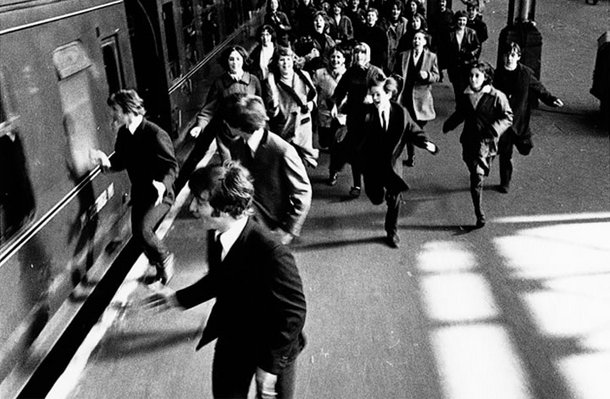
From the opening shot of the Fab 4 being chased down the street by screaming teenyboppers to the final clanging guitar notes of the title tune, A HARD DAY’S NIGHT makes a joyful noise introducing The Beatles to the silver screen. John, Paul, George, and Ringo come off as a mod version of the Marx Brothers with their anarchic antics, guided by the deft hand of director Richard Lester. Shot in cinema verite style, this zany, practically…
Today we see the release of Skyfall on Blu-Ray and DVD. This latest James Bond film surprised quite a bit of people who weren’t sure the franchise would be able to recover from the missed opportunity that was Quantum of Solace. So, it came out of left field that this follow-up ended up being one of the best films of 2012. From the acting, direction and writing the film was top-notch. One other thing which truly stood out about this film was it’s theme song.
“Skyfall” by Adele wasn’t just one of the best film songs of 2012, but most like going to turn out to be in the top 5 of best James Bond theme songs when all has been said and done. This is why to commemorate the release of the film on video I’ve chosen the Adele sung theme song of the same name to be the latest “Song of the Day”.
The song harkens back to the true James Bond classic theme songs by Shirley Bassey like “Goldfinger” and “Diamonds are Forever” right up to my personal favorite, Paul McCartney’s “Live and Let Die”. Maybe it was destiny that Adele would end up doing a James Bond theme song. Her soulful vocal range just shouts early James Bond and her “Skyfall” easily holds it’s own against the classic Bond themes of the 60’s and early 70’s.
The song itself has a very simple melody that incorporates the iconic 007 theme. Almost sung like a mournful ballad that hints at the danger and death awaiting the intrepid 007 and those around him, the song spends much of it’s running time with Adele singing in a very subdued fashion until we hit the final third of the track when she finally lets her inner diva shine….and shine she does.
Skyfall
This is the end Hold your breath and count to ten Feel the Earth move and then Hear my heart burst again
For this is the end I’ve drowned and dreamt this moment So overdue I owe them Swept away I’m stolen
Let the sky fall When it crumbles We will stand tall Face it all together
Let the sky fall When it crumbles We will stand tall Face it all together At skyfall At skyfall
Skyfall is where we start A thousand miles and poles apart Where worlds collide and days are dark You may have my number You can take my name But you’ll never have my heart
Let the sky fall When it crumbles We will stand tall Face it all together
Let the sky fall When it crumbles We will stand tall Face it all together At skyfall
Where you go I go What you see I see I know I’d never be me Without the security
Of your loving arms Keeping me from harm Put your hand in my hand And we’ll stand
Let the sky fall When it crumbles We will stand tall Face it all together
Let the sky fall When it crumbles We will stand tall Face it all together At skyfall
With the previous Bond entry, Diamonds Are Forever, we finally see Sean Connery run out of gas when it came to playing the title role of James Bond. Yet, despite the obvious boredom Connery was having in the film the producers of the series were still wanting him to come back for another Bond film. Maybe it was his experience during the production of Diamonds Are Forever or Connery finally decided it was truly time to go the series’ producers didn’t get their wish and were in a rush to find someone new to wear the mantle o Agent 007.
They finally found their new James Bond in the form of English-actor Roger Moore and production on Live and Let Die began soon after.
Roger Moore, for me, has always been the start of the less serious, but much more fun era of the James Bond franchise. His films still had the intrigue and action of the Connery-era, but the writers and producers of the series put in more one-liners and humor in the story. We begin to see the start of this in the previous Bond film (not handled as well and came off as awkward at times), but it was in Live and Let Die and in Roger Moore that this change in the series’ tone finally hit it’s stride.
The film dials back the global domination attempts by the series of villians both SPECTRE and not. This time around Bond must investigate the deaths of three MI6 agents who had been investigating one Dr. Kananga, the despot of the fictitious Caribbean island of San Monique. Kananga (played by Yaphet Kotto) also has an alter-ego in the form of Mr. Big who runs a series of soul food restaurants as a front for his drug business. Every Bond film always tries to out-elaborate the previous one with it’s villains plans. There’s no attempts by Kananga/Big to dominate the world. His plans are pretty capitalistic in a ruthless sort of way. He wants to corner the drug market in the US by flooding the illegal drug market with his own heroin which he plans to give away for free thus bankrupting the other crime lords and drug dealers.
This plan by Kananga actually looks to be very sound and it helps that he has the beautiful seer Solitaire (played by a young and beautiful Jane Seymour) to help him outwit ad stay ahead of his competitors and the law. His plan would’ve succeeded if not for the meddling of one British super-spy named James Bond.
Live and Let Die might not have been as serious about it’s story as the early Connery films, but it definitely had a much more faster pace with more action to distinguish Moore from Connery. One particular famous action sequence involves Bond escaping from Kananga’s drug farm in the Louisiana Bayou country being chased not just by Kananga’s henchmen but by the local police in the form of Sheriff J.W. Pepper who plays the role of fool and comedy relief in the film. Even the smaller action scenes in the film had more life and fun to them like Bond escaping a gator pit by timing a run across the backs of a line of gators to safety.
Where the previous bond film’s attempt at injecting humor and more action into the story were more failures than successes in this film Roger Moore Bond film they worked in due part to Moore’s playful delivery of the one-liners and bon mots the role has become known for of late. Any trepidation that audiences and producers might have had about Moore taking on the role that had been made famous by Connery soon went away as this film played out.
Live and Let Die still remains my favorite of all the Roger Moore Bond films and saw it as the highlight of his time playing the character. While the follow-up films were good in their own right it was this initial Moore entry in the series where the writers, Moore and veteran Bond filmmaker Guy Hamilton were able to find the perfect balance of thrilling action and humor that the rest of the Moore-era films couldn’t replicate.
Next up for James Bond…The Man with the Golden Gun.
Lisa Marie recently wrote up her very unique review of the James Bond film Live and Let Die and I’ve decided to use that review as the springboard for the latest “Song of the Day” entry. It’s easy enough to figure out that the latest choice is the similarly titled song from the film by Paul McCartney: “Live and Let Die”.
This song remains one of the most recognizable songs made specifically for a film. Most songs that become part of a film’s appeal tend to be pre-existing licensed songs and music. Live and Let Die would be the first James Bond film that would introduce Roger Moore as the British superspy and 007 agent. The song itself, written by Paul McCartney and his wife Linda, would become even more popular than the film through the years.
While the song has been covered by many bands and groups through the years it would be the cover by Guns N’ Roses in 1991 as part of their Use Your Illusion I album that many consider the best cover. I consider both favorite songs of mine, but I must pick McCartney’s original over the GnR cover by the smallest of margins.
Live and Let Die
When you were young and your heart was an open book You used to say live and let live you know you did you know you did you know you did But if this ever changin’ world in which we live in Makes you give in and cry Say live and let die Live and let die
What does it matter to ya When ya got a job to do Ya got to do it well You got to give the other fella hell
You used to say live and let live you know you did you know you did you know you did But if this ever changin’ world in which we live in Makes you give in and cry Say live and let die Live and let die
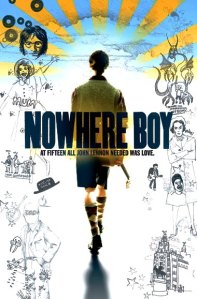
At first glance, Sam Taylor-Wood’s Nowhere Man sounds just a little bit too cutesy. The movie, which covers the youth of John Lennon, starts with the death of John’s Uncle George, covers both his attempts to reconcile with his mother Julia (portrayed here as being bipolar) and his troubles relationship with the aunt who actually raised him, details how John came to form his own band (The Quarrymen) and first met Paul McCartney and George Harrison, and ends with John preparing to leave for Germany. Yet the movie works surprisingly well and, by the end, is actually quite touching regardless of whether you idolize John Lennon or if you think Imagine is one of the most overrated songs of all time. By refusing to indulge in any easy sentimentality about either John Lennon or the iconic figure he would eventually become (the word “Beatles” is never uttered at any point in the film), Taylor-Wood crafts a touching coming-of-age story about an alienated teenager trying to find peace with his dysfunctional existence. The fact that the teen is going to grow up to be the John Lennon is secondary to the plot.
The film works mostly because of the cast. The young John Lennon is played by Aaron Johnson who, earlier this year, was the lead in Kick-Ass. I have to admit that I didn’t care much for Johnson in Kick-Ass. His performance seemed generic and bland and he was overshadowed by Nicolas Cage, Chloe Grace Moretz, Mark Strong, Christopher Mintz-Plasse, and just about everyone else in the movie. Here, however, Johnson gives a strong, sympathetic performance as a character who often comes across as being neither. He both manages to capture the young Lennon’s sensitivity as well as his anger and cocky arrogance.
However, the movie truly belongs to the two actresses playing Lennon’s aunt and mother, Kristen Scott Thomas and Anne-Marie Duff. Scott Thomas has an especially difficult job as her character is far less flamboyant and, at first sight, a lot less interesting as Duff’s. However, as the film progresses, Scott Thomas starts to subtly reveal the dry humor that lies underneath her character’s serious expression. As for Duff, she dominates the film as surely as Julia dominated her son’s life. Duff doesn’t resort to any of the easy (and insulting) clichés that are usually used to represent bipolar disorder on film. Instead, she captures both the exhilarating high of being manic along with the constant fear of the depressive episode that we always know is destined to follow. It’s a spot-on performance that elevates this film above the standard coming-of-age story.
Wisely, neither the director nor her actors ever get caught up in the fact that their film is about the John Lennon. There’s no portentous foreshadowing or awkwardly staged moments designed to specifically make you go, “Hey, that’s John Lennon!” Even the first time that Lennon meets Paul McCartney and, later, George Harrison is handled in a casual, off-hand manner. Taylor-Wood has enough faith in her audience to believe that we’ll be able to understand the importance of John being introduced to a younger guitar player named Paul without bashing us over the head with the fact that this is the Paul McCartney. As such, while you’re always aware that this is a movie about John Lennon, you can also see the movie as simply being the story of an alienated teenager who finds salvation through music.
In 1978, just based on what I’ve read, everyone in America was regularly doing huge amounts of cocaine. Whether you were in a disco or at a PTA meeting, you knew that eventually someone would produce a small mirror covered with white powder. President Carter even snorted it during that year’s State of the Union speech. Sure, some people used gold spoons and others had to make do with a one dollar bill but, in the end, cocaine brought all Americans together as a nation and helped the country heal after the trauma of Watergate.
It also contributed to some the year’s best films. Days of Heaven, Superman, The Deer Hunter, Coming Home, Grease, Animal House, Interiors, Halloween, Midnight Express, Convoy, Go Tell The Spartans, and An Unmarried Woman; these were all films fueled by the Peruvian Headache Powder.
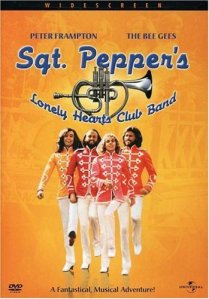
However, no discussion of 1978 cocaine-fueled films would be complete with mentioning Sgt. Pepper’s Lonely Hearts Club Band. Featuring songs originally performed by the Beatles and starring the Bee Gees, Peter Frampton, and a whole bunch of other people that my mom liked, Sgt. Pepper’s is a film that, quite honestly, should just be retitled 1978.
Plotwise — oh God, do I really have to try to describe the plot? Seriously, this could take forever. I mean, the film isn’t quite two hours long but a lot of stuff happens and really the only connection between any of it is that these odd cover tunes of classic Beatles songs keep popping up in the weirdest places. Okay, let me try to get this all into one paragraph —
There’s a small town called Heartland that is very small and simple but it’s also the home of the legendary Sgt. Pepper who, throughout history, has maintained world peace by playing his magic instruments. But then Sgt. Pepper dies and apparently turns into a gold weather vane. His magic instruments are given to the mayor of Heartland, Mr. Kite (George Burns, who also narrates the entire movie). The world is in mourning. But then one day, the Henderson Brothers (the Bee Gees) decide to form a new Sgt. Pepper’s Lonely Hearts Club Band and they invite Sgt. Pepper’s grandson, Billy Shears (played by Peter Frampton) to be their lead singer. Heartland rejoices and George Burns has a surprisingly sweet scene where he sings Fixing A Hole.
Anyway, the new band is such a hit that the owner of a record company invites them to come to Los Angeles and record an album. Billy says goodbye to his girlfriend, Strawberry Fields (Sandy Farina) and then joins the Hendersons in a hot air balloon which promptly leaves for California. En route, the balloon collides with an airplane but nobody is seriously injured.
In Los Angeles, they meet the record company owner and it turns out that he’s played by Donald Pleasence. (It’s interesting to think that Pleasence filmed this and Halloween around the same time.) Pleasence proceeds to sing the creepiest version of I Want You ever heard. I’d include a clip of the performance but Pleasence manages to go on for a good ten minutes, repeating “I want you,” in an odd little voice while staring at Peter Frampton.
The boys sign a contract with Pleasence. Billy Shears is led astray by Lucy and her band, the Diamonds. (Guess which song they get to sing.) Somehow, this allows Mean Mr. Mustard to steal Sgt. Pepper’s magic instruments. Mr. Mustard drives around in a yellow van and he’s assisted by two female robots who, at one point, sing She’s Leaving Home in their electronic, robot voices.
The band is informed that the instruments have been stolen. Outraged, they jump back in their hot air balloon and quickly start a recovery operation. It turns out that Mean Mr. Mustard has given the instruments to three separate villains.
The first villain is Dr. Maxwell Edison who uses his silver hammer to turn old people into boy scouts. This may sound ludicrous and silly but fortunately, Maxwell is played by Steve Martin. His cameo is one of the highlights of the film, if just because he seems to be one of the few people who actually enjoyed himself on set.
The second villain is the Reverend Sun. He brainwashes people or something. I’ve seen this movie a few times and I still can’t quite figure out what Reverend Sun’s deal is. When I first saw this movie, I got excited because I thought that Tom Savini was playing Rev. Sun. Then I forced my sister Erin to watch the movie and she told me I was stupid because Rev. Sun was obviously being played by Frank Zappa. Well, I did some reasearch and discovered that we’re both stupid. That’s neither Savini nor Zappa. It’s Alice Cooper.
The final villains are played by a very young (and very, very hot!) Aerosmith. Here, they are called the Future Villain Band and oh my God, Joe Perry…this film needed a lot more Joe Perry. I mean, it’s understandable that Steve Tyler gets most of the screen time and young Steve actually looks pretty good in a Mick Jagger sort of way but Joe Perry…Oh. My. God. Anyway, Aerosmith does a cover of Come Together and Joe Perry circa 1978 was just so freaking gorgeous, oh my God. Eventually, Frampton and the Bee Gees come along and ruin things by getting into a fight with Steve Tyler which leads to the camera constantly cutting away from Joe Perry who is really, really, really hot and all kinds of sexy in this movie. They should have just called this movie Joe Perry. Oh. My. God.
Uhmm, where was I? Oh yeah — so, anyway, eventually the weather vane comes to life and suddenly, Sgt. Pepper’s a black man who sings Get Back and ends up magically resetting the past and turning Mean Mr. Mustard into an altar boy or something like that. Oh, and the Bee Gee who looks like a New Age healer ends up singing my favorite Beatles song, A Day in the Life.
Finally, it appears that every single person on the planet shows up in the film’s final scene where a huge group of “stars” show up and sing the film’s title tune one last time. In the end credits, these people are listed as being “Our Guests At Heartland.” Doing some research (i.e., looking the thing up in Wikipedia), I’ve discovered that these folks were apparently all pop cultural icons in the 70s. I didn’t recognize a single one of them but I’m sure they probably all snorted a lot of cocaine.
(And, by the way, Joe Perry does not get to return for the finale so bleh on you, movie.)
For some reason, this movie kept showing up on Starz last November and that’s where I first discovered it. The first time I saw it, I came in right at the start of Steve Martin’s cameo and the film itself was so just plain weird that I had to jump on twitter and let the world know what I was watching. (Actually, it doesn’t take much to make me jump on twitter and tell the world what I’m doing.) As a result, I soon discovered that, apparently, I was the only person on the planet who didn’t know about this film.
Sgt. Pepper’s Lonely Hearts Club Band is really a pretty bad movie. The plot tries way too hard, the pacing is terrible with some scenes lasting forever and others ending before they really start, and Frampton and the Bee Gees are all distinguished by an utter lack of charisma. The youngest Bee Gee appears to be cheerfully stoned throughout the entire movie while the other two (and Frampton) are trying way too hard to act.
And yet, the film fascinates me. After I saw it the first time, I forced my sister to watch it with me a second time. I then watched it again on my own. Finally, I went down to the local Fry’s and nearly did a happy little dance when I found it on DVD. I’ve watched it since several times. Whenever I’m depressed, it always cheers me up.
What’s the appeal? Some of it is definitely the whole “so-bad-its-good” thing. Actually, that’s probably most of it. Another thing fascinating thing is how literally the filmmakers choose to interpret the Beatles lyrics. Considering the fact that the Beatles themselves were rather open about the fact that a lot of their lyrics were simply nonsense and word games, it’s interesting to try to understand logic behind trying to force them into a coherent storyline. (This is also the appeal of 2007’s Across The Universe, which is technically a better movie than Sgt. Pepper’s but isn’t half as fun to watch.) For instance, Billy Shears isn’t in the film because he’s an interesting character. Instead, he’s just here because — 10 years earlier — either John Lennon or Paul McCartney choose to toss the name into a song. We’re never quite sure what Mean Mr. Mustard’s dastardly motivation is beyond the fact that the filmmakers had the rights to his song. If nothing else, the film is an interesting example of what happens when people try to create a novel out of somebody else’s short story.
However, I think the main appeal of Sgt. Pepper’s is the appeal of 1978. Watching the movie, you feel almost as if you’re literally sitting beside the cast at Studio 54, watching as everyone snorts a line. I think that, for future historians, this film may very well turn out to be a cinematic Rosetta Stone.
Then again, maybe it really is just so bad that it’s good.







 Through the Shattered Lens