Retro Television Review: The Night They Saved Christmas (dir by Jackie Cooper)


Welcome to Retro Television Reviews, a feature where we review some of our favorite and least favorite shows of the past!  On Sundays, I will be reviewing the made-for-television movies that used to be a primetime mainstay.  Today’s film is 1984’s The Night They Saved Christmas!  It  can be viewed on Tubi and YouTube.

The Night They Saved Christmas argues that there are two types of people in the world.

There are people who still believe in Santa Claus and all that he represents and then there are the people who gave up their belief a long time ago.  Those who believe in Santa Claus are still full of the Christmas spirit and, under the right circumstances, they might even get to meet the elves and the jolly old man himself.  Those who do not believe are destined to waste their holiday on focusing on material things that aren’t really important.

Petroleum engineer Michael Baldwin (Paul Le Mat) doesn’t believe in Santa Claus and that’s why he had no trouble moving his entire family to the North Pole so that they could freeze while he headed up an oil exploration project.  Michael and his boss, billionaire Sumner Murdock (Mason Adams), are determined to find oil and they’ve got an endless supply of dynamite with which to search for it.

Michael’s wife, Claudia (Jaclyn Smith), still believes in the spirit of Santa and she encourages their children to believe as well.  For that reason, Ed the Elf (played by singer Paul Williams), is willing to take Claudia and the kids to North Pole City.  They get to meet Santa (Art Carney) and they even learn how Santa uses satellite technology to deliver presents all over the world.  The city is really quite impressive, with the movie making good use of matte paintings and miniatures to create the impression of a magical metropolis.  And Santa turns out to be a pretty nice guy, even if he does tell the elves that he’s sick of them singing Jingle Bells.

Unfortunately, North Pole City is in danger!  Every day, the oil company’s dynamite causes a mini-earthquake.  With the dynamiting getting closer and closer to North Pole City, Santa and the elves worry that they might be on the verge of getting blown up!  Can Claudia and the kids convince Michael to stop blowing up huge chunks of the North Pole before Christmas is ruined!?

Well, listen — I don’t think it’s a spoiler for me to tell you that Christmas is not ruined.  It would be pretty cynical for the movie to end with Michael blowing up Santa Claus and cynical is one thing that The Night They Saved Christmas is not.  This is a very earnest film, full of cheery elves, a paternal Santa, and lots of Christmas music.  Even greedy old Mr. Murdock turns out to be not that bad of a guy.  In the end, this film says that Santa and the spirit of Christmas is for everyone and that’s certainly not a bad message.  It’s a likeable movie for the holiday season and Art Carney is a perfect Santa Claus, even if he does appear to be a little underweight for the role.  As played by Carney, Santa is welcoming, good-humored, and still enthusiastic about his job, even after centuries of doing it.  He’s exactly the way you would want Santa to be.  This is a film that earns the right to wish everyone a merry Christmas!

The TSL’s Horror Grindhouse: Puppet Master (dir by David Schmoeller)


Since there’s been like 200 Puppet Master films made over the past 30 years — goddamn, 30 years of killer puppets! — I figured that maybe I should finally sit down and actually watch one of them.  I decided to go with the original film that started the entire franchise, 1989’s Puppet Master!

So, basically, this is a movie about little puppets that kill full-sized people.  Obviously, there’s a bit more to the plot but let’s be honest.  No one who watches this movie is going to be watching it for the specifics of the plot.  They’re going to be watching it because they want to see tiny puppets go on a rampage.  I have to say that the puppets themselves are pretty cute.  I mean, they’re murderous and a little bit pervy but they’re still really cute.  I understand that all of the puppets have their own specific names but, while watching the film, I just made up names of my own.

For instance, there’s Hooky, who has a hook for one hand and a knife for the other and looks like he should be the lead singer of an aging Prog Rock band.  And then there’s Drilly, who has a drill on his head.  He can be really dangerous, especially if you’re stupid enough to crawl around on the floor and just stay there, on all fours, while he’s running straight at you.  I mean, if you just stood up, you probably wouldn’t get that badly injured but …. well, what do I know, right?  And then there’s Leechy, who is a female puppet who spits up leeches.  What’s interesting is that she never runs out of leeches but I have to wonder, if you have that many leeches, why not just send them out on their own instead of stuffing them all into some poor little puppet?  I felt bad for Leechy.  She seemed kinda sad.  And then there’s Handy, who has big hands and Facey, who can assume several different facial expressions at once.  They’re all really adorable, to be honest.

Anyway, Puppet Master is about a bunch of psychics who all spend the night in a California hotel that was once home to the “last alchemist,” Andre Toulon (William Hickey).  Toulon had the power to bring inanimate creatures — like puppets! — too life but, when the Nazi spies were closes in on him, Toulon killed himself.  Many years later, a psychic named Neil Gallagher (Jimmie F. Skaggs) discovered Toulon’s hiding place in the hotel but then shot himself as well.  So now, Neil’s former colleagues are all trying to get Toulon’s power for themselves.  Or something.  As I said, following the plot is not always easy.  The main appeal here is watching the cute puppets do really bad things.

That said, who knew that a group of psychics and witches would prove to be so stupid?  I mean, you would think that — when all of you are having constant premonitions of death and destruction — you would be smart enough to take extra precautions or maybe just leave the hotel all together.  For instance, Dana (Irene Miracle) casts a protection spell over someone else but not on herself.  Meanwhile, Frank (Matt Roe) and Clarissa (Kathryn O’Reilly) make the rookie mistake of having sex in a horror film while our nominal hero, Alex (Paul Le Mat, looking like he’s trying to figure out how he went from American Graffiti to this), wanders around in a daze.

And yet, watching the film, I could see why it became so popular.  The puppets are memorable and well-designed and the backstory, with Toulon and all the rest, is actually pretty interesting.  Puppet Master is one of those films that defines “stupid but fun.”  No wonder the puppets came back!

Film Review: Firehouse (1973, directed by Alex March)


Firefighter Shelly Forsythe (Richard Roundtree) has just been assigned to a new firehouse and, from the minute he shows up, it’s trouble.  Not only is he resented for taking the place of a popular (if now dead) firefighter but he’s also the first black to have ever been assigned to that firehouse.  Led by angry racist Skip Ryerson (Vince Edwards), the other firemen immediately distrust Forsythe and subject him to a grueling hazing.  However, Forsythe is determined to prove that he’s just as good as any white firefighter and refuses to be driven out.  While the firehouse simmers with racial tensions, a gang of arsonists is setting buildings on fire.

Firehouse does not have much of a plot but what little it does have, it deals with in a brisk 72 minutes.  Forsythe shows up for his first day.  Everyone hazes him.  Forsythe gets mad.  There’s a big fire.  And then the movie ends, without resolving much.  Ryerson is still a racist and Forsythe is still mad at almost everyone in the firehouse.  The characters are all paper thin and most of the fire fighting scenes are made up of grainy stock footage.  What does make the film interesting is the way that it handles the causal racism of almost every white character.  Ryerson, for instance, comes across as being an unrepentant racist but the film suggests that this is mostly due to him being too stubborn to change his ways and that Ryerson’s not that bad once you get to know him.  When Andrew Duggan’s fire chief instructs Forsythe not to take any of the constant racial remarks personally, Firehouse portrays it as if Duggan is giving good and reasonable advice.  The mentality was typical for 1973 but wouldn’t fly today.

One reason why Firehouse ends so abruptly is because it was a pilot for a television series.  At the time Firehouse aired, it had been only two years since Roundtree starred as John Shaft and NBC hoped that to recapture that magic on a weekly basis.  However, it would take another year before the Firehouse television series went into production and, by that time, Roundtree had left the project.  In fact, with the exception of Richard Jaeckel, no one who appeared in the pilot went on to appear in the short-lived TV series.

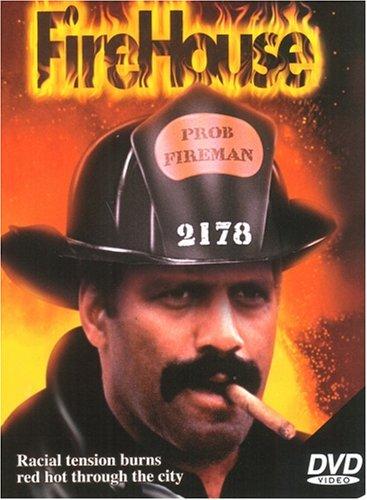
The DVD of Firehouse is infamous for featuring a picture of Fred Williamson on the cover, in which Williamson is smoking a cigar and wearing a fireman’s helmet.  Williamson does not appear anywhere in Firehouse and I can only imagine how many people have sat through Firehouse expecting to see a Fred Williamson blaxploitation film, just to discover that it was actually a Richard Roundtree television pilot.  Firehouse probably would have been better if it had starred Fred Williamson.  Roundtree’s good but sometimes, you just need The Hammer.

Horror Film Review: Strange Invaders (dir by Michael Laughlin)


In 1983, two years after the release of Strange Behavior, director Michael Laughlin and Bill Condon teamed up for another “strange” film.  Like their previous collaboration, this film was a combination of horror, science fiction, and satire.

The title of their latest collaboration?

Strange Invaders.

Strange Invaders opens in the 1950s, in a small, all-American town in Illinois.  Innocent children play in the street.  Clean-cut men stop off at the local diner and talk to the waitress (Fiona Lewis, the scientist from Strange Behavior).  Two teenagers (played by the stars of Strange Behavior, Dan Shor and Dey Young) sit in a car and listen to forbidden rock’n’roll music.  A lengthy title crawl informs us that, in the 1950s, Americans were happy and they were only worried about three things: communists, Elvis, and UFOs.  On schedule, a gigantic UFO suddenly appears over the town.

Twenty-five years later, mild-mannered Prof. Charles Bigelow (Paul Le Mat) teaches at a university and wonders just what exactly is going on with his ex-wife, Margaret (Diana Scarwid).  In order to attend her mother’s funeral, Margaret returned to the small Illinois town where she grew up.  When she doesn’t return, Charles decides to go to the town himself.  However, once he arrives, he discovers that the town appears to still be stuck in the 50s.  The townspeople are all polite but strangely unemotional and secretive.  Charles immediately suspects that something strange is happening.  When the towns people suddenly start shooting laser beams from their eyes, Charles realizes that they must be aliens!

Fleeing from the town, Charles checks all the newspapers for any reports of an alien invasion.  The only story he finds is in a cheap tabloid, The National Informer.  The author of the story, Betty Walker (Nancy Allen), claims that she just made the story up but Charles is convinced that she may have accidentally told the truth.  At first, Betty dismisses Charles as being crazy.  But then she’s visited by an Avon lady who looks just like the waitress from the small town and who can shoot laser beams.

Teaming up, Charles and Betty investigate the aliens and try to figure out just what exactly they’re doing on Earth.  It’s an investigation that leads them to not only a shadowy government operative (Louise Fletcher) but also a man (Michael Lerner) who claims that, years ago, he helplessly watched as his family was destroyed by aliens.

Like Strange Behavior, Strange Invaders is a … well, a strange film.  I have to admit that I prefer Behavior to Invaders.  The satire in Strange Invaders is a bit too heavy-handed and Paul Le Mat is not as strong a lead as Michael Murphy was in the first film.  I was a lot more impressed with Nancy Allen’s performance, if just because I related to both her skepticism and her sudden excitement to discover that her fake news might actually be real news.  I also liked Micheal Lerner, so much so that I almost wish that he and Le Mat had switched roles.  Finally, I have to say that Diana Scarwid’s performance was so bizarre that I’m not sure if she was brilliant or if she was terrible.  For her character, that worked well.

Strange Invaders gets better as it goes along.  At the start of the film, there are some parts that drag but the finale is genuinely exciting and clever.  If the film starts as a parody of 1950s alien invasion films, it ends as a satire of Spielbergian positivity.  It’s an uneven film but, ultimately, worth the time to watch.


A Movie A Day #172: Sensation (1994, directed by Brian Grant)


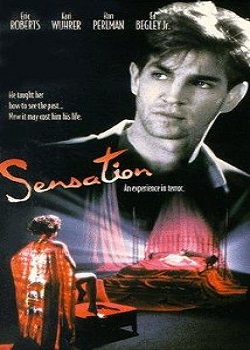
Doctor Ian Burton (Eric Roberts) is a college professor who believes that objects retain impressions of the past.  To prove his theory (and hopefully, not lose tenure), Burton recruits one of his students, Lila Reed (Kari Wuhrer), who has shown that she may have psychic abilities.  Lila holds objects and she sees the past.  At first, she is intrigued but then she realizes that she keeps seeing the same woman in her visions.  The woman was a former student of Burton’s.  She was murdered and the good Doctor Burton is the number one suspect.  Can Lila use her power to solve the crime and clear Burton’s name?  Or is Burton guilty and using her for something more sinister than just testing a thesis?
Sensation is one of the many softcore neo-noirs that used to regularly appear, “after hours,” on HBO and Cinemax in the 1990s.  Sensation has a tagline (“An experience in terror”) that it never lives up to but it is still watchable because of the combination of the sexiness of Kari Wuhrer and the strangeness of Eric Roberts.  The tawdry mystery will not fool anyone and Wuhrer’s visions were all done better in The Dead Zone but Sensation deserves some credit for at least trying to be a little more creative than the average 1990s straight-to-video release.

Keep an eye out for Ron Pearlman, as the lead detective on the case.  He does not get to do much but he’s still Ron Pearlman!


Back to School #13: American Graffiti (dir by George Lucas)


Well, this is certainly intimidating.  I know I’ve said this many time before but it deserves to be repeated: it’s often a hundred times more difficult to review a great film than it is to review a merely mediocre one.  When a film fails, it’s usually easy to say why.  The acting was bad.  The directing was uninspired.  The plot didn’t make any sense.  Or maybe the film has been so overpraised that you, as a reviewer, are almost obligated to be tougher on it than you would be with any other film.  However, it’s never as easy to put into words just what exactlyit is that makes a movie great.

Take the 1973 Best Picture nominee American Graffiti for instance.  I could tell you that this is a very well-acted film and that it features an ensemble of very likable performers, many of whom subsequently went on to become stars and celebrated character actors.  Then again, you can say the same thing about countless other films.

american-graffiti-1973-03-g

I could say that director George Lucas does such a good job putting this film together that it’s hard to believe that he’s the same man who would later be responsible for all three of the Star Wars prequels.  Then again, I could also say the same thing about how odd it is that the same man who directed the entertaining Final Destination 5 was also responsible for the far less enthralling Into The Storm.

i007737

I could tell you that the film serves as a valuable time capsule in that not only does it feature a loving recreation of small town America in the early 60s but that it’s also a chance to see what Richard Dreyfuss, Ron Howard, and Charles Martin Smith all looked like when they still had hair.  But then again, I also praised The Young Graduates for being a time capsule as well.

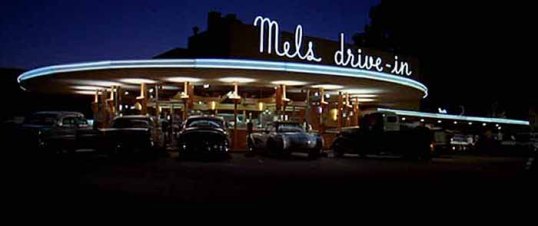
MelsGraffiti

Let’s face it — it’s difficult to define the intangible qualities that make a film great.  Often times, it’s a case of simply knowing it when you see it.  I’ve seen American Graffiti a few times.  The last time I saw it was at a special Sunday showing at the Alamo Drafthouse.  And, on that early Sunday afternoon, the theater was packed with people who had paid for the chance to see the 40 year-old film on the big screen.  I’m 28 years old and it’s significant that, while the majority of the audience was older than me, there were quite a few people who were younger.  American Graffiti is one of those films that obviously spoke to audiences when it was first released and continues to speak to audiences today.

As I mentioned in my review of Rebel Without A Cause, films about teens tend to age quickly and, often times, one generation’s masterpiece will turn out to be a later generation’s joke.  When a film like Rebel or American Graffiti survives the test of time, it’s because the film has managed to capture a universal truth about what it means to be young and to have your entire life ahead of you.

American Graffiti takes place over the course of one long night in Modesto, California in 1962.  The film follows several different characters, the majority of whom have just graduated from high school.  What these characters all have in common is that one phase of their life has ended and a new one is about to begin.  Over the course of that one night, all of them are forced to say goodbye to their past identities and, in some instances, are forced to face their future.

Curt and the Pharoahs

For instance, there’s Curt (an amazingly young Richard Dreyfuss), a neurotic intellectual who spends the night trying to decide whether or not he actually wants to leave for college in the morning.  Complicating Curt’s decision is a mysterious blonde who mouths “I love you” at him before driving away.  While searching for her, Curt finds himself unwillingly recruited into the Pharoahs, a somewhat ludicrous small town gang that’s led by Joe (played, in hilariously clueless fashion, by Bo Hopkins.)  Curt, incidentally, is my favorite character in the film.  He’s just adorable, which admittedly is not a reaction that one often has to Richard Dreyfuss.

(Curt is also featured in one of my favorite scenes, in which he smokes a cigarette with a lecherous teacher named Mr. Wolf.)

Cindy Williams, Ron Howard, and Charles Martin Smith

Curt’s sister (Cindy Williams) is dating Steve Bolander (Ron Howard).  Steve is the former class president and, unlike Curt, he’s very excited about leaving home.  Ron Howard gives such a likable performance that it actually takes a few viewing to realize just how big of a jerk Steve really is.

Terry and Debbie


And then there Terry (Charles Martin Smith) who wears big glasses and has bad skin.  Terry gets to spend the night driving around in Steve’s car and manages to pick up a girl named Debbie (Candy Clark).  For Terry, this is his night to actually be somebody and what makes it all the more poignant is just how obvious it is that Terry will probably never get another chance.  Though he may not realize it, those of us watching understand that this is literally going to the be the best night of Terry’s life.

(Incidentally, much like Ron Howard, Charles Martin Smith would go on to become a film director and gave the world the amazingly sweet Dolphin Tale.)

John Milner

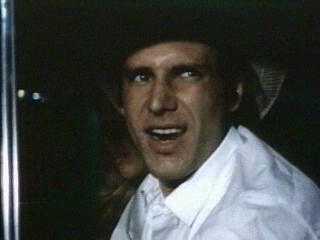
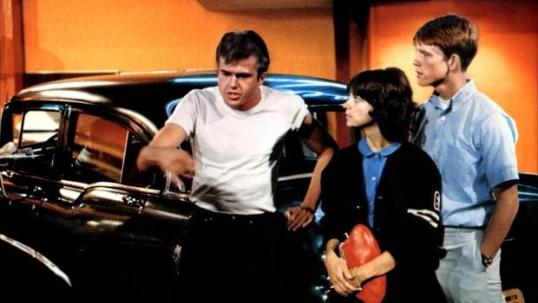
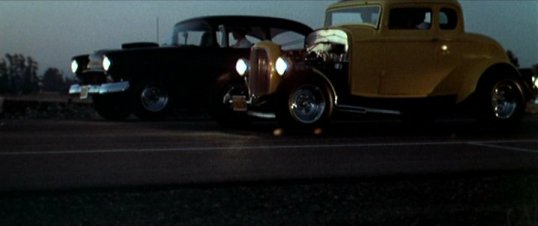
And finally, there’s John Milner (Paul Le Mat).  John is a little older than the other main characters.  He spends most of his time in his car, driving around and getting challenged to race.  He’s the epitome of late 50s/early 60s cool, with an attitude and a look that he obviously borrowed from James Dean and Marlon Brando.  Over the course of the night, he is forced to deal with a bratty 13 year-old stowaway (MacKenzie Phillips) and a mysterious challenger named Bob Falfa (played by a youngish Harrison Ford, who wears a cowboy hat and speaks with a country twang).

Harrison Ford in American Graffiti

The film follows these characters through the night and then, at the end of it, we get the famous epilogue where we discover that all of the male characters have pretty much ended up exactly how we thought they would.  In some cases, that’s a good thing.  And in other cases, it’s not.  It’s a good ending that’s kept from being great by the fact that none of the film’s female characters rate so much as even a mention.

So, what else can be said about American Graffiti?

It’s a great film.

Isn’t that enough?

American Graffiti