Horror Film Review: The Godsend (dir by Gabrielle Beaumont)


In The Godsend, a married couple, Alan and Kate Marlowe (played by Malcolm Stoddard and Cyd Hayman), have a chance meeting with a pregnant stranger (Angela Pleasence).  While Alan suspects that there is something wrong with the mysterious woman, Kate insists on allowing her to come have dinner with them.  At their rural home, the Stranger spends most of her time glaring at Alan and, when she’s left alone, she cuts the phone line.  When the Stranger goes into labor, Alan and Kate deliver her daughter.  The next morning, the Stranger has disappeared and Alan and Kate end up taking the baby — now named Bonnie — into their household.

Alan and Kate already have four other children but that soon starts to change.  First, baby Matthew is found dead in his crib.  As Bonnie grows up, the other children die.  Little Davey drowns in a creek and Bonnie is found with scratches on her hands.  Davey’s brother Sam says that he is scared to be left alone with Bonnie.  Alan and Kate tell him that he’s being silly.  Later, Sam is found dead in the barn.

With their neighbors flat-out accusing Alan and Kate of murdering their children and Bonnie doing strange things like attempting to give her father the mumps, Kate starts to have a nervous breakdown.  Meanwhile, Alan comes to fear that Bonnie may be the one responsible for the death of the other children and that she may now be targeting that last remaining child, Lucy (Angela Deamer).

First released in 1980 and based on a novel by Bernard Taylor, The Godsend is a British horror film that moves at its own deliberate pace.  The action unfolds slowly, with an emphasis on atmosphere and ambiguity.  While it certainly seems that Bonnie is responsible for the death of the other children, the first half of the film leaves room for doubt.  The viewer is left to wonder whether it’s possible that Alan himself is just being paranoid.  As the film progresses, one becomes aware that Bonnie is not only evil but she also has far greater powers than even Alan realizes.  The film ends on a properly dark note.  There really is no future in England’s dreaming.

The Godsend was a bit too slow.  As is so often the case with British horror films from the early 80s, the film was so determined to prove that it was better than the old Hammer bodice rippers that it allowed itself to get a bit too self-serious and stately.  That said, The Godsend is also undeniably creepy.  Viewers have been conditioned to believe that, no matter what else happens in a film, the children will survive.  Even though the children might very well be traumatized for life, it’s still generally accepted that they will somehow manage to make it to the end of the film.  The Godsend breaks that unofficial rule and it actually gets a bit depressing to watch.  Alan and Kate are going through the worst experience that a parent can can suffer.  Alan blames Bonnie while Kate clings to her as being one of the few things that she still has left.  It’s a sad movie that captures a very primal fear.

For the most part, the cast does a good if not spectacular job with the material.  The best performance comes from Angela Pleasence in the role of The Stranger.  Angela Pleasence was the daughter of Donald Pleasence, an actor who will always be best-remembered for playing Dr. Sam Loomis in the original Halloween films.  Dr. Loomis would have identified Bonnie as being evil from the start.  Unfortunately, no one would have listened to him until it was too late.

Lisa Reviews An Oscar Nominee: The Longest Day (dir by Ken Annakin, Andrew Marton, Bernhard Wicki, Gerd Oswald, and Darryl F. Zanuck)


As my sister has already pointed out, today is the 73rd anniversary of D-Day.  With that in mind, and as a part of my ongoing mission to see and review every single film ever nominated for best picture, I decided to watch the 1962 film, The Longest Day!

The Longest Day is a pain-staking and meticulous recreation of invasion of Normandy, much of it filmed on location.  It was reportedly something of a dream project for the head of the 20th Century Fox, Darryl F. Zanuck.  Zanuck set out to make both the ultimate tribute to the Allied forces and the greatest war movie ever.  Based on a best seller, The Longest Day has five credited screenwriters and three credited directors.  (Ken Annakin was credited with “British and French exteriors,” Andrew Marton did “American exteriors,” and the German scenes were credited to Bernhard Wicki.  Oddly, Gerd Oswald was not credited for his work on the parachuting scenes, even though those were some of the strongest scenes in the film.)  Even though he was not credited as either a screenwriter or a director, it is generally agreed that the film ultimately reflected the vision of Darryl F. Zanuck.  Zanuck not only rewrote the script but he also directed a few scenes as well.  The film had a budget of 7.75 million dollars, which was a huge amount in 1962.  (Until Steven Spielberg’s Schindler’s List, The Longest Day was the most expensive black-and-white film ever made.)  Not only did the film tell an epic story, but it also had an epic length.  Clocking in at 3 hours, The Longest Day was also one of the longest movies to ever be nominated for best picture.

The Longest Day also had an epic cast.  Zanuck assembled an all-star cast for his recreation of D-Day.  If you’re like me and you love watching old movies on TCM, you’ll see a lot of familiar faces go rushing by during the course of The Longest Day.  American generals were played by actors like Robert Mitchum, Robert Ryan, Henry Fonda, and John Wayne.  Peter Lawford, then the brother-in-law of the President of the United States, had a memorable role as the Scottish Lord Lovat, who marched through D-Day to the sounds of bagpipes.  When the Allied troops storm the beach, everyone from Roddy McDowall to Sal Mineo to Robert Wagner to singer Paul Anka can be seen dodging bullets.  Sean Connery pops up, speaking in his Scottish accent and providing comic relief.  When a group of paratroopers parachute into an occupied village, comedian Red Buttons ends up hanging from the steeple of a church.  When Richard Beymer (who is currently playing Ben Horne on Twin Peaks) gets separated from his squad, he stumbles across Richard Burton.  Among those representing the French are Arletty and Christian Marquand.  (Ironically, after World War II, Arletty was convicted of collaborating with the Germans and spent 18 months under house arrest.  Her crime was having a romantic relationship with a German soldier.  It is said that, in response to the charges, Arletty said, “My heart is French but my ass is international.”)  Meanwhile, among the Germans, one can find three future Bond villains: Gert Frobe, Curt Jurgens, and Walter Gotell.

It’s a big film and, to be honest, it’s too big.  It’s hard to keep track of everyone and, even though the battle scenes are probably about an intense as one could get away with in 1962 (though it’s nowhere near as effective as the famous opening of Saving Private Ryan, I still felt bad when Jeffrey Hunter and Eddie Albert were gunned down), their effectiveness is compromised by the film’s all-star approach.  Often times, the action threatens to come to a halt so that everyone can get their close-up.  Unfortunately, most of those famous faces don’t really get much of a chance to make an impression.  Even as the battle rages, you keep getting distracted by questions like, “Was that guy famous or was he just an extra?”

Among the big stars, most of them play to their personas.  John Wayne, for instance, may have been cast as General Benjamin Vandervoort but there’s never any doubt that he’s playing John Wayne.  When he tells his troops to “send them to Hell,” it’s not Vandervoort giving orders.  It’s John Wayne representing America.  Henry Fonda may be identified as being General Theodore Roosevelt II but, ultimately, you react to him because he’s Henry Fonda, a symbol of middle-American decency.  Neither Wayne nor Fonda gives a bad performance but you never forget that you’re watching Fonda and Wayne.

Throughout this huge film, there are bits and pieces that work so well that you wish the film had just concentrated on them as opposed to trying to tell every single story that occurred during D-Day.  I liked Robert Mitchum as a tough but caring general who, in the midst of battle, gives a speech that inspires his troops to keep fighting.  The scenes of Peter Lawford marching with a bagpiper at his side were nicely surreal.  Finally, there’s Richard Beymer, wandering around the French countryside and going through the entire day without firing his gun once.  Beymer gets the best line of the film when he says, “I wonder if we won.”  It’s such a modest line but it’s probably the most powerful line in the film.  I wish The Longest Day had more scenes like that.

The Longest Day was nominated for best picture of 1962 but it lost to an even longer film, Lawrence of Arabia.

Embracing the Melodrama Part II #61: Home Before Midnight (dir by Pete Walker)


-Home_Before_Midnight-_DVD_coverIf there’s any director who deserves to be rediscovered and be given a critical reevaluation, it’s … well, I was going to say that it’s Pete Walker but honestly, I’ve only seen a handful of Walker’s films.  And really, my admiration of Walker as a filmmaker is largely due to one film, 1974’s Frightmare.  So, I’ll just say that, based on Frightmare, Walker might deserve a critical reevaluation.

Unfortunately, I’m not reviewing Frightmare right now.  Instead, I’m taking a quick look at another Pete Walker film, 1979’s Home Before Midnight.

It’s going to be a quick look because there’s really not that much to say about Home Before Midnight.  The film opens with two 14 year-old girls hitchhiking.  Carol (Debbie Linden) is blonde and wild.  Ginny (Alison Elliott) is brunette and responsible.  They end up getting picked up by a truck driver who quickly decides that he’d rather just give a ride to Carol.  So, Carol and the driver drive off together and Ginny ends up alone and, once again, hitchhiking.  Eventually, Ginny is picked up by Mike (James Aubrey), a songwriter in his 30s.

Not realizing that Ginny is only 14 years old, Mike takes her back to his flat and they have sex.  Afterward, Mike discovers just how young Ginny is and tells her that they can be friends but that they can’t have sex because it’s illegal.  Ginny agrees.

And then Mike and Ginny end up having sex again anyway…

Anyway, as you can probably guess, things don’t go well as far as Mike and Ginny’s “romance” is concerned.  Though Ginny swears to her parents that she and Mike are just friends, her parents see Mike being interview on television, along with an unlikely rock star named Nick (Chris Jagger, far less charismatic brother of Mick).  When Mike is asked if he has a girlfriend, Nick announces that not only does Mike have a girl but her name is Ginny.  Soon, Ginny is moving on to boys her own age and Mike is on trial.

As someone whose first “serious” boyfriend was 9 years older than her and who has always appreciated a certain maturity in men, there were a few bits of Home Before Midnight to which I could relate.  Occasionally, the first part of the film even captures the excitement of having a secret and forbidden love.

But ultimately, the film just fails.  To put it lightly, Home Before Midnight is no An Education.  Instead, it’s a painfully boring film, one that pretends to examine a serious issue but then doesn’t even play fair.  We’re told that Ginny is 14 but the actress playing her was 20 and looked and acted like she was close to 30.  As well, about 90 minutes into the film, Ginny’s personality is totally changed, the better to portray Mike as somehow being a victim.  The film makes so many excuses for Mike and the camera spends so much time lingering on Ginny’s frequent naked body (and remember, Ginny is being played by a 20 year-old but is only supposed to be 14) that it actually becomes creepy to watch.

Ultimately, the most interesting thing about Home Before Midnight is the fact that it features Mick Jagger’s younger brother, Chris, in a supporting role.  Chris Jagger looks close enough to Mick that you would guess that they were related.  But Chris has absolutely none of Mick’s charisma and it’s actually funny to hear Chris continually being described as being one of the biggest stars in the world.  Chris Jagger makes Justin Bieber look like Adam Levine.

If you still want to see this boring and creepy movie, it’s currently available on Netflix.  However, I would suggest that your time would be better spent watching any other Pete Walker film.

http://www.youtube.com/watch?v=50fylKl8XsE

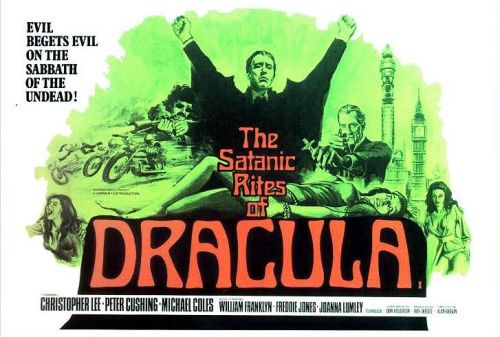
Horror Film Review: The Satanic Rites of Dracula (dir by Alan Gibson)


The_Satanic_Rites_of_Dracula_posterFirst released in 1973 and, like Dracula A.D. 1972, set in what was then the present day, The Satanic Rites of Dracula was the 8th entry in the Hammer Dracula series.  It was also the last to feature Christopher Lee in the role of Dracula and that perhaps is why, judging by some of the other reviews that I’ve read online, The Satanic Rites is one of the more reviled entries in the series.

Judging from a lot of those reviews, the attitude seems to be that The Satanic Rites of Dracula was so bad that it was the film that made Christopher Lee say, “No more!”  Reportedly, Lee felt that the film itself was both poorly written and that it was too violent.  And, even though the film is rather tame by the standards of today’s horror films, The Satanic Rites is still probably one of the more extreme entries in the series.  The film features a graphic and drawn-out flashback in which we see a naked woman sacrificed by a Satanic cult, a scene that’s bloody even by the standards of Hammer.  Later, when Jessica Van Helsing (played by Joanna Lumley, who took the role over from Dracula A.D. 1972‘s Stephanie Beacham) is menaced by a pack of female vampires, the vampires literally claw at her body like wild animals.  And finally, when one of Dracula’s brides is staked, blood literally splashes across the screen.

Christopher Lee was not a fan of The Satanic Rites of Dracula and neither are a lot of critics but you know what?  I think The Satanic Rites of Dracula is actually rather underrated.  If nothing else, it’s certainly far more unpredictable than some of the far more critically embraced Dracula films.

Satanic Rites opens with a British secret agent (Maurice O’Connell) escaping from a country house in which he had previously been held prisoner.  Though he’s fatally wounded during the escape, the agent manages to tell his superiors that, at the house, he witnessed a Satanic ritual that involved some of the most important people in the British government.  Since one of the accused occultists is a government minister, the secret service passes the case on to Scotland Yard’s Inspector Murray (Michael Coles, reprising his role from Dracula A.D. 1972) and then provide him with clandestine assistance.  (Or something like that.  To be honest, I get the feeling that the main reason Murray was called in was to maintain some continuity between Dracula A.D. 1972 and The Satanic Rites of Dracula.)  Murray suspects that vampires may be involved so he calls in Lorrimar Van Helsing (Peter Cushing).

After discovering that his old friend, scientist Julian Keeley (Freddie Jones), is a part of the cult, Van Helsing deduces that it’s all part of huge conspiracy headed by none other than Dracula himself.  The plan is to release a mutated form of bubonic plague and wipe out humanity.

Why is Dracula planning on destroying humanity?

Van Helsing theorizes that this might be Dracula’s way of committing suicide.  By wiping out humanity, Dracula will no longer have anyone to feed upon and his undead existence will finally end.  And, if nothing else, you have to admit that is a pretty interesting motivation!

How can you not enjoy a film that’s as strange as The Satanic Rites of Dracula?  It may not be a typical Hammer Dracula film and it may be a bit too obviously an attempt to revitalize a fading franchise by tossing everything that was then trendy at it but so what?  This is one of those movies that could have only been made at a certain point in time by a certain group of filmmakers and, as such, it’s valuable as both history and entertainment.

Christopher Lee may have hated The Satanic Rites of Dracula but he’s being way too hard on the film.  If nothing else, it provided a nice excuse for Christopher Lee and Peter Cushing to face off and how can you not appreciate that?