Retro Television Review: St. Elsewhere 1.12 “Release”


Welcome to Retro Television Reviews, a feature where we review some of our favorite and least favorite shows of the past! On Fridays, I will be reviewing St. Elsewhere, a medical show which ran on NBC from 1982 to 1988.  The show can be found on Hulu and, for purchase, on Prime!
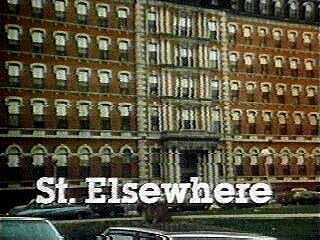
This week, things get dark.

Episode 1.12 “Release”

(Dir by Victor Lobl, originally aired on February 1st, 1983)

The gunshot victim (Tom Hulce) who was saved by Samuels last week has woken up but he has no idea who he is.  He is labeled John Doe #12, meaning there’s at least eleven other people at St. Eligius who are suffering from amnesia!  That’s a scary thought.  There’s a lot of things that I don’t want to suffer from and amnesia is high on the list.  I can’t imagine how frightening that would be, not having any idea who you are or where you belong.

Dr. Chandler tries to help John Doe #12 get his memory back but, in this episode at least, neither has any luck.  Even an attempt at hypnosis reveals that John can’t remember anything before being rolled into the ER.  At one point, an older couple step into the room to discover if John is their son, who has been missing for two years.  He’s not, which leaves the couple in tears.

As serious and as heart-breaking as this all is (and both Washington and Hulce give outstanding performances in this episode), there is one moment where Dr. Westphall makes a reference to a “Lt. Gerard,” who is searching for John’s parents.  It seems like a throw-away reference, unless you’re familiar with either the 1950s television show The Fugitive or the subsequent 1993 film adaptation.  Lt. Gerard was the name of the detective who was hunting for that show’s main character, Dr. Richard Kimble.  Ed Flanders delivers the line solemnly and it occurs at a serious moment.  There’s no winking at the audience.  Instead, it’s simply a reward for the pop culture-literate who might be watching the episode.

For the most part, this was a grim episode.  After losing a patient to cancer, Dr. Peter White was ordered to talk his family into signing a release for an autopsy.  The autopsy was largely to protect the hospital from getting sued.  The family didn’t want an autopsy.  Peter didn’t feel the autopsy was necessary.  But, having been bullied by his superiors, Peter proceeded to bully and manipulate the dead man’s son into signing the release.  In the end, it turned out that Peter was correct.  The man did die of cancer.  The autopsy was not necessary.  Upset over the whole process, Peter said that he felt like he had “raped” a mourning family.  The doctor who ordered Peter to get the release merely smiled and said he would see Peter at rounds the next day.

Meanwhile, Dr. Craig was shocked and angered when he discovered that his old friend (played by Andy Romano) had checked into the hospital for gender-affirming surgery.  This led to the episode final scene, in which Craig talked about not liking the way the world had changed since he was a young man.  The scene was well-acted by William Daniels, who was one of the best when it comes to giving a monologue of frustration.

And finally, Dr. Samuels and Dr. Paxson disagreed on how to treat a patient and this storyline would have been interesting if either Samuels or Paxson had been an interesting character.  But they’re not.  I don’t care about them.  I don’t care about their boring relationship.  And, knowing that neither is going to be around once this season ends, I really didn’t care that much about their storyline.  With all of the interesting stuff that happened in this episode, I groaned whenever I realized I was going to waste a few minutes watching Samuels and Paxson argue.

This episode left me feeling pretty depressed.  Between Peter bullying that family and John Doe searching for his identity, there wasn’t much hope to be found.  Still, I have faith that John Doe will find his identity and maybe Peter will even become a better doctor.  (He certainly can’t get much worse.)  If Lt. Gerard could find Richard Kimble, then anything’s possible!
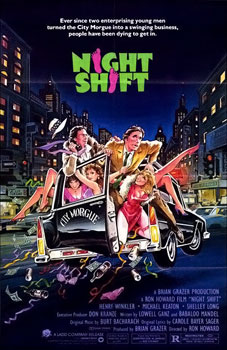
 

Night Shift (1982, directed by Ron Howard)


Chuck Lumley (Henry Winkler) was a Wall Street wizard until the stress of the job started to give him ulcers.  He dropped out of the rat race, got a less stressful job as an attendant at a New York City morgue, and eventually met and became engaged to Charlotte (Gina Hecht).  When Chuck’s supervisor decides to give Chuck’s day shift to his new guy, Chuck is promoted to the night shift.  “He has the same last name as you,” Chuck says when he learns the about the new employee.  “Yeah, I think he’s my nephew or something,” his supervisor replies.

Chuck finds himself working nights with “Billy Blaze” Blazejowski (Michael Keaton), a hyperactive “idea man,” who has so many brilliant plans that he has to carry around a tape recorder so he doesn’t forget them.  A typical Billy Blaze idea is to battle litter by creating edible paper.  Another one is to rent out the hearse as a limo and give rides to teenagers.  Chuck may not be happy about his new shift or coworker but he is happy that he shares his new work schedule with his upstairs neighbor, Belinda Keaton (Shelley Long).  Belinda is a high-class prostitute who first meets Chuck when she comes by the morgue to identify the body of her pimp.  When Chuck discovers that Belinda needs a new pimp, he and Billy take on the job themselves, which brings them into conflict with not only the vice cops but also with Pig (Richard Belzer) and Mustafa (Grand L. Bush).

Raunchy but good-hearted, Night Shift has always been one of my favorite comedies.  Along with being Ron Howard’s first movie for grown-ups, it also featured Michael Keaton in his first lead role.  Keaton is both funny and surprisingly poignant as Billy.  He’s hyperactive and impulsive and doesn’t think things through but his friendship with Chuck is real and later on in the movie, he reveals himself to have more depth than he lets on.  Also giving good performances are Henry Winkler and Shelley Long, two performers better-known for their television work than their film roles.  With his role here, Winkler proved that he was capable of playing more than just the Fonz.  Shelley Long has probably never been better (or sexier) than she was in this film.  The scene where she makes breakfast for Chuck is unforgettable.  Even though she’s playing a stock character, the prostitute with a heart of gold, Shelley Long brings her own unique charm to the role and makes Belinda seem like a real person.

Night Shift starts out strong but falters slightly during its second hour, when Chuck and Billy seem to magically go from being nerdy morgue attendants to successful pimps overnight.  Some of the violence feels out-of-place in what is essentially a buddy comedy with a dash of romance.  It’s still a funny movie that is full of memorable one liners and good performances.  As you might expect from Ron Howard, Night Shift is a surprisingly good-hearted look at the business of sex.  Ron Howard has directed a lot of films since but few of them are as much fun as Night Shift.

Lisa Reviews An Oscar Nominee: Coming Home (dir by Hal Ashby)


Well, here we are!  It’s January 1st.  In just a few days, the Oscar nominations will be announced and then, on February 9th, the winners will be revealed!  From now until the day of the ceremony, I will be taking a look at some of the films that were nominated for and won Oscars in the past.  As of this writing, 556 films have been nominated for best picture.  I hope that, some day, I will be able to say that I have seen and reviewed every single one of them.

Let’s start things off with the 1978 Best Picture nominee, Coming Home!

Coming Home takes place in California in 1968.  While hippies stand on street corners and flash peace signs, teenagers are being drafted and career military men are leaving for Vietnam and people continue to tell themselves that America is doing the right thing in Indochina, even though no one’s really sure just what exactly it is that’s going on over there.  At the local VA hospital, the wounded and the bitter try to recover from their wartime experiences while struggling with an often heartless bureaucracy and feelings of having been abandoned by their country.

When Marine Corps. Capt. Bob Hyde (Bruce Dern) is deployed to Vietnam, he leaves behind his wife, Sally (Jane Fonda).  Told that she can no longer live on the base while her husband is overseas, Sally gets an apartment, a new car, and eventually a new hairdo.  She also gets a new friend, Vi Munson (Penelope Milford).  Vi smokes weed and is critical of the war in Vietnam.  It doesn’t take long for Sally to start to enjoy the idea of being free and not having to cater to Bob’s every whim.  Sally even ends up volunteering at the local VA hospital.

That’s where she meets Luke (Jon Voight, looking youngish and incredibly sexy), a bitter but sensitive vet who, having gone to Vietnam and returned to the U.S. as a paraplegic, is now outspoken in his opposition to the war.  Luke is also friends with Billy (Robert Carradine), who is Vi’s shell-shocked brother.  When Luke and Sally first meet, they collide in a hallway and Sally gets a bag full of urine spilled on her.  It’s only later that Luke and Sally realize that they knew each other in high school and soon, they’re having an affair.  Luke, who is as gentle a lover as Bob is brutish, brings Sally to her first orgasm in a sensitively-directed scene that should be studied by any and all aspiring filmmakers.

Unfortunately, the problem with having an affair while your husband is away is that, eventually, your husband’s going to come back.  Bob returns from Vietnam and he’s no longer the confident and gung ho officer that he was at the start of the film.  He now walks with a pronounced limp and, like Luke, he’s angry.  However, whereas Luke has channeled his anger in to activism, Bob tries to keep his emotions bottled up.  (He does take the time to give the finger to a few protesters and, considering how obnoxious most of the protesters in this film are, you can’t help but feel that Bob may have had a point.)  When Bob discovers that Luke and Sally have been having an affair, he snaps….

Meanwhile, Billy is having a hard time readjusting to life, Vi is getting picked up by sleazy men in bars, and there’s a ventriloquist who shows up a few times.  There’s a lot going on in Coming Home and, at times, it feels like the film’s trying to cram in too much.  The film often seems a bit disjointed, with semi-documentary footage of Voight hanging out with real paraplegic vets awkwardly mixed in with didactic scenes of Sally turning against the war.

That the love story between Sally and Luke is so effective has far more to do with the performances of Jane Fonda and especially Jon Voight, than it does with anything in the film’s script.  Indeed, the script itself doesn’t seem to be too concerned with who Luke and Sally were before they collided in that hallway and it also doesn’t seem to be all that interested in who they’ll be after the end credits role.  As written, they’re just plot devices, specifically created and manipulated to express the film’s antiwar message.  But then you see Jon Voight’s haunted eyes while he’s listening to a group of vets discuss their experience or you hear the pain in his voice while he talks to a bunch of high school students and it’s those little moments and details that tell you who Luke is.  By that same token, Jane Fonda does a good job of showing each stage in Sally’s liberation, even if you can’t help but feel that the main reason Sally becomes an anti-war feminist is because she’s played by Jane Fonda.

Of course, in the end, the entire film is stolen by Bruce Dern.  You actually end up feeling very sorry for Bob Hyde (and, to the film’s credit, you’re meant to).  It would have been very easy to just portray Bob as being a close-minded pig but the film respects his pain just as much as it respects Luke’s anti-war activism and Sally’s need to be free.  In the end, you actually feel worse for Bob than you do for either Luke or Sally.  Bob is as much a victim of the war as anyone else in the film.

Coming Home was one of the first films about Vietnam to ever be nominated for best picture.  Jane Fonda and Jon Voight both won Oscars but the film itself lost to a far different look at the war in Vietnam, The Deer Hunter.