Decade of last.fm scrobbling countdown:
33. Аркона (909 plays)
Top track (49 plays): Покровы небесного старца, from От сердца к небу (2007)
Featured track: Гой, Купала!!!, from От сердца к небу
It’s no coincidence that a lot of folk-oriented Slavic metal bands have more of an edge than their western counterparts. There is a spirit of primitivism and barbarism that seems to permeate these acts; while Alestorm and Korpiklaani are reveling in booze, bands like Arkona are delighting in something more savage. Grittier distortion, harsher vocals, lower quality production, and a tendency to incorporate black metal all play a role. While this has allowed a lot of Slavic folk metal bands to capture a slightly deeper, more introspective connection to their cultural roots, it has also reduced their accessibility. Arkona are impervious to this consequence; they manage to invoke that essence of savage Slavic glory while still constructing songs I wouldn’t hesitate to recommend to people unconditioned to extreme metal. This is due in part to their above-average production quality (obviously lacking in a youtube rip), but more so to Masha’s wildly diverse range of sung and screamed vocals, often accompanied by a glorious operatic Russian chorus.
As with the last entry in my last.fm series, there is not much I care to say about Arkona that I did not already cover in a previous post. Their position as my 33rd most listened to band of the past decade is no accident. Hell, they’re the initial reason I learned how to transliterate Cyrillic.
On my way out of James Wan’s “The Conjuring” last night, I noticed Ryan Gosling’s name in the credits. A bit of curiosity led me to his band, Dead Man’s Bones. I wasn’t aware he sung, but he’s pretty good at it. Feeling like a mix of The Doors & Roy Orbison, this song really matches with some of the creepiness of the film. Here, the band plays “In The Room Where You Sleep” , with kids as the background vocals. Enjoy.
Decade of last.fm scrobbling countdown:
35. Blur (850 plays)
Top track (43 plays): Parklife, from Parklife (1994)
It wasn’t until about 1996 that my mother decided it would be acceptable to allow me to purchase cds. Prior to that, all non-Evangelical Christian music and television was banned in our household (aside from The Beatles and Pink Floyd; she liked them as a kid, so they must have never done drugs or any of that Satanic stuff). Her lovely father was exploiting me for slave labor at that point for the fair wage of 25 cents an hour, and I found that, at $8 a pop through the BMG music distribution club, I could buy a new cd every four days. I quickly replaced all of my secret cassette recordings of radio singles with actual albums, and some time the following year that lead to the acquisition of Blur’s Parklife. I was initially appalled to find that it did not contain “Song 2”–the only Blur track that most Americans have ever heard–and considered writing to BMG demanding my money back for their faulty advertising. How dare they sell me some other cd by a band that, according to my radio, only ever wrote one song worth listening to.
Well, suffice to say I gave it a few more listens and it became one of my lasting favorites of that decade. I was oblivious to its tongue-in-cheek social commentary at the time. What I heard was a vision of some foreign, advanced culture in which people spoke in tantalizing accents and could sing about subjects other than religion without resorting to aggression. The novel experience of a world beyond a particularly self-isolating yet prominent American subculture and its proclaimed enemies (grunge music and video games–we hadn’t reinstated the Crusades yet) is largely responsible for my persistent, overly glamorous and unrealistic Europhilia today. Blur’s ability to craft a sound that perfectly reflected the modern British life they were mocking placed them at the forefront of this experience. For me at the time, the most popular band in Britain was a close-kept secret. To have grown up and realized they really were one of the most talented and creative bands of their generation is just icing on the cake. Blur remains one of my most listened-to non-metal bands today–my 35th most-played band of the past decade–and I can’t imagine I’ll tire of them any time soon.
Decade of last.fm scrobbling countdown:
36. The Mountain Goats (846 plays)
Top track (37 plays): Home Again Garden Grove, from We Shall All Be Healed (2004)
Featured track: Fault Lines, from All Hail West Texas (2002)
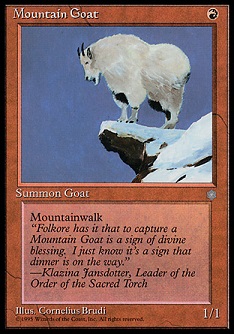
Back in my later high school days, when my early obsession with metal music coexisted with an active participation in games like Magic: The Gathering and Dungeons & Dragons, I remember stumbling across a 1/1 beast in Ice Age that I became bound and determined to name a pseudo-grim heavy metal band after:
I was very briefly disappointed to find that a band had already beaten me to the punch on that one. One of the things that makes John Darnielle an awesome person, though, is the very real possibility that this is no coincidence and he took his band name from M:tG too. (Probably not, given that his first album came out in 1994, but you never know.) This guy has made a guest appearance on an Aesop Rock hip-hop album and written an acoustic love song set to a Marduk black metal concert in the same year; his appreciation for the awkward and out-of-place couples with an above-average awareness of other musical scenes to conjure a constantly befuddling self-image. The first time I saw him live, before I was very aware of his works, I wasn’t sure if I ought to take the dialogue between each track as stand-up comedy or legitimate commentary by someone who was hopelessly socially inept. In retrospect, it was more the former, but the heart-felt sincerity Darnielle packs into everything he says or writes is both a quintessential part of the act and a reflection of who he really is–someone both incredibly aware and controlling of his public image and just a little bit legitimately weird. He has made his claim to fame writing sentimental solo acoustic songs with over-the-top lyrics and awkward subject matters that are simultaneously heart-felt and tongue-in-cheek. He has cultivated his awkwardness into some of the best solo acoustic albums recorded since Bob Dylan.
Lately, The Mountain Goats have evolved from a solo project to more of a full band. Last time I went to their show the audience had expanded from about a hundred to a few thousand, and Darnielle was hamming up the rock-star image with a shit-eating grin on his face the whole time. I absolutely love this guy and his works, and while I can’t say that I’ve kept up with him consistently over the years (his discography is massive), I’ve certainly listened to him enough to rank in my top 50 most played artists of the past decade. Here are the lines to Fault Lines, to give you some idea of his brilliantly bizarre lyrics:
Down here where the heat’s so fine
I’ll drink to your health and you drink to mine
As we try to make the money we scored out in Vegas hold out for a while
We drink vodka from Russia
We get our chocolates from Belgium
We have our strawberries flown in from England
But none of the money we spend seems to do us much good in the end
I got a cracked engine block, both of us do
Yeah the house, the jewels, the Italian race car
They don’t make us feel better about who we are
I got termites in the framework, so do you
Down here where the watermelon grows so sweet
Where I worshiped the ground underneath of your feet
We are experts in the art of frivolous spending
It’s gone on like this for three years I guess
And we’re drunk all the time, and our lives are a mess
And the deathless love we swore to protect with our bodies
is stumbling across its bleak ending
But none of the rage in our eyes
Seems to finish it off where it lies
I got sugar in the fuel lines, both of us do
Yeah the fights and the lies that we both love to tell
Fail to send our love to its reward down in hell
I got pudding for a backbone, and so do you
La la la la! Hey hey!
Decade of last.fm scrobbling countdown:
39. Camera Obscura (786 plays)
Top track (228 plays): Country Mile, from Let’s Get Out of This Country (2006)
Featured track: Razzle Dazzle Rose, from Let’s Get Out Of This Country (2006)
The presence of Camera Obscura on my decade-spanning last.fm charts might be the only fluke in this series. They basically got here because I listened to “Country Mile” on repeat for about 12 hours one day. Let’s Get Out of This Country is the only album I’ve really listened to extensively in their discography (they just released their fifth last month), and while I did get the pleasure of seeing them live once, I can’t say I know much about the band. But I do think this album is absolutely delightful–a little hidden ray of light in my mostly heavier music collection that warmed my heart the first time I heard it and still does today. Its retro vibe feels oddly more authentic than any of the actual classic pop sounds it replicates, made fresh by a heavy dose of 2000s indie aesthetics and Tracyanne Campbell’s angelic vocals. Let’s Get Out of This Country takes me back in time so vividly that I swear I remember growing up surrounded by the wallpaper on the album’s cover. It’s flooded with innocent ennui, played out in front of a kitchen window on a rainy Saturday afternoon. Its depression is refreshing and nostalgic, replaying some childhood memory in which boredom seemed to be the worst thing life had to offer.
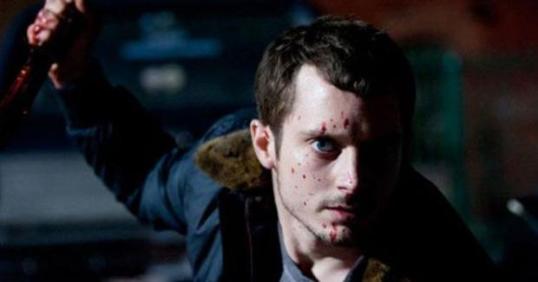
Today’s song of the day is an instrumental piece from the latest horror remake, Maniac. Composed by the French musician Rob, Maniac‘s score is just as important to the film’s unlikely success as Elijah Wood’s disturbing performance in the lead role. Reminiscent of the scores composed and performed by Goblin for the films of Dario Argento, Rob’s work here results in one of the best horror scores ever recorded.
Decade of last.fm scrobbling countdown:
45. 東野美紀 (Miki Higashino) (705 plays)
Top track (31 plays): Beautiful Golden City, from Suikoden (1995)
Ms. Higashino is the first of a handful of video game music composers to have risen through my ranks over the years, thanks almost entirely to her beautiful contributions to the soundtracks of Genso Suikoden I and II. (Funny, I would rank Suikoden II in a three way tie for my favorite video game ever, and all three relevant composers made it onto the charts.) Her discography is small but compelling, showcasing an appreciation for traditional Asian and European folk music that rarely surfaces with such force among her contemporaries. Paying special attention to Japanese and Irish folk in particular, she managed to imbue the first two Suikoden titles with a lively earthiness ideal for an unprecedented model of gameplay made possible by the Playstation. The Suikoden games eschewed fantasy in the raw for an appeal to political and military strife in which the hero moves from town to town gathering an army and waging war along grey lines, the quintessential naivete of the RPG hero being frequently exploited to generate scenarios in which the moral high ground stood open to debate. If the main plots centered around those characters most aware of war’s many faces, the hero and the bulk of his officers–108 recruitable characters in all–were simple folk, fighting for personal reasons without a grasp of the big picture. Miki Higashino’s success in the Suikoden soundtracks rested in her ability to score appropriate music for the simple majority–those characters with deep ties to the land, who lacked a grand vision and swallowed whole the political propaganda which cast their homes and country in jeopardy. Songs like Beautiful Golden City capture what the majority of the Suikoden cast fought to preserve.
Higashino has a long history in the video game music industry in spite of her short list of works. She composed her first two soundtracks–Gradius and Yie Ar Kung-Fu–in 1985, at the surprisingly young age of 17. Yie Ar Kung-Fu in particular reveals that Higashino bore an appreciation for folk music from the very beginning of her career. I’ll leave you with the NES version of this remarkably early score.
This is embarrassing. Here it is 2013, and my 2012 collection consists of only 38 albums, the majority of which I’ve listened to twice at best. I never heard the new Neurosis. I never heard the new High On Fire. Hell, forget metal, I didn’t even listen to the new Shins and Godspeed albums. I can’t offer an experienced, informed opinion now the way I could at the end of 2011. But I’ve been posting up some sort of album of the year list somewhere for over a decade now, and I’ll be damned if I let the fact that I didn’t really listen to any albums in 2012 stand in my way.
Or something like that. Here we go.
10. Dawnbringer – Into the Lair of the Sun God (track: IV)
It’s not often I get into a standard heavy metal album, but Dawnbringer did everything right in 2012. The songs rock along with a bit of an Iron Maiden drive to them, the power and black metal tendencies are tastefully incorporated to enhance the drive without altering the vibe, and the vocals know their limit. If it sounds a bit generic, don’t let that fool you. Not too many bands can pull this off without giving into the temptation to be more “epic” or “extreme” than they really are. Dawnbringer pull it off without the flare–without ever going over the top–and their accessibility places Into the Lair of the Sun God among the best of the year.
9. Korpiklaani – Manala
I wouldn’t say Hittavainen was the heart and soul of Korpiklaani, but he was an essential component. The band would be at a total loss without Jonne Järvelä, and their consistent line-up over the years has contributed enormously to their success, but Juho Kauppinen’s accordion aside, the folk instrumentation was almost all a product of Hittavainen. When he left due to health issues after Ukon Wacka in 2011, I feared it was the end of an era. Korpiklaani never missed a beat recovering from the loss in 2012. In addition to picking up the highly qualified Tuomas Rounakari as their new violinist, Jonne Järvelä stepped up to fill in the void by recording the mandolin, flute, and whistle tracks. I think I can hear some nuance differences between his and Hittavainen’s playing style, but it might just as well be in my head; Manala sounds like a Korpiklaani album through and through. I don’t like it as much as Karkelo and Ukon Wacka–it’s a bit heavier, too much so for my taste in folk metal–but in the greater sphere of Korpiklaani’s discography it is certainly composed and performed to par.
8. Ensiferum – Unsung Heroes
Ensiferum took a lot of slack for this album. I think a lot of people wanted to hear the over-the-top bombast that worked so effectively on Victory Songs, but in my opinion that was already growing stale on From Afar. Unsung Heroes is down to earth in a way they haven’t been since the 2001 self-titled debut, and I love it. They’re heading in exactly the direction I’d hoped for, and with the exception of the ugly mistake that is the album’s 17 minute closing track, Power Proof Passion, Unsung Heroes does not sound at all like a band past their prime. If they continue to push in the direction of tracks like Pohjola, they’re in position to trump Victory Songs and follow up Unsung Heroes with their best album to date.
7. Wodensthrone – Curse
I wish I’d taken the time to review this album earlier in the year, because I haven’t listened to it since the summer, and their flavor of epic black metal isn’t the sort of thing you can fully absorb in a quick last-minute listen. This is an album that can move nowhere but up in my charts over the months to follow, but for the time being I am content to place it somewhere in the middle. While busting out black metal that’s just as grim and unforgiving as the 1990s greats, Wodensthrone manage to infuse a tremendous amount of emotion that speaks of something beautiful hidden beneath the chaos. It’s buried a bit deeper than say, Femundsmarka by Waldgeflüster last year, but the feeling is similar.
6. Vattnet Viskar – Vattnet Viskar EP (song: Weakness)
If someone were to ask me what black metal sounded like in 2012, I might hand them this EP. It’s kind of cool getting to say that, because one of their members is a regular at the music forum where I get most of my recommendations. I wouldn’t have guessed back in March that they would be signed to Century Media by the end of the year, but I’m stoked to hear it. The whole notion of post-black metal has taken on a number of different flavors in these formative years, and Vattnet Viskar expand the genre by incorporating a lot of the all-encompassing guitar tones I associate with post-rock acts like Mono and This Will Destroy You. Top-notch stuff that’s really at the forefront of an emergent genre I’ve been anticipating for years.
5. Enslaved – RIITIIR
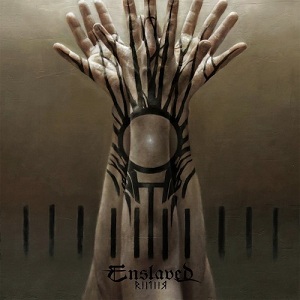
How Enslaved have aged so well is beyond me, but their last three albums have been their best three albums, and 22 years after the formation of this band they remain at the forefront of metal. Their viking-infused progressive black sound of late has done as much to shape the future of the genre as any new-found participant in the current popular trend towards black metal that has been taking shape over the past four years. RIITIIR is another outstanding output by the one classic early 90s black metal band that has managed to weather the ages unscathed.
4. Blut aus Nord – 777: Cosmosophy
The review I wrote of 777: Cosmosophy last month was one of the most thorough I’ve done all year, and there is nothing I care to say about the album that I haven’t said already. It is outstanding in its own right, but it does not feel like an entirely complete finale to their already classic 777 series. The first and third tracks, breathtaking though they may be, don’t seem to sufficiently progress from where the second album in the trilogy, The Desanctification, left off. The second track moreover, Epitome XV, is the weakest link on all three albums. The last two tracks compensate greatly by concluding in proper form, and I certainly think Cosmosophy is excellent. It can only be said to have “shortcomings” in so far as I expected it to be the best album of 2012. Fourth place isn’t too bad.
3. Torche – Harmonicraft (song: Reverse Inverted)
Calling Torche metal at this point is really pushing the limits of the definition. Since their early days writing crushing stoner anthems, they have evolved into a bizarre amalgamation equal parts metal and pop. But it’s not just the uniqueness of the happy, smiley-face hammers Harmonicraft beats you down with that makes it so appealing. Torche have become by all rights the heirs of the 1990s. These guys have more in common with the Smashing Pumpkins than they do with any of their stoner metal contemporaries. This is the sort of thing that 15 years ago we could have just labeled “alternative rock” and gone on enjoying without any need for classifications. While forging an entirely unique, original sound of their own, Torche have managed to capture a song-writing ethos that has been dead for a generation, and Harmonicraft is the cleanest breath of fresh air I’ve inhaled in years.
2. Krallice – Years Past Matter (song: Track 2)
Krallice is my favorite band making music today, and I dare say last year’s Diotoma might be my favorite album by any band ever. Seldom if ever has a band followed up such a masterpiece with something of equal worth, and I was shocked that Krallice had the energy left to release anything at all this year. Years Past Matter is an outstanding post-black metal outing in the vein of Dimensional Bleedthrough. The tracks took longer than usual to grow on me, and usual for Krallice entails dozens of listens, but the payout is always worth the time, and the slow process of appreciation is enjoyable in its own right. Mick Barr and Colin Marston’s dual tremolo is the grand ultimate ear-candy, and so long as they never compromise their commitment to that they will probably remain my favorite band. (Track 3 is my favorite song on Years Past Matter so far, but it was not available on youtube. Track 2 is a worthy substitute.)
1. Panopticon – Kentucky (song: Killing the Giants as They Sleep)
The fact that I didn’t review this album is almost embarrassing, because much like Aesthethica by Liturgy last year, it is an album that absolutely demands a thorough investigation to properly appreciate. I can’t easily tell you why I placed it this high, because frankly I don’t know yet myself. When I first read that a Louisville, Kentucky-based band called Panopticon had released a bluegrass black metal album, all sorts of thoughts ran through my head. Kentucky sounds like none of them. Do ignore the cliche “blackgrass” labels; while Austin Lunn listened to plenty of bluegrass in the process of recording this, he does not actually incorporate the genre as we might think of it. Instead he interweaves traditional Appalachian folk–not bluegrass particularly–as distinct tracks separated from the black metal. What folk does emerge in the bm is more akin to Waylander, and certainly far from “bluegrass”. That’s not a bad thing, just an–I think–important distinction to be made, because otherwise we might be left searching for genre stereotypes which simply aren’t present here. What Kentucky really accomplishes is a merging of a musical themes which perfectly juxtapose a beautiful landscape and a totally destitute human condition. The first half of “Killing the Giants as They Sleep” for instance generates landscape imagery with a degree of effectiveness similar to Femundsmarka by Waldgeflüster. (Have I referenced that album twice now? I think it’s time I paid it another visit.). You take a look around, take a deep breath, and really appreciate the natural beauty that surrounds you. About half way through the dialogue begins, and the explosion around 9:15 serves to draw you fully into the atrocities taking place here, both in the exploitation of workers and the desecration of the environment.
I don’t think Austin Lunn intended to make any sort of political statement here, but in succeeding so comprehensively to depict elements of Appalachia and its outskirts, he effectively did so. At a time when the working class of America is inexplicably becoming staunch supporters of big capital, this album hits a bulls-eye on all of the thoughts that have been forefront on my mind of late. His bleak renditions of union anthems like “Which Side Are You On?”, recently covered with such optimism by the likes of Dropkick Murphys, strike me as a painfully realistic reminder that the entire notion of equality as an American ideal is becoming antiquated.
But that might be seen as secondary. Wherever our ideas may lead us, Kentucky is the sort of album that inclines us to form them. It’s an album that makes me think. Like Aesthethica by Liturgy and Diotima by Krallice last year, it forces me to set aside my mundane daily routines and really engage the human experience. That alone, all other considerations aside, suffices to render it my favorite album of 2012.
Continuing my series on the best of 2012, here are ten of my favorite songs from 2012. Now, I’m not necessarily saying that these were the best songs of 2012. Some of them aren’t. But these are ten songs that, in the future, will define 2012 for me personally. Again, these are my picks and my picks only. So, if you think my taste in music sucks (and, admittedly, quite a few people do), direct your scorn at me and not at anyone else who writes for the Shattered Lens.
By the way, I was recently asked what my criteria for a good song was. Honestly, the main thing I look for in a song is 1) can I dance to it and 2) can I get all into singing it while I’m stuck in traffic or in the shower?
Anyway, at the risk of revealing just how much of a dork I truly am, here are ten of my favorite songs of 2012.
10 and 9) Make Bullying Kill Itself and Jacking It In San Diego (Trey Parker and Matt Stone)
These two songs were featured in the classic bullying episode of South Park. They should be required listening for anyone who thinks that a YouTube video can change human nature.
8) Big Machine (Ryan Miller)
Perhaps not surprisingly, I discovered a lot of my favorite music of 2012 in the films of 2012. This song was written for the Safety Not Guaranteed soundtrack.
7) Abraham’s Daughter (Arcade Fire)
This is from The Hunger Games soundtrack.
6) The Poison Tree (Moby, feat. Inyang Bassey)
Technically, this song — which is featured on Destroyed — is from 2011 but it was released, as a single, in 2012.
5) Call Me Maybe (Carly Rae Jepsen)
This is just a fun song.
4) Stronger (Kelly Clarkson)
Kelly Clarkson is always going to have to deal with haters, because she won American Idol and voted for Ron Paul. She’s one of my favorites, however.
3) Skyfall (Adele)
The minute I heard this song, I knew Skyfall was going to be great.
2) Blow Me (One Last Kiss) (P!nk)
It’s not really a year in music unless I have P!nk somewhere on the list.
1)Razor’s Out (Mike Shinoda featuring Chino Moreno)
This is from the soundtrack of The Raid: Redemption. Quite simply put, this is a great soundtrack for writing.
Tomorrow, I’ll continue my look at 2012 with my list of 10 good things that I saw on television last year.




 Through the Shattered Lens