This October, I’m going to be doing something a little bit different with my contribution to 4 Shots From 4 Films. I’m going to be taking a little chronological tour of the history of horror cinema, moving from decade to decade.
Today, we reach the end of the 50s and the rise of British horror.
4 Shots From 4 Horror Films
Night of the Demon (1957, dir by Jacques Tourneur)
The Curse of Frankenstein (1957, dir by Terence Fisher)
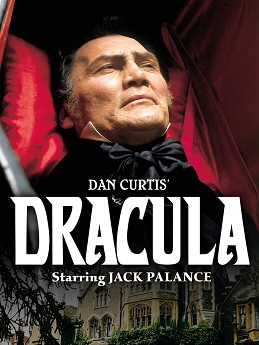
1974’s Bram Stoker’s Dracula opens with a familiar sight.
British solicitor Jonathan Harker (Murray Brown) is in Transylvania, where he has an appointment with a mysterious man named Dracula. The local villagers are superstitious and seem to be frightened of Dracula’s very name. When Harker reaches Dracula’s castle, he discovers that Dracula (Jack Palance) is a courtly but enigmatic man. When Dracula sees a photograph of Jonathan’s fiancée, Mina, and her best friend, Lucy, something about it seems to capture his attention. Later, that night, Jonathan is attacked by several female vampires. After Dracula saves Jonathan’s life, he forced Jonathan to write a letter home, saying that he will be staying in Transylvania for month. Jonathan attempts to escape but is instead dragged off to the crypt, where Dracula’s brides await….
Soon, Dracula is in England. Lucy (Fiona Lewis), who looks exactly like Dracula’s long-dead wife, is taken mysteriously ill and dies. Dr. Abraham Van Helsing (Nigel Davenport), called in when Lucy was showed signs of being sick, suspects that there is a vampire at work. Lucky’s fiancé, Arthur Holmwood (Simon Ward), doesn’t believe it until he sees, with his own eyes, Lucy raised from the dead and calling for him to come and join her….
Not to be confused with the Francis Ford Coppola film, 1974’s Bram Stoker’s Dracula was directed by horror impresario Dan Curtis. It’s a rather loose adaptation of Bram Stoker’s novel. For one thing, Jonathan Harker does not return to England. Dracula is, from the start, more interested in Lucy than in Mina. Lucy’s other suitors — Quincy Morris, John Seward — are not present. And Dracula himself does not get younger as the result of drinking blood. In fact, it’s such a loose adaptation that it’s actually difficult to justify calling it Bram Stoker’sDracula. (In fact, the film is also known as Dan Curtis’s Dracula, which is a far more appropriate title.)
That said, it’s still an entertaining vampire movie. Jack Palance, who previously worked with Dan Curtis in The Strange Case of Dr. Jekyll and Mr. Hyde, gives a properly intense performance as Dracula. He doesn’t try to adopt any sort of Eastern European accent or anything like that. Instead, he delivers his lines through clenched teeth (or, perhaps, fangs) and he fixes his victims with a powerful stare that hints at the animalistic urges behind his controlled demeanor. Palance plays Dracula as being arrogant and convinced that no mere mortal can defeat him. At the same time, there’s a vulnerability to Palance’s Dracula. Watch how his face briefly lights up when he sees Lucy’s picture and is reminded of his long-dead wife. Watch his fury when he discovers that Van Helsing and Arthur have gotten to Lucy before him. His love for his wife is the one shred of humanity that Dracula still has within him. When he loses her a second time (in the form of Lucy), he’s prepared to go to war.
Bram Stoker’s Dracula was originally meant to air in October of 1973 but the showing was pre-empted by the announcement that Vice President Spiro Agnew had resigned. As a result, this film — so clearly meant for Halloween — did not air until February of 1974. That doesn’t seem fair. Poor Dracula.
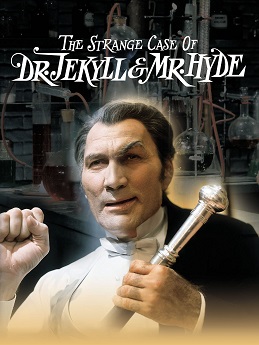
First released in 1968, The Strange Case of Dr. Jekyll and Mr. Hyde is a somewhat loose adaptation of the famous novella by Robert Louis Stevenson.
Jack Palance stars as Dr. Henry Jekyll, a mild-mannered and respected doctor who lives in Victorian-era London and who is convinced that there is a good and dark side lurking in every single person. The dark side is what forces people to break the law and fight with each other. Jekyll feels that his experiments will allow people to get closer to their dark side and, in doing so, defeat it. When Dr. Jekyll explains his theories to a medical association, he is violently jeered and booed. Jekyll returns to his home, enters his laboratory, and takes a drink of the serum that he’s been developing.
The next morning, Dr. Jekyll wakes up with a hangover and no memory of how he spent the previous night. Trying to retrace his steps, Jekyll finds himself in a dance hall where everyone is talking about a well-dressed but ugly man named Edward Hyde. Hyde showed up the previous night, spent a lot of money on a woman named Gwyn (Billie Whitelaw), and then got into a fight with two men. Hyde broke a window to make his escape. Jekyll, sensing what must have happened, pays for the window on behalf of his “friend,” Edward Hyde.
Jekyll continues to drink the serum and he continues to indulge in all of the forbidden vices as Edward Hyde. Eventually, we get to see Palance as Hyde. Unlike a lot of other actors who have played the role, Palance uses a minimum of makeup to suggest his transformation. Instead, he hunches over, scrunches up his face, and he has a unibrow. One of the stranger things about this production is that we are continually told that Hyde looks nothing like Jekyll but we know that’s not true. Instead, Hyde looks exactly like Jekyll making a funny face.
Palance gives one of his more eccentric performances as Jekyll and Hyde. Somewhat surprisingly, he’s far more convincing as the kindly and troubled Dr. Jekyll than as the villainous Mr. Hyde. (As Hyde, Palance is often trying to so hard to maintain his facial paralysis that it’s hard to understand exactly what it is that he’s saying.) With each drink of the serum, Jekyll becomes a bit more confident in himself. However, he also finds himself losing the ability to control the transformations. One morning, he wakes up in his bed and is shocked to discover that he is still Hyde. That same morning, he learns that Hyde is suspected of committing a senseless and brutal murder. Jekyll has no memory of it but he knows that Hyde is guilty. And if Hyde is guilty, so is Jekyll. (Those who make the argument that Dr. Jekyll and Mr. Hyde is ultimately about drug addiction will find plenty to back up that argument in this production,) Jekyll’s anguish as he realizes what he has become is rather poignant to watch.
Produced by horror impresario Dan Curtis, The Strange Case of Dr. Jekyll and Mr. Hyde can seem a bit creaky today. It was apparently highly acclaimed when it first aired but, seen today, it can feel rather stagey and talky. That said, the film has a strong supporting cast, with Denholm Elliott especially giving a good performance as Jekyll’s best friend. Jack Palance’s performance is so bizarre that it transcends the usual standards used to determine good and bad. It’s definitely a film worth watching.
For today’s horror on the lens, how about a little werwolf action?
In the 1974 made-for-TV movie, Scream of the Wolf, Peter Graves is a writer who is asked to help solve a series of mysterious murders. The fact that both human footprints and wolf tracks have been found at each murder scene has led some people to assume that the killer must be a werewolf! Will Graves be able to prove them wrong or will it turn out that they are right? Graves calls in a famous hunter (Clint Walker) to help track down the killer but it turns out that the hunter has secrets of his own.
Scream of the Wolf features a screenplay from Richard Matheson and it was directed by television horror specialist, Dan Curtis. It feels like it was probably meant to be a pilot in which Peter Graves would deal with a supernatural mystery on a weekly basis. Even if the movie didn’t lead to a series, it’s still enjoyably atmospheric.
2015’s FaithOfOurFathers tells the story of a road trip to Washington, D.C.
John (Kevin Downes) and Wayne (David A.R. White) might not seem to have much in common. John is uptight and neurotic, on the verge of getting married but feeling like he has to do one final thing while his fiancée (Candace Cameron Bure) plans their wedding. Wayne is a proud redneck, someone who lives in a trailer and enjoys picking fights. When John first shows up at the trailer, Wayne shoots a shotgun at him. When John refuses to leave, Wayne eventually allows him into the trailer and the two of them talk.
They are linked by their fathers, who both served and bonded in Vietnam. Through flashbacks, we see how John’s father (Sean McGowan) found strength from his religious faith and how Wayne’s father (Scott Whyte, who viewers of a certain age will recognize from CityGuys) eventually set aside his cynicism. Wayne is in possession of the letters that his father wrote home from Vietnam and John, feeling a need to know who his father was, wants to read those letters. Wayne agrees to show John the letters if he drives Wayne to Washington D.C. so that they can visit the Vietnam War memorial.
Along the way, the two of them bicker, bond, and have adventures. This is a road film, which means that it has to take a while for John and Wayne to stop arguing with each other and start to open up about their pasts and their views on the modern world. They meet a wide variety of people while on their trip, some of whom are trustworthy and many of whom are not. They also meet Mansfield (Stephen Baldwin), who served in Vietnam with their fathers and who offers up some details about what happened to the men while they were serving in the military.
Unfortunately, the film itself doesn’t really work. It has all of the flaws that one typically associates with a faith-based filmmaking. The budget is noticeably low, something that especially becomes an issue during the Vietnam flashbacks. The dialogue is often didactic. Downes and White are familiar faces when it comes to faith-based films and they’ve both given good performances in other films but they both feel miscast here. As played by Downes, John is a bit too neurotic to be believable (or particularly sympathetic) while White’s earnest and, at times, goofy style of performing feels wrong for a character who is supposed to be into random fights and beer. For someone whose career has largely become about appearing in faith-based films, Stephen Baldwin seems rather detached throughout FaithofourFathers. In the flashbacks, he’s one of the least convincing commanding officers that I’ve ever seen in a war film. In the modern scenes, he just seems bored. If I’m being hard on Baldwin, it’s because I’ve seen him give really good performances in other films. Knowing that he could be giving a good performance makes his bad performances all the more frustrating.
I will say this, though. FaithofOurFathers takes a stand for supporting our veterans, both when they’re serving and after they’ve come home. I appreciated that. All too often, we seem to hold the unpopular wars against those who served, as if the mistakes of those in command are somehow their fault. That happened with Vietnam and it’s happening right now with Iraq and Afghanistan. No one should ever be forgotten or deserted by their own country.
In this 2014 shocker, a young couple moves into what seems like a perfect 2 bedroom, 1 bath apartment. Rachel (Michele Hooks) and Kevin (Andrew W. Walker) are hoping to start a family in their new apartment. Their landlady (Dee Wallace) is very happy to hear that. In fact, it’s hard not to feel that she’s a bit too happy to hear it….
In many ways, 2 Bedroom 1 Bath is a typical “is it haunted or not?” thriller. From the minute that they move into the apartment, Kevin starts to have strange and nightmarish visions. He imagines himself trying to pick up a baby, just for it to fall to the ground and shatter like a doll. Dark shadows move in the background while pale faces are reflected in the windows. After taking a shower, Rachel doesn’t notice that ghostly figure in the mirror behind her. Things get creepier and stranger after Rachel gets pregnant and Kevin finds himself not only tempted by student but also taunted by mysterious messages that appear in the mail box.
It’s a bit predictable but Hooks and Walker both give strong performances and director Stanley Yung does a great job of creating an ominous and dream-like atmosphere. This is a film that features several dozen jump scares and just about everyone of them is effective. It’s an effective piece of haunted apartment horror.
As for Eric Roberts, his role is a small one. He plays the fertility specialist and he has three scenes with Rachel and Kevin. When Roberts first appeared, I assumed his character was going to be revealed to be a part of the supernatural conspiracy but no. He was just a well-intentioned doctor with two patients who had no idea how much trouble they were about to face. To be honest, I’m so used to seeing Eric Roberts playing villains that it was kind of nice to see him playing a sympathetic professional for once.
Previous Eric Roberts Films That We Have Reviewed:
In the 1979 made-for-TV movie, MindoverMurder, Deborah Raffin stars as Suzy.
Suzy is a model and an actress. She has a nice apartment, which she shares with her football-loving boyfriend, Ben (Bruce Davison). She has a best friend (Penelope Willis), who is constantly looking to get laid. Her latest job requires her to dance with a man who is dressed up like a giant hamburger. It would seem that, by the standards of 1979, Suzy has the perfect life.
However, her life is turned upside down when she suddenly starts having visions. All of the action around her will either switch to slow motion or stop altogether while Suzy has a vision of a scary-looking bald man (Andrew Prine) stalking her. Her most disturbing vision involves Suzy hearing the sound of a pilot begging for help while his airplane crashes. Ben tells her that she’s probably just working too hard but, the next morning, Suzy looks at a newspaper and immediately sees a headline about a plane crash.
With Ben dismissing her concerns, Suzy takes it upon herself to meet with the two detectives (David Ackroyd and Robert Englund — yes, Robert Englund!) investigating the plane crash. They are surprisingly sympathetic to Suzy’s story of hearing the plane crash before it happened. They arrange for her to meet a psychic researcher, who explains that Suzy must have some sort of mental connection to whoever was responsible for the crash. While Ben continues to be skeptical and jealous of all the time that she’s spending with one of the detectives, Suzy keeping having disturbing visions of the bald man….
Considering its origins as a made-for-TV movie, MindOverMurder is a surprisingly frightening film. This is a film that proves that slow motion can make just about anything creepy and Deborah Raffin does a good job of showing us just how much Suzy dreads those moments when everything starts to slow down and she realizes that she’s about to get hit with another vision. That said, what truly makes this film frightening is the performance of Andrew Prine, who plays the bald man as being every woman’s nightmare. He’s a misogynist, the type who is convinced that every woman should be in love with him and that those who aren’t should be punished. Whether he’s appearing in Suzy’s visions or stepping into her reality, Andrew Prine is never less than terrifying.
Along with featuring a scary performance from Prine, this film also features a genuinely likable one from Robert Englund. Englund is playing a nice guy here. In fact, before he made horror history in A Nightmare in Elm Street, Englund almost always played nice guys. It’s interesting to watch him here, with his friendly manner and his polite style, and to imagine the roles Englund would have ended up playing if he hadn’t gotten typecast as a horribly scarred serial killer.
The first hour of MindoverMurder is brilliant. The final 30 minutes, unfortunately, find the film turning into a far more conventional thriller, as Suzy’s visions are replaced by the Bald Man actually coming after her. That said, this is still an effective horror thriller and one that deserves to be rediscovered this Halloween season.
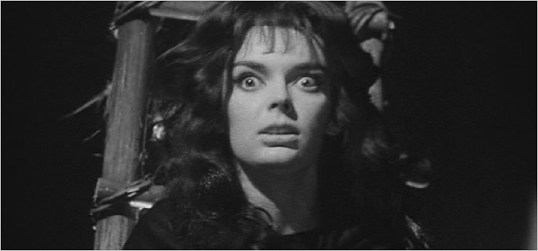
The British-born actress, Barbara Steele, became a star in Italy in the 60s, working with directors from Riccardo Freda to Mario Bava to Federico Fellini. One of Steele’s defining roles was in Bava’s 1960 film, Black Sunday.
In this scene, Steele’s witch is sentenced to be executed and, since this is a Bava film, it won’t be a quick execution. What makes this scene stand-out is Steele’s defiance. It’s hard not to admire her refusal to give those judging her what they want. You watch this scene and you have no doubt that if you get cursed by Barbara Steele, it’s going to be a curse for life.
Kill, Baby…. Kill!, Mario Bava’s 1966 masterpiece, opens at the turn of the 20th Century.
In a small German village, a woman named Irena Hollander (Mirella Panfili) runs up a set of stairs at an abandoned church. From the bell tower, she either falls or deliberately jumps and crashes into the sharp spikes of the gate below. Agck! Falling from that high of a spot is bad enough without then landing on a gate and getting pierced by several sharp points at once. Making it even more disturbing is that it’s suggested that the spikes don’t instantly kill Irena. It’s a grotesque and disturbing image, shown to us in bright color. It’s death as pop art. It’s the sort of thing that only Mario Bava could have paid off.
Dr. Paul Eswai (Giacomo Rossi Stuart) is summoned to the village by Inspector Kruger (Piero Lulli). Kruger suspects that Irena may have been intentionally pushed and he wants Paul to conduct an autopsy. However, the superstitious townspeople say that her body must be buried immediately and Paul and Kruger actually have to rush out to the local cemetery to prevent the Irena from being buried. The gravediggers warn Paul and Kruger that they will be bringing a curse on themselves by not burying Irena. Paul and Kruger don’t listen. At the autopsy, a local medical student named Monica (Erika Blanc) is assigned to serve as the witness. Paul discovers that a silver coin has somehow been embedded in Irena’s heart.
Paul discovers that the villagers live in fear of the ghost a little girl. They claim that if you see the girl, that means you are cursed to die. Paul, being a man of science, is skeptical. When the daughter of the local innkeeper becomes horrified after saying that she has seen the little girl, Paul is critical of the treatment offered up by her superstitious parents. (That treatment include a chain of leeches — agck!) Meanwhile, Kruger goes to the estate of the mysterious Baroness Graps (Giovanna Galletti) and disappears! It soon becomes clear that the key to mystery lies in the estate of the Baroness and her past. Karl (Luciano Catenacci), the burgomaster, knows the secret of the Baroness but soon, he finds himself being targeted by the little girl.
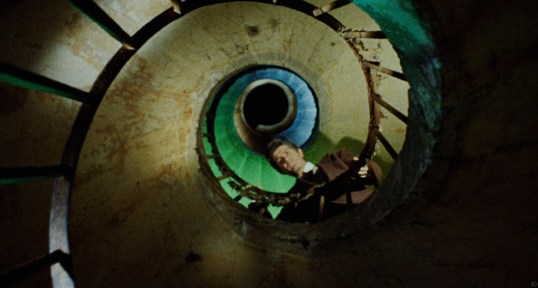
Maria Bava is a director who has been cited as an influence by everyone from David Lynch to Martin Scorsese and Kill, Baby…. Kill! is his masterpiece, a work of horrific pop art that is full of atmosphere, creative use of color, and an intentionally surreal style of plotting that makes the film less a standard story and more of a filmed nightmare. Towards the end, as Paul pursues the ghost of the little girl, an overhead view of a special staircase, lit in blues and greens, brings to mind Hitchock’s Vertigo while the village itself feels as if it could have been transported over from a Hammer horror film. Paul is a man of science and the villages are people of superstition and, in the end, both seem to be equally destructive. Paul is too quick to dismiss the old traditions while the villagers are too quick to put their faith in herbs and incantations. Bava creates an atmosphere in which everyone seems to be equally doomed.
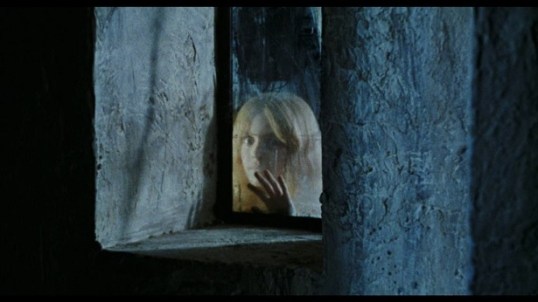
Of course, the main reason why Kill, Baby…. Kill! works is because that little girl (played by Valerio Vali, about whom little is known) is absolutely terrifying. When she suddenly shows up at a window and stares straight at her latest victim, it’s a true jump scare. She had an intense stare but, even worse, she seems to be so happy after she’s cursed someone. The true horror is that she can basically pop up anywhere. It doesn’t matter if you’re a good person or a rational person or someone who doesn’t even believe in ghosts. Fate cannot be escaped.
Kill, Baby…. Kill! is a both a story of nightmarish horror and a love letter to pure cinema.
Angel Maturino Resendiz, now there was a scary person.
Resendiz was a drifter who hitched rides on trains and who killed at least 15 people over the course of 13 years. Because he traveled by stowing away on trains, his first few crimes went undetected. Even when people realized that there was a serial killer haunting the nation’s railroads, no one knew exactly where Resendiz would next turn up. He committed the majority of his murders in Texas, killing random people and using whatever method happened to be most convenient at the time. However, he also killed people in Florida, Georgia, California, Kentucky, and Illinois. He would steal his victim’s jewelry but leave behind their money. (He would return to his home in Mexico to give the jewelry to his sister and mother, both of whom apparently had no idea where he was getting his gifts from.) After he was placed on the FBI’s Most Wanted List, Resendiz eventually surrendered himself in 1999. Resendiz was apparently under the impression that he would not be given the death penalty if voluntarily turned himself in. Resendiz was wrong about that and he was executed in 2006.
Until Resendiz surrendered himself, everyone living near a railroad track was nervous. I know this from personal experience because, in 1999, my family lived close enough to the tracks that I could lay in bed in the middle of the night and listen to the sound of the trains rumbling in the distance. Resendiz was a killer who targeted those who were smaller and weaker than him, which basically would have included me, my mom, and my sisters. Apparently, whenever he did a home invasion, he would also eat whatever food he could find in the refrigerator. Whereas most killers would probably want to get away from the scene as quickly as possible, Resendiz would sit down and eat leftovers. For whatever reason, that little detail is the one that creeps me out the most.
2020’s The Texas Railroad Killer is loosely based on the crimes of Angel Resendiz. The film features Resendiz (Lino Aquino) as he wanders around South Texas, randomly killing. As played by Aquino, Resendiz comes across as being a somewhat dazed, paranoid shell of a human being, a shadow of death who doesn’t seem to be aware of the difference between reality and what’s only happening in his mind. Does he really witness a group of strippers being gunned down by law enforcement or is it something that he only imagined? It’s hard to tell. After Resendiz commits a murder, he looks over his victim’s identification as if he’s trying to absorb the life that he just ended. And yes, he does eat in a victim’s house. Agck!
The Texas Railroad Killer is an extremely low-budget film. Lino Aquino is convincingly out-of-it as Resendiz but some of the other performers are noticeably less convincing in their roles. The film is largely plotless and the slow pace will be a turn-off for many viewers. And yet, there’s a disturbing power to the film’s sun-drenched visuals. The images of the sweaty Resendiz walking down broken streets or stumbling dazed out of someone’s home stick with you. Flaws and all, the film captures the soulless existence of a man who lives for no other reason than to kill.






 Through the Shattered Lens