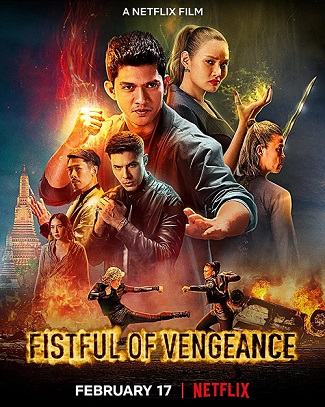
I just finished watching Fistful of Vengeance on Netflix. The film has a running time of 95 minutes and I have to admit that I spent a good deal of the film in a state of confusion. While some of that was undoubtedly due to my ADD, there are two other factors to consider:
First off, Fistful of Vengeance is based on a show called Wu Assassins. (Wu Assassins is also available on Netflix.) The movie takes place immediately after the end of the show’s first season. At this point, I should go ahead and admit that I have never seen the show. The movie does start with a quick recap of who everyone is and why they’re running around the world and fighting supernatural warriors and, from what I’ve read, the film itself is meant to be stand-alone work of entertainment. That said, I’m sure it can be argued that my lack of knowledge of Wu Assassins effected my ability to actually follow the plot of Fistful of Vengeance. If you’re a fan of the show, you should probably just watch the movie and ignore my review.
The second thing to consider about Fistful of Vengeance is that the plot really didn’t matter. Yes, there’s a lot of people conspiring against each other. Yes, there’s a lot of talk of talismans and spirits and monsters and ancient powers. And, yes, there’s international cartels and magical warriors. There’s a mystery to be solved, as Tommy (Lawrence Kao) and his friends try to track down the person or persons responsible for the death of Tommy’s sister. New allies are found and a few surprisingly enthusiastic sex scenes are staged. Enemies are fought and I assume that there’s a reason for it all. However, when watching the film, it soon becomes obvious that all of that plot is just there as an excuse for the action and the glossy images. Fistful of Vengeance is not plot-driven. Instead, Fistful of Vengeance is driven by style.
And you know what?
There’s not a damn thing wrong with that.
Seriously, you don’t watch a film like this because you’re searching for the meaning of life or because you’re hoping for some form of greater enlightenment. You watch a movie like Fistful of Vengeance because you want to see good-looking people wearing nice clothes and kicking ass. One fight follows another and all you really need to know is that you want Kai Jin (played by action specialist Iko Uwais), Tommy, and their team to win. You don’t really need to know who they’re fighting or why they’re fighting. Instead, the appeal is watching the artistry of the kicks and the punches and the tossing of weapons. Add in some monsters and some magical powers and a nice propulsive soundtrack and the movie pretty much has everything that an audience needs to be entertained. It’s a big, glossy, colorful, and rather silly movie. I had no idea what was going on for most of it but I still found myself watching. It’s fun, it’s entertaining, and it really doesn’t demand much. It’s not really a film that’s going to stick with you but watching it is also not terrible way to spend 95 minutes of your day.
Once upon a time, Pat Pitsenbarger (Udo Kier) was one of the most important citizens of Sandusky, Ohio. He was the town’s leading hairdresser. He was the man who the wealthy trusted with their appearance. When he wasn’t cutting hair, he performed drag as Ms. Pat and when he wasn’t cutting or performing, he built a nice home with his partner. He often remembers the two of them working in the garden.
All of that is in the past, though. Pat’s partner died years ago and Pat was reminded of his place in the community when some of his wealthiest clients didn’t even bother to come to the funeral. Pat lost his business. He lost his home. He’s spent the past decade or so living in a nursing home. Pat may be the best-groomed and best-spoken resident of the nursing home but he’s still definitely a man who is waiting for death.
One day, a lawyer shows up at the home and informs Pat that one of his most faithful clients, Rita Parker Sloan (played by Linda Evans), has died. Rita had one last request. She wanted Pat to do her hair and makeup for the funeral. At first, Pat is hesitant. His memories of Rita are not particularly pleasant. But finally, he decides to do it. He escapes from the nursing home and starts to walk to the funeral home. To do Rita’s makeup, he’s going to need supplies, some of which haven’t even been existed since the 80s. Unfortunately, he has no money and, as he soon discovers, his old home no longer exists either. The world has changed.
As quickly becomes clear, there’s more to Pat’s journey than just wanting a final chance to do Rita’s hair. As he walks through the town, he tries to reconnect with his past, just to discover that much of his past has been torn down. His old beauty shop is under different management. His old house has been torn down. Few people seem to remember or recognize him. One of the few people who does remember Pat is his former protégé, Dee Dee (Jennifer Coolidge), who now basically hates his guts. Meanwhile, Rita waits in the funeral home, her hair and makeup a mess.
Released last year, Swan Song is an imperfect but ultimately touching movie. The shadow of death hangs over almost every scene. It’s not just that Pat is doing one last favor for the deceased Rita. Nor is it just that Pat is haunted by memories of his dead partner. (The scene where Pat visits his grave is one of the most effective in the movie, thanks to Kier’s heartfelt performance.) It’s the fact that Pat himself knows that he’s getting older and he only has a certain amount of time left. His walk across Sandusky is not just about traveling to the funeral home. It’s also his final chance to see the world, remember the past, and experience how things have changed (or not changed as the case may be). The journey is about Pat coming to terms with his anger, his sadness, and his past. It’s also about Pat’s desire to go out the same way that he’s always lived, on his own terms.
As I said, it’s not a perfect film. There are a few scenes that threaten to get a bit mawkish. But even the most overwritten scenes are saved by the brilliant lead performance of Udo Kier, who gives a wonderfully complex performance as Pat. Since the 70s, Kier has been a mainstay in European exploitation cinema. He stared in Flesh For Frankenstein and Blood For Dracula. He had key supporting roles in two Dario Argento films. He appeared in art films, horror films, dramas, comedies, and thrillers. He’s appeared in blockbusters and small indie films. At times, it can seem like Kier is one of those actors who basically accepts anything that’s offered to him, regardless of whether the material is worthy of his talents or not. Kier has appeared in good films and bad and, perhaps because he’s been such a ubiquitous cinematic presence, he’s often been unfairly taken for granted as an actor. In Swan Song, Udo Kier gives one of his best performances as the sometimes brutally snarky but ultimately kind-hearted Pat Pitsenbarger. If for no other reason, watch this movie to appreciate the often underrated talent of Udo Kier. A lesser actor would have turned Pat into a cliché. Udo Kier transforms Pat into a complex and rather heart-breaking character.
Today, the Shattered Lens wishes a happy 89th birthday to Bob Rafelson, who was one of the first directors to not only truly recognize the genius of Jack Nicholson but also one of the co-creators of the Monkees. (In fact, Rafelson brought the Monkees and Nicholson together when he made his directorial debut with 1968’s Head. The Monkees starred in the film while Nicholson wrote the script.) After getting his start on television, Rafelson became one of the leading figures of the Hollywood counterculture that came to power in the late 60s and the early 70s and a business partner of producer Bert Schneider, Rafelson also played a role in the creation of such classic films as Easy Rider, The Last Picture Show, and Hearts and Minds. Like Nicholson, Rafelson was never a hippie. Instead, his vision was closer to the vision of Jack Kerouac and Neal Cassady. Rafelson and Nicholson brought the sensibility of the Beat Generation to Hollywood and, for a while at least, they changed the face of American culture.
In honor of Bob Rafelson’s birthday, today’s scene that I love comes from his 1970 film, Five Easy Pieces. In this Oscar-nominated film, Jack Nicholson plays Bobby Dupea. Born to a wealthy and music-obsessed family, Bobby currently works in an oil field and is alternatively angry, cynical, and idealistic. (That both the main character and the director shared the same first name is probably not a coincidence as Rafelson also came from an artistic family. Though many of Bobby’s famous outbursts — especially the famous one involving a chicken sandwich — were based on things that had actually happened to Nicholson, the character was equally based on Rafelson.) After Jack Nicholson’s Oscar-nominated turn in Easy Rider,Five Easy Pieces featured Nicholson playing the type of role for which he would be best-known in the 70s, the wayward rebel who must choose between being a part of society or being forever an outcast.
In this scene, Bobby and his oilfield co-worker find themselves stuck in a traffic jam. Bobby gets a chance to show off both his temper and his talent. It’s a great scene and Nicholson gives such a strong performance that it’s only later that you realize that Bobby’s anger didn’t really accomplish much. That was a recurring theme in Nicholson’s early films. With this scene, Bob Rafelson captures both a man and a country in conflict.
Five Easy Pieces would be nominated for Best Picture, though it would lose to Patton. After his supporting nomination for Easy Rider, Nicholson received his first best actor nomination for this role here. (Again, Patton triumphed, though George C. Scott famously refused to accept his Oscar.) Sadly, Bob Rafelson was not nominated for Best Director.
Equally sadly, Rafelson’s subsequent films received mixed reviews (though most have been positively reevaluated in recent years) and struggled at the box office. With Hollywood becoming more concerned with finding the next blockbuster than producing films about existential wanderlust, Rafelson often struggled to bring his vision to the screen. He hasn’t directed a film since 2002’s No Good Deed. However, his work lives on amongst serious film students and historians of the 70s. If any director’s work is worthy of rediscovery and reevaluation, it’s Bob Rafelson’s.
On October 29th, 2018, Lion Air Flight 610 crashed into the Java sea, killing all 187 passengers and crew. It was the first accident to involve the Boeing 737 Max series of aircraft and it was also one of the first major air disasters after a period of relative safety in the sky.
A few months later, on March 10th, 2019, Ethiopian Airlines Flight 302 crashed juts six minute after taking off. All 157 passengers and crew were killed. Like the Lion Air flight, the plane was a Boeing 737 Max.
At the time, Boeing insinuated that pilot error was to blame for both crashes but several investigations revealed that Boeing, which previously had a reputation for being one of the most safety-conscious companies around, cut corners when it came to the 737 Max series. In order to cut costs, not all safety protocols were followed. As a result, many concluded that the 737 Max jets should never have been approved for service to begin with. After a lengthy congressional hearing, Boeing CEO Dennis Mullenburg stepped down as a result of the scandal. Despite the fact that over 300 people had been killed in the two crashes and the fact that he left the company in shambles, Mullenburg left Boeing with a 62 million dollar severance.
That’s the story that’s told in the new Netflix documentary Downfall: The Case Against Boeing. It’s the type of thing that will and should leave you outraged. Due to the company’s negligence, over 300 people are dead and their families and friends have been left behind to mourn their loss. Boeing, at first, blamed the pilots, with the implication being that Indonesian and Ethiopian pilots just weren’t as good as their western counterparts. When the inevitable investigation was launched into just what exactly was going on over at Boeing, the company was less than forthcoming. There’s a lot to be angry about and the majority of the people who watch the documentary will be angry.
That said, the actual documentary itself is typical of a lot of the docs that turn up on the streaming services. It deals with an important subject but it does so in a rather superficial manner. It brings up the relevant issues but it doesn’t actually bother to dig too deeply into them. “Wow, this is really messed up, right?” the documentary seems to be saying and yes, it is messed up. But, at the same time, Downfall doesn’t really explore how it came to be so messed up or what can be done to make it less messed up. Instead, there’s a lot of archival news reports and enough footage of U.S. Rep. Peter DeFazio grilling the Boeing executives that the documentary could pass for a campaign commercial if not for the fact that DeFazio is retiring at the end of his current term. Aesthetically, the documentary feels more like an extended episode of Dateline or 60 Minutes than an actual examination as to just what exactly was going on at Boeing. As far as documentaries directed by Kennedys are concerned, Rory Kennedy’s public service docs are certainly preferable to the anti-vax nonsense pushed out by RFK, Jr. (Rory, it should be noted, is pro-vaccination and has publicly condemned her brother’s anti-vax activities.) But still, it’s hard not to wish that Downfall had dug just a little deeper.
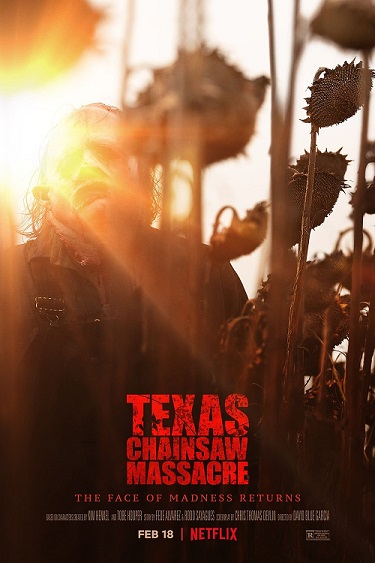
Leatherface is back but don’t worry! He’s mostly just killing hipsters.
The newest version of Texas Chainsaw Massacre is a direct sequel to the classic 1975 film. 50 years after the murders the shocked the world, Leatherface is still missing. True crime shows still do specials about the massacre at Harlow, Texas and the mysterious murderer who were a mask made out of human skin. The only survivor of that massacre, Sally Hardestry (Olwen Fouéré, taking over the role from the late Marilyn Burns), went from being a half-crazed hippie to being a Texas Ranger. She spent decades searching for Leatherface but she never found him.
I can only assume this means that Sally was terrible at her job because this film reveals that Leatherface is still living in the small rural town of Harlow, Texas. Harlow has been largely abandoned since the original massacre. But Mrs. Mc (Alice Krige) still owns the orphanage where Leatherface apparently grew up and Leatherface still lives with her, which is weird since Leatherface had a very tight-knit family in the first film and all of the subsequent sequels. (As opposed to what David Gordon Green did with his Halloween reboot, the new Texas Chainsaw Massacre does not go out if its way to specifically deny the canonicity of the other Chainsaw films. I, for one, appreciated that. Regardless to what the critics may say, there’s always been a rather appalling smugness to the way that Green’s Halloween franchise casually wiped out everything that came after Carpenter’s original film.) Unfortunately, the bank has foreclosed on most of Harlow and the town has been bought by a bunch of Austin hipsters, who are planning on turning the town into a Marfa-style artist’s colony. I guess the idea is that artists will be attracted to the town by its cannibalistic history, just as some are attracted to Marfa’s frequent UFO spottings. Of course, the Marfa Lights have never killed anyone but who knows? Austin’s weird.
When the main hipster and the sheriff order Mrs. Mc to leave the orphanage, she has a heart attack. Leatherface accompanies her in the ambulance because, apparently, no one finds it odd that there’s a silent, hulking man wandering around in the same location where a silent, hulking man previously killed a lot of people. About halfway to the hospital, Mrs. Mc dies and Leatherface decides that it’s time to retrieve his tools and go hipster hunting.
The new Texas Chainsaw Massacre isn’t terrible as much as its just generic. Everything about it feels like it’s been lifted from other recent horror revivals. The film opens with some stabs at modern relevance, with scary rednecks glaring at the Yankee invaders and Dante (Jacob Latimore) declaring the Harlow represents the “joys of late stage capitalism.” Lila (Elsie Fisher, who previously starred in Eighth Grade and who gives a good performance here, despite getting stuck with a poorly written character) is a survivor of a school shooting and she gets upset when she sees that the local mechanic owns an AR-15. The film then turns, very briefly, into a social satire when the smug hipsters are revealed to be just as greedy and superficial as the people that they’re looking down on. However, once Leatherface grabs his chainsaw, it turns into just another slasher film. Sally does eventually show up and calls Leatherface a “motherfucker” while pointing a rifle at him but that moment feels a bit too derivative of the recent Halloween films. Perhaps if Marilyn Burns were still alive and had returned to play the role, Sally vs. Leatherface would have been the iconic horror moment that it was obviously meant to be but, with a new actress who doesn’t even have a Texas accent, it just feels a bit forced. The problem with this slasher film being generic is that it’s called Texas Chainsaw Massacre. That’s quite a legacy to live up to and, for a lot of horror fans, generic simply won’t cut it.
Indeed, as I watched this latest version, I couldn’t help but think about what made the original version a classic. The original version used its low budget to its advantage. It had a rough, raw feel to it, one that made you feel as if you were watching real people as opposed to local actors. It also had very little gore, leaving it to the audience to imagine what horror truly went on inside of Leatherface’s kitchen. (Needless to say, the imagination can always come up with something far more disturbing than anything that could actually be captured on film.) This new version takes the opposite approach. If the original worked because it haunted you after the final frame, the new version is all on the surface. There’s a lack of authenticity to this new version of Texas Chainsaw Massacre. The first film was made by Texans and it was filmed in Texas. You could look at any scene in the original and feel the heat and the humidity. This new version was filmed in Bulgaria. Texas may be in the title but it’s nowhere in the film.
(Indeed, one of the main reasons why the original film was a success was because it was identified as taking place in Texas, a state that scared a lot of people when the film was originally released and a state that, admittedly, probably still scare scares a lot of people, even though we’re all pretty nice down here. People would laugh off a Vermont Chainsaw Massacre.)
There’s also no family dynamic in this new version. There’s no sign of Leatherface’s brothers or their ancient grandpa. Once Mrs. Mc dies, it’s pretty much just Leatherface and no one, not even Sally, comments on the fact that Leatherface didn’t work alone in the first film. Without his family around, Leatherface just becomes another silent serial killer. There were times, in the sequel, where he seemed like he had more in common with Rob Zombie’s version of Michael Myers than with the overwhelmed but hard-working Leatherface of the original film.
That said, on the positive side, I did appreciate the remake’s final scene. It was a bit predictable but it still managed to be enjoyably chaotic. What’s more annoying? Leatherface or a self-driving car?
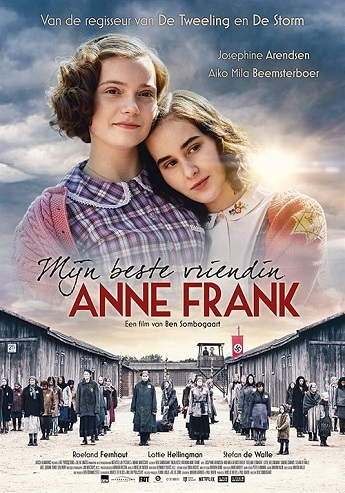
The year is 1944 and 16 year-old Hannah Goslar (Josephine Arendsen) and her younger sister, Gabi, are among the many Jews being held at the Bergen-Belsen concentration camp. Death is all around. At night, when Hannah is sent to empty out the buckets of waste that have been filled up in her barracks, she sees another prisoner being casually shot by the guards. Whenever things get to be too much for her, Hannah closes her eyes and asks herself, “What would Anne do?”
As terrible as things are where Hannah is being held, it’s rumored that things are even worse behind the wall that runs through the center of the camp. The less “privileged” prisoners are kept there. The wall is thin enough that Hannah can talk to the people on the other side, even if she can’t see them. Hannah asks them if her best friend, Anne, is among them. “She has beautiful hair,” Hannah says. The voice on the other side of the wall explains that no one in the other half of the camp has hair. Everyone on the other side of the wall is being starved and worked to death.
Occasionally, Hannah remembers what life was like before she and her family were arrested by the Nazis. Two years earlier, she was a student in Amsterdam and her best friend was Anne Frank (Aiko Beemsterboer). Hannah was shy but Anne definitely wasn’t. Hannah was often naïve and fearful but Anne was always intellectually curious and up to try almost anything. Occasionally, they fought as friends sometimes do. But Hannah always considered Anne to be her best friend.
The Amsterdam scenes do a good job of contrasting Hannah and Anne acting like ordinary teenagers with the evil that’s always lurking in the background. Haughty soldiers in German military uniforms stroll the streets of Amsterdam, moving with the arrogance of men who know that no one can defy them. Because Hannah and Anne wear gold stars on their clothing, they have to sneak into the movies and, when they do, they find themselves watching a propaganda newsreel about how much better life is in the Netherlands now that the Germans are in charge. Hannah often sees her father having hushed conversations with other nervous-looking adults.
Of course, those of us watching at home know what is going to happen. We know who Anne Frank was. Or, I should say, I hope we know who Anne Frank was. I tend to assume that everyone knows about the horror of the Holocaust and that everyone knows about the anti-Semitism that fueled the rise of Adolf Hitler and the Third Reich. Unfortunately, over the past year or so, my faith has been shaken. Anti-Semitism has never gone away but, in recent years, it seems as if it’s become socially acceptable within certain parts of mainstream society and that really should scare the Hell out of anyone who has any knowledge of history. I have seen reportedly intelligent people either playing down the horrors of the Holocaust or trying to act as if the Holocaust was not about the Third Reich’s obsession with wiping out a race of people. Whoopi Goldberg may have been the most famous person to have recently gotten the facts of the Holocaust wrong but she’s hardly the only one.
To me, that’s why a film like My Best Friend Anne Frank is important because it reminds us of not only what happened at camps like Bergen-Belsen but also what happened beforehand. The camps and the ideology that fueled them didn’t just spring up out of nowhere. Instead, they were built while the rest of the world tried to deny what was happening right before their eyes. The concentration camp scenes in this film are harrowing but even more disturbing are the Amsterdam scenes where people casually walk by signs that declare that no Jews allowed and almost everyone merely averts their eyes. When Anne and Hannah walk through Amsterdam, they are insulted not just by the Nazis but also by the Dutch citizens who don’t wear gold stars, many of who seem to take an attitude of, “At least it’s not me being othered.”
My Best Friend Anne Frank is currently on Netflix. Josephine Arendsen and Aiko Beemsterboer both give good and heart-breaking performances as Hannah and Anne. The film is not just a story of survival under the worst of circumstances but it’s also a tribute to the power of friendship. Though Anne did not survive the camps, Hannah was liberated after 14 months at Bergen-Belsen and now lives in Jerusalem. She is now 93 years old.
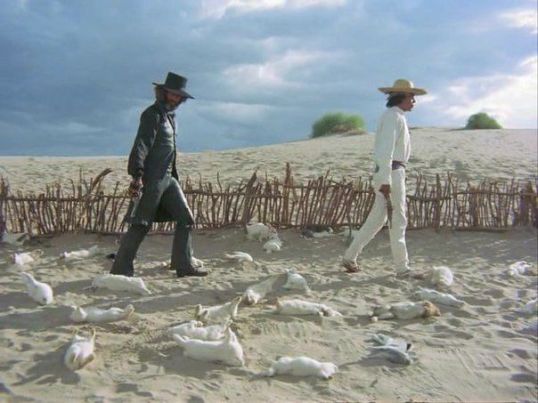
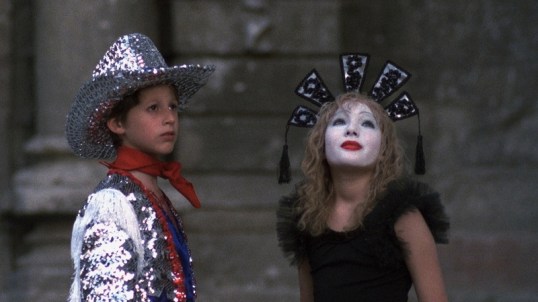
4 Or More Shots From 4 Or More Films is just what it says it is, 4 shots from 4 of our favorite films. As opposed to the reviews and recaps that we usually post, 4 Shots From 4 Films lets the visuals do the talking!
Today, the Shattered Lens wishes a happy birthday to master of surrealism and the man who nearly turned Dune into a film before either David Lynch or Denis Villeneuve, Alejandro Jodorowsky! It’s time for….
4 Shots From 4 Alejandro Jodorowsky Films
Fando y Lis (1968, dir by Alejandro Jodorowsky, DP: Rafael Corkidi and Antonio Reynoso)
El Topo (1970, dir by Alejandro Jodorowsky, DP: Rafael Corkidi)
The Holy Mountain (1973, dir by Alejandro Jodorowsky, DP: Rafael Corkidi)
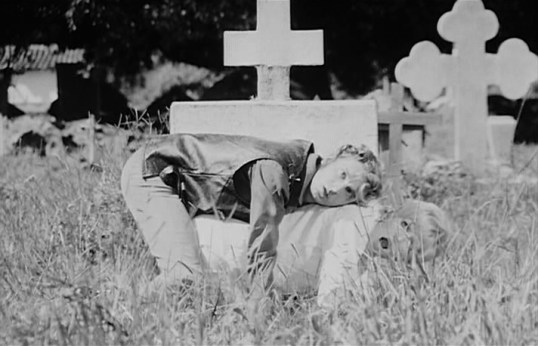
Santa Sangre (1989, dir by Alejandro Jodorwosky, DP: Daniele Nannuzzi)
For as long as I can remember, I always wanted to fall in love with a gangster.
*cue Layla piano coda*
How I Fell In Love With A Gangster is a three hour Polish film, one that the audience is told is based on the true story of Nikodem ‘Nikos’ Skotarczak (played by Tomasz Wlosok), a career criminal who became a bit of a celebrity in Eastern Europe during the late 80s and 90s. The film follows Nikos from his unhappy childhood in Poland to his time as one of Eastern Europe’s most notorious car thieves. He assembles his own crew and, while he does steal a lot of cars, he also seems to be a rather amiable criminal. He’s not the type of criminal who kills people or who even threatens to kill people. Instead, he’s just looking to make some extra money, have a good time, and defy anyone who would try to tell him what to do. He’s the type of criminal who would rather deal with trouble by escaping out a window than by drawing a gun. At least from the way that he’s portrayed in the film, it’s hard not to like him. As more than one character points out, he’s hardly a gangster.
Unfortunately, things change. Nikos does a few stints in prison. Each time he gets out, he discovers that the underworld had become a bit more violent and that it’s becoming increasingly more difficult to stay loyal to his old business associates. He may not be a gangster but the people around him definitely are. The cops are still after him. Two rival gangs expect him to support them in a gang war. Nikos just wants to snort cocaine, spend time with his latest wife, and try to be a good father but none of that turns out to be as easy as he was hoping. Also haunting Nikos is his own belief that his family has been afflicted with a death curse. Every six years, one of his relatives dies violently. Eventually, Nikos believes, it will be his turn.
It’s a bit of an odd film. The story features a framing device, in which a young reporter interviews an older woman who was in love with Nikos. The majority of the film is told in flashback but, throughout the flashbacks, Nikos’s friends and business partners often break the fourth wall and talk straight to the audience. Occasionally, this is used to good effect but it still leaves the viewer wondering just who exactly is telling the story. The film’s 3-hour running time also feels excessive. For every scene that really works (and there are quite a few), there are other scenes that are a bit too derivative of other gangster films. As soon as Nikos partnered up with a criminal named Silvio, it was obvious that the audience had reached the part of the film where the clever and honorable criminal mastermind would have to deal with an out-of-control subordinate.
Flaws and all, the film did work for me. A lot of that was due to Tomasz Wlosok’s charismatic performance as Nikos. Over the course of the film, Nikos went from being a fun-loving, hyperactive criminal to being a rather sad and defeated middle-aged man, isolated from his former associates and waiting for fate to intervene. Wlosok was never less than compelling in the role. Though the soundtrack was occasionally a bit too on-the-nose, the use of Moby’s One Of These Mornings added a certain poignance to the film’s final scenes. Finally, the film itself looked great, providing a nice contrast between the industrial drabness of communist-controlled Eastern Europe and the neon-infused glory of Nikos’s life as a criminal. In the end, Nikos emerges as a tragic figure, a man who just can’t understand how or why the underworld has suddenly become such a dangerous and unforgiving place.
If this aired during the Super Bowl, I missed it. Regardless, here is the DC — The World Needs Heroes trailer, which features scenes from several upcoming DCEU films.





 Through the Shattered Lens