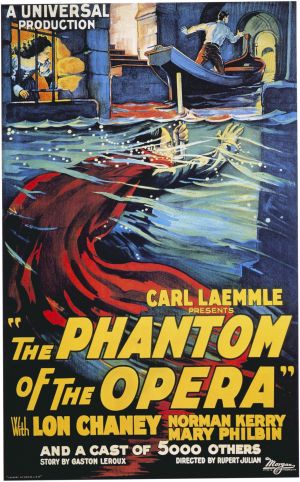
Today’s horror movie on the Shattered Lens is both a classic of silent era and one of the most influential horror films ever made. It’s one that I previously shared in 2013, 2015, 2016, 2108, 2019, 2020, 2021, and 2022 but it’s such a classic that I feel that it is worth sharing a second (or fifth or even a sixth or perhaps an ninth) time.
First released in 1925, The Phantom of the Opera is today best known for both Lon Chaney’s theatrical but empathetic performance as the Phantom and the iconic scene where Mary Philbin unmasks him. However, the film is also a perfect example of early screen spectacle. The Phantom of the Opera was released during that period of time, between Birth of the Nation and the introduction of sound, when audiences expected films to provide a visual feast and Phantom of the Opera certainly accomplishes that. Indeed, after watching this film and reading Gaston Leroux’s original novel, it’s obvious that the musical was inspired more by the opulence of this film than by the book.
This film is also historically significant in that it was one of the first films to be massively reworked as the result of a poor test screening. The film’s ending was originally faithful to the end of the novel. However, audiences demanded something a little more dramatic and that’s what they got.
Here’s one last trailer for the night. This one is for The Legend of Ochi, starring Willem DaFoe and released by A24. I have no idea if this will be any good or not but let’s all take a moment to consider just how amazing an actor Willem DaFoe actually is.
The trailer for The Electric State, the latest film from the Russo Brothers, dropped earlier today. The film stars Chris Pratt and Millie Bobby Brown and, if this trailer intrigues you, you’ve got a while to get ready for the film as it’s not set to be released until March of 2025!
Since today’s horror on the lens was the original Nosferatu, it feels appropriate that today’s scene of the day should come from Werner Herzog’s 1979 remake. In this scene, Lucy (Isabella Adjani) observes firsthand the madness that has come to the town of Wismar, along with the vampire and ship full of plague-carrying rats. While the people of the town have a last supper and celebrate their impending doom, Lucy tries to figure out a way to save them from Klaus Kinski’s Dracula.
This scene is a perfect example of how the director of a remake can both pay respectful homage to his source material while also bringing his own concerns to the story.
Handling The Undead opens, as many Norwegian films tend to do, with a shot of an overcast sky, an ugly apartment complex, and a forest that appears to be submerged in shadows. From the opening shots, it’s a depressing film. Again, that won’t come as a surprise to anyone who has ever watched a Norwegian film.
Three families are dealing with death. A woman has buried her young son and is now struggling not only with her grief but also her loving but overbearing father, whose attempts to make her feel better have the exact opposite result. An old woman’s longtime spouse lies in a coffin, having not yet been put back into the Earth. A woman is rushed to a hospital after an automobile accident and is not expected to live.
At night something happens. The lights turn off. Static is heard on every radio. When the lights come back, so do the dead. The grandfather hears his grandson wheezing and beating on his coffin and promptly digs him up. The old woman’s spouse climbs out of her coffin on her own and returns to the home where she lived for decades. The car accident victims opens her eyes and is alive, even though the doctor say that her heart is not beating rapidly enough to sustain life. While the local authorities try to figure out why the dead have come back to life and to try to keep track of where they’ve all gone, their relatives spend one more day with their loved ones.
The problem is that dead may be alive but they’ve come back as silent and unemotional empty shells. They seem to have a slight memory of their former lives but they don’t react to anything in a normal way. Instead, they stare straight ahead. The child has already started to decay and his return brings no happiness to his mother. In fact, there’s not much happiness to be found anywhere in Handling the Undead. One gets the feeling that even Ingmar Bergman would want to tell this film to lighten up.
Handling the Undead unfolds at a leisurely pace. There are a few creepy scenes but, for the most part, the horror comes from what we’re expecting the zombies to do than what we actually see them do. Everyone watching the movie knows what is eventually going to happen with the zombies. We know that eventually, the undead will attack the living. Handling the Undead, however, is more concerned with how the living would react to the dead than how the dead will eventually destroy the living. There’s very little dialogue and every scene is darkly lit and full of shadows. The majority of the characters hope that the returned dead will act like their old selves but they soon discover that they can’t go back to the way things once were. It’s an intelligent film about how we grieve and deal with loss.
That said, it’s also a rather dull film. It’s a deliberately boring film and, at times, it’s low-key approach feels almost as gimmicky as the blood and guts that can be found in more traditional zombie films. Stretched out to 90 minutes, the running time feels like an endurance test. And again, that’s probably what the filmmakers were going for but it doesn’t make the film any easier to sit through. When one reaches the end of a 90-minute film that is this purposefully slow, one has the right to expect more of an emotional or intellectual payoff than this film provides. This is a film that I can grudgingly respect but it’s not something that I’ll ever watch again.
4 Shots From 4 Films is just what it says it is, 4 shots from 4 of our favorite films. As opposed to the reviews and recaps that we usually post, 4 Shots From 4 Films is all about letting the visuals do the talking.
Today’s director in Lamberto Bava, one of the most underrated directors in the history of Italian horror cinema.
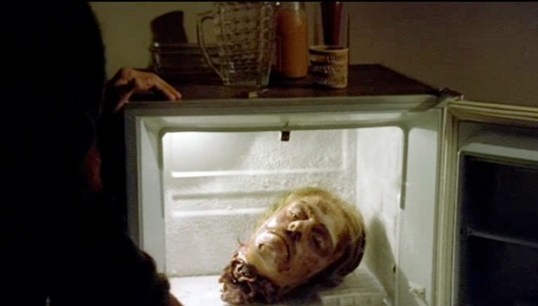
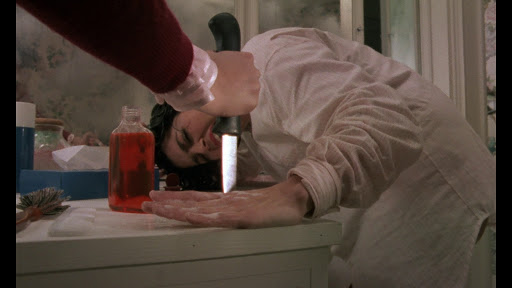
4 Shots From 4 Lamberto Bava Films
Macabre (1980, dir by Lamberto Bava, DP: Franco Delli Colli)
A Blade In the Dark (1983, dir by Lamberto Bava, DP: DP: Gianlorenzo Battaglia)
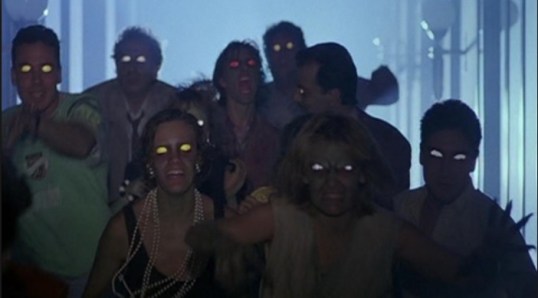
Demons 2 (1986, dir by Lamberto Bava, DP: Gianlorenzo Battaglia)
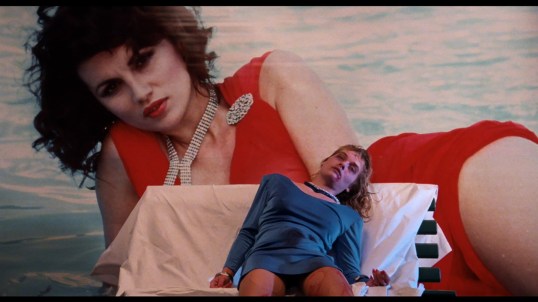
Delirium (1987, dir by Lamberto Bava, DP: Gianlorenzo Battaglia)
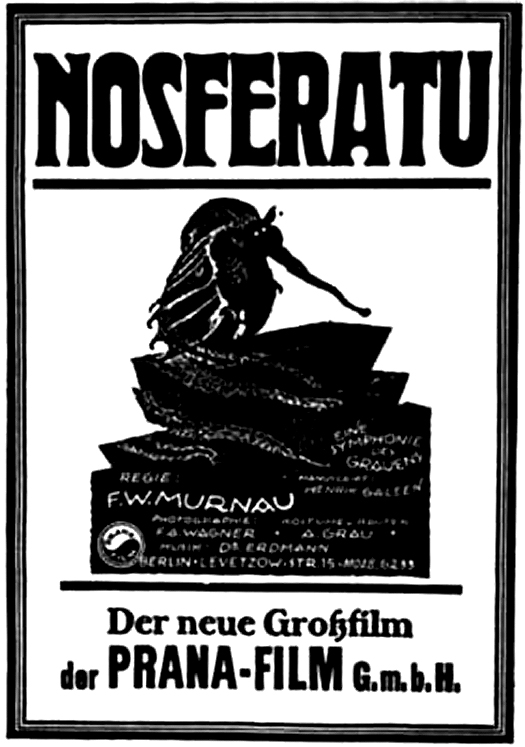
Today’s Horror on the Lens is a classic film that really needs no introduction! Released in 1922, the German silent film Nosferatu remains one of the greatest vampire films ever made. It’s a film that we share every October and I’m happy to do so again this year!
It can be easy to forget just what a big splash God’s Not Dead made when it was released back in 2014. Today, it’s taken for granted that every year, at least one faith-based movie will be released to terrible reviews and then “shock” everyone by opening up strong at the box office. However, in 2014, God’s Not Dead was the film that started the whole trend, along with sparking the ongoing debate about whether or not Hollywood has the slightest idea what most Americans want to see.
That’s not to say, of course, that God’s Not Dead was a good film. It’s not. It’s a ludicrously simplistic and smug film that, over the course of its overly long run time, promotes the idea that the only reason atheists exist is because they’re either bitter, evil, or both. (For the record, if a professor truly threatened to fail a paying student solely because of his religious beliefs, the end result would probably be a lawsuit.) The idea that someone could sincerely disagree with the film’s heroes or even believe differently than them without having an ulterior motive is not one that is entertained in the God’s Not Dead universe. Indeed, perhaps the most interesting thing about the God’s Not Dead films is that they are just as heavy-handed and often just as condescending as the secular films being churned out by the major studios.
God’s Not Dead has, to date, spawned four sequels. The second was enjoyably campy and featured an earnest performance from Melissa Joan Hart. The third, which is the the closest that the franchise has gotten to actually making a good film, was surprisingly even-handed, or at least as even-handed as a film in this franchise can be. The fourth was way too talky but, because it came out during the COVID lockdowns, its condemnation of government overreach reflected the way that a lot of people were feeling at the time. Somewhat inevitably, the fifth film finds Reverend David Hill (David A.R. White) running for Congress again the villain from the second film, dastardly atheist Peter Kane (Ray Wise).
The film opens with the death of an incumbent congressman. His opponent, Peter Kane, tells the press that the congressman was a good man and then proceeds to gloat about his death in private. Kane is an ultra-liberal atheist. Usually, the villains in the God’s Not Dead universe have a dead relative to help explain why they’ve lost their faith but Kane is just evil. (In God’s Not Dead 2, Kane specifically put Melissa Joan Hart on trial for expressing her Christian beliefs and then chortles, “We are going to prove God is dead!”) With Kane on the verge of being elected to Congress by default, Rep. Daryl Smith (Isaiah Washington) suggests that David Hill, who went viral for denouncing Congress in the fourth film, should be the party’s new nominee.
After some hesitation, Hill agrees. However, he drives his campaign manager, Lottie Joy (Samaire Armstrong), crazy by basing his campaign on his religious beliefs. Of course, if you didn’t want a candidate to talk about his religious beliefs in a campaign, why would you nominate a pastor whose fame is totally based on those beliefs? Add to that, Hill is running for a Congressional seat in Arkansas. I have family in Arkansas. Growing up, I occasionally lived in Arkansas. Sure, there are liberals in Arkansas and there are atheists in Arkansas. But none of them are going to get elected to Congress anytime soon. Arkansas is probably one of the few states where Hill’s faith-based campaign wouldn’t be considered controversial.
(That Mike Huckabee has a cameo as himself should be all the reminder that viewers need that Arkansas is not at all hesitant about electing pastors to higher office.)
It’s heavy-handed and cartoonish, which is probably to be expected. Unfortunately, it’s also rather boring, with not even Ray Wise’s villainy providing much entertainment value. Outside of arguing that atheists are evil and that separation of church and state is just a catch phrase, the film argues that money is a divisive force in politics and that politicians shouldn’t be bought. Wow, really!? It’s a film about politics that has little fresh insight to offer. David Hill goes from being a media-savvy pastor to being an innocent naïf who is shocked to discover that politics is a dirty business. God’s Not Dead: In God We Trust makes Billy Jack Goes To Washington seem like a hard-hitting portrayal of American politics.
I will give this franchise some credit for maintaining a surprising sense of continuity. As I mentioned earlier, Ray Wise returns as the character that he played in the second film. Paul Kwo is back as Hill’s associate pastor. Dean Cain returns as the amoral businessman from the first film. You have to imagine that Kevin Sorbo is kicking himself for allowing his smug professor character to die in the first film. What’s funny is that the college student who kicked off the franchise by refusing to sign a piece of paper declaring God to be dead has pretty much vanished from the films. Whatever happened to that kid?
In the end, we all know where this is going. The next film will undoubtedly feature David Hill running for president. 2028 is right around the corner.
 Through the Shattered Lens