Horror Film Review: Earth vs. The Flying Saucers (dir by Fred Sears)


In 1956’s Earth vs. The Flying Saucers, the aliens have finally decided that it’s time to land their ships and meet with the Earthlings. Believe it or not, the aliens are coming in peace. They even send a coded message down to Dr. Russell Marvin (Hugh Marlowe) as he’s driving through the desert with his wife, Carol (Joan Taylor).

Unfortunately, that turns out to be a mistake because Russell totally fails to decipher the message. The flying saucers land at a local military base and, instead of being greeted in peace, they’re fired upon by a bunch of soldiers. After the aliens vaporize most of the soldiers, they kidnap Russell’s father-in-law (Morris Ankrum) and they send out another message. The citizens of Earth have 56 days to negotiate a surrender or the planet will be destroyed!

It’s now falls to Russell to not only figure out a way to defeat a superior invading force but to also build the weapon that will save Earth. And really, seeing as how this is all his fault, that’s the least that Russell could do.

Despite the campy name and the low-budget, Earth vs. The Flying Saucers actually takes itself fairly seriously. This movie was made at the start of the big UFO boom, when newspapers were still full of stories about people claiming that they had spotted something strange in the air. The legendary Ray Harryhausen based his UFO designs on actual reports of what people claimed that they had seen in the sky. As a result, this is the film that, for many, first solidified the idea of what a flying saucer should look like.

One of the most interesting things about this film is that the aliens, themselves, are rather reasonable. Oh sure, they end up killing a lot of people and trying to destroy the planet but really, it’s all just a big misunderstanding. The aliens came in peace and, even after they get mad, they still give humanity time to negotiate a surrender. Of course, that being said, we still have to blow them out of the sky because they are trying to conquer the world and, as always seemed to happen in 50s sci-fi films, it’s pretty much up to America to do all the work.

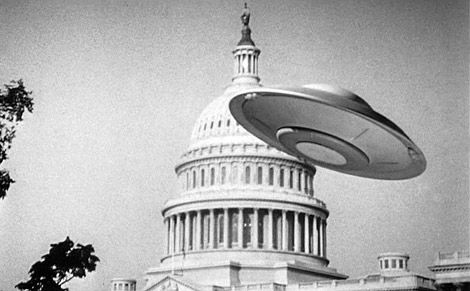
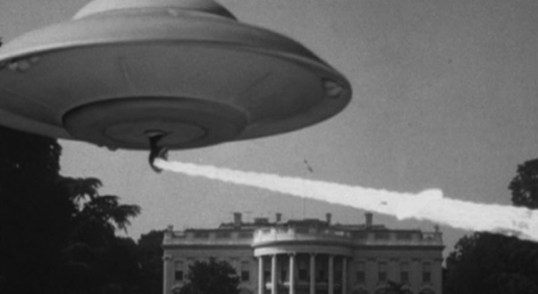
Though director Fred Sears keeps the action moving quickly and both Marlowe and Ankrum give good performances in their stock roles as, respectively, the scientist and the military leader, Ray Harryhausen is the real star of this movie. The stop-motion animation special effects are still a lot of fun to watch today. Plus, if you don’t applaud when that flying saucer crashes into the Capitol dome, there may be no hope for you.

Earth vs. The Flying Saucers is one of the better alien invasion films of the 50s. If nothing else, it’s a film that will inspire you to keep watching the skies!
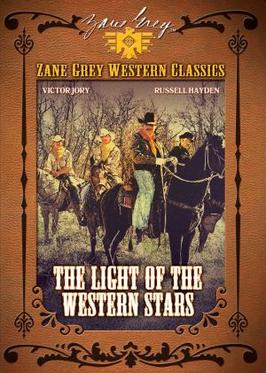
The Light of Western Stars (1940, directed by Lesley Selander)


In the dead of night, a train stops in an isolated western town.  Only one passenger disembarks.  Majesty Hammond (Jo Ann Sayers) is a wealthy Bostonian, who has traveled all the way to the town to try to prevent her bother from marrying a local woman.  Majesty takes a seat in the station and waits for someone to come get her.

After a few minutes, a drunken ranch foreman named Gene Stewart (Victor Jory) enters the station.  He has made a bet with the local sheriff (Tom Tyler) that he can convince the first new woman to arrive in town to marry him.  Stewart’s friends find a priest but before Gene can force the priest to marry them, a local girl named Bonita (Esther Estrella) rides up and tells Gene that one of the ranch hands, Danny (Alan Ladd, the future Shane in one of his earliest roles), has been forced to flee town after getting into a fight with the sheriff.

As if that’s not bad enough, Gene then discovers that Majesty’s brother is going to marry Flo Kingsley (Ruth Rogers), who happens to be Gene’s employer!  Ashamed of his behavior, Gene leads Majesty to Flo’s ranch.

After some initial weariness, Majesty is convinced that Flo and her brother really are in love.  Flo explains to Majesty how life works out in the frontier and Majesty is even able to forgive Gene for his drunken antics.  Majesty decides to buy a ranch in town but what she doesn’t know is that corrupt businessman Hayworth (Morris Ankrum) is using the ranch to smuggle weapons to the Mexican army and that he’s working with the sheriff!  Majesty is going to need Gene’s help to run the ranch but, after getting into another fighting with the sheriff, Gene goes into hiding.  Can Majesty find Gene and convince him to return to town?

Based on a novel by Western specialist Zane Grey, The Light of Western Stars is only 65 minutes long but it packs a lot of plot and a lot of action into those sixty minutes.  Of course, the plot is pretty standard stuff but, for B-movie fans, it’s a chance to see Victor Jory in a rare leading role and also a chance to see what Alan Ladd was doing before he became a noir mainstay.  Hard-drinking and occasionally irresponsible, Gene is an interesting hero and Jory does a good job playing him.  Alan Ladd doesn’t make a huge impression as Danny but he looks convincing fleeing town on horseback and that’s all the role really requires.

For many viewers, though, the main appeal of Light of Western Stars will be the beautiful Jo Ann Sayers as Majesty.  Primarily a stage actress, Sayers only appeared in 16 films before she got married and semi-retired but she made an impression in every one of them.  That’s certainly the case here, where her beauty makes it very plausible that even a wanted man would return to town just to be with her.

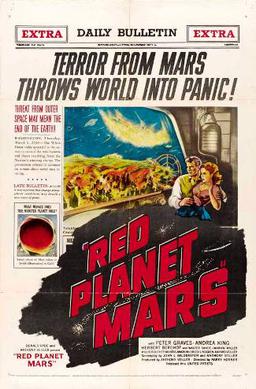
Red Planet Mars (1952, directed by Harry Horner)


Chris Cornyn (Peter Graves) and his wife, Linda (Andrea King) are two scientists who have spent the years since World War II listening to transmissions from Mars.  The technology that they use was developed by a scientist who may have been a Nazi but the Cornyns feels that the greater good of learning about Mars outweighs the problematic background of their equipment.

One day, the transmitters pick up a message from Mars, announcing that Mars is a Socialist paradise where there is no fear of nuclear war.  The Soviets are gleeful because they think the Martian messages will lead to the collapse of NATO.  But then the Martians start sending out religious messages, which lead to riots in the USSR and Eastern Europe.

Are the Martians really contacting Earth?  Is God really transmitting a message from Mars?  Or is a more sinister figure responsible?

Red Planet Mars is one of those films that only could have been made at the height of the Cold War.  Despite the title, the film is decidedly Earth-bound and full of stock footage of the nations of the world reacting to the Martians.  The main theme is that, Martians or not, nothing is more important than protecting the American way of life. even if that means sacrificing your own life and misleading the world.  Even if it is now impossible to listen to his dialogue without thinking about the “Do you like movies about gladiators?” conversations from Airplane!, Peter Graves was the perfect, no-nonsense messenger.  An artifact of a different time, the movie’s greatest strength is that it takes its ridiculous story seriously and even today, it leaves you wonder how we would react to messages from Mars.  Hopefully, we would today be more skeptical.  People in 1953 would believe anything.

Horror on the Lens: How To Make A Monster (dir by Herbert L. Strock)


You’ve seen I Was A Teenage Werewolf….

You’ve watched I Was A Teenage Frankenstein….

Now, it’s time to watch How To Make A Monster!

Released in 1958, How To Make A Monster is a clever little horror satire from American International Pictures in which the stars of Teenage Werewolf and Teenage Frankenstein are hypnotized into believing that they actually are the monsters that they played!  The main culprit is a movie makeup artist (Robert H. Harris) who has been deemed obsolete by the new bosses at AIP.

Be sure to watch for the finale, which features cameo appearances from several other AIP monsters!  And read my full review of the film by clicking here!

Horror On The Lens: Earth vs. The Flying Saucers (dir by Fred F. Sears)


For today’s horror on the lens, we’ve got a sci-fi shocked from 1956.

In Earth vs. The Flying Saucers …. well, the plot is right there in the title.  In a semi-documentary style, this film tells the story of what happens when a bunch of flying saucers come to Earth.  Unfortunately, the inhabitants of those flying saucers aren’t looking to open up a new trading route.  Instead, they want to enslave humanity and, as always, it falls to America to save the world.

This film is probably best known for the scenes of the flying saucers crashing into monuments and buildings in Washington, D.C.  The special effects were done by Ray Harryhausen.

The film was originally black-and-white.  The version below is colorized.  I’m not a huge fan of colorization in general but I do have to say that they did a pretty good job with Earth vs. The Flying Saucers.  While the film may not be as deeply philosophical as Plan 9 From Outer Space, it’s still pretty enjoyable.

Keep watching the skies!

https://www.youtube.com/watch?v=J-JcWNK-0AE

30 More Days Of Noir #12: No Man’s Woman (dir by Franklin Adreon)


This 1955 film tells the story of a murder.

When we first meet Carolyn Elleson Grant (Marie Windsor), she refuses to give her husband, Harlow Grant (John Archer) a divorce, despite the fact that they’ve been separated for several years and Harlow now wants to marry Louise Nelson (Nancy Gates) and Carolyn is now involved with an art critic named Wayne Vincent (Patrick Knowles).  Carolyn only married Harlow for his money and, while she has other rich lovers, she just enjoys making Harlow’s life as difficult as possible.  It’s hard to blame her because Harlow is kind of whiny.

However, Carolyn has grown bored with Wayne Vincent and she’s now decided that she would rather get involved with Dick Sawyer (Richard Crane), who is rich and owns a boat.  However, Dick is engaged to Carolyn’s personal assistant, Betty (Jill Jarmyn).  Carolyn thinks it would be perfectly amusing to not only seduce Dick but to also destroy Betty’s happiness.

Why?

As one character put it, Carolyn is “a witch!”

(Someone then adds that Carolyn is a word that “rhymes” with witch.  They don’t actually say the word because this film was made in 1955 but still….)

With Carolyn casually trying to destroy everyone’s lives and happiness, is it really a shock when some unseen person shows up at her art studio late at night and shoots her?

With Carolyn dead, it falls to Detectives Colton (Louis Jean Heydt) and Wells (John Gallaudet) to figure out the identity of the murder.  They immediately suspect that it had to have been Harlow Grant.  Not only does he have the motive and the opportunity but his name is Harlow Grant and I defy you to find anyone named Harlow Grant who hasn’t subsequently turned out to be involved in something shady.  Harlow, however, insists that he’s innocent and the investigation is about to get a lot more complicated….

Well, okay, maybe not a lot more complicated.  To be honest, it’s really not that difficult to figure out who the murderer actually is No Man’s Woman but that’s okay.  The investigation itself only takes the last third of this 70-minute film.  No Man’s Woman is a like a low-budget version of Gosford Park.  The murder is less important than all of the drama surrounding it.

And make no mistake, there’s a lot of drama!  This is a fun movie, specifically because Carolyn is such a wonderfully evil character and Marie Windsor has so much fun playing her.  Carolyn doesn’t really have any deep motivation for why she does the terrible things that she does.  She just does them because she can and she believes that she can get away with it.  A good deal of the film’s entertainment comes from just seeing how bad Carolyn can be.  In fact, you’re a bit disappointed when she’s murdered because Carolyn is the most enjoyable character in the movie.  She’s someone who is literally willing to do and say anything and she makes an apologies for her actions.  You wouldn’t necessarily want to work with her but she’s fun to watch.

The rest of the cast is adequate.  John Archer and Nancy Gates are a bit on the dull side as the “good” characters but I liked the performances of the other suspects.  Richard Crane and Jill Jarmyn, in particular, are memorable as Dick and Betty.  I loved how going out on someone’s boat was apparently the height of decadence in 1955.

No Man’s Woman is an entertaining mix of noir and soap opera.  Find it on Prime!

Horror on the Lens: How To Make A Monster (dir by Herbert L. Strock)


You’ve seen I Was A Teenage Werewolf….

You’ve watched I Was A Teenage Frankenstein….

Now, it’s time to watch How To Make A Monster!

Released in 1958, How To Make A Monster is a clever little horror satire from American International Pictures in which the stars of Teenage Werewolf and Teenage Frankenstein are hypnotized into believing that they actually are the monsters that they played!  The main culprit is a movie makeup artist (Robert H. Harris) who has been deemed obsolete by the new bosses at AIP.

Be sure to watch for the finale, which features cameo appearances from several other AIP monsters!  And read my full review of the film by clicking here!

Horror Film Review: Invaders From Mars (dir by William Cameron Menzies)


The aliens have arrived!  They landed one night in the middle of a thunderstorm and now, they’re hiding underground in a sandpit.  Only David McClean (Jimmy Hunt) was awake to witness their arrival.  He was supposed to be asleep but who could sleep through all that thunder and lightning?  (Not to mention the sound of the flying saucer!)  Unfortunately, no one’s going to believe David because he’s only 12 years old!

That’s the premise at the heart of Invaders from Mars, a nicely surreal science fiction film from 1953.

In order to humor David, a few people do go to the sandpit to look for this supposed UFO.  They include his scientist father (Leif Erickson) and a few local cops.  They all return saying that they found nothing.  They also all return in a really bad mood.  David’s formerly loving and humorous father is suddenly distant and rather grumpy.  And he no longer speaks like himself.  Instead, he is now rigidly formal, like someone still getting used to speaking a new language.  Maybe it has something to do with the strange mark on the back of his neck….

David goes into town and soon discovers that several townspeople are acting just like his father.  It’s almost as if something is controlling them!  Well, what else can David do but go to the local observatory and get the U.S. Army involved!?

Invaders from Mars may be disguised as a children’s film about a flying saucer but it actually deals with some very adult issues.  What do you do when you know that you’re right but no one is willing to listen to you?  Do you stubbornly cling to what you believe or do you just become a mindless and unquestioning zombie like everyone else?  Do you remain independent or do you get the mark on your neck?  Of course, it should also be pointed out that Invaders From Mars was made at a time when people were very much worried that America was being invaded from within by communists and subversives, all of whom would rob Americans of their individual freedoms just as surely as the aliens in David’s town.  Invaders From Mars came out two years before Invasion of the Body Snatchers but they both deal with very similar issues.

What sets Invaders From Mars apart is that it’s told from a child’s point of view.  It plays out like a nightmarish fairy tale.  The film was directed by the famous production designer, William Cameron Menzies and he gives the entire film a nicely surreal look.  The town is just a little bit too perfect while the inside of the spaceship is a maze of corridors, all overseen by a ranting head in a crystal ball.

The film’s ending was probably chilling to audiences in 1953.  For modern audiences, it’s a bit of groan-inducing cliché.  Still, the ending itself makes sense when viewed in the context of the entire film.  (It’s literally the only ending that makes sense.)  Still, ending aside, Invaders From Mars is a classic sci-fi film and one well worth watching this Halloween season.


Film Review: The Loves of Edgar Allan Poe (dir by Harry Lachman)


I have to admit that the 1942 film, The Loves of Edgar Allan Poe, turned out to be far different from what I was expecting.

Just based on the title, I was expecting it would be a highly fictionalized, borderline silly film about Edgar Allan Poe defeating his romantic rivals and winning the hand of the woman he loved while still finding time to write The Raven.  I figured that there would be at least a few gentlemanly fisticuffs, with Poe portrayed as a combination of Rhett Butler and Cary Grant.  Looking at the title, it was easy for me to imagine the film closing with Poe kissing his future wife and then looking straight at the camera.  “Quoth the Raven!” he would say and wink while romantic music swelled in the background…

But no.  The Loves of Edgar Allan Poe is actually a very conventional biopic.  With a running time of only 67 minutes, the movie often feels rather rushed but it still manages to include most of the better known details of Edgar Allan Poe’s short but eventful life.  (An ever-present narrator is always ready to fill us in on every thing that happens off-screen.)  The film doesn’t spend much time on what initially inspired Poe’s macabre imagination.  There’s a scene of Poe, as a child, standing on a desolate hill and looking at a raven perched in a dead tree.  With the exception of an extended section that deals with Annabel Lee, that’s about as deep as the movie is willing to get as far as Poe’s art is concerned.

When Poe grows up, he’s played by actor Sheppard Strudwick, who has a good mustache but never exactly comes across as being the type of tortured genius who would eventually end up both revolutionizing literature and drinking himself to death.  The majority of the film deals with Poe’s advocacy for copyright reform, which is an important issue but not exactly the most cinematic of concerns.  Poe survives college.  Poe tries to sell The Raven for $25.  Eventually, Poe marries Virginia Clemm (Linda Darnell) and her subsequent sickness and death leads to not only Poe’s greatest work but also his own tragic end.

Along the way, Poe meets both Thomas Jefferson and Charles Dickens.  Jefferson shows up long enough to tell a young Poe that he’s a good writer and that he needs to stop gambling.  Dickens meets Poe and encourages him to continue to advocate for better copyright laws.

It is known that Poe and Dickens actually did meet but did Poe also meet Thomas Jefferson?  Legend says that he did but no one knows for sure.   Here’s what we do know:

Poe attended the University of Virginia in 1826.  The University’s founder, former President Thomas Jefferson, was still alive in 1826 and would often invite promising students to Monticello.  Whether Jefferson was still doing that when Poe enrolled at the University of Virginia is questionable.  Jefferson died five months after Poe started his studies.

As for Dickens, Charles Dickens and Edgar Allan Poe admired each other’s writing and they met in Philadelphia during Dickens’s 1842 tour of North America.  No record has been kept of what they discussed, though some think that Dickens told Poe about his pet raven and perhaps inspired Poe’s best-remembered poem.  In the movie, they discuss copyright laws, which is nowhere near as much fun.

(When it comes to Poe’s meetings with both Jefferson and Dickens, it is perhaps best to remember the lesson of The Man Who Shot Liberty Valance and print the legend.)

The Loves of Edgar Allan Poe is a very short film and an obviously low-budget one as well.  When the presence of that somewhat pedantic narrator, The Loves of Edgar Allan Poe feels more like an educational special than a real movie.  It’s an okay introduction to Poe’s life but, ultimately, the best way to get to know Edgar Allan Poe is to sit down and start reading.

Cleaning Out the DVR: Lady In The Lake (dir by Robert Montgomery)


(Lisa is once again in the process of cleaning out her DVR!  She recorded the 1947 film noir Lady In The Lake off of TCM on June 17th!)

You are Raymond Chandler’s world-famous private detective, Phillip Marlowe!

Well, no.  Actually, you aren’t.  Lady in the Lake is best-known for being one of the first (if not the first) film to be shot from the viewpoint of the main character but actually, the film goes out of its way to remind you that you’re seeing the story through Marlowe’s eyes but you’re not Marlowe yourself.  There are three scenes in which Marlowe (played by Robert Montgomery, who also directed the film) is seen sitting behind a desk and directly addressing the audience.  He shows up to fill in a few plot details and to assure the audience that, while the film they’re watching may be experimental, it’s not too experimental.  For his part, Montgomery looks and sounds absolutely miserable whenever he has to speak directly to the audience.  One gets the feeling that these scenes were forced on him by nervous studio execs, who were probably worried that the film would be too weird for mainstream audiences.

However, the rest of the film is seen totally through Marlowe’s eyes.  When Marlowe gets punched, we see the fist flying at him.  When Marlowe smokes a cigarette, we see the smoke float away from him.  When Marlowe leers at every single woman that he meets, the camera leers as well.  When Marlowe looks at himself in a mirror, we see his reflection.  When Marlowe passes out after a beating or a car accident, the image grows blurry before fading to black.  There’s even a rather clever scene when Marlowe leans in for a kiss, just to suddenly change his mind and pull back.

Today, of course, the film’s technique doesn’t seem quite as revolutionary.  We’re used to point of view shots and moving cameras.  Last year, Hardcore Henry told its entire stupid story through a point of view shot and the shaky cam effect actually made me physically ill.  In Lady in the Lake, there is no shaky, hand-held camera work and I was happy about that.  Marlowe may turn his head left and right and he may walk forward but he apparently has nerves of steel because the image stays steady and only shakes when Marlowe’s getting beat up.

As for the film’s plot, it opens with Marlowe explaining that, since he’s not making enough money as a P.I., he’s decided to try his hand at writing for a pulp magazine.  While his stories are not accepted, publishing executive Adrienne Fromsett (Audrey Totter) does hire him to track down the missing wife of her boss, Derace Kingbury (Leon Ames).  As Marlowe quickly figures out, nobody’s motives are exactly pure.  Adrienne wants to marry her boss and get her hands on his money.  The wife’s lover (Richard Simmons) claims that he hasn’t seen her in weeks but still lets slip that she may no longer be alive.  The police (represented by Lloyd Nolan and Tom Tully) are corrupt, rather rude, and may know more than they are letting on.  Even a seemingly innocent landlady (Jayne Meadows) might have a secret or two.

And, of course, there’s the dead woman who is discovered in a nearby lake.  Her identity holds the key to many mysteries…

It’s an intriguing puzzle and it actually helps to see everything through Marlowe’s eyes.  If nothing else, it cuts down on the red herrings.  If Marlowe stops to stare at something, you know exactly what he’s staring at and you can be sure that it will prove to be important at some point in the story.

By the way, did I mention that Lady In The Lake is not just an experimental film noir but a Christmas movie?  Seriously, it opens with holiday music playing in the background and the opening credits are printed on cheery Christmas cards.  It’s only after the credits are over that we see that there’s a gun underneath the cards.  As a director, Montgomery does a great job juxtaposing the cheeriness of Christmas with the sordidness of the people who Marlowe has to associate with on a daily basis.  He may be dealing with a bunch of murderers and greedy con artists but almost everyone has a Christmas tree in their apartment.

In fact, it’s so easy to get so wrapped up in the film’s technique that the viewer runs the risk of not noticing just how dark and cynical Lady in The Lake truly is.  Everyone that Marlowe meets is sleazy.  Marlowe, himself, does not come across as being particularly likable.  Every room that Marlowe enters is underlit.  Interestingly, with the exception of the opening credits and a driving montage, there’s not much music to be heard in the film, a reminder that we’re only hearing what Marlowe hears.  And, in Marlowe’s world, there’s no music playing in the background to provide relief from the tension.  There’s just a mix of lies and threats.

Lady in the Lake is an intriguing film and it shows up on TCM fairly frequently.  Keep an eye out for it.