Released in 1958, How To Make A Monster is a clever little horror satire from American International Pictures in which the stars of Teenage Werewolf and Teenage Frankenstein are hypnotized into believing that they actually are the monsters that they played! The main culprit is a movie makeup artist (Robert H. Harris) who has been deemed obsolete by the new bosses at AIP.
That’s the plot of this 1957 film from director Bert I. Gordon. Chicago-haters will love this film, especially the scene where General Morris Ankrum announces that he has no choice but to nuke the entire city. If you don’t hate Chicago, you can still enjoy watching Peter Graves somehow retaining his dignity while dealing with the threat of giant locusts.
For the record, I’m enough of a country girl that I fully understand just destructive locusts can be. That said, when it comes to their appearance, they’re not the most intimidating creatures out there. The worst that can be said about them is that they look like really ugly grasshoppers. A giant grasshopper still looks like a giant grasshopper. And, needless to say, locusts do not attack humans.
(I’m also enough of a Southern girl that I can remember collecting the locust exo-skeletons that would always show up in the fall and winter.)
Here is the ludicrous and entertaining BeginningoftheEnd!
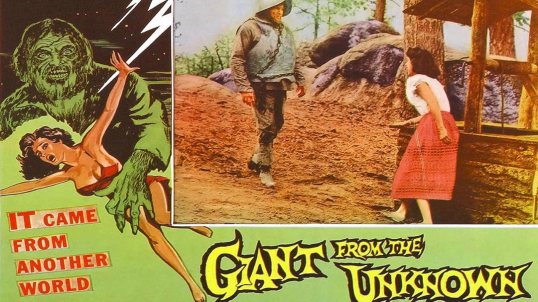
In 1958’s Giant From The Unknown, something strange is happening in a California mountain town. Animals are being killed. Property is being destroyed. People are being murdered.
Sheriff Parker (Bob Steele) suspects that the murderer might be Dr. Frederick Cleveland (Morris Ankrum), mostly because Dr. Cleveland spends a lot of time in the mountains looking at fossils with his daughter, Janet (Sally Fraser). When a younger scientist named Wayne (Ed Kemmer) shows up to help Dr. Cleveland out with his research, Sheriff Parker is even more suspicious. Meanwhile, the local citizenry suspects that it might be a member of the local Native American community.
It turns out that everyone’s wrong!
The murderer is a formerly dead conquistador (Buddy Baer), who was brought back to life by a bolt of lightning and who is now wandering around the mountains and killing people. The conquistador walks around in his full conquistador uniform, which is in pretty good shape when you consider the fact that he’s been dead for over two hundred years, maybe longer.
The odd thing about the conquistador is that he’s regularly described as being a giant, even though he’s clearly not. I mean, he’s tall. He appears like he might be 6’5. That makes him taller than the average person but shorter than the average professional basketball player. The filmmakers regularly attempt to shoot him from a lower angle in order to make him look taller but there’s nothing that can be done to disguise the fact that he’s just a 6’5 guy wearing what appears to be a fake beard and mustache. If anything, he looks like the frozen-faced Burger KIng mascot. Maybe he would stop killing people if the sheriff would just order a cheeseburger and fries. I mean, seriously, his whole rampage could have been avoided.
The title is also incorrect about the giant being from the unknown. He’s very obviously from Spain. All one has to do is look at his uniform. I think the unknown element of this film is how the conquistador has spent centuries underground without losing any skin. For someone who has been dead for as long as this conquistador was, his hair is very clean and well-groomed. Watching this film, it’s hard not to feel that Dr. Cleveland should have spent some time researching conquistador embalming techniques because whoever preserved the “giant” did a very good job! Everyone should be so lucky to look that good for being dead for that long.
Giant From The Unknown attempts to do the usual thing where the monster falls for the only woman in the entire film. (Indeed, it was hard not to notice that town’s population seemed to be 99% male.) Unfortunately, the giant was a pretty silly monster so it was difficult to get wrapped up in his emotional journey. There are some monsters that you feel sorry for and there are other monsters that you just wish would go away. The giant is a monster who probably had a lot of good haircare tips and who could have probably helped out the entire town …. if only they had been willing to listen!
As a person who sees his love of movies through a lens of “Bronson connections,” I have a special fondness for Kurt Russell. In 1963 and 1964, Charles Bronson worked on a television series with Kurt Russell called THE TRAVELS OF JAIMIE MCPHEETERS. The series itself is the story of twelve year old Jaimie McPheeters (Kurt Russell) who, along with his ne’er-do-well doctor dad (Dan O’Herlihy) and a ragtag group of pioneers, travel westward from Paducah, Kentucky to the California gold fields in 1849. Charles Bronson first appeared on episode 10 of the series, and would stay with the series until it ended after 26 episodes. Russell was the star, with Charles Bronson riding along in the important role of Linc Murdock, the guide who gets them through all sorts of dangerous situations. 1964’s GUNS OF DIABLO is an interesting concoction, using the final episode of the series, “The Day of Reckoning” and adding some new scenes shot specifically for a movie release.
GUNS OF DIABLO opens with Linc Murdock (Charles Bronson) leading the wagon train across a raging river. The group constructs a wooden barge, and most of the group makes it across safely. Unfortunately for one of the groups, a tree floating down the river smashes into the barge, causing it to sink along with the wagon and the man on top of it. Murdock jumps into the river and is able to save the man who unfortunately suffers a broken leg. Needing to rest for a few days, Murdock decides to go into the local town, Devil’s Gap, to get supplies. Jaimie (Kurt Russell), a boy with the wagon train, asks his dad if he can go with him. Dad says yes under one condition, Jaimie gets a real bath while he’s in town. So Linc and Jaimie head off together. When they get to town, Linc immediately goes to the saloon to get a beer, where he sees the beautiful Maria (Susan Oliver), a woman with whom he has a dangerous past. Via flashback, we learn the story of Linc and Maria falling in love while he was working as a hand on the Macklin ranch five years earlier. But it was a doomed love affair as Maria had been promised to the eldest son of the family, Rance Macklin (Jan Merlin). When Linc and Maria plan to elope and get married, Rance and his brothers get the drop on them. A big gunfight ensues, with Rance taking a shot in the arm, and Maria being shot in the crossfire. Believing her to be dead, Linc barely escapes with his own life.
Back in the present time we meet a Maria who is stuck in a loveless marriage to a one-armed Rance. Rance and his brothers have lost the ranch and are always trying to stay one step ahead of the law. That’s why Maria’s been reduced to working as a waitress at the saloon. She also believes that Linc ran out on her five years ago, so she’s mad at him. But soon those old feelings start stirring up deep within her when Linc talks sweet to her. When the duplicitous bartender Ives (John Fiedler) sees Linc go into Maria’s room, he sends word to Rance. Soon the Macklin Brothers are on their way back to town to settle their old score with Linc. What they didn’t count on was the 12 year old Jaimie McPheeters, with all of his youthful exuberance and ingenuity, being there to swing the odds in Linc’s favor! I made up that last line, but Jaimie does help Linc a couple of times.
I mentioned earlier that GUNS OF DIABLO was assembled together using the final episode of THE TRAVELS OF JAIMIE MCPHEETERS, along with some new footage added specifically for the movie. I’ve never seen the final episode of the series that this movie was based on, but I have seen some of the earlier episodes and I did notice one key difference. The TV series revolves mostly around the trials and tribulations of Jaimie and his dad, Dr. Sardis McPheeters. Dan O’Herlihy played Dr. McPheeters in the series, but actor Russ Conway plays him in this movie. He’s not a big part of the movie, just appearing at the beginning and the end, but it was odd seeing a different actor portraying Jaimie’s dad. It sure would be great if the series were to become more widely available at some point in time. I’d love to compare the TV version to this movie version.
Charles Bronson was not a big movie star when GUNS OF DIABLO was released, but he was a well respected character actor. He had already headlined his own TV series, MAN WITH A CAMERA (1958-1960), and he had prominent roles in the massive box office hits THE MAGNIFICENT SEVEN (1960) and THE GREAT ESCAPE (1963). This movie heavily focuses on his character, and Jaimie McPheeters takes a back seat. Bronson, already 43 years old, was more than up to the challenge. He comes across as a decent, hardworking man, who’s capable of taking care of himself. In other words, he shows the strength and charisma that would make him the most popular actor in the world just a few years later. Susan Oliver is quite beautiful as Maria. Although primarily known as a blonde, blue eyed beauty, her hair is dark here. She’s so beautiful that I can understand why a man with such limited options would be willing to fight to the death for her. And what can you really say about Kurt Russell?! He’s such a good child actor. While Jaimie McPheeters may not be the focus of the movie, he’s still so good in the role, showing kindness, loyalty and bravery in equal measure. In a world where so many child actors can’t adjust to life as an adult, Russell has made it look easy for the last six decades. In my opinion, he’s one of the all time greats.
Overall, GUNS OF DIABLO will never be confused with HIGH NOON (1952) or RIO BRAVO (1959), but for a movie assembled from a 60’s TV western and a few newly shot scenes, it’s actually quite enjoyable. And the storyline may not be the most original, but the time tested tale of true love and honor winning out over greed and evil will always make for compelling viewing. I got my first VHS of this film in the 80’s and I still own it to this day. I even watched it multiple times while I was writing up this review. As far as I’m concerned, GUNS OF DIABLO is well worth watching for fans of westerns or fans of the stars.
Rather than sharing a trailer for the film I thought I’d share this heartwarming story of the time Kurt Russell bought Charles Bronson a birthday gift while they were working together on this series. It’s a classic. Enjoy, my friends!
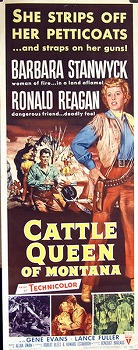
Pop Jones (Morris Ankurm) and his daughter Sierra Nevada (Barbara Stanwyck) leave their ranch in Texas and head up to Montana to take over some land that Pop has inherited. Evil Tom McCord (Gene Evans) wants the land for himself and conspires with a member of the local Blackfoot tribe, Natchakoa (Tony Caruso), to take it over. After a surprise attack leaves Pop dead, Sierra is nursed back to health by Colorados (Lance Fuller), the son of the Blackfoot chief. Sierra tries to reclaim her land from McCord, with the eventual help of the mysterious gunslinger Farrell (Ronald Reagan).
There are a lot of reasons why this B-western doesn’t really work, a huge one of them being that Barbara Stanwyck was several years too old to be playing Morris Ankrum’s innocent daughter. The biggest problem though was casting Ronald Reagan as a mysterious gunslinger. Farrell is a character who is supposed to keep us guessing. We’re not supposed to know if he’s a good guy or a bad guy. But as soon as Ronald Reagan shows up and starts to speak, we know everything we need to know about Farrell. There was nothing enigmatic or even dangerous about Ronald Reagan’s screen persona. He came across as being more open and honest as just about any other actor from Hollywood’s Golden Age. For the role of Farrell, it appears that he went a day without shaving and he tried not to smile while on-camera but he’s still good old dependable Ronald Reagan. That pleasantness and lack of danger may have kept him from becoming an enduring movie star but it did serve him very well when he moved into the political arena.
Cattle Queen of Montana was one of the 200 westerns that Allan Dwan directed over his long career. It’s not one of his more interesting films, though he does manage a few good action sequences. A far better Dwan/Reagan collaboration was Tennessee’s Partner, which was released four years after this film.
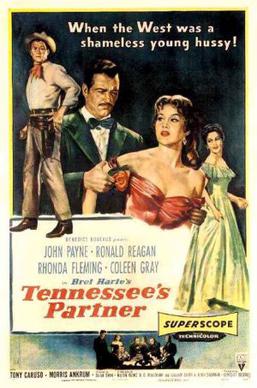
Tennesse (John Payne) is an old west gambler who co-owns a saloon (and bordello) with Elizabeth Farnham (Rhonda Fleming). When Tennessee is ambushed after a poker game, he’s saved by a local man who goes by the name of Cowpoke (Ronald Reagan). Tennessee and Cowpoke become fast friends but when Tennessee realizes that Cowpoke is about to marry a golddigger (Coleen Gray), Tennessee puts the woman on the next boat out of town. Cowpoke vows to get vengeance but Tennessee has bigger things to worry about. Rival businessman Turner (Tony Caruso) has framed Tennessee for the murder of a local prospector, Grubstake McNiven (Chubby Johnson).
Very loosely based on a short story by Bret Harte, Tennessee’s Partner has surprisingly high production values for a B-western. Director Allan Dwan started his career in the 1910s and directed over 200 westerns. He knew how to keep the action moving. Tennessee’s Partner is also the only film that old friends John Payne and Ronald Reagan made together. Reagan, whose days as a major studio leading man had ended by the time he made this film, gives one of his better performances in the role of the simple but honest Cowpoke and shows the likability that he was later able to translate into a political career. Reagan could be a stiff actor but his naturally amiable manner made him perfect for best friend and sidekick roles, like in this movie. Payne also gives a good performance as the gambler with a moral code. However, the best thing about the film is Rhonda Fleming, giving a tough and sexy performance as Elizabeth. Because this film came out in 1955, it couldn’t really come out and say that Elizabeth was a madam and the saloon was a bordello but Fleming’s performance and a few lines of innuendo left little doubt about what was actually going on upstairs from the bar. Keep an eye out for Angie Dickinson, playing one of Elizabeth’s girls.
The performance elevate Tennessee’s Partner, making it a B-western that can be enjoyed even by people who aren’t necessarily into westerns.
Released in 1958, How To Make A Monster is a clever little horror satire from American International Pictures in which the stars of Teenage Werewolf and Teenage Frankenstein are hypnotized into believing that they actually are the monsters that they played! The main culprit is a movie makeup artist (Robert H. Harris) who has been deemed obsolete by the new bosses at AIP.
X: The Man With The X-Ray Eyes (1963, dir by Roger Corman, DP: Floyd Crosby)
Eyes. They’re one of the most important parts of our body but they’re also frightening easy to damage. Unlike the heart or the liver or the brain, they don’t have a protective covering of skin and bone. They sit exposed and are easily injured. They can be ripped out of one’s head, which is a scary thought. As well, they tend to grow weaker over time. I love my multi-colored eyes and I think they’re one of my best features but I still spend a lot of time wishing that they weren’t quite as vulnerable as they are. I often say that I’m blind without my contacts or my glasses. That’s not quite true, of course. I can see enough to get by if I forget to put in my contacts but I still have to do a lot of squinting, enough so that most people can take one look at me and say, “You forgot to put in your contacts, didn’t you?” In my case, my eyesight has definitely gotten even worse over the past few years. I’ve been told that’s normal but it still freaks me out. I worry about waking up one day and not being able to see anything at all.
Director Lucio Fulci, a diabetic who was slowly going blind during the final years of his life, was infamous for including scenes of eyes being either pierced or gouged out in his films. The New York Ripper even featured one scene where an eye was slit in half with a razor blade. (This occurred in a close-up, no less!) In Joe D’Amato’s Beyond the Darkness, there’s a scene where a mad taxidermist replaces the eyes of his dead fiancée with glass and for me, that’s one of most disturbing elements of the film. Horror directors understand the vulnerability of the eyes and the sadness when life is extinguished from those eyes. Eyes are said to be the windows to soul and when those eyes are lifeless, it’s a reminder that a living soul is a fleeting thing.
Perhaps that’s why 1963’s X: The Man With The X-Ray Eyes is such an effective work of art. Directed by Roger Corman, the film tells the story of Dr. James Xavier (Ray Milland), a doctor who has developed eye drops that, when taken, allow one to have x-ray vision. Dr. Xavier claims that the eye drops will allow doctors to more easily diagnose their patients and certainly, he has a point there. His friend, Dr. Sam Brant (Harold J. Stone), points out that the eyes are directly connected to the brain and that using experimental eye drops on them could potentially drive a person mad. Dr. Xavier proves Dr. Brant’s point by losing his tempter and accidentally pushing him out of a window.
Ah, x-ray vision. It all starts out fun. Dr. Xavier is performing miracle surgeries and seeing what everyone looks like naked. (The swinging jazz party scene is a classic example of how 60s B-movies teased audiences while never quite showing everything.) But once he’s forced to go on the run from the police, Xavier finds himself making a living as a carnival psychic while still trying to refine his eyedrops. Xavier’s sleazy manager (Don Rickles) tries to turn Xavier into a faith healer but, with Xavier’s x-ray vision growing more erratic and more intense, Xavier ends up running off to Vegas with a former colleague, Dr. Diane Fairfax (Diana Van der Vils).
And again, it’s all fun and games as Xavier uses his powers to cheat at cards. But then the megalomania kicks in and, after Xavier basically announces that he’s cheating, he finds himself being chased through the desert by a police helicopter and freaking out as more and more of the universe is revealed to him. Much like a Lovecraftian protagonist who has been driven mad by the sight of the Great Old Ones, Xavier finds himself overwhelmed by the center of the universe. At a tent revival, a preacher shouts, “If thine eye offends thee, pluck it out!”
The film’s final image is a shocking one and it stays with you. (There were rumors that the film originally ended with Xavier shouting, “I can still see!” but Corman himself said that never happened.) Even without that final image, this would be one of Corman’s best films, a surprisingly intelligent and rather sad story about a man who, in trying to see what is usually hidden, was driven mad by what he discovered. Ray Milland was well-cast as Dr. Xavier and watching him go from being a somewhat stiff but good-hearted scientist to a raving madman at a revival is quite an experience, a testament to the vulnerability that all humans share. In the name of science, Xavier goes from being a respected researcher to being chased through the desert by a helicopter. The man who wanted to be able to see everything finds himself wishing to be forever blinded. Sometimes, the film suggests, it’s best not to be able to see everything around us. Sometime, the mysteries of the universe should remain mysteries and the rest of us should respect our own vulnerabilities.
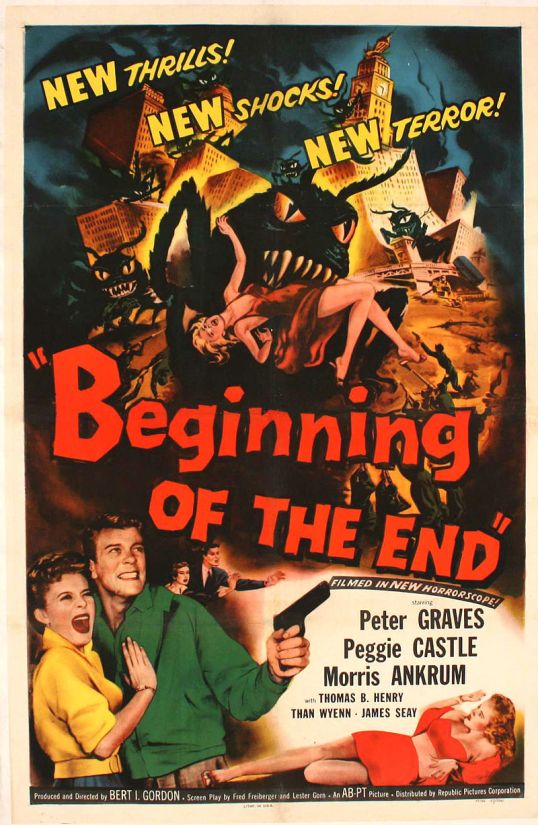
The 1957 film, Beginning of the End, is perhaps the ultimate horror film for people who dislike Illinois.
Because it’s a Bert I. Gordon film and Gordon took his “Mr. Big” nickname seriously, it deals with giant monsters. In this case, the monsters are a bunch of locust who ate all of this radioactive grain that was being stored in a silo. The locusts grew to giant size and then they went on a rampage.
Fortunately, the rampage appears to be localized to Illinois. Apparently, the locusts have enough respect for state boundaries that they know better than to hop into Indiana, Missouri, or Wisconsin. Instead, the locusts take out the farming community of Ludlow and then start making their way to Chicago, perhaps hoping to battle the Chicago Outfit for control of the city’s politics. Do they seriously think Mayor Daley is just going to sit back while a bunch of locusts overrun his city?
The government wants to cover up the locust rampage because they don’t want to risk a mass panic in the 47 states that they actually care about. (This film came out before Alaska and Hawaii joined the Union.) However, when enterprising reporter Audrey Aimes (Peggie Castle) comes across the remains of Ludlow and discovers that the U.S. military has taken over the area, she is determined to discover what happened. She hooks up with Dr. Ed Wainwright (Peter Graves), whose work in making food bigger led to the giant locust attacks in the first place. In most movies, Ed would shoulder most of the blame for the locust attack but Beginning of the End seems to understand that these things happen when you’re dousing food with radiation and then keeping the food in a poorly secured silo.
Of course, the main reason why it’s not Ed’s fault is that Ed is played by Peter Graves and seriously, who could blame anything on Peter Graves? Graves was one of those actors who could deliver even the silliest of dialogue with a straight face and he certainly gets to do that in Beginning of the End. He seems to be taking the situation seriously, even if no one else is.
One reason why it is a little bit difficult to take the situation seriously is because it’s about giant locusts. Now, make no mistake about it. I’m enough a country girl that I know how destructive locusts can be. The problem is that locusts may be destructive but they don’t look all that menacing. Even giant locusts just look like really ugly grasshoppers. This film uses a lot of rear projection and still photography to create the idea of giant locusts crawling over buildings and threatening the soldiers who have been sent to fight them. As is so often the case with Bert I. Gordon’s film, there’s a definite charm to the cheap special effects. But still, locusts are locusts.
Chicago haters will love the scene where General Hanson (Morris Ankrum) announces that the locusts have only left him with one option, the drop an atomic bomb and wipe the city off the face of the Earth. Fortunately, Ed is there to suggest another solution. Good old Peter Graves. I don’t know what we would have done without him.
As a final note, I’ll just mention that the poster for this film is actually more exciting than the film itself:
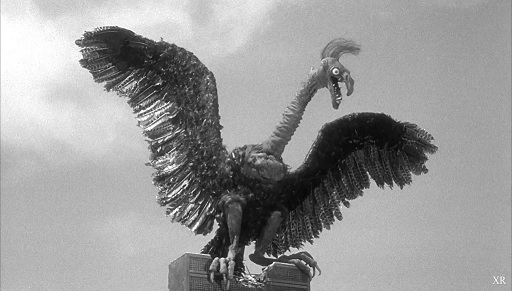
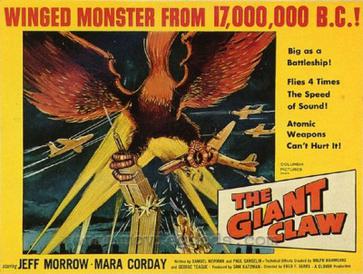
You know, a lot of people are a bit of dismissive of 1957’s The Giant Claw because they say that the monster — a big flying turkey from an anti-matter universe that has somehow slipped into our universe — is not convincing.
They make fun of the fact that, instead of hiring Ray Harryhausen like they were originally planning to do, the producers decided to save money by going for his non-union, Mexican equivalent.
They make fun of the scene in which a French-Canadian trapper announces that the Turkey Monster is actually a mythological beast that has the body of a woman, the head of a wolf, and the wings of a bat because the Turkey Monster certainly looks nothing like that.
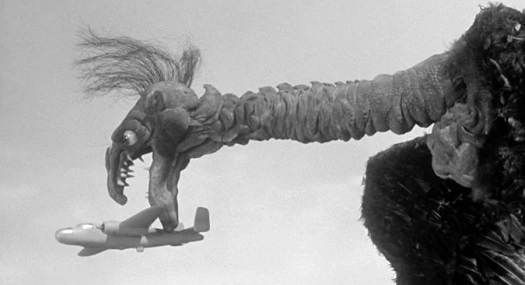
They laugh at the scene where the Turkey Monster chases an airplane, even though I think that would be pretty terrifying if I was actually on the airplane. I mean, the last time we were flying home from the UK, we hit a bit of turbulence and it traumatized me for days. I can only imagine how I would feel if I looked out the window and I saw a giant flying turkey chasing after the plane.
Critics will even make fun of how the turkey sounds, mocking it for its weird “caw caw” noises.
Well, alright. Let’s just admit it. The turkey isn’t the most menacing monster in the world and yes, it does sometimes sound a bit hoarse and it could definitely stand to put on a little weight but seriously, how can you not love this thing?
As for the film itself, it not only features one of the greatest monster of all time but it’s also a love story! Mitch MacAfee (Jeff Morrow) is a pilot who sees a UFO and who faces an attempt, by the government, to cover up what he’s seen. As happened to so many of the people who saw UFOs in the 50s, he’s accused of being either mistaken or an outright hoaxer. Meanwhile, Sally Caldwell (Mora Corday) is a mathematician who is originally skeptical of Mitch and his claims but who realizes that he was right when they’re attacked by the Turkey Monster. Their plane crashes in Canada, where they are rescued by a French-Canadian trapper named Pierre Brousssard (Lou Merrill). While the Turkey Monster is terrifying the world, Sally and Mitch are falling in love and since Jeff Morrow and Mara Corday are the most attractive people in the film, it only seems right. They’re a cute couple, who cares if the script makes any sense?
Anyway, back to the Turkey Monster. The Turkey Monster is protected by an anti-matter shield, which makes it impossible for it to be attacked by missiles and planes. A high-ranking general is left repeating, “Missiles and bombs,” after realizing that they’re all useless against the turkey.
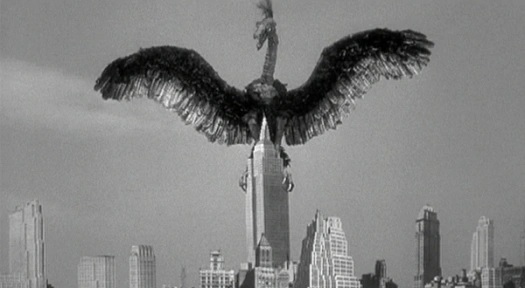
Eventually, the Turkey Monster makes its way to New York City and announces that it’s not going anywhere!
Well, you know what, Giant Turkey? If you can make it there, you can make it anywhere!
Sadly, the Turkey’s New York visit doesn’t end well and that’s a shame. Benjamin Franklin famously suggested that America’s official bird should have been the turkey as opposed to the eagle. Looking at the Giant Turkey sitting on the Empire State Building, how can you disagree?
Seriously, don’t listen to the critics. The Turkey Monster is one of the most entertaining monsters of all time and The Giant Claw is tons of fun!





 Through the Shattered Lens