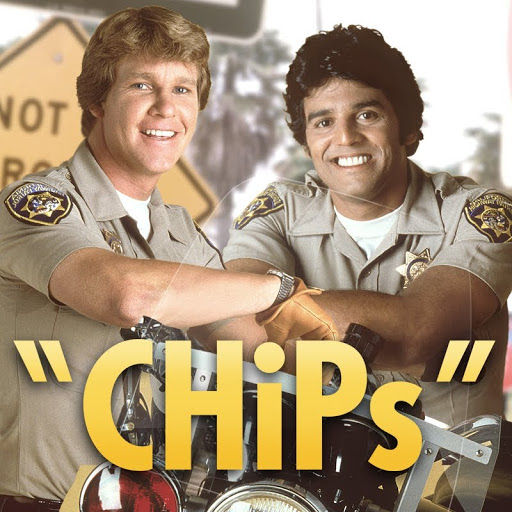
Welcome to Late Night Retro Television Reviews, a feature where we review some of our favorite and least favorite shows of the past! On Mondays, I will be reviewing CHiPs, which ran on NBC from 1977 to 1983. The entire show is currently streaming on Prime!
This week, the hills have eyes.
Episode 3.21 “The Strippers”
(Dir by Don Weis, originally aired on February 16th, 1980)
Calm down, boys, we’re not talking those types of strippers!
This episode of CHiPs finds Ponch and Jon searching through the California hill country for two rednecks who are stealing cars and stripping them for the parts. One of the strippers is a fat guy who likes to sing while he’s working. The other is a guy played by Evan C. Kim, who later played Clint Eastwood’s partner in TheDeadPool. Baker’s girlfriend’s car gets stolen so this one is …. wait for it …. PERSONAL! Of course, this being CHiPs, the episode is still mostly about Ponch even though Baker’s the one with a personal stake in the case.
It turns out that Ponch and Jon aren’t the only ones investigating crimes in the hills of California. The DEA is investigating a drug-running operation and they really don’t want to two motorcycle cops getting in the way. (Doesn’t the DEA understand that motorcycles are cool? At least they’re not bike cops like those schmucks on PacificBlue.) The head drug smuggler is played by Morgan Woodward, who was a veteran of the western genre. The old cowboys are smuggling cocaine into Los Angeles. It’s like an extremely depressing country song. There’s no more cattle but there’s plenty of the devil’s dandruff to be sold.
If I seem to be rambling, it’s because there’s not really much to say about this episode. Airing, as it did, late in the season, it’s hard not to feel that show’s writers were probably tired and out-of-ideas when it came to coming up with the plot for this one. Ponch and Jon catch the car strippers who have information on the drug dealers. The car strippers turn informant and hope that they’ll get a deal as a result. Let’s hope so because prison is not a friendly environment to snitches.
This episode did feature one nicely-filmed accident scene, featuring multiple cars flying through the air (in glorious slo mo of doom!) and a bunch of broken glass. Bonnie and Bear cleaned up the accident site so that Ponch and Baker could get back to searching for the car thieves. That was nice of them. It’s all about team work!
Welcome to Retro Television Reviews, a feature where we review some of our favorite and least favorite shows of the past! On Tuesdays, I will be reviewing the original Fantasy Island, which ran on ABC from 1977 to 1984. Unfortunately, the show has been removed from most streaming sites. Fortunately, I’ve got nearly every episode on my DVR.
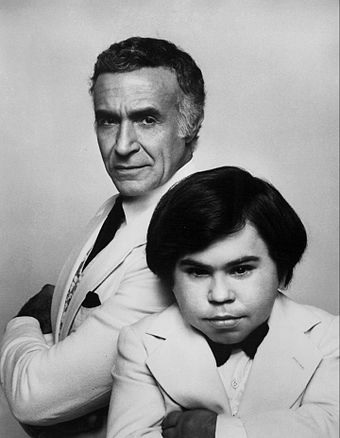
Smiles, everyone! Smiles!
Episode 5.17 “Funny Man/Tattoo, The Matchmaker”
(Dir by George W. Brooks, originally aired on February 20th, 1982)
For the second week in a row, Julie only appears in the stock footage at the start of the episode. And again, for the second week in a row, no mention is made of her. Mr. Roarke doesn’t say anything about why she’s not greeting the guests at the docks. Tattoo doesn’t seem to care.
This is actually a big episode for Tattoo. It turns out that Tattoo has a side hustle going. He’s running a computer dating service! (This isn’t surprising. During the early seasons of the show, Tattoo always had some sort of extra money-making scheme going on.) He’s invited both Harriet Wilson (Laurie Walters) and Claudette Mills (Misty Rowe) to the Island so that they can be set up with the perfect future husband. Usually, Roarke isn’t happy when Tattoo invites people to the Island on his own but this time, he doesn’t seem to be too upset about it. He tells Tattoo that the two women and their fantasies will be his responsibility. At one point, Roarke even mentions that Tattoo is in charge of overseeing all of the weddings that occur on Fantasy Island. Does that include Mr. Roarke’s wedding from a few seasons ago?
However, there’s a problem. Tattoo’s big computer has decided that both Harriet and Claudette should marry Mr. Roarke. Tattoo and his business partner, Ambrose Tuttle (Skip Stephenson), think that the computer must be malfunctioning but Tattoo did promise the women that he would set them up with the most charming man on the Island and what better description is there for Mr. Roarke?
Mr. Roarke is not particularly amused to discover that he is now expected to marry two women who he doesn’t even know. Considering the tragic ending of Mr. Roarke’s previous marriage, this isn’t a huge shock. Roarke tells Tattoo that he has to find other husbands for both Harriet and Claudia. Fortunately, Amrbose Tuttle is single and a former football player (Russ Francis) has also come to the Island. Can Tattoo pull it off and help all four of these people fall in love? To quote Mr. Roarke, “Indeed, he can.” This is Fantasy Island!
Along with learning about Tattoo’s computer dating operation, we also learn about Tattoo’s favorite comedian. Beau Gillette (Jimmy Dean) has built a successful career telling jokes about his redneck family. What he’s never told anyone, including his fiancée (Vicki Lawrence), is that his family is imaginary. Beau grew up in an orphanage and created his family in his head so he wouldn’t be lonely. Beau’s fantasy is for his family to exist, just so he can introduce them to his fiancée. Mr. Roarke suggests that it might be a better idea for Beau to just tell the truth but Beau’s like, “Nah, let’s just bring imaginary people to life.”
While Beau’s performing his act, Uncle Jack (Morgan Woodward), grandma (Jeanette Nolan), and cousin Lindy (Linda Thompson Jenner) all come to life. The only problem is that they all know that they’re really imaginary and they’re not happy that Beau’s been thinking less about them and more about his fiancée. They decide that Lindy should break up Beau’s engagement by seducing him. And if they doesn’t work, they can just kill Beau’s fiancée….
Wow, that got dark!
Actually, this isn’t a very dark fantasy at all. Both fantasies are played largely for laughs. Beau, realizing that his imaginary family has been a crutch that he’s been using for too long, confesses that they don’t really exist and, as a result, they all fade away. Beau’s free to get married and I guess come up with new act. Yay!
Much like last week, this episode felt like a throwback to the early seasons of Fantasy Island. Tattoo got a storyline and Mr. Roarke was heavily involved in the fantasies, as opposed to just being a bystander. Both Herve Villechaize and Ricardo Montalban appeared to be having fun in this episode and, as a result, it was fun to watch, even if it was hard to buy into the idea the Beau Gillette’s rather anodyne jokes about his redneck family would have made him into a star. Largely due to Tattoo and his computer dating service, this was an enjoyable trip to the Island.
Welcome to Retro Television Reviews, a feature where we review some of our favorite and least favorite shows of the past! On Tuesdays, I will be reviewing the original Fantasy Island, which ran on ABC from 1977 to 1984. Almost the entire show is currently streaming on Daily Motion.
Welcome to Fantasy Island, where Mr. Roarke does whatever he wants.
Episode 4.22 “Hard Knocks/Lady Godiva”
(Dir by Don Weis, originally aired on May 9th, 1981)
Sheila Godfrey (Michelle Phillips) comes to Fantasy Island with a simple fantasy, one that Mr. Roarke manages to totally screw up.
Sheila grew up in Montana and loves horses. Because she was often ill while she was growing up, she was often not allowed to ride as much as she would have liked. Now, she wants to be the world’s most famous female equestrian. To me, this seems like a pretty simple and straight-forward request. Sheila is asking to be famous for riding a horse.
Roarke, however, decides that Sheila’s fantasy is that she wants to be the most famous female equestrian in history. And, in Roarke’s opinion, that means that Sheila wants to be Lady Godiva. Now, setting aside the idea that Mr. Roarke is suddenly such a stickler for detail that he’s forcing Sheila to go with a literal translation of her fantasy (which is something that no other guest has ever had to deal with), is Lady Godiva truly the most famous female equestrian ever? Katharine Hepburn used to ride horses. Belle Starr used to ride horses. Joan of Arc rode a horse on occasion. What about Annie Oakley?
But let’s accept that Sheila’s fantasy is to become Lady Godiva. Roarke doesn’t even do that! Instead, he gives her a magic horse named Lancelot, which Sheila rides into medieval England. And, in the past, Lancelot turns into a donkey and Sheila is promptly arrested for poaching on a nobleman’s land. Sheila ends up a servant to Lady Godiva (Gunilla Hutton), who is being imprisoned in her own castle for criticizing the taxes that her husband, Leo (Ken Berry, who is very much not British), has placed on the people living on his land. When Leo says that he’ll release his wife and lower the taxes but only if she’ll agree to humiliate herself by riding her horse naked, Godiva agrees. However, before the ride, she is given a magic potion that knocks her out.
It falls to Sheila to disguise herself as Godiva and take the famous ride. The servants respect her decision and turn their back as she rides by on a horse. Well, one guy does take a look and gets yelled at as a result. “You’ll always be known as Peeping Tom!”
Sheila returns to the present and is somehow not upset about the fact that she really didn’t get her fantasy. (Not only did she not get the fantasy she asked for but she didn’t even get the fantasy that Roarke claimed she was asking for. I mean, even if we accept that Sheila’s fantasy was to be Lady Godiva, that didn’t happen. Instead, she became a servant who pretended to be Lady Godiva.) Roarke agrees to send her Lancelot and also informs her that handsome Sir John Apensdale (Patrick Wayne), who Sheila fell in love with while in the past, was actually a Montana rancher who was having a fantasy of his own. And he’ll be happy to teach Sheila how to ride!
Meanwhile, Steve Pryor (Philip Levian) comes to the Island with the fantasy of being a hard-boiled detective. Roarke gives Steve his fantasy and even provides him with a mentor to offer him advice. Who is that mentor? The ghost of Humphrey Bogart (played by Robert Sacchi)! Only Steve can see Bogart, which leads to a lot of scenes of people wondering why Steve is talking to himself.
The case involves delivering a package, picking up a key to a safety deposit box, and dealing with a femme fatale (Martha Smith). It’s a pretty simple case, to be honest. But at least Steve gets to hang out with Bogart. And, to give credit where credit is due, Robert Sacchi’s Bogart impersonation was spot-on.
This episode was silly enough to be likable. That said, I do think Sheila could probably sue Mr. Roarke for not actually granting her fantasy. Seriously, I wonder how many lawyers Mr. Roarke kept on retainer.
Welcome to Retro Television Reviews, a feature where we review some of our favorite and least favorite shows of the past! On Tuesdays, I will be reviewing the original Fantasy Island, which ran on ABC from 1977 to 1986. Almost entire show is currently streaming is on Youtube!
This episode features a trip to the past and a surprisingly good turn from Peter Graves.
Episode 3.20 “Nona/One Million B.C.”
(Dir by Earl Bellamy, originally aired on March 1st, 1980)
This week, we have another episode of Fantasy Island in which a somewhat effective fantasy is matched with an incredibly dumb one.
The dumb fantasy involves two women (Phyllis Davis and Jo Ann Pflug) who want to go back to a time when men took care of everything and women didn’t have to do anything. They’re sick of all that women’s lib stuff! Mr. Roarke explains that their fantasy is rather vaguely worded and then sends them back to the time of dinosaurs and cavemen. (Of course, dinosaurs and cavemen didn’t exist at the same time but whatever.) After the two women are nearly killed by a Claymation dinosaur, they are taken in by a tribe of cavemen. Since their modern clothes were ruined in all the excitement, they are given fashionable fur outfits to wear. Despite the fact that they’ve gone back to One Million B.C., the new animal skins outfits have built-in bras, showing that the cave people were more advanced than anyone realized.
Anyway, living in a cave sucks but, fortunately, it turns out that tribe’s leader (Neville Brand) is actually just Mr. Roarke in disguise. Just as the cavemen find themselves in a battle with another tribe of cave dwellers, Roarke reveals himself and ends the fantasy. Yes, it was dumb.
The other fantasy was significantly better. Ned J. Scott (Peter Graves) is a former Chicago cop who is now blind but still obsessed with finding the whereabouts a missing actress named Nona (Joanna Pettet). Roarke gives Scott one of his magic potions, which briefly returns his ability to see. Fortunately, Nona is on Fantasy Island, being held prisoner by a knife-wielding pimp (Edd Byrnes). Scott saves her from the pimp, encourages her not to be so critical of herself, and reunites Nona with her family before losing his eyesight once again. Nona, having fallen in love with Scott, declares that she loves him whether he can see or not. They leave the Island together. Awwwwww!
The second fantasy had its flaws, not the least of which was that Nona certainly got over being a sex slave in record time. But, almost despite itself it still worked. A lot of that is due to Peter Graves. Graves, who we normally think of as being something of a stiff actor, gives a very emotional performance here and the viewer never doubts for a second his love for Nona. Graves especially does a good job in the scenes where Scott realizes that his vision is starting to fade and that he will soon be blind again. He gives a fully committed performance, one that elevates the fantasy.
Finally, this episode features one brief scene of Roarke and Tattoo banter. (Roarke and Tattoo banter used to be one of the show’s trademarks but it was rarely seen during the third season.) Roarke tricks Tattoo into thinking that he’s just taken an invisibility serum. It’s a bit cruel but at least they were speaking to each other again.
In a southwestern metropolis, a mysterious criminal is stealing cars and outrunning the police. When the insurance company realizes that the cops are never going to be able to do their job, they decide to bring in an outside hire to solve the crimes. They turn to a paisley-shirt wearing private investigator named Pete Novick (played by Joe Don Baker). Novick’s a hard-drinking, hard-living P.I. who is going to solve the case no matter what. Authority figures like police Captain Hogan (Morgan Woodward) hate him. Women like cop Niffty Nolan (Tyne Daly) and psychic New Blossom (Lana Wood) want to have him. Men like mechanic Billy (Richard Jaeckel) want to hang out with him. You get the idea. It’s a Joe Don Baker movie.
Speedtrap is basically one car chase after another, the majority of which are excitingly filmed and continue until almost every car involved has been destroyed. Though the movie was directed by Earl Bellamy, it has the feel of a Hal Needham film as it keeps the characterization to a minimum and instead focuses on vehicular mayhem. Speaking of Hal Needham, it’s also easy to imagine Burt Reynolds, in his B-movie days, playing the role of Pete Novick but not even he would have been as perfect for the role or the movie as Joe Don Baker. Baker shambles through the movie, all the while keeping the same passive-aggressive grin on his face. There’s nothing smooth about Joe Don Baker, which is why he was fun to watch in a movie like this. Whether he’s having a one-night stand with a psychic (only in order to help for “totally relax” so that she can have her visions) or going out of his way to annoy almost every single person that he meets, he’s undeniably Joe Don Baker. During one chase scene, an annoyed Novick snaps, “Beep beep my ass!” Only Joe Don Baker could have pulled that off.
Eventually, the thief steals the wrong car. This one has a suitcase in back that’s full of the mob’s money. This gives Robert Loggia a chance to ham it up as a mafia don who wants Novick to capture the thief and then turn him over to the syndicate. Novick, however, has even less respect for the mob than he does for the police. The mafia subplot is a distraction but Timothy Carey plays Loggia’s main henchman and brings with him a few moments of genuine menace to the film.
Speedtrap has never gotten a DVD or Blu-ray release but it’s an entertaining B-movie and it deserves one. How about it, Shout Factory? A million Joe Don Baker fans are looking to you.
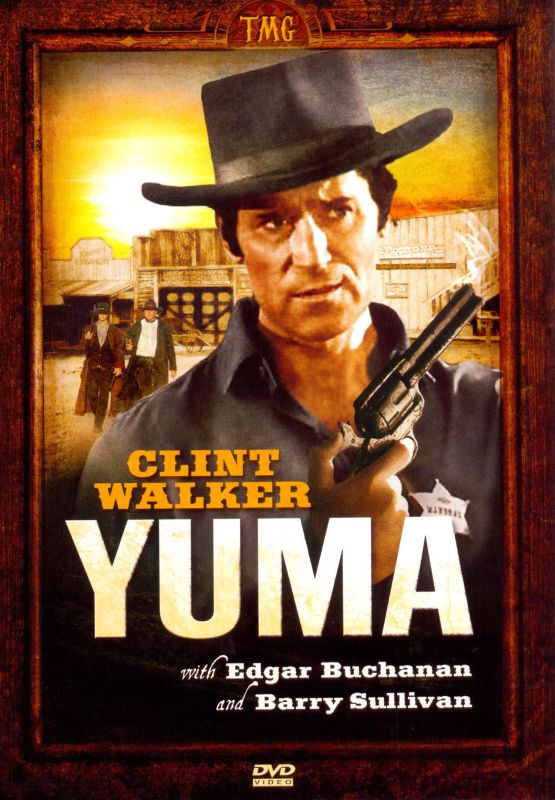
At the start of this made-for-TV western, experienced lawman Dave Harmon (Clint Walker) has just been appointed the new marshal of Yuma. He’s served as the marshal of several towns, all of which were near rowdy army bases. He’s a laconic, no-nonsense lawman who is quick with a gun and smart enough to negotiate with the local Indian tribes.
As soon as Harmon rides into town, he comes across the King Brothers (Bruce Glover and Bing Russell) making trouble. He kills one of the brothers in a saloon and then takes the other one to jail, where he’s mysteriously gunned down during a midnight jailbreak. It turns out that there’s a third Harmon brother, cattle baron Arch King (Morgan Woodward), and he rides into town looking for revenge. He gives Harmon a set amount of time to find and arrest his brother’s killer or Arch and his men are going to return to town and kill Harmon.
Fortunately, Harmon has a witness to the jailbreak murder. Andres (Miguel Alejandro) is a young, Mexican orphan who sleeps at the jail. He witnessed the murder but he only saw that the killer was wearing what appeared to be army boots. Harmon’s investigation brings him into conflict with the local army base’s commandant (Peter Mark Richman) and also leads to the discovery of a plot to defraud the local Indians.
The main problem with Yuma is that it was clearly designed to be a pilot for a weekly television series and, as a result, it introduces a lot of characters who don’t get much to do. There’s a lot of talk about how Harmon is searching for the men who earlier killed his family but that subplot is never resolved. (If Yuma had been picked up as a weekly show, maybe it would have been.) Yuma has to set up the premise for a potential show and tell a complete story in just 70 minutes. That’s a lot to handle and Yuma ends up feeling rushed and incomplete.
As a B-western for undemanding fans of the genre, it’s acceptable. Clint Walker was a convincing lawman and the film was directed by Ted Post, who knew how to stage a gunfight. But it’s not really a western that you’re going to remember for long after you watch it.
At the turn of the 20th century, the mayor and the business community of Cottonwood Springs, Texas are determined to bring their small town into the modern era. The Mayor (Larry Gates) has even purchased one of those newfangled automobiles that have been taking the country by storm. However, the marshal of Cottonwood Spings, Frank Patch (Richard Widmark), is considered to be an embarrassing relic of the past. Patch has served as marshal for 20 years but now, his old west style of justice is seen as being detrimental to the town’s development. When Patch shoots a drunk in self-defense, the town leaders use it as an excuse to demand Patch’s resignation. When Patch refuses to quit and points out that he knows all of the secrets of what everyone did before they became respectable, the business community responds by bringing in their own gunfighters to kill the old marshal.
Death of a Gunfighter is historically significant because it was the very first film to ever be credited to Allen Smithee. The movie was actually started by TV director Robert Totten and, after Widmark demanded that Totten be fired, completed by the legendary Don Siegel. Since Totten worked for 25 days on the film while Siegel was only on set for 9, Siegel refused to take credit for the film. When Widmark protested against Totten receiving credit, the Director’s Guild of America compromised by allowing the film to be credited to the fictitious Allen Smithee.
In the years after the release of Death of a Gunfighter, the Allen (or, more often, Alan) Smithee name would be used for films on which the director felt that he had not been allowed to exercise creative control over the final product. The Smithee credit became associated with bad films like The O.J. Simpson Story and Let’s Get Harrywhich makes it ironic that Death of a Gunfighter is not bad at all. It’s an elegiac and intelligent film about the death of the old west and the coming of the modern era. It also features not only one of Richard Widmark’s best performances but an interracial love story between the marshal and a brothel madame played by Lena Horne. The supporting cast is full of familiar western actors, with Royal Dano, Harry Carey, Jr., Larry Gates, Dub Taylor, and Kent Smith all making an impression. Even the great John Saxon has a small role. Though it may be best known for its “director,” Death of a Gunfighter is a film that will be enjoyed by any good western fan.
For our next film in this series of Back to School reviews, we take a look at 1985’s Girls Just Want To Have Fun!
And you know what?
It’s true — we do just want to have fun!
The fun in Girls Just Want To Have Fun is pretty much defined by dancing, which is okay with me because I love to dance. However, Girls Just Want To Have Fun had the misfortune to be made in the mid-80s. I have lost track of many 80s films that I’ve watched but I’m still always shocked at how undanceable most 80s music truly was. This film, of course, does contain a cover version of the famous song by Cyndi Lauper and that’s actually a pretty good 80s song. However, the rest of the music (and, by that, I mean the music that everyone in the movie is actually dancing to) is incredibly bland in the way that only music from the decade of We Built This City could be.
As for the film itself, it takes place in Chicago. Janey Glenn (Sarah Jessica Parker) is the newest student at the local Catholic girls school. Janey’s overprotective father (Ed Lauter) is in the army and Janey has lived all over the world. Despite that, Janey is not at all worldly. In fact, when she tries to introduce herself to her classmates, all she can get out is that she’s a gymnast and she loves to dance. (When we actually see Janey dancing or doing any sort of gymnastics, Sarah Jessica Parker’s hair always seems to fall in her face, which is certainly one way to hide a stunt double.)
Janey makes one friend at the school. Lynn (Helen Hunt, looking like a teenager but already sounding like a hung over 40 year-old) is about as wild as a girl can be in 1980s PG-rated film. That’s to say, she wears a leather skirt when she’s not in school and, when she babysits, she orders pizza and then allows the baby to sit on it. (Ewwwwwww! There’s a reason why babies wear diapers….) Lynne and Janey are automatically BFFs because they both love Dance TV!
That’s right — it’s DTV! I wonder what that’s supposed to be based on…
It turns out that DTV is having a contest to pick two new dancers! Disobeying her strict father, Janey sneaks out of the house and joins Lynn in auditioning! Lynn’s partner turns out to be so spastic that Lynn doesn’t make the semi-finals. Later, Lynn discovers that her partner was bribed by rich bitch Natalie Sands (Holly Gagnier). I’m not sure why Natalie felt the need to do that since Lynn wasn’t that impressive to begin with. She’s about as good a dancer as you would expect Helen Hunt to be.
However, Janey does make it to the semi-finals, where she’s partnered with Jeff. Jeff is tough and blue-collar and, at first, it doesn’t seem like he and Janey will get along. So, of course, they end up falling in love and, of course, Natalie’s father tries to force Jeff out of the contest by threatening to put his father out of work. Jeff, incidentally, is played by Lee Montgomery. Years before appearing in Girls Just Want To Have Fun, Montgomery played the little kid who gets crushed by a chimney at the end of Burnt Offerings. Burnt Offerings is a really crappy film but I watch it every time that it comes on TCM just so I can see that chimney crush Lee Montgomery. That said, Montgomery actually does a pretty good job of Jeff. You never quite buy him as a rebel without a cause but he still seems like an authentic and likable teenager. Jeff and Janey are a cute couple and that’s all that really matters.
Just as Janey has a best friend, Jeff also has a best friend. Drew Boreman (Jonathan Silverman) talks too much, tries to sell t-shirts from the trunk of his car, and there’s also a scene were he grabs a random girl’s breasts and makes a comment about using her nipples to tune a radio. Drew is annoying and, once you get over the fact that she’s being played by a young Helen Hunt, so is Lynn. Watching the movie, you kind of want to tell both of them to just calm down for a few minutes.
But you know who is not annoying? Jeff’s younger sister, Maggie, who is played by none other than a very young Shannen Doherty. Maggie was my favorite character because she alone seemed to understand how stupid everyone else in the film was. And she was willing to call them out on it.
ANYWAY — Girls Just Want To Have Fun is one of those movies where next to nothing actually happens. There is an extended sequence where our heroes destroy Natalie’s snooty party with the help of a bunch of punks and female body builders but otherwise, it’s remarkable how little actually happens. That said, some of the dancing is good (even if most of the music is totally bland in the way that only 80s music can be) and it’s interesting to see Sarah Jessica Parker and Helen Hunt when they were young. Sarah Jessica Parker actually gives a surprisingly likable performance here, even if it is often way too obvious that a body double is doing the majority of her dancing. That said, you really can’t get any further away from Carrie Bradshaw than Janey Glenn.
Girls Just Want To Have Fun is a time capsule of the decade in which it was made and that is definitely the main reason to watch it. Until time machines are a reality and we can experience the past firsthand, we’ll just have to keep getting our information from movies like this one.
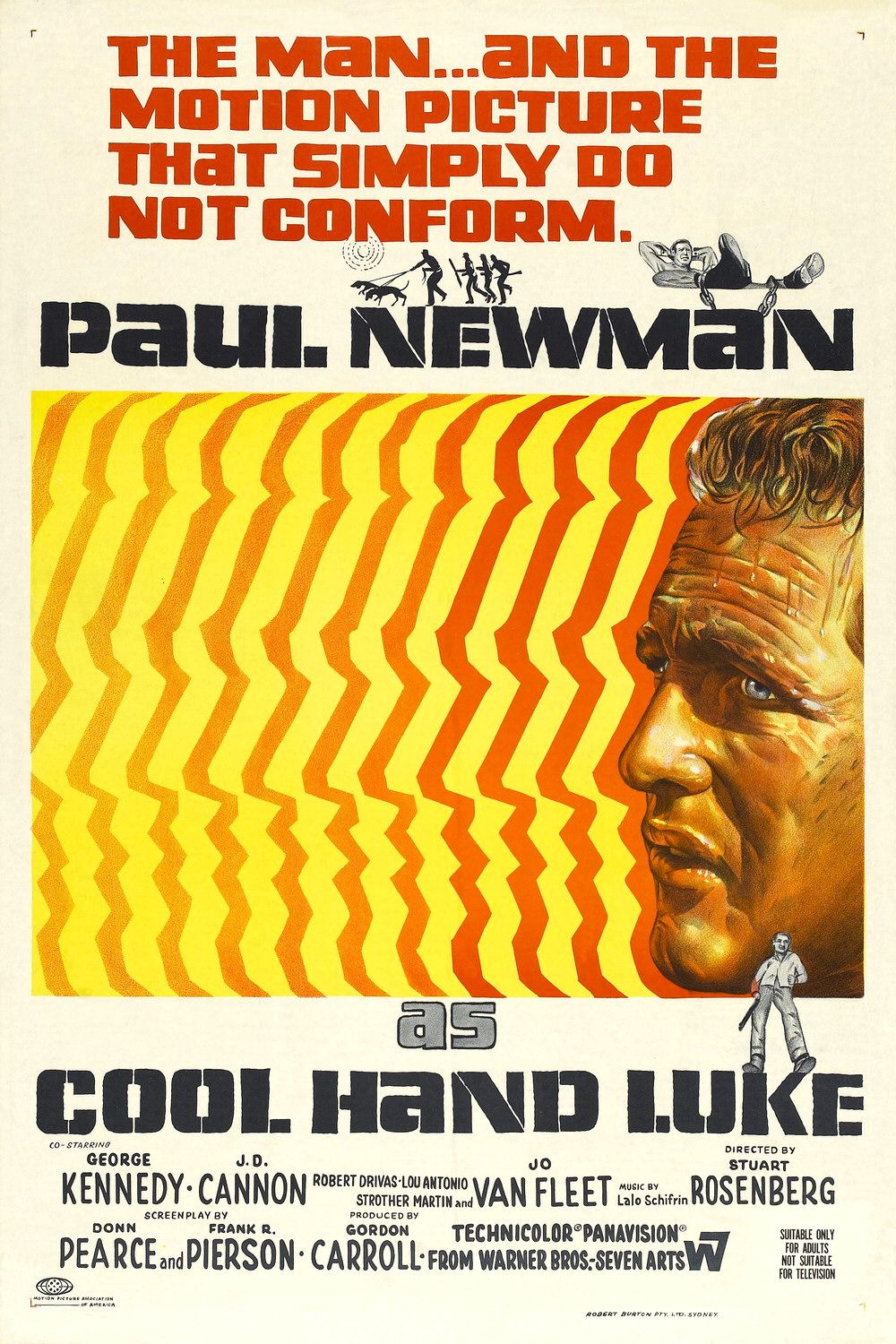
The Sixties was the decade of the rebellious anti-hero. The times they were a-changin’ and movies reflected the anti-establishment mood with BONNIE & CLYDE, EASY RIDER, and COOL HAND LUKE. Paul Newman starred as white-trash outsider Luke Jackson, but it was his co-star George Kennedy who took home the Oscar for his role as Dragline, the king of the cons who first despises then idolizes Luke.
War vet Luke gets busted for “malicious destruction of municipal property while drunk”, and sent to a prison farm in Florida. The non-conformist Luke butts heads with both the “bosses” (prison guards aka authority) and Dragline, a near illiterate convict who runs the yard. Dragline and Luke decide to settle their differences in a Saturday boxing match. The hulking Dragline beats the shit out of Luke, but the smaller man keeps getting up for more. Dragline finally walks away, and Luke earns both his and…
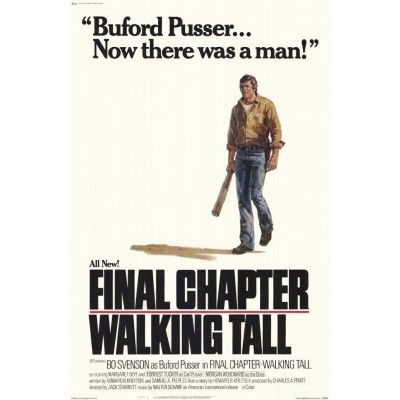
For one last time, Buford Pusser is back! The 1977 film Walking Tall: Final Chapter ends the story that was begun in Walking Tall and continued in Walking Tall Part II.And it turns out that the final chapter is pretty much just like the previous two chapters. In fact, I’m tempted to just tell you go reread my review of Walking Tall Part II because that review works just as well for most of the Final Chapter.
Final Chapter starts with footage from the first Walking Tall, with Bo Svenson awkwardly inserted in place of Joe Don Baker. Once again, we watch as Elizabeth Hartman is shot in the back of the head and Svenson — in the role of Buford Pusser — is shot in the face. Oh my God, we think, how many times can the exact same thing happen to the exact same character!?
Oh wait — it turns out that Buford is just remembering the death of his wife. Buford is still haunted by that day and he’s still out for vengeance. For the next hour or so, we follow Buford as he and his deputies blow up moonshiners across Tennessee. After each arrest, an attorney shows up and yells at Buford for violating everyone’s civil rights. In response, Buford smirks until the attorney gets so mad that he decides to run for sheriff himself.
Buford doesn’t give his opponent much of a chance. As one of his deputies puts it, this guy is just a “bleeding heart liberal.” (But if he’s so liberal, what’s he doing in Tennessee? Off with you, sir — return to Vermont!) Instead of campaigning, Buford spends his time hunting down more moonshiners. When he discovers that one moonshiner is also an abusive father, he personally drives the man’s son down to the local orphanage. Oddly enough, Buford does not offer to adopt the kid himself.
Anyway, to the shock of everyone, Buford is not reelected. No longer sheriff, he struggles to find a full-time job and makes plans to run in the next election. One of the moonshiners shows up and taunts Buford until Buford is forced to beat him up in the middle of the street. The new sheriff show up and demands to know what happened. None of the townspeople are willing to snitch on Buford. Good for them!
After about an hour and a half of this, something interesting actually happens. A film producer drives up to the Pusser Farm and tells Buford that he wants to make a movie out of his life. “We’re going to tell the story exactly how it happened!” the producer assures him. In the next scene, Buford is advising the director of Walking Tall on how to properly film a car chase.
And you know what? These scenes of Buford watching his life story be filmed are actually rather charming. For the only time in the series, Bo Svenson actually appears to be having fun in these scenes. And, when Buford runs from a theater while watching the recreation of his wife’s murder, it’s actually a very effective moment.
Anyway, there’s not much running time left after all of that. We see Buford sign a contract to play himself in the sequel and, by this point, we all know what happened afterward. Buford was killed in a mysterious car accident. But fear not! The film opens with a heavenly choir and Svenson’s voice booming from the heavens so we all know that Buford Pusser is arresting moonshiners in Heaven.


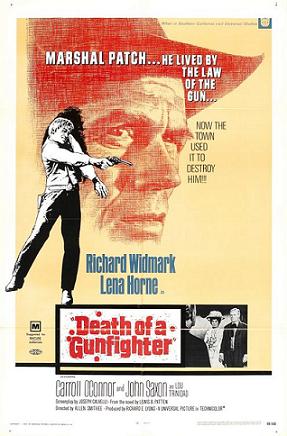 At the turn of the 20th century, the mayor and the business community of Cottonwood Springs, Texas are determined to bring their small town into the modern era. The Mayor (Larry Gates) has even purchased one of those newfangled automobiles that have been taking the country by storm. However, the marshal of Cottonwood Spings, Frank Patch (Richard Widmark), is considered to be an embarrassing relic of the past. Patch has served as marshal for 20 years but now, his old west style of justice is seen as being detrimental to the town’s development. When Patch shoots a drunk in self-defense, the town leaders use it as an excuse to demand Patch’s resignation. When Patch refuses to quit and points out that he knows all of the secrets of what everyone did before they became respectable, the business community responds by bringing in their own gunfighters to kill the old marshal.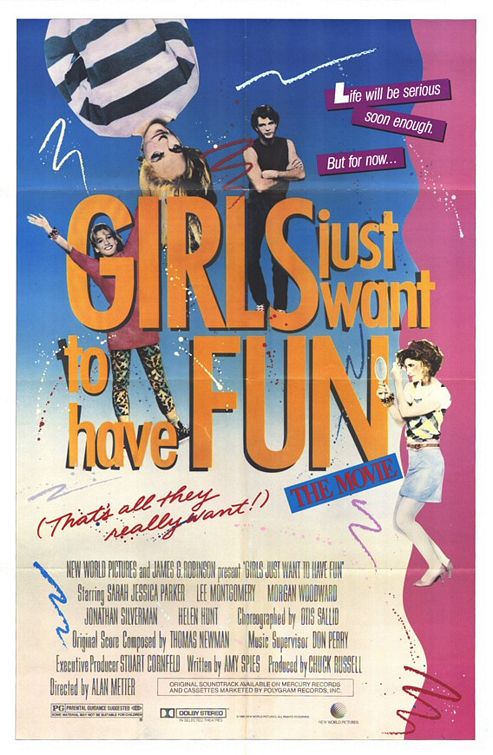

 Through the Shattered Lens