Retro Television Review: Miami Vice 2.16 “Little Miss Dangerous”


Welcome to Retro Television Reviews, a feature where we review some of our favorite and least favorite shows of the past!  On Mondays, I will be reviewing Miami Vice, which ran on NBC from 1984 to 1989.  The entire show can be purchased on Prime!

The power has returned, my mood is better, and my wrist has healed.  It’s time to get back to the reviews!

Episode 2.16 “Little Miss Dangerous”

(Dir by Leon Ichaso, originally aired on January 31st, 1986)

There’s a serial killer stalking the red light district of Miami, haunting cheap motels, dark alleys, and neon-lit sex clubs.  Men are turning up dead all over the place, brutally stabbed and then set on fire.  Occasionally, a crude drawing is left behind.  Castillo announces that every member of the Squad will be working a 12-hour shift until the killer is brought to justice.  He says that they may be looking for a pimp or a prostitute who is looking for revenge.

Of course, every prostitute knows and likes Sonny Crockett.  And again, this leads to the question of how exactly Sonny is able to work undercover when everyone in Miami knows who he is.  For that matter, all of the prostitutes also seem to know that Gina and Trudy are working Vice as well, despite the fact that Gina and Trudy’s regular gig to go undercover as high-priced escorts.  How do these people ever succeed at going undercover?  Everyone knows them!  I guess that’s to be expected, though, when you’ve only got 6 detectives working Vice in a city as big as Miami.

Tubbs meets a Jackie (played by singer Fiona), a young runaway who swears that she’s 18 and who says that she’s happy working as a prostitute because her body is just a commodity.  Tubbs becomes obsessed with protecting the spacey but seemingly innocent Jackie, especially after he becomes convinced that Jackie’s pimp, Cat (Larry Joshua), is the murderer.  Except, of course, Cat isn’t the killer.  Jackie is!  When Tubbs takes Jackie to a safehouse (which, of course, is also an art deco mansion), she snaps.  As Crockett tries to break down the locked front door and Cat crashes into the house on his motorcycle, Jackie starts a fire and approaches Tubbs.  But, instead of killing the only man who hasn’t tried to use her body, Jackie instead holds a gun to her head.  This is another episode that ends with an off-screen gunshot.  Interestingly, we never see Crockett actually get into the safehouse to rescue Tubbs from the fire.  Instead, the ending is abrupt and the viewer, while having no doubt that Tubbs will escape the fire, knows that Tubbs will now carry Jackie’s scars as his own.

What an unsettling episode.  This was Miami Vice at its most surreal and dream-like, with almost all of the action taking place at night and both Fiona and Larry Joshua giving edgy performances as two self-destructive people who live in the shadows of a wealthy American city.  For once, the entire Vice Squad gets in on the action, though Tubbs is clearly the one at the center of the story.  This episode reminds us that Tubbs is not quite as cynical and emotionally closed-off as Crockett but maybe, for the sake of his sanity, he should be.  Little Miss Dangerous is a journey into the heart of Miami darkness.
“DAMN YOU, KENNEDY!”: Assignment — Kill Castro (1980, directed by Chuck Workman)


7d9oDL3Y5kupCGgUsR6Jh5ZU1KfOne of my earliest memories of staying up late and watching cheesy movies on local television was the sight of Robert Vaughn standing on a beach and cursing, “Damn you, Kennedy!”  An echo effect kicked in, making the line: “Damn you, Kennedy Kennedy Kennedy Kennedy Kennedy!”
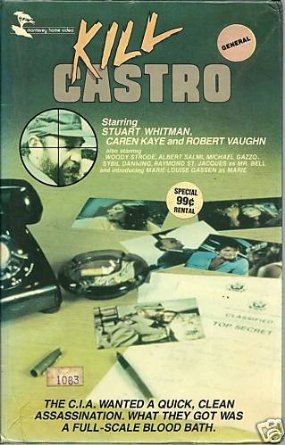
The name of the movie was Assignment — Kill Castro and sometimes it seemed like it came on every other night.  The movie started with a title crawl that was so lengthy and so set the tone for the entire film that I feel it is worth quoting in its entirety:

From 1961, the year of the Bag of Pigs to today, the Government of the United States has been embroiled in a series of events which have continually led our nation to crisis after crisis and to the brink of war.

ASSIGNMENT — KILL CASTRO, a true story is one of the most confusing and frustrating historical events that might have led to a world power showdown.  It happened yesterday!  It happened today!  It can happen again!

Names of persons and places have been changed to protect the individuals who were called upon to aid their country and in doing so placed their lives in jeopardy.

“I WILL GIVE ALL FOR THE LOVE OF MY COUNTRY … RIGHT OR WRONG! — G.W. Bell, Chief of Carribean (sic) Operations, Central Intelligence Agency”

This motion picture is dedicated to all people who desire to live in a free democratic society.

Robert Vaughn plays Hud, a former CIA agent who was involved in the original Bay of Pigs invasion.  When the mysterious Mr. Bell (Raymond St. Jacques) and a gangster named Rossellini (Michael V. Gazzo) agree to finance an operation to kill Fidel Castro, Hud recruits a Key West bar owner named Tony (Stuart Whitman) to take him to Cuba.  However, Mr. Bell and Rossellini are just using Hud to secretly smuggle heroin into Florida and, much like John F. Kennedy in 1961, they are planning on abandoning him on the beaches of Cuba.

The main problem with Assignment — Kill Castro is that we already know that Hud is not going to succeed in his mission because Fidel Castro is still alive and probably still bragging about how he sent Tony Montana to Miami.  The other problem is that the movie does not make any damn sense.  That title crawl was not kidding when it said the story was confusing and frustrating.  Everyone is so busy double-crossing everyone else that it is hard to keep track.  There has to be a simpler way to get heroin into Florida.  Surprisingly, this incoherent movie was written and directed by the legendary editor, Chuck Workman, the same Chuck Workman who puts together those montages for the Oscars.

Kill Castro does have a good cast, though none of them are at their best.  Along with Whitman, Vaughn, St. Jacques, and Gazzo, the cast includes Woody Strode, Albert Salmi, and Sybil Danning (whose last name is misspelled Daning in the end credits).  Fidel Castro plays himself and the film’s ending is provided by cannibal turtles.

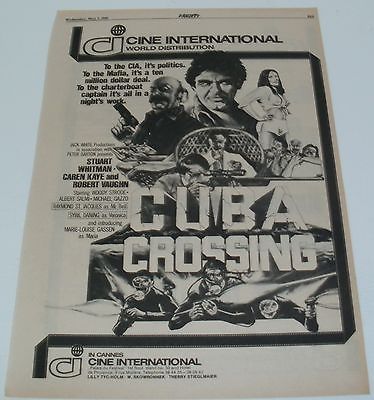
Assignment — Kill Castro was just one of the many titles that this movie was released under.

51-brX2eGmL._SY445_

It was also known as Cuba Crossing,

STUART-WHITMAN-CUBA-CROSSING-MOVIE-ADVERT-FULL-PAGE

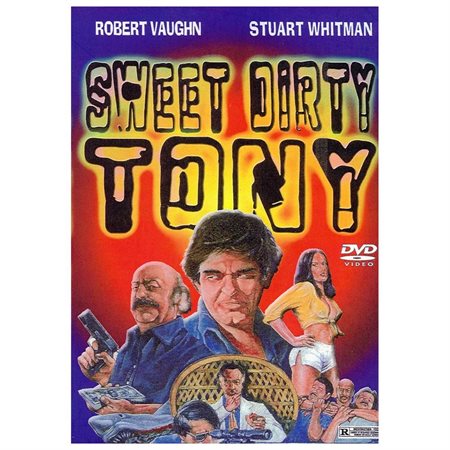
Key West Crossing, The Mercenaries, and my personal favorite, Sweet Dirty Tony.

55706564

Embracing the Melodrama Part II #57: Saturday Night Fever (dir by John Badham)


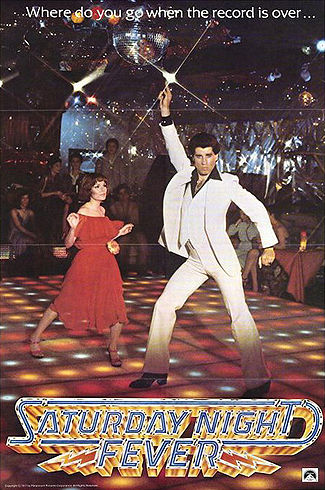
Saturday_night_fever_movie_posterHere’s a little bit of trivia about the iconic 1977 film Saturday Night Fever.

First off, according to the imdb, Saturday Night Fever was the first mainstream Hollywood film to ever use the term “blow job.”  That actually took me by surprise.  I mean, with all of the risks that the major studios took in the 70s, it still took them until 1977 to have someone say “blow job” in a movie?  But somehow, it seems appropriate that it would turn up in Saturday Night Fever.  We tend to think of Saturday Night Fever as being a movie where the soundtrack is nonstop disco and John Travolta dances in that iconic white suit.  But actually, Saturday Night Fever is a film about four guys who neither understand nor respect women.

When Tony (John Travolta), Joey (Joseph Cali), Double J (Paul Pape), and Bobby (Barry Miller) go down to that disco, it’s because they want to get laid.   Joey and Double J take turns having sex with insecure Annette (Donna Pescow) and, afterwards, Tony scornfully ask her if she‘s proud of herself.  When Bobby discovers that his girlfriend is pregnant, he is so terrified of having to be a father that he becomes suicidal.  As for Tony, he looks down on the women who are so eager to dance with him.  When he enters a dance contest with Stephanie (Karen Lynn Gorney), he can’t handle the fact that she wants more out of her life than just being his latest partner.

So, it makes sense that this would be the first mainstream movie to feature someone talking about a blow job because that’s what these boys are obsessed with.  Sexually primitive, hypocritically puritanical, and emotionally repressed, a blow job is all the intimacy that these boys can handle.

Another piece of trivia: while John Travolta was always the first choice for Tony Manero, several actors were seen for the roles of Joey and Double J.  At one point, both Ray Liotta and David Caruso were nearly cast in the role of Tony’s friends.  Imagine this: in some alternative universe, while white-suited John Travolta rules over the dance floor, Ray Liotta and David Caruso are standing in the background and cheering him on.

Of course, if Liotta and Caruso had been cast, it would be a totally different movie.  Whenever you watch Saturday Night Fever, you’re surprised by how much John Travolta totally dominates the film.  Even though the film devotes a good deal of time to Annette, Stephanie, Bobby and to Tony’s brother who has recently left the priesthood, Tony Manero is the only character that you remember.  That’s largely because Travolta is the only one of them who gives a truly memorable performance.

In theory, it’s easy to laugh at the thought of Travolta in that white suit, striking a dramatic pose on that cheap-looking dance floor.  But then you watch the film and you realize that Travolta truly did give a great performance.  And, to your surprise, you don’t laugh at Tony with his white suit because you know that the only time Tony has any control over his life is when he’s dancing.  He may work in a paint store.  He may regularly get slapped around by his family.  He may not be very smart or sensitive.  But when Tony’s dancing, he’s a king and you’re happy that he at least has one thing in his life that he can feel good about.

Even if he is kind of a jerk.

Of course, it helps that Tony is a really good dancer.  There’s actually a lot more going on in Saturday Night Fever than you might think but ultimately, it’s a dance movie and it’s one of the best.