A Book For The Weekend (6/28/25)


A man who has no memory arrives in the town of Lyncastle and immediately discovers that, whoever he may be, no one wants him around.  One person tells him that his name is Johnny McBride and that the police are looking for him.  Our stranger may not know who he is but he’s fairly sure that he’s not Johnny McBride.  But yet everyone in town insists that he is.  When the police try to check his fingerprints, they discover that he has no fingerprints!  Apparently, he lost them at the same time that he lost his memory….

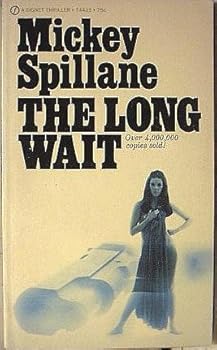
That’s the set up for Mickey Spillane’s 1951 novel, The Long Wait.  I won’t spoil the rest of it because 1) this book is full of shocking twists, 2) none of them make much sense, but 3) they’re all so over-the-top and ludicrous that you can’t help but love them.  Reading The Long Wait, one gets the feeling that Spillane made up the plot as he went along and it’s hard not to admire his dedication to sticking with the story, no matter how weird and, to be quite frank, ridiculous things got.

This is not one of Spillane’s Mike Hammer novels.  Hammer is not in this book.  If anything, our amnesiac hero is even more violent and brutal than Hammer because the hero of The Long Wait literally has nothing to live for.  Hammer at least had an office and a life that he could return to after killing all the bad guys.  The hero of The Long Wait may not know who he is but he still knows that’s he’s pretty angry with a lot of people.

Violent, melodramatic, and at times thoroughly gratuitous, The Long Wait is an entertainingly absurd book.  I read it in a hotel room and I recommend you do the same.

(Check out last week’s book here!)


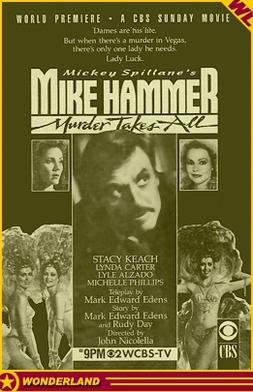
Mike Hammer: Murder Takes All (1989, directed by John Nicollela)


Entertainer Johnny Roman (Ed Winter, best-known as the crazed Colonel Flagg on M*A*S*H) sends an invitation to New York P.I. Mike Hammer (Stacy Keach), asking him to come to Vegas for a job.  Hammer refuses.  Vegas is not for him.  He’s pure New York.  So, someone has Hammer abducted and thrown out of an airplane over Vegas.  Luckily, they gave Hammer a parachute.  Unluckily, for them, Hammer is now in Las Vegas and he’s pissed off.

Johnny, who says he had nothing to do with the kidnapping and just wants Hammer to help him deal with a singer who has been stealing from him, is killed by an explosive device while hosting a telethon.  Everyone suspects Hammer.  When the singer that Hammer was supposed to investigate also turns up dead, Hammer is again suspected.  Hammer has to clear his name while dealing with guest stars ranging from Lynda Carter to Michelle Phillips to Jim Carrey.

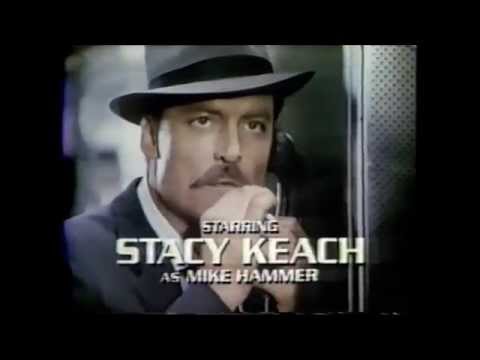
Stacy Keach was Mike Hammer for most of the 80s, playing Mickey Spillane’s notorious detective in a television series and in several made-for-TV movies, like this one.  Television was an awkward fit for Mike Hammer, or at least Hammer the way he was imagined in the books.  Mike Hammer was written to be a killer with his own brand of justice.  He was not written to be a nice person.  Instead, he was the brutal but intelligent warrior that you hoped would be on your side.  The television version of Mike Hammer was considered to be violent for the era but the show still toned down Hammer’s signature brutality.  Keach’s Hammer still killed people but he no longer gloated about it.  Stacy Keach, with his trademark intensity, was a good pick for Mike Hammer, even if the show’s scripts often let him down.

This movie is hamstrung by the fact that it was made-for-TV.  Hammer is not happy about being in Las Vegas but he can’t go off on the city in the same way that he would have in one of Mickey Spillane’s novels.  Keach still gives a good and tough performance as Hammer, getting as close to the character as anyone could under the restrictions of 80s network television.  The mystery is interesting, though Hammer doesn’t really solve it as much as he just waits until all the other suspects have been killed.  The main attraction of this one is the amount of guest stars who show up.  Lynda Carter is a great femme fatale and it’s always good to see Michelle Phillips, even in a small role.  Jim Carrey, in his pre-In Living Color days, plays an accountant and does okay with a serious role.

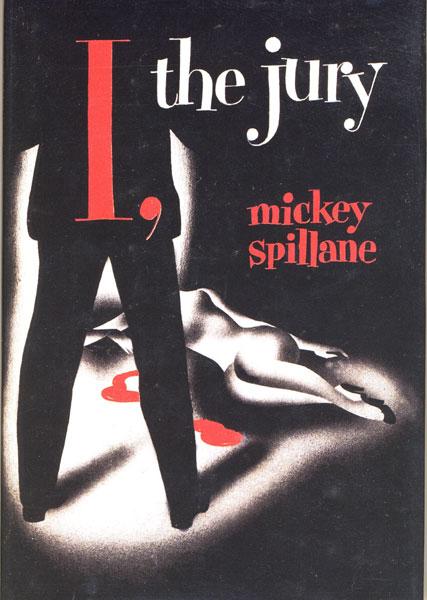
Who could play Mike Hammer today?  It’s hard to say.  There aren’t many believably tough actors around anymore and even those who do seem like they could hold their own in a fight don’t have the gritty world-weariness that the character requires.  (Just try to imagine Dwayne Johnson reenacting the end of I, the Jury.)  A few years ago, I would have said Frank Grillo.  In the 90s, Bruce Willis would have been the perfect Hammer.  Today, though, Mike Hammer’s time may finally have passed.

Book Review: One Lonely Night by Mickey Spillane


As you may have heard, we’ve had a bit of inclement weather down here in Texas.  Tuesday morning, around one a.m., the house was surrounded by six inches of snow.  The temperature outside was 3 degrees.  Because the power was down (not due to the rolling blackouts that had paralyzed the rest of the state but instead because some idiot drove into a substation) it was about 40 degrees inside of the house.  It was cold, I was shivering, and I couldn’t sleep.  So, I decided to sit in bed and read a book.  Even though I had a flashlight with me, I quickly discovered that I didn’t need it.  The snow outside was so bright that it actually generated enough light that I was able to read by it.  That was actually kind of nice.

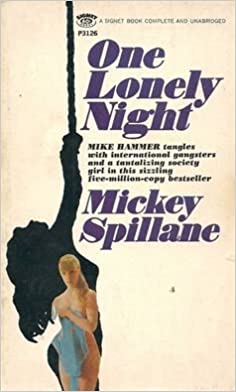
As for the book that I decided to read, it was an old paperback detective novel that I purchased at Half-Price Books a few years ago.  (Half-Price Books has a wonderful vintage section.)  Originally published in 1951, Mickey Spilliane’s One Lonely Night is one of the many books that Spillane wrote about the adventures of a tough New York-based private investigator named Mike Hammer. Many of those books were later adapted into films.  1955’s Kiss Me Deadly is probably the best-known.  (And, of course, the much-missed Gary Loggins was quite a fan of Mike Hammer and the author who created him.)

One Lonely Night opens at night and with Mike Hammer in a bad mood.  Earlier in the day, a judge scolded Hammer for being too quick to kill people, leaving Hammer to feel as if he was being portrayed as being some sort of blood-thirsty monster.  When night comes, Hammer is still wandering around Manhattan and obsessing on the fact that he’s somehow developed a reputation for being violent and quick to kill.  It’s interesting because, on the one hand, it’s hard not to feel bad for Hammer.  His feelings have obviously been hurt and, as he explains in his hard-boiled narration, he only kills people who have to be killed.  He doesn’t necessarily do it for fun though, at the same time, he doesn’t make any apologies for doing what he feels needs to be done.  On the other hand, as you read the book, you can’t help but notice that Hammer really does kill a lot of people.  When he’s not killing, he’s thinking about killing.  He’s obsessed with violence and, even if he’s found a way to justify that to himself, it’s still hard not to be slightly disturbed by such a one-track mind.  Hammer knows that he will never be able to escape his fearsome reputation and he also know that most people will never see him as being anything more than a murderer.  But, at the same time, he also understands that important role that he, in his own ruthless way, plays in maintaining the proper balance between good and evil.  He’s a former soldier, a World War II vet who one took as much pleasure in killing Nazis as he now takes in killing criminals.  He’s frightening but he’s necessary.

As for the book’s plot — well, it’s hard to know where to even begin.  It all starts with Hammer wandering around Manhattan and running into a mysterious woman being pursued by a male assassin.  The woman, apparently thinking that Hammer is another assassin, jumps off a bridge rather than accept Hammer’s help.  Hammer, who has just told us in glorious detail about how much he resents being called a killer, proceeds to kill the other man and then toss his body off the bridge as well.  Before Hammer throws away the dead man, he uses the pavement to scrape off the man’s fingerprints because …. well, he’s Mike Hammer and he does stuff like that.  (What’s interesting is that Hammer informs us about destroying the man’s fingerprints rather casually, as if it’s something that anyone would do under the circumstances.)  Through a convoluted series of events, this all leads to Hammer investigating a politician who is being blackmailed by his twin brother and also uncovering a secret communist spy ring and a plot to steal a lot of very sensitive documents.  Everything’s connected in its own strange way.  Hammer seduced two communists, kills a lot of people, and spends a lot of time talking about how much he hates the weaklings who, in his opinion, are destroying American society.  Hammer may not believe in much but he definitely believes in America.

The story is next to impossible to follow.  One gets the feeling that Spillane simply made it up as he was writing it, without really worrying about whether or not everything really added up.  When Spillane can’t come up with a logical way to connect the various elements of the story, he resorts to coincidence.  Mike Hammer has a talent for being in the wrong place at the wrong time.  And yet, the story’s incoherence is actually one of the reasons why One Lonely Night works.  The narrative messiness, mixed with Hammer’s unapologetically over-the-top tough guy narration, makes the story feel like almost a fever dream.  Hammer walks through an increasingly surreal version of New York and only he seems to understand just how ludicrous the world has become.  He’s neither as idealistic as his allies nor as cynical as his opponents.  Instead, he’s an untouchable avenger, moving through the chaos and simply accepting that nothing makes sense beyond his own primal instincts.  Hammer is the ultimate individualist, worrying only about himself and occasionally his secretary, Velda.

One Lonely Night is definitely a product of its time.  One can only imagine the howls of rage that would greet the book if it were written today.  In 1951, one could presumably get away with writing a novel about a private detective ruthlessly killing a bunch of political subversives.  Today, of course, the book’s storyline would probably lead to an angry twitter hashtag campaign.  Of course, what those readers would probably miss is that Spillane clearly doesn’t mean for us to take Mike Hammer all that seriously.  At it’s best, the book is almost a parody of the classic tough guy posturing that we associate with pulp fiction.  Hammer is so ruthlessly determined and his enemies are so incredibly weasely that it’s obvious that Spillane was having a bit of fun with both his readers and at the expense of his critics.  Just as Hammer spends the book complaining about a judge who accused him of being too quick to kill, Spillane seems to saying to the critics of his style of writing, “You think pulp detective stories are sordid?  I’ll show you sordid!”

I enjoyed One Lonely Night.  It kept me entertained during one very cold night.
Murder Me, Murder You (1983, directed by Gary Nelson)


When two employees of an all-female courier service are murdered, Private Investigator Mike Hammer (Stacy Keach) is on the case.  The service was owned by his ex-girlfriend, Chris (Michelle Phillips), and she wants him to protect her while she testifies in front of a grand jury.  It turns out that her courier service has gotten involved in some shady business, transporting deliveries between a helicopter company and a South American dictator.  Chris fears that she’ll be murdered to keep her from testifying.  Hammer agrees to protect her and she tells him that he has a 19 year-old daughter who he’s never met.

While Chris is testifying, she suddenly dies on the stand.  The doctors say that it was a heart attack but Hammer knows that it was murder.  Hammer sets out to not only get revenge for Chris but also to find his daughter, who has disappeared into the world of underground pornography.  It’s all connected though, as is traditional with Mike Hammer, it can sometimes be difficult to keep up with how.

Murder Me, Murder You was a pilot film for a brief-lived but fondly-remembered Mike Hammer TV series that aired in the 80s.  Murder Me, Murder You takes Mickey Spillane’s famous detective into what was then the modern age but it allows him to remain a man of the hard-boiled noir era.  Hammer’s narration is tougher than leather, he’s more interested in listening to swing music than new wave, and he still dresses like an old-fashioned private eye, complete with a fedora on his head.  As played by Stacy Keach, he’s also just as dangerous and quick to kill as Hammer was in Spillane’s original novels.  In the novels, Hammer was an unapologetic brute who often bragged about how much he enjoyed killing criminals and communist spies and whose closest associate was his gun, which he nicknamed Betsy.  When Spillane’s novels were filmed, the violence of Hammer’s character was often downplayed.  (A notable exception was Robert Aldrich’s Kiss Me Deadly, which suggested that Hammer was such a fascist that he would eventually be responsible for the end of the world.  The Mike Hammer of Spillane’s novels would probably dismiss Kiss Me Deadly as being red propaganda and set out to deliver American justice to the Hollywood communists who wrote it.)  In Murder Me, Murder You, Mike Hammer is just as brutal an avenger as Spillane originally imagined him to be.  With his hulking frame, grim eyes, and his surly manner, Stacy Keach is the perfect Mike Hammer.

Murder Me, Murder You is a convoluted and often difficult-to-follow murder mystery but with Keach’s bravura lead performance, a strong supporting cast (including notable tough guys Tom Atkins and Jonathan Banks) and good direction from TV movie vet Gary Nelson, this movie comes about as close as any to capturing the feel of Mickey Spillane’s original novels.  Murder Me, Murder You was released on DVD fourteen years ago.  Though it is now out-of-print, copies are still available on Amazon.

Book Review: THE LAST STAND by Mickey Spillane (Hard Case Crime 2018)


gary loggins's avatarcracked rear viewer

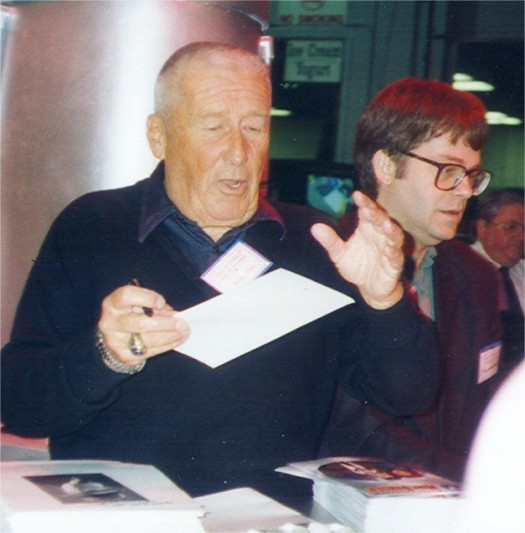
2018 is the centennial anniversary of Mickey Spillane’s birth! Spillane got his start in comic books, then caused a sensation with his 1947 novel I, THE JURY, introducing the world to that hardest of hardboiled PI’s, Mike Hammer. Hard Case Crime, an imprint every pulp fiction fan should know about, celebrates Spillane’s birth by releasing THE LAST STAND, The Mick’s last completed novel, with a bonus unpublished novella from the early 1950’s.

Spillane with friend/literary executor Max Allan Collins

Mickey’s literary executor and friend Max Allan Collins writes the introduction. Collins is no stranger to the hardboiled genre himself, having been Chester Gould’s replacement on the long-running comic strip Dick Tracy from 1977-92, author of the graphic novel ROAD TO PERDITION, and the Quarry series of books (made into a Showtime series in 2016). Since Spillane’s death in 2006, Collins has been editing and completing the writer’s (“I’m not an…

View original post 553 more words

Pulp Fiction #1: Mickey Spillane’s Mike Hammer


gary loggins's avatarcracked rear viewer

“The roar of the .45 shook the room. Charlotte struggled back a step. Her eyes were a symphony of incredulity, an unbelieving witness to truth. Slowly, she looked down at the ugly swelling in her belly where the bullet went in.

“How c-could you”, she gasped.

I only had a moment before talking to a corpse. I got it in.

“It was easy”, I said. “

– from I, THE JURY by Mickey Spillane, first published in 1947 by EP Dutton

Mickey Spillane’s PI Mike Hammer made his debut in I, THE JURY, and set the shocked literary world on its collective ear with its sex-and-violence laden story. Critics savaged Spillane, but the book buying public ate it up, turning I, THE JURY into a best seller and launching Hammer as a pop culture icon. Hammer’s roots were deeply set in the bloody pulps and another 20th century phenomenon… the four-color comics!

View original post 959 more words

A Movie A Day #158: The Girl Hunters (1963, directed by Roy Rowland)


Private detective Mike Hammer (Mickey Spillane) has spent the last seven years in the gutter.  Ever since his secretary, Velda, disappeared, Hammer has stopped working cases and, instead, spends all of his time drinking and passing out in alleys.  That is where he is found by his old friend, Captain Pat Chambers (Scott Peters).  Pat tells Mike that there has been a shooting.  A man named Richie is dying in the hospital and want to speak to him.  According to Richie, he was shot by the Dragon, the same communist super villain that Velda is currently hiding from.  That sobers Hammer up.  In fact, Mike Hammer is so tough that it only takes him a few minutes to shake off seven years of alcoholism.  Mike discovers that Richie’s murder is also connected to the murder of a senator.  Mike’s investigation leads him to both the senator’s bikini-clad wife (Shirley Eaton) and a communist conspiracy to take over the world.  What is strange is that it never leads him to Velda.  Maybe he would have found her if The Girl Hunters had gotten a sequel.
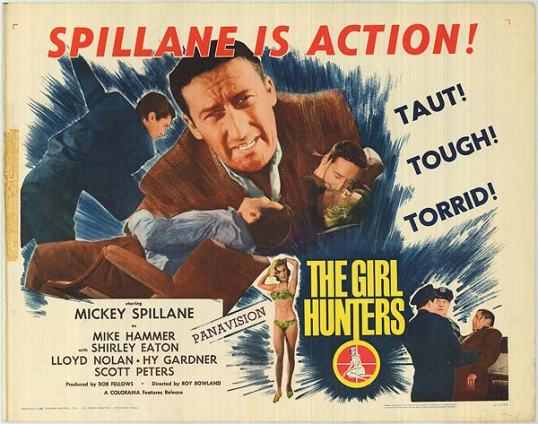
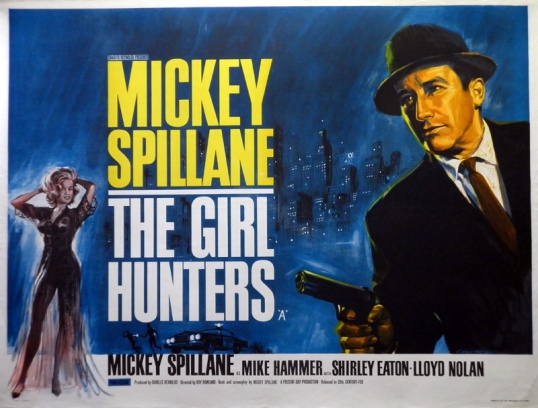
Many films were based on Mickey Spillane’s Mike Hammer novels but The Girl Hunters is unique because it stars Mickey Spillane as Hammer.  Spillane was not much of an actor but he was a genuine tough guy who, even after he became a successful writer, still looked like he had gone a few rounds with the world so he was not necessarily miscast in the role of Hammer.  The main problem with The Girl Hunters is that the mystery is not that interesting.  Mike Hammer does not really investigate anything.  He just goes from fight to fight.  At the end of the movie, he does come up with a clever trick to catch the killer but since there is only one suspect, the killer’s identity is not a surprise.s   The Girl Hunter is worth seeing for Shirley Eaton in a bikini and the novelty of Mickey Spillane playing his most famous creation but Kiss Me Deadly is still the best Mike Hammer film.

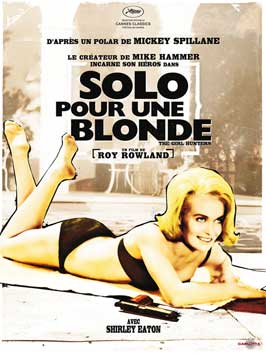
The French poster leaves no doubt about The Girl Hunters’ main selling point.

Hammer Time!: KISS ME DEADLY (United Artists 1955)


gary loggins's avatarcracked rear viewer

kissme1

Mickey Spillane’s Mike Hammer novels have long been one of my favorite Guilty Pleasures. Spillane’s books were the literary equivalent of knocking back shots of Jack Daniels with no chaser. The misanthropic Mike Hammer’s Sex & Violence filled adventures are rapid paced, testosterone fueled trips through a definitely un-PC world where men are men, women are sex objects, and blood and bullets flow freely through a dark, corrupt post-war world.  Spillane turned the conventional detective yarn on its ear and, though critics hated his simplistic writing, the public ate up his books by the millions.

kissme2

The film version of Spillane’s KISS ME DEADLY turns film noir on its ear from its opening shot of Christine Bailey (a young Cloris Leachman) running down a lonely highway, almost getting run over by Mike Hammer. The PI picks her up and the opening credits roll backwards to the strains of Nat King Cole crooning “Rather Have The Blues”. This beginning set-up lets…

View original post 844 more words