Retro Television Review: The Love Boat 6.13 “The Christmas Presence”


Welcome to Retro Television Reviews, a feature where we review some of our favorite and least favorite shows of the past!  On Wednesdays, I will be reviewing the original Love Boat, which aired on ABC from 1977 to 1986!  The series can be streamed on Paramount Plus!
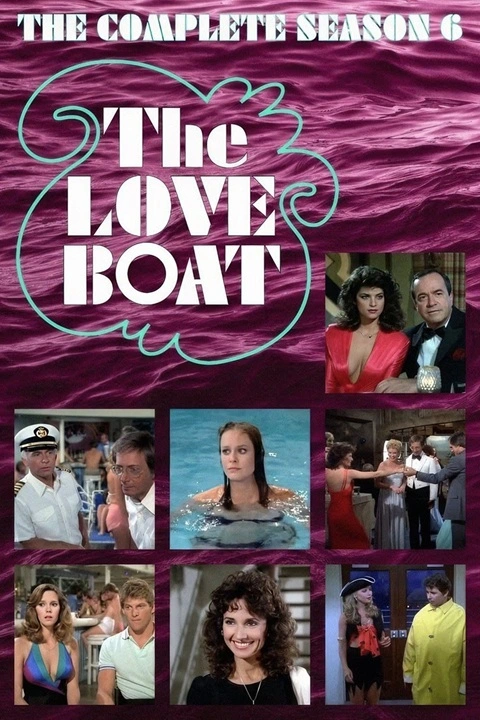
This Week, Captain Stubing is unimpressed by proof that God exists…

This episode had surgery, singing, and supernatural beings who did not impress Captain Stubing. I assume Stubing runs into angels on earth just on his way back from shuffleboard- they’re just old hat to him. There is a sexist and abusive husband Jim Markham (Donny Osmond) married to Lori Markham (Maureen McCormick- He wishes!). Henry Beemus (Henry Gibson) and Charlie Dobbs (Keenan Wynn) are two crooks who want to smuggle gold using nativity figurines and Nuns to unknowingly move the stolen gold through customs – this plot annoyed/tired me; it tannoyed me A LOT. The Nuns were traveling with a choir of Dominican children one of whom was deadly ill, requiring surgery!!! Lastly, an Angel with limitless powers was played by Mickey Rooney.

Jim wanted a traditional wife, but Lori wanted to keep her career. He was abusive even by 1970s standards because everyone wanted to hit him. He kept this bitter storyline going until Lori helped Doc Bricker cut into a Dominican Choir Boy’s throat to allow him to breathe! Yes, The Love Boat became The Mercy Ship!

Questions: why was there no blood on any of the scrubs after the surgery? They cut a hole in a kid’s throat! Then, Jim’s heart was changed because he found out that his wife helped save the Dominican Boy’s life. Hold on, did he not know she was a surgical nurse?! If Jim thinks this was something, wait until your wife tells you about the multiple gang related GSWs she has to treat every Wednesday night!

The Dominican boy’s plotline was interminable and there were great lamentations that his tracheotomy was going to prevent him from singing. Duh! He has a hole in his throat! Along with the throat hole plotline, there were the two thieves Henry and Charlie. These storylines just annoyed me. Mostly, they were just weird foils for Mickey Rooney to work his divine powers.

Speaking of powers, Mickey Rooney’s powers were endless: he healed the Dominican boy, allowing him to sing, he created ornaments out of thin air, he transported matter with his mind, he remade people’s thoughts, and spoke to planets! A fair number of these miracles were witnessed by Captain Stubing and he was as casually impressed as I am when I get a 5 dollar off promotion for Civilization VI on Steam. Captain Stubing barely shrugged.

The episode ended with Mickey Roony’s disembodied animated head atop the ship’s Christmas tree. It was just his head and it winked and smiled at them! Save yourselves! RUN!

There was a lot going on in this episode, but overall it was enjoyable if not hyper-strange.
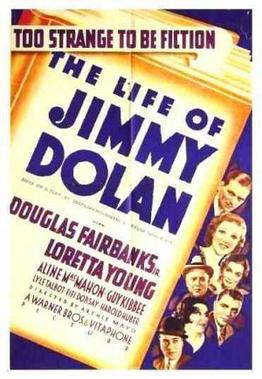
The Life of Jimmy Dolan (1933, directed by Archie Mayo)


Jimmy Dolan (Douglas Fairbanks Jr.), the light heavyweight champion of the world, goes out of his way to present himself as being a wholesome boxer who loves his mom and is as saintly outside the ring as he’s fearsome inside.  Instead, in private, Jimmy is a hard-drinking cynic with a corrupt manager (Lyle Talbot) and a wild girlfriend (Shirley Grey).  When a reporter (George Meeker) threatens to reveal the truth, Jimmy’s manager punches him and accidentally kill him.  The manager frames Jimmy for the crime and then flees with Jimmy’s girlfriend, just to suffer a fiery end in a car accident.

Everyone except for weary Inspector Phalanxer (Guy Kibbee) thinks that Jimmy is dead.  Jimmy goes on the run, hitching rides on freight trains and nearly starving to death before he stumbles over a home for orphans.  Peggy (Loretta Young) takes Jimmy in and gives him food and a place to live.  Jimmy helps with the kids (including Mickey Rooney).  When Jimmy learns that the orphanage might be shut down, he agrees to fight in a charity boxing match against the fearsome King Cobra (Sammy Stein).  King Cobra is so tough that even John Wayne (playing a boxer named Smith) is scared to get in the ring with him.  Jimmy risks his life and his freedom for the orphanage.

This is a good pre-code melodrama.  Because this was a pre-code film, it doesn’t have to shy away from portraying Jimmy’s decadent lifestyle outside of the ring.  Douglas Fairbanks, Jr. was a likable actor and easy to root for.  He was athletic enough to be convincing as someone who could handle himself in a fight.  When he finds himself down-and-out, he’s standing in for everyone who was struggling during the Depression.  The great character actor Guy Kibbee also has some great moments as the inspector, especially towards the end of the film.  Fans of John Wayne won’t see much of him here but it’s still interesting to see Wayne play a character who is frightened of something.

All in all, The Life of Jimmy Dolan is a good, pre-code boxing movie.

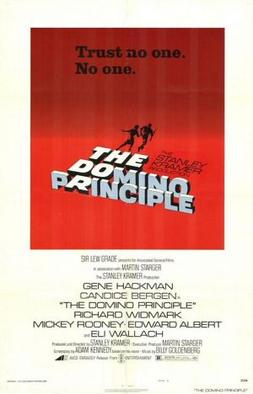
The Domino Principle (1977, directed by Stanley Kramer)


Roy Tucker (Gene Hackman) loyally served his country as a part of a “search and destroy” team in Vietnam but when he returned home, he discovered that America didn’t appreciate his sacrifice.  When he was convicted of murdering his wife’s abusive first husband, he was tossed in prison.  But now, two mysterious men (Richard Widmark and Edward Albert) have offered Tucker a chance to escape from prison and reunite with his wife (Candice Bergen) in Costa Rica.  The only catch is that they also expect Tucker to do a job for “the Organization” and assassinate an unidentified target.  As Tucker discovers, The Organization has been watching and manipulating him entire life, setting him up for this very moment.  Every small event in Tucker’s life led to another event that eventually sent him to both the war and to prison.  It’s almost like a game of dominos.  And we have a title!

The Domino Principle gets off to a good start, with a black-and-white montage of actual assassinations and then an opening credit sequence that features someone placing dominos over pictures of Roy Tucker at different ages.  (I am guessing that actual childhood photos of Gene Hackman were used because even the baby pictures feature the Hackman squint.)  However, the scene immediately following the credits features Gene Hackman and Mickey Rooney as cellmates and the film never really recovers.  Though they were both talented actors, Gene Hackman and Mickey Rooney don’t seem as if they belong on the same planet together, let alone sharing a prison cell in a grim and downbeat political thriller.  Hackman is his usual surly self, while Mickey seems like he’s going to try to get the entire prison to put on a show.  The film tries to do some unexpected things with Mickey’s character but it doesn’t change the fact that he’s Mickey Rooney and he just doesn’t belong here.

As for the rest of The Domino Principle, it’s slow and ponderous.  Best known for earnest social issue films like The Defiant Ones and Guess Whos’ Coming To Dinner, Stanley Kramer is the wrong director for a film that aspires to duplicate the conspiracy-themed atmosphere of other 70s thrillers like The Parallax View and Three Days of the Condor.  For all the time that film takes to build to its obvious conclusion, Kramer doesn’t even bother to identify who Tucker is supposed to kill or why the Organization wants him dead.  Though he seems like he should be a good choice for the lead role, Gene Hackman goes through the movie on autopilot.  Perhaps he was overwhelmed to be sharing a prison cell with Mickey Rooney or to be playing the husband of Candice Bergen, who the film unsuccessfully attempts to deglamorize.

Sadly, this would be one of Kramer’s last films.  He followed it up with The Runner Stumbles, which starred Dick Van Dyke (!) as a conflicted priest, and then went into semi-retirement.  (A few attempts to return to directing failed.)  Kramer spent his twilight years writing about movies for The Seattle Times.  Before his death in 2001, he also published a very entertaining autobiography, A Mad Mad Mad Mad World: A Life in Hollywood, which I recommend to anyone interested in the history of Hollywood.

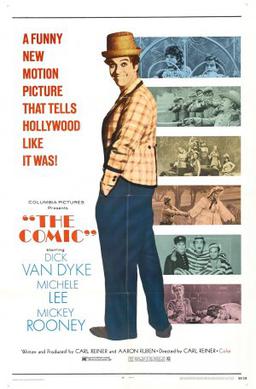
Film Review: The Comic (dir by Carl Reiner)


The 1969 film, The Comic, details the long and not particularly happy life of silent screen star Billy Bright (played by Dick Van Dyke).  Billy Bright tells us his story from beyond the grave.  The film opens with his funeral, which is sparsely attended and features the type of self-consciously mawkish eulogies that are usually trotted out whenever a generally unlikable person dies.  The only sign of life at the funeral comes when Billy’s oldest friend, Cockeye (Mickey Rooney), throws a pie at one of the speakers.  The speaker says that the pie was Billy’s final joke.

Billy Bright was a funny performer but a miserable man.  That’s pretty much the entire plot of The Comic.  We see the young Billy, performing in silent films and winning laughs through the seemingly impossible contortions through which he puts his body and his face.  Off-screen, Billy marries one of his co-stars (Michele Lee) and starts a production company.  When she discovers that he’s been cheating on her, their divorce is a major Hollywood scandal.

Even before the coming of the talkies, Billy struggles with alcohol.  Once the talkies do come, his career is pretty much over.  Billy became a star in silent films and he stubbornly wants to continue to make silent films, despite the fact that there’s no longer an audience for them.  Billy quickly goes from being a star to being forgotten.  He’s reduced to walking down Hollywood Boulevard with Cockeye and looking at the names under his feet.  When he reaches his name, he discovers that someone has dropped their gum on it.

Billy finally does get his comeback in the late 60s but it’s not much of a comeback.  He appears on a talk show and it’s hard not to cringe a little as the clearly infirm Billy duplicates some of his silent era pratfalls.  He’s reduced to appearing in a rather awkward commercial for a laundry detergent called, I kid you not, White-ee.  “That’s White-ee, baby!” his commercial co-star says after a freshly cleaned Billy emerges from a washing machine.

The idea that most funny performers are actually rather serious and depressing off-stage is certainly nothing new.  Judd Apatow has basically built an entire career out of making films about how funny people are actually carrying around tons of emotional baggage.  The thing distinguishes The Comic from so many other films about angsty comedians is that Billy Bright himself never seems to have a single moment of self-awareness.  Usually, films about miserable celebrities will at least have one scene where the main character realizes that his misery is all his fault.  Billy Bright is pretty much a jerk from the minute we meet him and he’s still a jerk when the film ends.  He’s the type of guy who makes a big deal about picking up his son from school but who still manages to grab the wrong kid because it’s been so long since he’s spent any time with his family that he’s really not sure what his son looks like.  Towards the end of the film, we see him watching one of his old films and what we notice is that he doesn’t seem amused at all.  Is he thinking about how he lost it all or is it possible that this man who made millions laugh never really had much of sense of humor himself?  The film leaves it to you to decide.

The Comic was written and directed by Carl Reiner, who undoubtedly knew quite a few Billy Brights in his life.  As such, the film feels authentic in a way that a lot of other films about creative people do not.  The Comic is a well-made film.  It’s hard not to appreciate the film’s obviously affection for Old Hollywood.  That said, Billy Bright is such an unpleasant character that I found the film difficult to enjoy.  Van Dyke is genuinely funny whenever he’s doing Billy’s silent film shtick and he’s genuinely tiresome when Billy’s ego gets out of control.  It’s a good performance as a generally unlikable character.  How you react to The Comic will probably depend on how much sympathy you can summon up for a character who doesn’t really seem to deserve any.

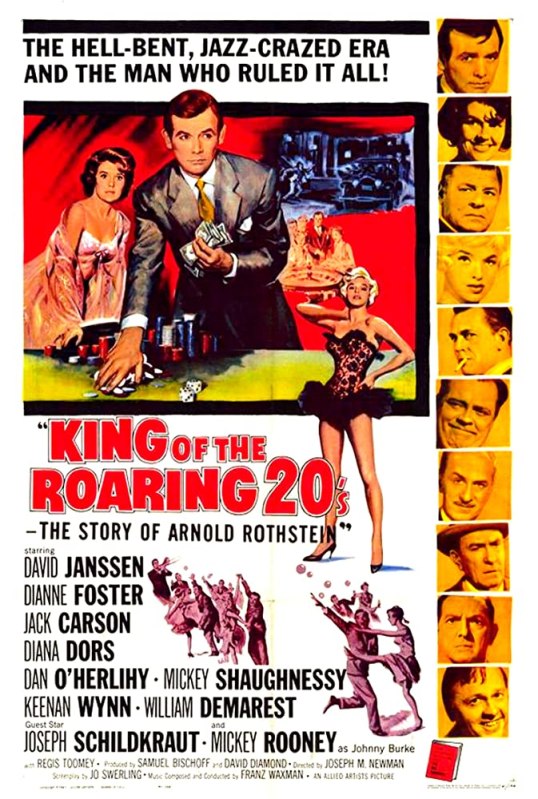
An Offer You Can’t Refuse #6: King of the Roaring 20s: The Story of Arnold Rothstein (dir by Joseph M. Newman)


The 1961 gangster biopic, King of the Roaring ’20s: The Story of Arnold Rothstein, tells the story of two men.

David Janssen is Arnold Rothstein, the gambler-turned-millionaire crime lord who, in the early years of the 20th Century, was one of the dominant figures in American organized crime.  Though he may be best-remembered for his alleged role in fixing the 1918 World Series, Rothstein also served as a mentor to men like Lucky Luciano, Meyer Lansky, and Bugsy Siegel.  Rothstein was perhaps the first gangster to to treat crime like a business.

Mickey Rooney is Johnny Burke, Arnold’s best friend from childhood who grows up to be a low-level hood and notoriously unsuccessful gambler.  Whereas Arnold is intelligent, cunning, and always calm, Johnny always seems to be a desperate.  Whereas Arnold’s success is due to his ability to keep a secret, Johnny simply can’t stop talking.

Together …. THEY SOLVE CRIMES!

No, actually, they don’t.  They both commit crimes, sometimes together and sometimes apart.  Perhaps not surprisingly, Arnold turns out to be a better criminal than Johnny.  In fact, Johnny is always in over his head.  He often has to go to his friend Arnold and beg him for his help.  Johnny does this even though Arnold continually tells him, “I only care about myself and money.”

The friendship between Arnold and Johnny is at the heart of King of the Roaring 20s, though it’s not much of a heart since every conversation they have begins with Johnny begging Arnold for help and ends with Arnold declaring that he only cares about money.  At a certain point, it’s hard not to feel that Johnny is bringing a lot of this trouble on himself by consistently seeking help from someone who brags about not helping anyone.  From the minute that the film begins, Arnold Rothstein’s mantra is that he only cares about money, gambling, and winning a poker game with a royal flush.  Everything else — from his friendship to Johnny to his marriage to former showgirl Carolyn Green (Dianne Foster) to even his violent rivalry with crooked cop Phil Butler (Dan O’Herlihy) — comes second to his own greed.  The film’s portrayal of Rothstein as being a single-minded and heartless sociopath may be a convincing portrait of the type of mindset necessary to be a successful crime lord but it hardly makes for a compelling protagonist.

Oddly enough, the film leaves out a lot of the things that the real-life Arnold Rothstein was best known for.  There’s no real mention of Rothstein fixing the World Series. His mentorship to Luciano, Lansky, and Seigel is not depicted.  The fact that Rothstein was reportedly the first gangster to realize how much money could be made off of bootlegging goes unacknowledged.  By most reports, Arnold Rothstein was a flamboyant figure.  (Meyer Wolfsheim, the uncouth gangster from The Great Gatsby, was reportedly based on him.)   There’s nothing flamboyant about David Janssen’s performance in this film.  He plays Rothstein as being a tightly-wound and rather unemotional businessman.  It’s not a bad performance as much as it just doesn’t feel right for a character who, according to the film’s title, was the King of the Roaring 20s.

That said, there are still enough pleasures to be found in this film to make it worth watching.  As if to make up for Janssen’s subdued performance, everyone else in the cast attacks the scenery with gusto.  Mickey Rooney does a good job acting desperate and Dan O’Herlihy is effectively villainous as the crooked cop.  Jack Carson has a few good scenes as a corrupt political fixer and Dianne Foster does the best that she can with the somewhat thankless role of Rothstein’s wife.  The film moves quickly and, even if it’s not as violent as the typical gangster film, it does make a relevant point about how organized crime became a big business.

It’s not a great gangster film by any stretch of the imagination and the lead role is miscast but there’s still enough about this film that works to make it worth a watch for gangster movie fans.

Previous Offers You Can’t (or Can) Refuse:

  1. The Public Enemy
  2. Scarface
  3. The Purple Gang
  4. The Gang That Could’t Shoot Straight
  5. The Happening

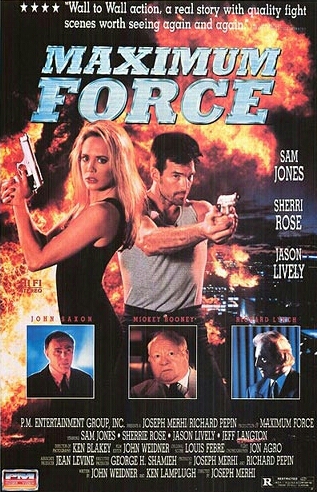
Cinemax Friday: Maximum Force (1992, directed by Joseph Mehri)


Max Tanabe (Richard Lynch) is Los Angeles’s biggest crime lord, involved in everything from prostitution to illegal fight clubs.  But, because he’s rich, no one can touch him.  He plays golf with the mayor.  He’s paid off the police commissioner (Mickey Rooney).  The police commissioner spends the entire movie riding around in a limo.  How do you think he was able to afford that?

Captain Fuller (John Saxon) needs some new jack cops to take down a new jack gangster so he goes out and recruits three.  Cody Randal (Sherries Ross) works vice.  Rick Carver (Jason Lively) is a “tech expert” who rigs toy cars with explosives.  Mike Crews (Sam J. Jones) is looking to avenge the death of his partner.  Fuller brings them together and put them through an extensive training course.  At the end of it, he tests their skills and their teamwork by bringing in a secret team of ninjas to attack them.

Which begs the question: If you already have a secret team of ninjas, why do you have to recruit and train three detectives to take down Tanabe?  Why not just have the ninjas do it?

So, logic is not exactly Maximum Force‘s strong point but it still has some good points.  For instance, you have to respect any movie that can bring together Richard Lynch and John Saxon, not to mention Mickey Rooney!  Of course, there’s not really much of a reason for Mickey Rooney to be there.  All of his scenes feature him in the limo and they are edited together so awkwardly that it seems probable the he never actually acted opposite any of his co-stars.  But it doesn’t matter because he’s Hollywood legend Mickey Rooney, picking up a paycheck in his twilight years.  As for Saxon and Lynch, they do what they do best and bring gravitas to their otherwise stock roles.

As for the three heroes, they’re adequate even if none of them really shine.  I liked the tech expert the best but that was just because he rigged all of those remote control cars to explode.  Sam J. Jones and Sherrie Ross are both better at throwing punches than showing emotion but that’s what a film like this demands.  Some of the fight scenes are exciting.  There’s a helicopter attack early in the film.  Towards the end of the film, when Mike decides that the team needs some extra help, he calls in an amateur wrestler named Bear who just randomly shows up during the final battle.  Maximum Force knows what its audience wants and that’s the important thing.

New Recipe: HOW TO STUFF A WILD BIKINI (AIP 1965)


gary loggins's avatarcracked rear viewer

HOW TO STUFF A WILD BIKINI, the sixth entry in American-International’s “Beach Party” series, attempts to breathe new life into the tried-and-true  formula of sun, sand, surf, songs, and corny jokes. Frankie Avalon and Annette Funicello are still around as Frankie and Dee Dee, but in this go-round they’re separated; he’s in the Navy stationed on the tropical island of Goona-Goona, while Annette has to contend with the romantic enticements of Dwayne Hickman .

Frankie’s part amounts to a cameo, enlisting local witch doctor Buster Keaton (!!) to keep those girl-hungry beach bums away from Dee Dee (while he frolics unfettered with lovely Irene Tsu !). Keaton’s magic ain’t what it used to be, so he has his daughter conjure up a knockout named Cassandra, who first appears on the beach as an animated bikini. All the boys go ga-ga for Cassandra, including a go-go ad man named Peachy Keane…

View original post 455 more words

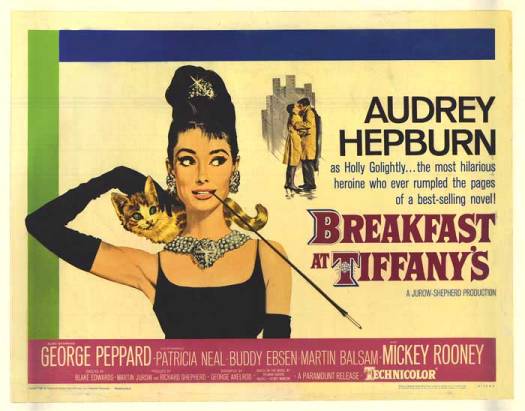
My Huckleberry Friend: BREAKFAST AT TIFFANY’S (Paramount 1961)


gary loggins's avatarcracked rear viewer

(“Breakfast at Tiffany’s” airs tonight, 6/12/17 at 8:00 EST on TCM as part of their month-long salute to Audrey Hepburn.)

“You mustn’t give your heart to a wild thing. The more you do, the stronger they get, until they’re strong enough to run into the woods or fly into a tree. And then to a higher tree and then to the sky” – Audrey Hepburn as Holly Golightly in BREAKFAST AT TIFFANY’S.

From it’s hauntingly romantic theme “Moon River” to it’s sophisticated screenplay by George Axelrod, BREAKFAST AT TIFFANY’S is a near-perfect movie. The bittersweet comedy-drama stars Audrey Hepburn in an Oscar nominated performance as Holly Golightly, a New York “party girl” who winds up falling for struggling writer George Peppard. That Hepburn didn’t get the Oscar (Sophia Loren took it home that year for TWO WOMEN) is one of the Academy’s greatest crimes. The film has a very personal connection with…

View original post 1,020 more words

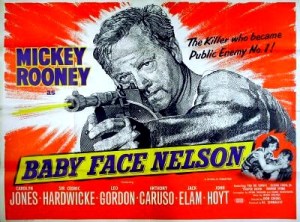
A Movie A Day #126: Baby Face Nelson (1957, directed by Don Siegel)


The place is Chicago.  The time is the era of Prohibition.  The head of the Chicago Outfit, Rocca (Ted de Corsia), has arranged for a career criminal named Lester Gillis (Mickey Rooney) to be released from prison.  A crack shot and all-around tough customer, Gillis has only two insecurities: his diminutive height and his youthful appearance.  Rocca wants to use Gillis as a hit man but Gillis prefers to rob banks.  When Rocca attempts to frame Gillis for a murder, Gillis first guns down his former benefactor and then goes on the run with his girlfriend, Sue Nelson (Carolyn Jones).  Because they are both patients of the same underworld doctor (played by Sir Cedric Hardwicke), Gillis eventually meets public enemy number one, John Dillinger (Leo Gordon).  Joining Dillinger’s gang, Gillis becomes a famous bank robber and is saddled with a nickname that he hates: Baby Face Nelson.
While it is true that Lester “Baby Face Nelson” Gillis was an associate of John Dillinger’s and supposedly hated his nickname, the rest of this biopic is highly fictionalized.  The real Baby Face Nelson was a family man who, when he went on the run, took his wife and two children with him.  While he did get his start running with a Chicago street gang, there is also no evidence that Nelson was ever affiliated with the Chicago Outfit.  (The film’s Rocca is an obvious stand-in for Al Capone.)  In real life, it was Dillinger, having just recently escaped from jail, who hooked up with Nelson’s gang.  The film Nelson is jealous of Dillinger and wants to take over the gang but, in reality, the gang had no leader.  Because Nelson killed three FBI agents (more than any other criminal), he has developed a reputation for being one of the most dangerous of the Depression-era outlaws but, actually, he was no more violent than the typical 1930s bank robber.  Among the era’s outlaws, Dillinger was more unique for only having committed one murder over the course of his career.  In this film (and practically every other film that has featured Baby Face Nelson as a character), Nelson is a full on psychopath, one who even aims his gun at children.

Baby Face Nelson may be terrible history but it is still an excellent B-movie.  Don Siegel directs in his usual no-nonsense style and Mickey Rooney does a great job, playing Baby Face Nelson as a ruthless but insecure criminal with a perpetual chip on his shoulder.  As his fictional girlfriend, Carolyn Jones is both tough and sexy, a moll that any gangster would be lucky to have waiting for him back at the safe house.  B-movie veterans like Thayer David, Jack Elam, Elisha Cook Jr., and John Hoyt all have colorful supporting roles but the most unexpected name in the cast is that of Cedric Hardwicke, playing an alcoholic surgeon with broken down dignity.

Don’t watch Baby Face Nelson for a history lesson.  Watch it for an entertaining B-masterpiece.


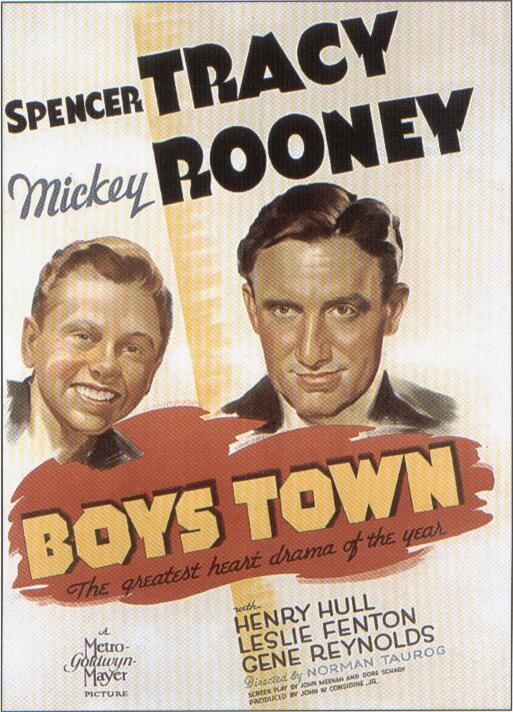
Lisa Reviews An Oscar Nominee: Boys Town (dir by Norman Taurog)


boys_town

Before writing about the 1938 film Boys Town, I want to share a story that might be false but it’s still a nice little story.  Call this an Oscar Urban Legend:

Boys Town is about a real-life community in Nebraska, a home for orphaned and homeless boys that was started by Father Edward Flanagan.  In the film, which was made while Father Flanagan was still very much alive, he was played by Spencer Tracy.  Boys Town was a huge box office success that led to the real Boys Town receiving a lot of favorable publicity.  When Tracy won his Oscar for Boys Town, his entire acceptance speech was devoted to Father Flanagan.

However, a problem arose when an overeager PR person at MGM announced that Spencer Tracy would be donating his Oscar to Boys Town.  Tracy didn’t want to give away his Oscar.  He felt that he had earned it through his acting and that he should be able to keep it.  Tracy, the legend continues, was eventually persuaded to donate his Oscar on the condition that he would get a replacement.

However, when the replacement arrived, the engraving on the award read, “Best Actor — Dick Tracy.”

That’s a fun little story, one that is at least partially true.  (Tracy’s Oscar — or at least one of them — does currently reside at the Boys Town national headquarters.)  It’s also a story that, in many ways, is more interesting than the film itself.

Don’t get me wrong.  Boys Town is not a bad movie.  For me, it was kind of nice to see a movie where a priest was portrayed positively as opposed to being accused of being a pederast.  In a way, Boys Town serves as a nice counterbalance to Spotlight.  But, with all that said, there’s not a surprising moment to be found in Boys Town.  It’s pretty much a standard 1930s juvenile delinquency melodrama.

The movie opens when Father Flanagan giving last rites to a man who is about to be executed.  (Boys Town takes a firm stand against the death penalty, which is one of the more consistent and laudable stands of the modern Church.)  The man says the he never had a chance.  From the time he was a young boy, he was thrown into the reform school system.  Instead of being reformed, he just learned how to be a better criminal.  Father Flanagan is so moved by the doomed man’s words that he starts Boys Town, under the assumption that “there’s no such thing as a bad boy.”

Father Flanagan’s techniques are put to the test when Whitey Marsh (Mickey Rooney ) arrives.  Whitey is angry.  He’s rebellious.  He tries to run away every chance that he gets and, during one such escape attempt, he even gets caught up in a bank robbery.  Can Father Flanagan reach Whitey and prove that there’s no such thing as a bad boy?

Well, you already know the answer to that.  As I said, there’s really nothing surprising to be found in the plot of Boys Town.  It’s just not a very interesting movie, though there is a great shot of a despondent Whitey walking past a several lines of former juvenile delinquents, all kneeling in prayer.  As Father Flanagan, Spencer Tracy is the ideal priest but his role is almost a supporting one.  Believe it or not, the film is dominated by Mickey Rooney, who gives a raw and edgy performance as the angry Whitey Marsh.

(That said, it’s hard to take Whitey seriously as a future gangster when he’s always wearing a bowtie.  Then again, that may have been the height of gangster style in 1938.)

Boys Town was nominated for best picture but lost to You Can’t Take It With You.