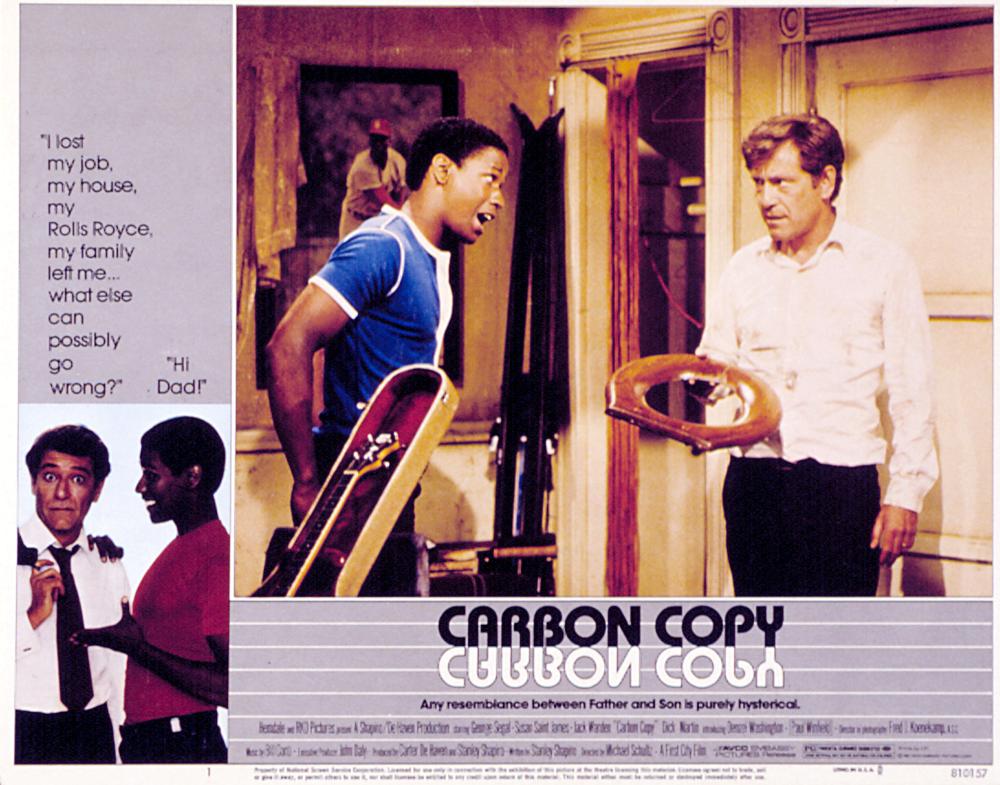
#MondayMuggers presents CARBON COPY (1981) starring George Segal and Denzel Washington!


Every Monday night at 9:00 Central Time, my wife Sierra and I host a “Live Movie Tweet” event on X using the hashtag #MondayMuggers. We rotate movie picks each week, and our tastes are quite different. Tonight, Monday March 3rd, we’re watching CARBON COPY starring George Segal, Susan Saint James, Jack Warden, Dick Martin, Paul Winfield, and “introducing” Denzel Washington.

CARBON COPY is the story about a rich, white corporate executive (George Segal) who finds out that he has an illegitimate black son (Denzel Washington). This creates a variety of issues for him at home, at work, and in his social circles.

Although CARBON COPY was chosen by Sierra, I’m looking forward to watching it for the first time for several reasons:

  1. This is the theatrical film debut of one of the all-time great actors in Denzel Washington. Everyone has to start somewhere, and it will be interesting to see Denzel at the very beginning.
  2. George Segal starred in a movie with Rod Steiger called NO WAY TO TREAT A LADY (1968). My dad used to always tell me about this movie. I bought it on DVD and added it to my collection simply because my dad loved it. I even took it to their house one year for our annual Christmas celebration so we could watch it together. That doesn’t have anything to do with CARBON COPY, but it’s always given me a reason to appreciate Segal.
  3. George Segal reportedly turned down the lead role in the film ARTHUR (1981) in order to make CARBON COPY. I enjoyed ARTHUR when I watched it growing up. It will be interesting to see how the two films compare.
  4. Director Michael Shultz also directed movies like COOLEY HIGH (1975), CAR WASH (1976), GREASED LIGHTNING (1977), WHICH WAY IS UP (1977), and BUSTIN’ LOOSE (1981) leading up to CARBON COPY. It will be interesting to see how he handles the material.

So, join us tonight for #MondayMuggers and watch CARBON COPY! It’s on Amazon Prime.

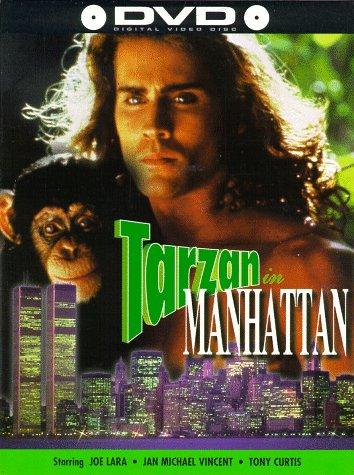
Tarzan in Manhattan (1989, directed by Michael Schultz)


An evil businessman named Brightmore (Jan-Michael Vincent) abducts Cheetah the Chimpanzee from Africa and takes him back to Manhattan.  It’s up to Cheetah’s best friend, Tarzan (Joe Lara), to rescue him.  Tarzan goes to New York where he meets a cabbie named Jane (Kim Crosby) and her father, a tough private investigator named Archimedes (Tony Curtis).  Tarzan is also briefly detained for being in the country illegally but he pulls the bars out of his cell window and escapes.  Presumably, so does everyone else in the jail.  Way to go, Tarzan.

Lisa and I discovered this playing on the Z-Living Channel last night and we watched it because it was either watch this or start binging the Police Academy films on Netflix.  That’s what this damn pandemic is leading to.  We know we’re probably going to have to watch the entire Police Academy franchise at some point but we’re trying to put it off.  So, we watched Tarzan in Manhattan.  Damn you, COVID-19!

It was bad.  It was really, really bad.  It was obviously meant to be a pilot for television series but I guess it didn’t happen.  The timing was off.  If Tarzan in Manhattan had been made in the 90s, it probably would have led to a syndicated series that would currently be airing on H&I, next to episodes of Renegade and Sheena.  It came out in 1989, though, too early to cash in on the wave of syndicated crap that was unleashed after the success of Baywatch proved that you didn’t have to produce a quality show to find success in syndication.  Because it came out too early, we were spared annual Tarzan in Manhattan conventions.  Let that sink in and be happy.

Plus, it’s just really, really bad.  Did I say that already?  It’s true.  There’s nothing consistent about Tarzan in Manhattan.  It wants to be a comedy, it wants to be a drama.  It wants to be an updated version of Tarzan but it still wants him to be confused by the modern world.  The movie also doesn’t seem to know if Tarzan is famous or not.  It seems like he must be because Brightmore went through a lot of trouble to kidnap his chimpanzee.  But, in Manhattan, no one seems to know who he is.  The movie also doesn’t get Tarzan’s famous jungle call right, either.  This Tarzan just yells, without any special inflection to let the world know that he’s Tarzan.  Instead of It’s like he’s not Tarzan at all.  Jan-Michael Vincent and Tony Curtis both seem bored while Joe Lara has the right look for Tarzan but not much else to recommend him.  The chimpanzee survives without being used to test makeup or whatever it was Brightmore was planning on doing with him so at least the movie has that going for it.

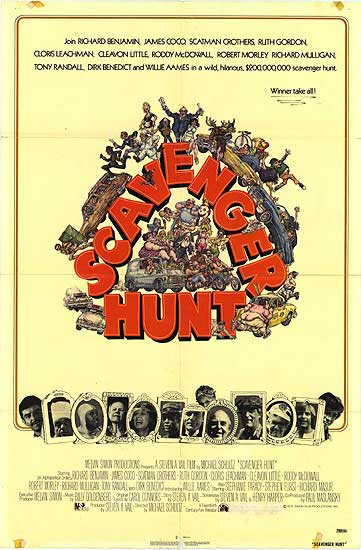
A Movie A Day #114: Scavenger Hunt (1979, directed by Michael Schultz)


When game designer Milton Parker (Vincent Price) dies, all of his greedy relatives and his servants gather for the reading of his will.  Parker’s lawyer, Benstein (Robert Morley), explains that Parker is leaving behind a $200 million dollar estate to whoever can win an elaborate scavenger hunt.  Dividing into five teams, the beneficiaries head out to track down as many items as they can by five o’clock that evening.  Among the items that they have to find: a toilet, a cash register, an ostrich, a microscope, and an obese person.  Hardy har har.
The five teams are made up of a who’s who of sitcom and television actors who had time to kill in 1979.  The Odd Couple‘s Tony Randall is Henry Motely, who is Parker’s son-in-law and who works with his four children.  Soap‘s Richard Mulligan plays a blue-collar taxi driver named Marvin Dummitz (because funny names are funny) who teams up with his friend, Merle (Stephen Furst).  The Mary Tyler Moore Show‘s Cloris Leachman (an Oscar winner, no less) gets stuck with the role of Milton’s greedy sister, Mildred.  She works with her conniving lawyer (Richard Benjamin) and her stupid son (Richard Masur).  Maureen Teefy plays Milton’s niece while his nephews are played by Willie Aames and Dirk Benedict.  Cleavon Little, James Coco, Roddy McDowall, and Stephanie Faracy play the servants.

It doesn’t stop there, though.  Avery Schreiber plays a zookeeper.  Meat Loaf plays a biker who beats up Richard Benjamin.  Ruth Gordon, Stuart Pankin, Pat McCormick, and Scatman Crothers all have cameos.  Even Arnold Schwarzenegger makes an appearance as a gym instructor who knocks Tony Randall out of a second story window.

There are a lot of famous people in Scavenger Hunt.  It’s just too bad that the movie itself is barely watchable and not at all funny.  It tries to go for the zaniness of It’s A Mad, Mad, Mad, Mad World but, unless watching Willie Aames steal a clown head from Jack in the Box is your idea of hilarity, the film never comes close to succeeding.  Michael Schultz directed some classic films (like Car Wash) during the 1970s but, unfortunately, he also directed Sgt. Pepper’s Lonely Hearts Club Band and this.

Scavenger Hunt used to show up on a late night television, where it was always advertised as starring Arnold Schwarzenegger.  (He barely has five minutes of screentime.)  It was released on DVD/Blu-ray earlier this year but watching for the cameos is the only reason to take part in this Scavenger Hunt.

Back to School #17: Cooley High (dir by Michael Schultz)


http://www.youtube.com/watch?v=tmw1Llp92PU

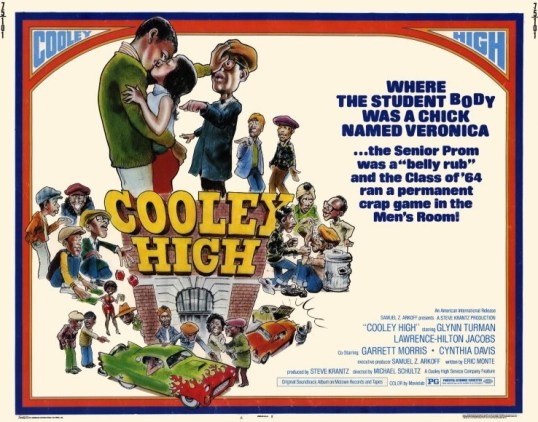
For our next entry in Back to School, we take a look at a film that is often referred to as being a “black American Graffiti,” 1975’s Cooley High.

Cooley High follows the adventures of two lifelong friends who are both seniors at Edwin G. Cooley Vocational High School in Chicago, Illinois.  The charismatic Cochise (Lawrence Hilton-Jacobs) is a popular and friendly basketball star.  Meanwhile, Preach (Glynn Turman) is an aspiring writer who, despite his obvious intelligence, is also one of the worst students at the school.  Preach divides his time between skipping school, gambling, and writing poetry.  Alone among their friends, Cochise and Preach both seem to have a chance to escape from life in the projects.  At the start of the film, Cochise has just received a scholarship to play basketball in college.  As for Preach, he’s the eternal optimist.  He knows he’s going to make it, even if he doesn’t seem to be quite sure how he’s going to do it.

For the first half of the film, Cooley High is largely a plotless collection of vignettes featuring Cochise, Preach, and their friends skipping school, chasing girls, getting into minor trouble, and trying to avoid major trouble.  The emphasis is on comedy but, unlike a lot of high school comedies from the 70s and 80s, the humor grows organically from the characters.  Facing a future that’s likely to be dominated by prejudice, poverty, and limited opportunity, what can the students of Cooley High do other than laugh?  The second half of the film takes a far more dramatic turn, with Preach and Cochise accused of both stealing a car and snitching on the actual thieves in order to get out of jail.  The film’s downbeat conclusion may be predictable but it’s effective all the same.

One reason why I wanted to review Cooley High is because a few months ago, while I was trying to find something to watch on TV, I came across an episode of a show called Unsung Hollywood.  The title of the episode was “The Story of Cooley High” and it told the story of how and why this film was made.  It was actually pretty interesting to watch, as it featured interviews with screenwriter Eric Monte (who based the character of Preach on himself), director Michael Schultz (who directed a lot of memorable films in the 70s — including Sgt. Pepper’s Lonely Hearts Club Band — but has never quite gotten the recognition that he deserves), and the film’s two stars.  Even more interesting, however, were the interviews with the local Chicago residents who essentially played themselves during the filming of Cooley High.  Some of them had fond memories of appearing in the film while others were upset that the film’s box office success didn’t open up any new opportunities for them.  Most haunting of all was the fate of an amateur local named Norman Gibson.  After giving a genuinely good performance as a petty criminal who comes to a violent end in Cooley High, Gibson was murdered a year after the film was released.

As I mentioned before, Cooley High is often compared to American Graffiti and the two films do have some things in common, like the period setting and a great soundtrack.  Ultimately, though, Cooley High can stand on its own.

cooley