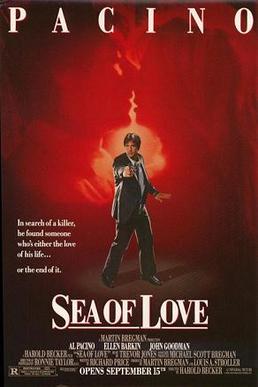
Sea of Love (1989, directed by Harold Becker)


In New York City, someone is ritualistically murdering the men who are placing rhyming personal ads in a tabloid newspaper.  Assigned to the case is Frank Keller (Al Pacino), an alcoholic burn-out whose wife just left him for another cop.  Keller and his partner (John Goodman) decide to go undercover.  Frank places a rhyming personal ad of his own and then goes to a restaurant to see who shows up.  When Helen Cruger (Ellen Barkin) answers the ad, it leads to a relationship between Frank and Helen.  Frank is falling for Helen but what if she’s the murderer?

Sea of Love is a superior thriller, even though it doesn’t really work as a mystery.  As soon as you see a certain person’s name in the cast list, you’re going to guess who the killer is because that person is always the killer.  Sea of Love isn’t really about the mystery, though.  It’s about people looking something that’s missing from their lives and realizing that the world is passing them by.  The movie works because of the performances of Al Pacino and Ellen Barkin, cast as two lonely middle-aged people who are desperately looking for some sort of connection.  Helen and Frank are both in their 40s and wondering if their current situation is really as good as it’s going to get.  The film uses Frank’s fear that Helen could be the killer as a metaphor for the fear that anyone feels when they are first starting to open up to someone.  Both Pacino and Barkin give emotionally raw and poignant performances.  I don’t think I’ve ever seen Al Pacino look as miserable as he did for the majority of Sea of Love.  This was Pacino’s first film role after the disaster of Revolution and the movie’s box office success was revived Pacino’s career and convinced him to give movies a try again.

Director Harold Becker captures the feel of New York at its grittiest and least welcoming and Richard Price’s script is full of priceless dialogue.  This is one of the rare films in which everyone has something intelligent or meaningful to say.  Featuring a strong supporting cast and career-best performances from Ellen Barkin and Al Pacino, Sea of Love is much more than just another cop film.

October True Crime: The Grim Sleeper (dir by Stanley M. Brooks)


It’s not known, for sure, how many people Lonnie David Franklin killed.

A residenct of Los Angeles and a former enlistee of the U.S. Army who was given a dishonorable discharge after doing time in prison for taking part in the gang-rape of a 17 year-old girl in Germany, Franklin was convicted of 10 murders but he was suspected of much more.  His earliest known murder was committed in 1984 and he was apparently very active up until 1988.  Then, much like the BTK Killer, Franklin appears to have taken a break for nearly two decades before returning to his murderous ways in 2002.  (It could be just as likely that Franklin was still killing but his victims were either not discovered or he was never linked to the crimes.)  Franklin’s murders didn’t get much attention, with the police not acknowledging that they were dealing with a serial killer until 2007.  Some of that can be blamed on the fact that many of Franklin’s murders were committed before DNA testing became a commonplace thing.  However, it has also been acknowledged that Franklin escaped detection because he targeted black women and tended to prey on sex workers, neither one of whom were a priority for the LAPD in the 80s.

2014’s The Grim Sleeper stars Dreama Walker as Christine Pelisek, the journalist who first reported on the existence of the Grim Sleeper and Ernie Hudson and Michael O’Neill as the detectives who investigated the murders and ultimately arrested Lonnie Franklin.  Franklin (played by James R. Baylis) only appears briefly in the film.  As The Grim Sleeper was made before Franklin had actually been convicted and sentenced to death for his crimes, the film does not actually state that the police arrested the right man.  Indeed, the film discusses very little about the man who was arrested for the crimes.

Instead, the film focuses on Pelisek and her attempts to get someone to take her seriously when she argues that there’s a serial killer on the loose and that the public has a right to know.  At first, everyone is skeptical of her claims.  Her editor tells her that she doesn’t have enough for a story.  The police tell her to mind her own business.  Her fellow reporters order her to get coffee.  The only people who really support Pelisek’s attempts to uncover the truth are the families of the victims, some of whom have spent over twenty years waiting for someone to tell them what happened to their loved ones.

The film is at its best when it focuses on the pain of the families, all of whom feel that they have been ignored and forgotten by the people who are supposed to be protecting them.  It’s at its least interesting when it focuses on Pelisek and her efforts to be taken seriously.  (Deama Walker has given good performances in films like Compliance and Once Upon A Time In Hollywood but she’s miscast here.)  Though flawed, the film honors the memories of those victimized by the Grim Sleeper and it reminds viewers that no one should be forgotten.

As for the real Grim Sleeper, he died suddenly while on Death Row.  The cause of death has never been released but he died in March of 2020, around the same time that COVID was spreading throughout the nation’s prisons and I’ve always assumed that he was an early fatality.  Regardless of the cause, the Sleeper met the Reaper and will never awaken again.


The Things You Find on Netflix: The Stand at Paxton County (dir by Brett Hedlund)


The Stand at Paxton County, which is currently playing on Netflix, opens with an ominous title card warning us that what we’re about to see is “based on a true story.”

I may be alone in this but I find the term “based on a true story” to be fascinating.  It’s signifies that the film that we’re about to watch was inspired by something that actually happened but it’s not actually a recreation of that event.  It’s an invitation to watch and to try to figure out how much is true and how much is just a product of a screenwriter’s imagination.  “Based on a true story” is a real cinematic tease.

The Stand at Paxton County tells the story of Janna Connelly (Jacqueline Toboni), an army medic who is still haunted by her memories of serving in Afghanistan.  When her rancher father, Dell (Michael O’Neill), has a heart attack, Janna returns home to Paxton County, North Dakota.  What she discovers is that, after she left home, the ranch fell into disrepair.  Dell only has one ranch hand, a seemingly amiable doofus named Brock (Greg Perrow) and it doesn’t appear that Brock’s been doing a very good job.

When Sheriff Bostwick (Christopher McDonald) shows up to do a compliance check on the ranch, he finds a lot of problems.  When he returns with a cold-eyed veterinarian named Dr. Morel (Marwa Bernstein), Dell is informed that his ranch is in such disrepair that the sheriff can take away his livestock and essentially put Dell out of business!

How can the sheriff get away with this, Janna asks.  Dell explains that, years ago, the voters of the state voted down a proposition that would have given law enforcement the right to confiscate a rancher’s livestock.  However, a bunch of unelected lobbyists and left-wing activists went ahead and forced the law through the state legislature!  Now, the sheriff can pretty much do whatever he wants and anyone who tries to stand up for their Constitutional rights is subject to harassment and perhaps even murder!

While all of this is going on, Brock vanishes from the ranch.  It turns out that Brock is a professional bad employee who goes from ranch to ranch and goes out of his way to mess things up so that the ranchers lose their livestock.  The livestock is then sold to the highest bidder or sometimes the sheriff will just keep a horse for himself.  With Brock gone, Janna hires sexy Matt (Tyler Jacob Moore) to be the new ranch hand and then sets out to get justice for her father.

I had mixed feelings about The Stand at Paxton County.  On the one hand, I’m not a fan of the government regulation in general and I’m always happy to watch a libertarian-themed film.  Christopher McDonald’s smug and corrupt sheriff felt like a stand-in for all of the authoritarian-minded politicians and bureaucrats who have recently come out of the woodwork and used the COVID-19 pandemic to increase their own power.  (“Hey, it’s Clay Jenkins!” I said as soon as the sheriff showed up.)  So, on that level, I enjoyed the film.

Unfortunately, The Stand at Paxton County doesn’t just stick to criticizing the government for overstepping their authority.  Instead, it also portrays animal rights activists as being a part of a sinister financial conspiracy and that’s where it lost me.  It’s a lot easier to buy into the idea of a corrupt sheriff than it is to imagine the head of the PSCA sitting in a darkened war room and ordering his minions to torment one rancher, all so he can resell the rancher’s livestock.  That doesn’t mean that activists should be immune from criticism or that there isn’t a legitimate argument to be made that even well-intentioned regulations are vulnerable to abuse.  But the film’s portrayal of its central conspiracy just got a bit too cartoonish to be effective.  Once the villains went from being smug to being downright evil, it became impossible to take the movie seriously.  If the film had simply stuck to criticizing government overreach instead of imagining a shadowy conspiracy, it would have been a lot more effective.

The Stand at Paxton County has some lovely shots of the North Dakota countryside and Christopher McDonald is a wonderfully smarmy villain.  I always appreciate a film that has an anti-authoritarian subtext but The Stand At Paxton County is ultimately dragged down by its own heavy hand.

Horror Film Review: Ghost Story (dir by John Irvin)


ghoststory

A Fred Astaire horror movie!?

Yes, indeed.  Ghost Story is a horror movie and it does indeed star Fred Astaire.  However, Fred doesn’t dance or anything like that in Ghost Story.  This movie was made in 1981 and Fred was 82 years old when he appeared in it.  Fred still gave an energetic and likable performance and, in fact, his performance is one of the few things that really does work in Ghost Story.

Fred Astaire isn’t the only veteran of Hollywood’s Golden Age to appear in Ghost Story.  Melvyn Douglas, John Houseman, and Douglas Fairbanks, Jr. all appear in the movie as well.  They play four lifelong friends, wealthy men who have formed an informal little club called The Chowder Society.  They gather one a week and tell ghost stories.  Myself, I’m wondering why these four intelligent and accomplished men (one is a lawyer, another a doctor, another a politician, and another is Fred Astaire) couldn’t come up with a better name than Chowder Society.

(But I guess that’s something that people do up north.  Harvard has something called the Hasty Pudding Club, which just sounds amazingly annoying.)

Unfortunately, the members of the Chowder Society have a deep, dark secret.  Way back in the 1930s, the boys listening to too much jazz and they all ended up lusting after the mysterious and beautiful Eva Galli (Alice Krige).  As Astaire explains it, “We killed her, the Chowder Society.”

(Of course, there’s more to the story.  It was more manslaughter than murder but either way, it was pretty much the fault of the Chowder Society.)

And now, decades later, a woman named Alma (Alica Krige, again) has mysteriously appeared.  When she sleeps with David (Craig Wasson), the son of a member of the Chowder Society, David falls out of a window and ends up splattered on the ground below.  David’s twin brother, Don (also played by Craig Wasson), returns to their childhood home and attempts to make peace with his estranged father.

However, now the member of the Chowder Society are starting to die.  One falls off a bridge.  Another has a heart attack in the middle of the night.  Fred Astaire thinks that Eva has come back for revenge.  John Houseman is a little more skeptical…

I pretty much went into Ghost Story with next to no knowledge concerning what the film was about.  I thought the plot desription sounded intriguing.  As a classic film lover, I appreciated that Ghost Story was not only Fred Astaire’s final film but the final film of Douglas and Fairbanks as well.  Before he deleted his account, I had some pleasant interactions with Craig Wasson on Facebook.   I was really hoping that Ghost Story would be a horror classic.

Bleh.

Considering all the talent involved, Ghost Story should have been great but instead, it just fell flat.  Alice Krige is properly enigmatic as both Alma and Galli and really, the entire cast does a pretty good job.  But, with the exception of exactly three scenes, the film itself is never that scary.  (Two of those scary scenes involve a decaying corpse and it’s not that hard to make decay scary.  The other is a fairly intense nightmare sequence.)  Largely due to John Irvin’s detached direction, you never really feel any type of connection with the characters.  I mean, obviously, you don’t want to see the star of Top Hat die a terrible death but that has more to do with the eternal charm of Fred Astaire than anything that happens in Ghost Story.

Add to that, Ghost Story‘s special effects have aged terribly.  There are two scenes in which we watch different characters fall to their death and both times, you can see that little green outline that always used to appear whenever one image was super imposed on another.  It makes it a little hard to take the movie seriously.

Sadly, Ghost Story did not live up to my expectations.  At least Fred Astaire was good…

Back to School #53: Dancer, Texas Pop. 81 (dir by Tim McCanlies)


dancer-texas-pop-81-movie-poster-1998-1020196368

Dancer, Texas Pop. 81 is a 1998 film about a small town in West Texas that only has a population of 81 citizens.  Just from my own experience of telling people about how much I happen to like this movie, I get the feeling that only 81 people may have actually seen it.  But no matter!  Regardless of how many people have actually seen it, Dancer, Texas is one of my favorite films about my home state.

Dancer starts out with a scene that is so quintessentially Texan that it might as well appear next to Texas in the dictionary.  Four teenagers — all of whom are scheduled to soon graduate from high school — sit out in the middle of the highway.  The road seems to stretch on forever.  The land around them is empty.  If you’ve ever been to West Texas, you know what type of land I’m talking about.  It’s the type of land where you feel like you can see forever.  In the far distance, we see a pair of headlights.

“Car’s comin'” one of them drawls, knowing that they’ve got at least another 15 minutes before that car ever gets anywhere near the tiny town of Dancer, Texas.

These four teenage boys make up 80% of the graduating class of Dancer’s high school and all four of them are planning on leaving town and heading for Los Angeles.  Keller (Breckin Meyer) is their leader, the big dreamer who can’t wait to get out of the state.  Terrell Lee (Peter Facinelli) is the son of the only rich man in town and he’s being pressured by his mother to stay in Dancer and to learn the oil business.  John (Eddie Mills) is the simplest of the four and also the most reluctant about leaving.  He simply wants to be a farmer and he can’t understand why his taciturn father refuses to say anything to keep him from leaving town.  And finally, there’s Squirrel (Ethan Embry), who is the weird one.  Every group needs a weird one and Squirrel is weird even by the usual standards of small town oddness.

Not much happens in Dancer, Texas.  That goes for both the film and the town.  Over the course of two days, all four of the boys are forced to decide whether they really want to leave or if they actually want to stay.  Adding an extra poignancy to their decision is the fact that there literally is no chance that life in Dancer is ever going to change.  Dancer is as it has always been and always will be.  Deciding to stay means staying forever.  And, as the film shows, that’s okay for some people and terrible for others.

I really like Dancer, Texas.  Yes, it does move at its own deliberate pace and yes, a few scenes do tend to get a bit too obvious in their sentimentality (just to name two of the complaints that I saw from some commenters over at the imdb).  Meyer, Facinelli, and Mills all give such wonderfully natural performances that it makes you all the more aware that Embry seems a bit out-of-place.  But, ultimately, none of that matters.  Dancer, Texas is one of the most honest and sincere films that I’ve ever seen and it’s a film that does my home state proud.

Lisa’s Rating: 8 out of 10

211