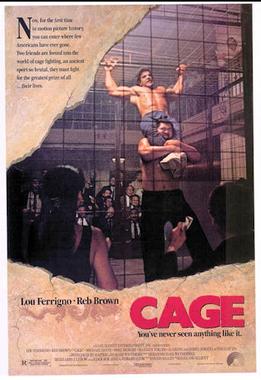
Cage (1989, directed by Lang Elliott)


As with so many stories, it all starts with Vietnam.

In 1969, soldier Billy Thomas (Lou Ferrigno) heroically saves the life of his captain, Scott Monroe (Reb Brown).  Unfortunately, while their helicopter is taking off, Billy takes a bullet to the head.  While he survives the wound, he is left with the mind of a child.  Scott dedicates his life to taking care of Billy and, after the war, they open a bar together.  However, mobster Tony Baccola (Michael Dante) feels that Billy would be the perfect contestant for a series of fight-to-death cage matches that have been set up by Chinese gangster Tin Lum Yin (James Shigeta).  In desperate need of money, Tony kidnaps Billy and forces him to fight, telling him that it’s what Scott needs him to do.  Billy doesn’t want to fight and, when he first enters the cage, he says, “Hi, how are you?” and tries to shake his opponent’s hand.  But when his opponents try to hit Billy, he has no choice but to defend himself.  It’s up to Scott to rescue his friend.

The plot of this movie is pretty dumb but I’m not embarrassed to say that the film itself won me over.  The fights were decent but the main reason why the movie works is because of Lou Ferrigno and Reb Brown, who made their friendship and their bond feel very real.  Ferrigno was especially good in this film.  How can you not root for a guy who just wants to be everyone’s friend and who, even after his twelfth cage match, still gets upset over having to hit people?

A pure B-movie all the way, Cage also features familiar faces like Branscombe Richmond, Al Leong, and Danny Trejo.  Most of the critics may not have liked it but Ferrigno has described Cage as being his his favorite film performance and I agree.

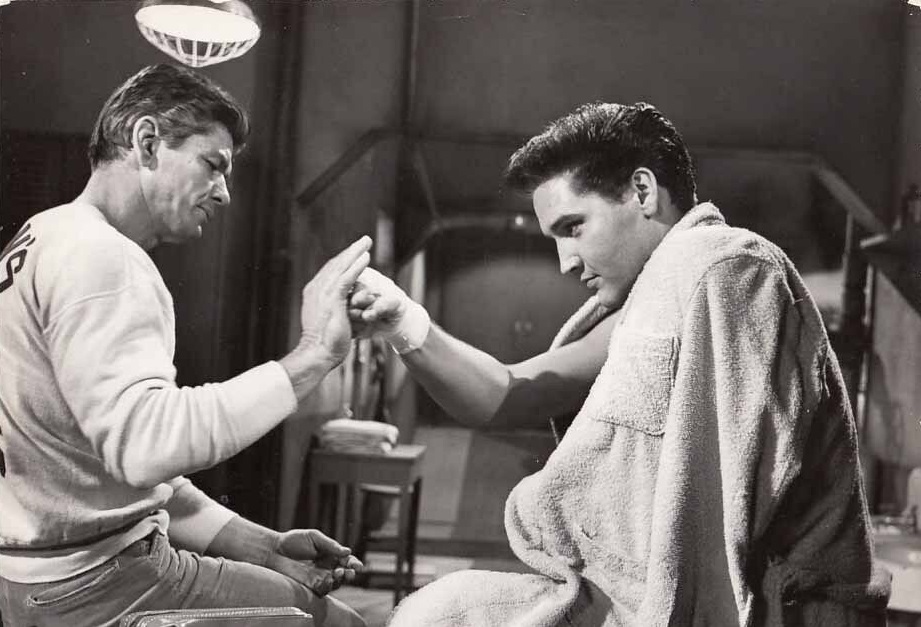
KID GALAHAD (1962) – Charles Bronson teaches Elvis how to box! Happy Birthday to the King!


In celebration of the January 8th birthday of the great Elvis Presley, I decided to watch his 1962 film KID GALAHAD, the only film where he co-stars with my movie hero Charles Bronson. I’ve always been a fan of Elvis Presley and seeing him on-screen with Bronson is a real treat for me.

KID GALAHAD opens with Walter Gulick (Elvis Presley) returning to his hometown in upstate New York. Recently discharged from the army, and in the need of money, the aspiring mechanic finds his way to Willy Grogan’s (Gig Young) boxing camp and agrees to spar with one of his up-and-coming young boxers. Walter doesn’t have much boxing skill, but he ends up having one hell of a right hook and knocks the young boxer flat on his ass. Seeing this, Willy Grogan, who has all sorts of personal and financial problems, thinks Walter might be the answer to getting out of debt to his bookie. Willy asks his trainer Lew (Charles Bronson) to work with the young, strong Walter, who’s now been dubbed “Galahad” by Willy’s girlfriend Dolly (Lola Albright) after he had protected her honor from a “man who doesn’t know how to behave around a lady.” Pretty soon, Willy has fights arranged for Walter under the name of “Kid Galahad.” The first fight begins with Galahad getting his faced being punched repeatedly until he gets one opening and then knocks the other fighter out with one punch. After that, with Lew’s help, Galahad’s skills start showing definite improvement. When he’s not working with Lew at the gym, Galahad finds time to romance and propose to Willy’s sister, Rose (Joan Blackman). This causes problems with the troubled Willy who doesn’t want his sister married to some “meatball” or “grease monkey.” Even worse, smelling money, gangster Otto Danzig (David Lewis) and his henchmen start putting pressure on the financially troubled Willy to force Galahad to take a dive in his big fight with “Sugar Boy” Romero so they can clean up on the fix, going so far as breaking Lew’s hands. Will Willy get the balls to say no to the gangsters? Will Galahad be able to beat Sugar Boy Romero and then retire to open his garage with Rose by his side? You probably already know, but you’ll just have to watch and see!

1962’s KID GALAHAD is a remake of a 1937 movie of the same name directed by Michael Curtiz, and starring cinematic legends Edward G. Robinson, Bette Davis, and Humphrey Bogart. I’ve never seen the earlier version, so I will not compare the two in any way. And to be completely honest, I haven’t watched very many Elvis Presley movies either. As I type this, I can’t think of a single moment I remember in his filmography not included in KID GALAHAD, and I wouldn’t have watched this one without the presence of Charles Bronson. With that said, I think Elvis gives a good performance in KID GALAHAD. He’s very likable, with his character having an old-fashioned chivalry towards women, a friendly, open way with men, and an appreciation for a strong work ethic. I think Elvis handles each of these parts of his character in a way to that makes me want to root for him. As good as Elvis is as Kid Galahad, Gig Young does most of the heavy lifting as the story really revolves around his character’s troubles even more than it does around Galahad. I think he does a pretty good job of taking a character who’s a pretty sorry guy, and by the end of the movie we actually find ourselves starting to like him. Even though he’s in a true supporting role, Charles Bronson is excellent as the trainer who teaches Galahad how to box. Every scene Bronson’s in is elevated by his enormous screen presence and authority. With Bronson in his corner, you feel Galahad is capable of anything. The most powerful scene in the entire film is when the gangsters try to buy his character off under the threat of violence, and he refuses, leading to his hands being broken. After becoming one of the biggest stars on the planet a number of years later, it’s easy to look back at these moments and wonder how in the hell was he not already a huge star in 1962.

Of course, this being an Elvis Presley movie, there are several musical numbers spread throughout the movie. While I don’t remember too much about the songs themselves, they didn’t really take me out of the drama of the movie either. I actually enjoyed seeing Elvis perform, with the people around him clapping along and enjoying themselves. I do remember a specific scene where Elvis is singing as he’s driving down the road, and Bronson’s sitting in the back seat with a big smile on his face like he’s having a great time. That’s my favorite moment of all the songs.  

Although I haven’t watched many of his movies, I’ve been an appreciative fan of Elvis Presley all my life. I can’t tell you how many times I heard his Christmas album in my younger years, as my mom would play it almost on repeat once we got to November. He was a talented, versatile singer whose charisma and stage presence have never been matched, and whose influence on music and entertainment is immeasurable. The fact that Elvis Presley and Charles Bronson made KID GALAHAD together means something to me, and I had a great time revisiting the film on his birthday!

See the Original Trailer for KID GALAHAD below.

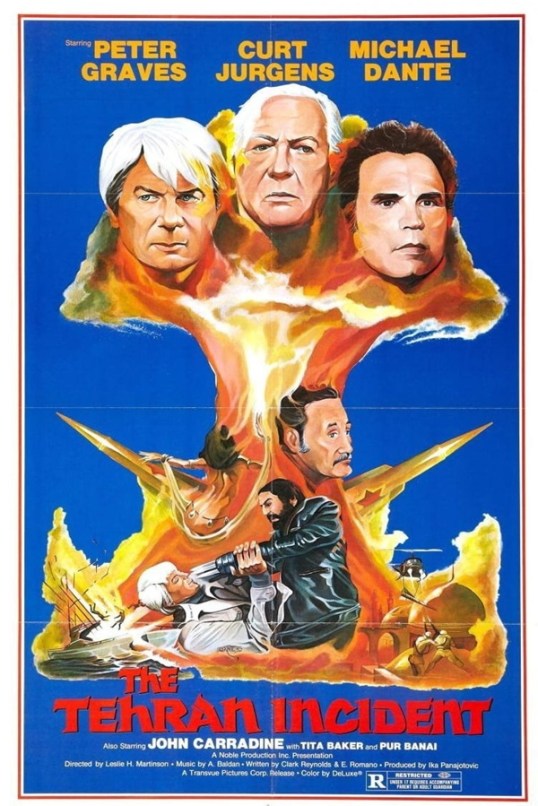
Missile X: The Tehran Incident (1979, directed by Leslie H. Martinson)


The international terrorist and casino owner known as The Baron (Curd Jurgens) has stolen a Soviet-made nuclear warhead.  With the help of Prof. Nikolaeff (John Carradine), the Baron is planning on dropping the warhead on an international peace conference that is being held off the coast of Iran.  American Alec Franklin (Peter Graves) and Russians Konstanine Senyonov (Michael Dante) and Galina Fedorovna (Karin Schubert) want to prevent the Baron from doing that but, in order to stop the Baron, they’re going to need the help of Leila (Pouri Baneai), a member of the Shah’s secret police.

Missile X was a German-Italian-Spanish co-production that was shot on location in Tehran with the full cooperation of the Shah of Iran.  The film goes out of its way to attempt to present the Shah-era Tehran as being a modern and welcoming city, the type of place that anyone would by a fool not to choose for a vacation.  The Shah’s secret police are portrayed as being friendly and heroic and the only time the name “Ayatollah Khomeini” is mentioned is when Alex and Leila are listening to a radio and a news report mentions that Khomeini is far away in Paris.  Leila turns off the radio in the middle of the report, as if to say, “There’s someone will never have to think about again.”  Unfortunately, for both the film and the world at large, that was the case.  In an example of truly bad timing, Missile X was not released in the United States until December 10th, 1979, six days after Khomeini officially took control of Iran and a month into the Iran hostage crisis.  By the time the film was released, the Shah had long-since fled Iran and was seeking asylum and medical care in the United States.

As for the film itself, imagine a Bond film with no car chases, no exciting action sequences, no creative gadgets, and no one-liners.  Imagine also that the main Russian was played by an American who don’t even attempt to speak with any sort of accent.  On top of that, imagine if James Bond himself came across less like a ruthless super spy and more like an insurance executive trying not to overspend on the company account while on a business trip.  Curd Jurgens actually did play a memorable Bond villain in The Spy Who Loved Me but he sleepwalks his way through Missile X.  Not even giving him a mute henchman with a knife-hand can make the Baron seems dangerous.  Even if you can overlook all of that, the Baron’s plan never makes sense.  What does he have to gain from blowing up a peace conference?  Alec and Konstantine both agree that the Baron’s actions will probably start World War III and lead to the end of the world but it’s never explained why the Baron would want that.  Presumably, the Baron would end up getting blown up with everyone else.

Of course, you don’t have to imagine any of this.  You can just watch Missile X — The Tehran Incident.

Embracing the Melodrama #18: The Naked Kiss (dir by Sam Fuller)


The Naked Kiss

When I first decided to do this series on embracing the melodrama, I knew that I would have to include at least one film from Sam Fuller.  A former war hero and tabloid journalist, Sam Fuller made films that felt like a punch in the face to everything that he considered to be hypocritical about American society.  Fuller’s films may have been B-movies and they certainly were unapologetic about being melodramas but, at the same time, they were — at the time of their release — some of the only films willing to deal with controversial subject matter.  While the rest of American filmmakers embraced safety, Fuller could always be counted on to be dangerous.

For instance, at a time when most films were celebrating “good girls” and punishing the bad ones with unplanned pregnancies and bad reputations, Fuller directed a film in which the heroine was a former prostitute and the main villains came from every corner of respectable society.  That film was 1964’s The Naked Kiss.

The Naked Kiss opens with a scene as striking and as memorable as one of the tabloid headlines that Fuller would have cranked out back in his days as a journalist.  Kelly (Constance Towers), a prostitute, attacks her pimp with her purse (with the camera often standing in for the pimp’s point-of-view so, for a good deal of the scene, Kelly appears to be striking those of us in the audience).  During the struggle, Kelly’s wig is knocked from her head, revealing her to be bald.

Fleeing from her pimp, Kelly ends up in the town of Grantville, where her first customer turns out to be Griff (Anthony Eisley), the chief of police.  Once they’ve completed their business, Griff informs Kelly that it might be a better idea for her to find a more permissive town in which to set up operations.  However, Kelly has decided that Grantville would be the perfect place for her to escape from her past and start a new life.

Despite Griff’s continued attempts to get her to leave town, Kelly finds a job working, with handicapped children, in a pediatric ward.  Full of empathy for children who have been just as abused as she has, Kelly proves herself to be an excellent nurse.  She is also soon dating the most powerful and popular man in town, J.L. Grant (Michael Dante).  Grant, at first, seems to be the perfect man and Kelly soon falls in love with him.  Even after she reveals the truth about her past, Grant says that he wants to marry her.

However, things change when Kelly drops by Grant’s mansion one day and discovers Grant on the verge of molesting a little girl.  (Making the scene all the more disturbing is the children’s song that plays in the background through almost the entire scene.)  Grant explains that he’s a deviant, just like her.  Kelly’s reaction forces both her and the citizens of Grantville to confront the truth about who they really are.

Though The Naked Kiss is often overshadowed by Fuller’s Shock Corridor (which was released the year before), The Naked Kiss is actually the better film of the two.   Along with Fuller’s lively direction and Constance Towers’ strong performance as Kelly, The Naked Kiss is also distinguished by Stanley Cortez’s atmospheric black-and-white cinematography.  The scenes in which Kelly sings with the children and then discovers Grant with his potential victim could both be textbook examples of how to properly stage a scene.  This unapologetically tawdry film is also an undeniably great one and you can watch it below!