Bronson One Last Time: Death Wish V: The Face of Death (1994, directed by Allen Goldstein)


To quote Geoffrey Chaucer, “All good things must come to an end.”
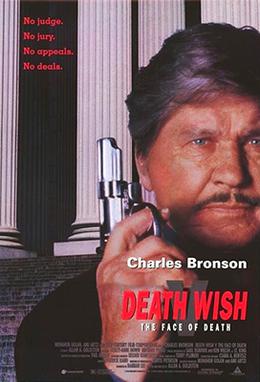
Death Wish V: The Face of Death marked the end of the original Death Wish franchise, concluding the violent saga of Paul Kersey 20 years after it began.  It probably should have ended sooner.

After the box office failure of Death Wish IV and the subsequent bankruptcy of Cannon Films, future plans for the Death Wish franchise were put on hold.  After the collapse of Cannon, Menahem Golan started a new production company, 21st Century Film Corporation.  In 1993, needing a hit and seeing that the previous Death Wish films were still popular on video, Golan announced that Paul Kersey would finally return in Death Wish V: The Face of Death.  Charles Bronson also returned, though he was now 72 years old and in poor health.  Death Wish V would also mark the end of Bronson’s feature film career.  He would make appearances in a few television movies before subsequently retiring from acting.

Death Wish V finds Paul in the witness protection program.  His latest girlfriend, Olivia (Lesley-Anne Down), just happens to be the ex-wife of a psychotic mobster named Tommy O’Shea (Michael Parks).  Throughout the entire franchise, the Death Wish films argued that crime is so out of control that no one was safe and that Paul had no choice but to pick up a gun and shoot muggers.  But, judging from Death Wish V, Paul just seems to have incredibly bad luck.  What are the odds that a mild-mannered architect would lose his wife, his maid, his daughter, his best friend from the war, his next two girlfriends, and then end up dating the ex-wife of New York City’s craziest gangster?

The district attorney’s office wants Olivia to testify against her ex-husband so Tommy gets his henchman, the dandruff-prone Freddie Flakes (Robert Joy), to kill her.  Looks like it’s time for New York’s favorite vigilante to launch a one-man war against the Mafia!

The only problem is that New York’s favorite vigilante is too old to chase people down dark alleys and shoot them.  He has to get creative, which means using everything from poisoned cannoli to a vat of acid to take out his targets.  One gangster is killed by an exploding soccer ball!

With both Bronson and Lesley-Anne Down giving an indifferent performances, it is up to the supporting cast to keep the movie interesting.  Appearing here after his bravura turn as Jean Renault in Twin Peaks but before Robert Rodriguez and Quentin Tarantino introduced him to a whole new generation of filmgoers, Michael Parks is flamboyantly evil as Tommy O’Shea and injects the movie with what little life that it has.  Speaking of Twin Peaks alumni, Kenneth Welsh (who played Windom Earle in the last few episodes of season 2) plays this installment’s understanding police detective.  Saul Rubinek plays the district attorney who is willing to look the other way when it comes to killing gangsters.

Dull and cheap-looking, Death Wish V was a box office bomb and it brought the original franchise to a definite end.  Will the Eli Roth/Bruce Willis reboot of Death Wish also lead to a reboot of the franchise?  Time will tell!

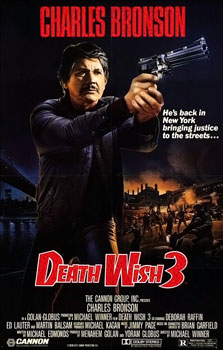
Bronson’s Old: Death Wish 3 (1985, directed by Michael Winner)


To quote Roger Murtaugh, “I’m too old for this shit.”

It has been ten years since Paul Kersey (Charles Bronson) left New York City and the place has gone to Hell.  It’s no longer just muggers that you have look out for.  Now, there are roving street gangs of directionless teenagers, terrorizing the elderly and forcing them to live like prisoners in their own apartment building.

One street corner now looks like a war zone, controlled by spiky-haired, face-painting punks who look like something from a Mad Max movie.  Manny Fraker (Gavan O’Herlihy) rules this street corner, supported by a gang that worships him as if he was some sort of god.  Manny thinks that he is immortal but he’s just targeted the wrong person.  The gang may think that Charley (Francis Drake) is just a defenseless old man but what they don’t know is that, when Charley served in Korea, his best friend was Paul Kersey.

The past few years have been busy for Paul.  He’s killed muggers and rapists in Los Angeles, Chicago, and Kansas City and now he’s returned to New York City, to visit his old friend Charley.  Paul arrives at Charley’s apartment just in time to witness Fraker’s gang murdering him.  The gang flees and when the police arrive, they take Paul into custody.

While public defender Kathryn Davis (Deborah Raffin) tries to figure out why Paul is being held in jail, Paul has a conversation with Lt. Shriker (Ed Lauter).  Shriker remembers Paul as being the New York vigilante and he has a proposition for him.  Paul can kill as many members of Fraker’s gang as he wants, as long as he allows the police to take the credit and reports everything that he discovers to Shriker.  Paul agrees.

In the neighborhood, Paul starts to put Fraker and his gang (one of whom is played by pre-Bill and Ted Alex Winter) in their place.  In a scene borrowed from Brian Garfield’s original Death Wish novel, he uses a used car as bait to gun down two aspiring car thieves.  When Paul gets a new gun, he tests it out on a depraved mugger known as the Giggler.  Though some might call him a serial killer, Paul is soon a hero to the entire neighborhood.  Though Charley may be gone, Paul befriends the other residents of the apartment.  He shows the elderly Kaprovs how to catch anyone trying to climb through their window.  He protects Maria Rodriguez (Marina Sirtis) from the gang.  Best of all, he befriend Bennett Miller (Martin Balsam), a World War II vet who still remembers how to load a machine gun.

(Balsam and Bronson previously co-starred in The Stone Killer, though in that one Bronson was a cop and Balsam was on the other side of the law.)

He also finds time to pursue a relationship with Kathryn Davis.  This is one recurring element in the Death Wish franchise that has never made sense to me.  Paul always has a new girlfriend, despite the fact that almost every woman that he ever gets involved with ends up getting killed.  Paul also only seems to go out with women who would be upset to discover that they were dating a notorious vigilante.  In Death Wish II, he went out with a crusading journalist who was against the death penalty.  In Death Wish 3, he falls for a public defender whose job is to provide legal counsel to the very people that Paul is trying to kill.  After Death Wish 3, Paul would date yet another crusading journalist and, finally, the ex-wife of a notorious mobster.  Maybe Paul should just give up and concentrate on mourning his wife.

Michael Winner returned to direct Death Wish 3 and, this time around, he imagines New York City as being a post-apocalyptic wasteland, full of abandoned buildings and murderous scavengers.  Imagine A Clockwork Orange if Charles Bronson suddenly showed up to shoot Alex and the Droogs.  As played by Gavan O’Herlihy, Manny Fraker is the type of seemingly indestructible bad guy who can actually give Paul Kersey a challenge, something that was missing from the previous films.

The other thing that distinguishes Death Wish 3 is that it was one the only film in the franchise to directly confront an obvious truth.  Charles Bronson was 53 when the first Death Wish was released.  By the time he made Death Wish 3, he was 64 and decades older than the typical action star.  (As way of comparison, Clint Eastwood was 55 when Death Wish 3 was released and was already experimenting with less action-orientated roles.)  By partnering him with Martin Balsam and the other elderly residents of the neighborhood, Death Wish 3 not only acknowledged Bronson’s advanced age but also took advantage of it.  Death Wish 3 is a film where the old folks finally get to teach the young punks a thing or two.  If the other Death Wish films were about one man fighting a lonely war, Death Wish 3 is about a community refusing to be silenced.  The chance to put those kids in their place even seems to perk up Charles Bronson, who gives one of his best performances in Death Wish 3.

Death Wish 3 may have been roundly despised by the critics but it’s the best of the Death Wish sequels.  It made a fortune at the box office so naturally, another sequel would follow.

Tomorrow: Death Wish 4: The Crackdown!

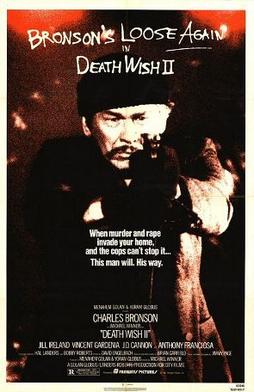
Bronson’s Back!: Death Wish II (1982, directed by Michael Winner)


To quote John McClane, “How can the same shit happen to the same guy twice?”

It has been eight years since Paul Kersey (Charles Bronson) lost his wife and single-handedly cleaned up New York City.  The first Death Wish ended with Paul in Chicago, preparing to gun down a new group of criminals.  I guess Chicago didn’t take because, at the start of Death Wish II, Paul is in Los Angeles and he’s working as an architect again.  He has a new girlfriend, a bleeding heart liberal reporter named Geri (Jill Ireland, Bronson’s real-life wife) who is against the death penalty and who has no idea that Paul used to be New York’s most notorious vigilante.  Having finally been released from the mental institution, Carol (Robin Sherwood) is living with her father but is now mute.

Crime rates are soaring in Los Angeles and why not?  The legal system is more concerned with the rights of the criminals than the victims and Paul has retired from patrolling the streets.  But when a group of cartoonish thugs rape and kill his housekeeper and cause his daughter to fall out of a window while trying to escape them, Paul picks up his gun and sets out for revenge.

Death Wish II was not the first sequel to Death Wish.  Brian Garfield, the author of the novel on which Death Wish was based, never intended for Paul to be seen as a hero and was disgusted by what he saw as being the film’s glorification of violence.  As “penance,” he wrote a sequel called Death Sentence, in which Paul discovered that he had inspired an even more dangerous vigilante.  When Menahem Golan and Yoram Globus bought the rights to produce a second Death Wish film, they decided not to use Garfield’s sequel and instead went with a story that was co-written by Golan.

It’s the same basic story as the first film.  Again, Paul is a mild-mannered architect who is a liberal during the day and a gun-toting reactionary at night.  Again, it’s a home invasion and a death in the family that sets Paul off.  Again, Paul gets help from sympathetic citizens who don’t care that the police commissioner (Anthony Franciosa) wants him off the streets.  Jeff Goldblum played a rapist with a switch blade in the first film.  This time, it’s Laurence Fishburne who fills the role.  (Fishburne also carries a radio, which he eventually learns cannot be used to block bullets.)  Even Detective Ochoa (Vincent Gardenia) returns, coming down to Los Angeles to see if Paul has returned to his old ways.

The main difference between the first two Death Wish films is that Death Wish II is a Cannon film, which means that it is even less concerned with reality than the first film.  In Death Wish II, the criminals are more flamboyant, the violence is more graphic, and Paul is even more of a relentless avenger than in the first film.  In the first Death Wish, Paul threw up after fighting a mugger.  In the second Death Wish, he sees that one of the men who raped his daughter is wearing a cross, leading to the following exchange:

“Do you believe in Jesus?”

“Yes, I do.”

“Well, you’re going to meet him.”

BLAM!

Death Wish II is the best known of the Death Wish sequels.  It made the most money and, when I was a kid, it used to show on TV constantly.  The commercials always featured the “You believe in Jesus?” exchange and, every morning after we saw those commercials, all the kids at school would walk up to each other and say, “You believe in Jesus?  Well, you’re going to meet him.”  It drove the teachers crazy.

Overall, Death Wish II is a lousy film.  Michael Winner, who was always more concerned with getting people into the theaters than anything else, directs in a sledgehammer manner that makes his work on the first film look subtle.  He obscenely lingers over every rape and murder, leaving no doubt that he is more interested in titillating the audience than getting them to share Paul’s outrage.  The script is also weak, with Geri so poorly written that she actually gets more upset about Paul going out at night than she does when she learns that Paul’s daughter has died.  When Paul sets out to track down the gang, his method is to merely wander around Los Angeles until he stumbles across them.  It doesn’t take long for Paul to start taking them out but no one in the gang ever seems to be upset or worried that someone is obviously stalking and killing them.

There are a few good things about the film.  Charles Bronson was always a better actor than he was given credit for and it’s always fun to watch Paul try to balance his normal daily routine with his violent night life.  Whenever Geri demands to know if he’s been shooting people, Paul looks at her like he is personally offended that she could possibly think such a thing.  Also, the criminals themselves are all so cartoonishly evil that there’s never any question that Paul is doing the world a favor by gunning them down.  For many otherwise sensible viewers, a movie like Death Wish II may be bad but it is also cathartic.  It offers up a simple solution to a complex issue.  In real life, a city full of Paul Kerseys would lead to innocent people getting killed for no good reason.  But in the world of Death Wish II, no one out after nightfall is innocent so there’s no need to worry about shooting the wrong person.

Finally, the film’s score was written by the legendary Jimmy Page.  The studio wanted Isaac Hayes to do the score but Winner asked his neighbor, Page.  Page took the film, retreated into his studio, and returned with a bluesy score that would turn out to be the best thing about the movie.  The soundtrack was the only one of Page’s solo projects to be released on Led Zeppelin’s record label, Swan Song Records.

Tomorrow, Bronson returns with Death Wish 3!

A Movie A Day #356: The Delta Force (1986, directed by Menahem Golan)


Last year, at this time, I set a goal for myself.

I decided that, in 2017, I would review a movie a day and I nearly succeeded. I didn’t review a movie on the day Chris Cornell died.  I missed a few days in March due to a sinus infection.  Including the review that I’m posting below, I reviewed 356 movies in 2017.  According to the year-end stats, my most popular reviews were for Heavy Metal Parking Lot, Slaughter, Body Chemistry 3, Body Chemistry 4, and Beatlemania.

Since tomorrow will be the start of a new year, this is going to be the end of my A Movie A Day experiment.  In 2018, I’ll still be watching movies and posting reviews on this site but this is my final daily review.  For my final Movie A Day, I picked the greatest movie of all time, The Delta Force!

Produced by Cannon Films, The Delta Force starts in 1980, with a helicopter exploding in the desert.  America’s elite special missions force has been sent to Iran to rescue the men and women being held hostage in the embassy.  The mission is a disaster with the members of Delta Force barely escaping with their lives.  Captain Chuck Norris tells his commanding officer, Col. Lee Marvin, that he’s finished with letting cowardly politicians control their missions.  Chuck heads to Montana while Lee spends the next few years hitting on the bartender at his local watering hole.

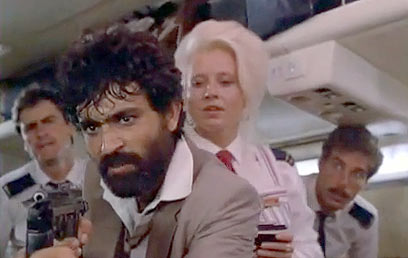
In 1985, terrorists led by Robert Forster hijack an airplane and divert it to Beirut.  Among those being held hostage: Martin Balsam, Shelley Winters, Lainie Kazan, Susan Strasberg, Kim Delaney, and Bo Svenson.  The great George Kennedy plays a priest named O’Malley who, when the Jewish passengers are moved to a separate location, declares himself to be Jewish and demands to be taken too.  Jerry Lazarus is a hostage who spends the movie holding a Cabbage Patch doll that his daughter gave him for luck.  Former rat packer Joey Bishop plays a passenger who says, “Beirut was beautiful then.  Beautiful.”  Fassbinder favorite Hanna Schygulla is the stewardess who refuses to help the terrorists because, “I am German!”

In America, General Robert Vaughn activates The Delta Force to rescue the hostages and take out the terrorists.  As Lee Marvin prepares everyone (including Cannon favorite, Steve James and, in a nonspeaking role, Liam Neeson) to leave, the big question is whether Chuck Norris will come out of retirement for the mission.  Of course, he does.  Even better, he brings his motorcycle with him.

Anyone who has ever seen The Delta Force remembers Chuck’s motorcycle.  Not only did it look incredibly cool but it was also mounted with machine guns and it could fire missiles at cowardly terrorists.  It didn’t matter whether you agreed with the film’s politics were or whether you even liked the movie, everyone who watched The Delta Force wanted Chuck’s motorcycle.  As the old saying goes, “You may be cool but you’ll never be Chuck Norris firing a missile from a motorcycle cool.”

The Delta Force is really three different films.  One film, shot in the style of a disaster film, is about the hostages on the plane and their evil captors.  The second film is Lee Marvin (in his final movie role) preparing his men to storm the airplane.  The third movie is Chuck Norris chasing Robert Forster on his motorcycle.  Put those three movies together and you have the ultimate Cannon movie.  The Delta Force was even directed by Cannon’s head honcho, Menahem Golan.  (Years earlier, Golan also directed Operation Thunderbolt, an Israeli film about the raid on Entebbe, which features more than a few similarities to The Delta Force.  Golan received his first and only Oscar nomination when Operation Thunderbolt was nominated for Best Foreign Language Film.)

The Delta Force is also the ultimate 80s movie.  It opens with the Carter administration fucking everything up and it ends with the Reagan administration giving Lee Marvin and Chuck Norris the greenlight to blow up some terrorists.  There is not much nuance to be found in The Delta Force but it still feels good to watch Chuck beat the bad guys.  Top that off with a shameless score from Alan Silvestri and you have one of the greatest action movies of all time.

At the end of The Delta Force, as cans of Budweiser are being passed out to rescued hostages, an extra is clearly heard to shout, “Beer!  America!”  Then everyone sings America The Beautiful.

That says it all.

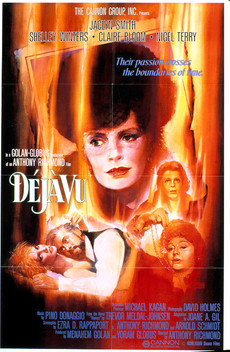
A Movie A Day #211: Deja Vu (1985, directed by Anthony B. Richmond)


Damn, son.  I’ve seen some bad movies before but Deja Vu is something else altogether.

Around the mid-80s, Menahem Golan and Yoram Globus decided to prove that Cannon Films was capable of doing more than making movies about Chuck Norris refighting the war in Vietnam.  Golan and Globus had already made money, now they wanted respect.  Teaming up with respected directors (Robert Altman directed an adaptation of Sam Shepard’s Fool For Love for them) and casting actors who had slightly more range than Chuck Norris or Reb Brown, Cannon tried to go the prestige route.  Some of the Cannon’s quality movies actually were good movies.  The same year that Deja Vu came out, Cannon’s Runaway Train scored several Oscar nominations.  However, Deja Vu is a far more representative example of a Cannon prestige film.  It may have had higher production values than Missing in Action but it was still a Golan/Globus production through and through.

Nigel Terry (best known for playing King Arthur in John Boorman’s Excalibur) plays Michael, a screenwriter who views a documentary about a famous and tragic ballerina and is shocked to discover that she looks just like his actress fiancée.  (Both roles are played by Jaclyn Smith.)  Michael is even more shocked when it turns out that he looks exactly like the ballerina’s husband.  Convinced that his girlfriend is the reincarnation of the ballerina, Michael researches her life and murder.  Meanwhile, his fiancée starts to act strangely.

Deja Vu starts out a merely mediocre, slowly paced and miscast.  (There is no chemistry whatsoever between Nigel Terry and Jaclyn Smith.)  But then Shelley Winters shows up, playing a Russian psychic named Olga Nabokova. As soon as Winters started to deliver her lines in one of the least convincing Russian accents that I have ever heard, Deja Vu made the leap from being merely bad to being a cinematic trainwreck.  While Terry and Smith sleepwalk through their roles, Winters and, later, Claire Bloom (cast as the ballerina’s mother) chew up every piece of scenery that they can get their hands on.  Though the plot may be so predictable that it will cause viewers to have deja vu of their own, it must be said that, eventually, Deja Vu becomes so bad and misjudged that it is impossible to look away.  Golan and Globus may have had Oscars in their eyes when they decided to produce this prestige pic but instead, they won the laughter of anyone who comes across it on TV.


A Movie A Day #209: Assassination (1987, directed by Peter R. Hunt)


Charles Bronson, man.

Long before Clint Eastwood starred in In The Line of Fire, Charles Bronson played an over the hill secret service agent in Assassination.  Having just returned to active service after a six month leave of absence, Jay Killian (Charles Bronson), thinks that he is going to be assigned back to the presidential detail.  Instead, he is given the job that no one wants.  Jay is assigned to protect the first lady, Lara Craig (Jill Ireland, Bronson’s real-life wife).

Lara is a handful.  Every one tells Killian that she is “even worse than Nancy.”  (This running joke probably played better in 1987.  If Assassination had been released ten years later, Lara would have been described as being “even worse than Hillary.”)  Lara does not like being told what she can and cannot do. When she refuses to follow Killian’s orders not to ride in a convertible, she ends up getting a black eye when a motorcycle crashes and Killian instinctively throws her to the floor.  Lara may not like Killian but when, she is targeted by a notorious terrorist (Erik Stern), she will have to learn to trust him.  Her life depends on it, especially when it becomes clear that the order to have her killed is coming from inside the White House.  It turns out that the President has been impotent for years.  That may not have troubled Lara before but now Killian is showing her that a real man looks like Charles Bronson.  A divorced president will never be reelected.  A widowed president, on the other hand…

Assassination was one of the last films that Bronson made for Cannon.  It’s never as wild as Murphy’s Law, Kinjite, or many of Bronson’s other Cannon films but it is always interesting to watch Bronson acting opposite of Ireland.  Bronson famously did not get along with many people but he loved Ireland and that was something that always came through in the 15 movies that they made together.  Whenever Bronson and Ireland acted opposite each other, Bronson actually seemed to be enjoying himself.  And while it may be subdued when compared to his other Cannon films, Assassination provides just enough scenes of Bronson being Bronson.

Who other than Bronson could tell his much younger girlfriend that, because of her, he might “die of terminal orgasm?”

Who other than Bronson could drive around a motorcycle with machine gun turrets and execute a jump that would put his old co-star Steve McQueen to shame?

Who other than Bronson could use a bazooka to kill one man and then smile about it?

Charles Bronson, man.  No offense to Bruce Willis, who will be trying to step into Bronson’s gigantic shoes with the upcoming Death Wish remake, but nobody did it better than Bronson.


A Movie A Day #136: Missing in Action 2: The Beginning (1985, directed by Lance Hool)


Goddamn, dude.  Chuck Fucking Norris.  Even when the movie is terrible, Chuck is cool.

That is especially relevant when it comes to a movie like Missing In Action 2: The Beginning.  Produced by Cannon Films and shot back-to-back with the first Missing in Action, The Beginning was supposed to come out first.  However, Menahem Golan and Yoram Globus took a look at the two movies and realized that The Beginning would work better as the 2nd film in the series.  They were right though some post-production tinkering did lead to some serious errors in continuity.

(Not that anyone watching a Golan/Globus production would be worrying about continuity.)

Did you ever wonder how James Braddock (Chuck Norris) became a POW in the first place?  No?  Missing In Action 2 is going to show you how it happened anyway.  It turns out that he and his men were captured, in 1972, by the Viet Cong when their helicopter crashed into a lake.  At the start of the movie, Chuck only has a mustache.  If Chuck had been fully bearded, there is no way the VC could have captured him.  After Chuck and his men have spent ten years in a jungle prison, where they are forced to pick poppies for a French heroin drug lord, Chuck has grown a full beard and is finally strong enough to escape from the prison, rescue his men, and defeat the sadistic camp commandant (Soon-Tek Oh) in hand-to-hand combat.  None of it is surprising but there’s enough weird stuff, like the prostitutes that the French drug dealer flies into the camp and the Australian journalist who shows up out of nowhere and is executed ten minutes later, to keep it interesting.  Chuck is as stiff as always but he’s good in the action scenes and gets to show off some sweet karate moves towards the end of the movie.  Supposedly, Chuck viewed the Missing in Action films as a tribute to his brother, Wieland, who was killed in Vietnam.

The continuity error has to do with the amount of time that Braddock and his men spend in the camp.  After Chuck is captured in 1972, the film inserts some footage of Ronald Reagan giving a speech about the men who never returned from Vietnam.  A narrator says that the Americans are still wondering what happened to the thousands of soldiers who were reported as being MIA in Vietnam.  The implication is that Chuck and company spent ten years in the POW Camp, which means that they escaped in 1982.  Since it is said, in Missing in Action, that it has been ten years since Chuck escaped, that means that Missing in Action actually took place in 1992.  But if Chuck and the boys escaped and returned to America in 1982 then why, in 1992, was everyone so convinced that all the POWs were released immediately after the Vietnam War?

Fortunately, Chuck Norris is so cool that it doesn’t matter what year it is.

Chuck Norris, man.

Chuck Fucking Norris.

A Movie A Day #135: Missing in Action (1984, directed by Joseph Zito)


Chuck Fucking Norris, man.  Is there anything this man can not do?

In Missing in Action, he plays Colonel James Braddock, an army intelligence officer.  For a career military man, his long hair and his beard are definitely against regulations but who is going to tell Chuck Norris to get a haircut?  Ten years ago, Braddock escaped from a POW camp in North Vietnam.  Haunted by nightmares and still convinced that there are American POWs in Vietnam, Braddock is inspired by an episode of Spider-Man and his Amazing Friends (I am not joking!) to accompany a U.S. Senator on a fact-finding trip to Ho Chi Minh City.  It’s there that Braddock uncovers evidence that American soldiers are being held prisoner by the evil General Trau (James Hong).  With the government refusing to help him, Braddock is forced to go to Thailand, where he hooks up with an old friend, a former soldier turned black marketeer named Tuck (M.  Emmett Walsh).  Braddock and Tuck head into the jungle, to both rescue the POWs and to remind the world that, no matter what a bunch of pointy-headed lefties might say, Americans never lose a war!

A blatant rip-off of the Rambo films, Missing in Action was one of Cannon Films’ most financially successful movies.  Seen today, Missing in Action is borderline xenophobic and it takes forever for the action to really get started.  I was surprised by the number of scenes that were devoted to Braddock looking for evidence that the POWs were still in Vietnam, as if there was ever any real suspense about what Braddock would find.  (No POWs = no movie.)

On the positive side, once it finally starts, the action is exciting.  Joseph Zito was a veteran genre director and he know how to handle a battle scene.  Unfortunately, in this one, Chuck does most of his fighting with a machine gun instead of his hands.  This is also one of the first movies where Chuck Norris has the full beard going.  The beard serves to distract from what a stiff actor Chuck Norris usually was and it does its job in Missing in Action.  When it comes to picking a Chuck Norris film to watch, it’s a good idea to see how much facial hair will be featured.  If Chuck has a beard, definitely watch.  If Chuck only has a mustache, proceed with caution but, if there’s nothing else to watch, give the movie a chance.  If Chuck is clean-shaven and Bruce Lee is nowhere to be seen, throw the movie back and never speak of it again.

Missing in Action was shot back-to-back with what eventually became known as Missing in Action 2: The Beginning.  Originally, The Beginning was meant to be released first and Missing in Action was intended to be a sequel.  However, once the execs at Cannon saw the footage, they deemed The Beginning to be unreleasable and instead sent Missing in Action out to theaters.  (A movie so bad that even Cannon was hesitant to release it?  It boggles the mind.)  Missing in Action was such a box office success and The Beginning was subsequently released as a prequel.  However, when it comes to Norris/Cannon films, Invasion USA is the one to watch.  That one has a bearded Chuck and Richard Lynch!

A Movie A Day #133: American Ninja 2: The Confrontation (1987, directed by Sam Firstenberg)


Duuuuuuuuude!  The American Ninja is back!

In this sequel to the first American Ninja, ninja Joe (Michael Dudikoff) and sidekick Jackson (Steve James) are now Army Rangers.  They have been assigned to provide security at an embassy on a small Caribbean island.  At first, it seems like an easy gig but then Joe discovers that a large number of Marines have recently vanished.  According to the only witness, they were abducted by men dressed in black.  Joe and Jackson know what that means!

The Marines are being set up by a traitor in their own ranks, Tommy Taylor (played by Miguel Ferrer look-alike Jonathan Pienaar).  Taylor is being blackmailed by a master criminal known as, I kid you not, Leo the Lion (Gary Conway, who also co-wrote the script).  Leo is brainwashing the Marines, shooting them up with all sorts of drugs and transforming them into zombie-style ninjas.

Doing away with any pretense towards reality, American Ninja 2 is pure comic book action.  A bad guy even says, “It’s the American Ninja!” when he sees Joe.  It’s a strange film.  On the one hand, it is full of goofy humor and it even has a streetwise kid sidekick, all things that would indicate that it was made to appeal to kids.  On the other hand, the first cut was reportedly so violent that it got a dreaded X-rating.  The final version still has enough impalings, decapitations, and throwing stars to the head to earn its R.

With its combination of nonstop action and Steve James one-liners, American Ninja 2 is both a worthy sequel and a worthy addition to the Cannon library.  Still, it bothers me that at least a few of the ninjans that Joe and Jackson killed were probably just brainwashed Marines.  That amounts to a lot of innocent victims being killed by our heroes.

The life of an American ninja is never an easy one.

A Movie A Day #132: American Ninja (1985, directed by Sam Firstenberg)


Hell yeah!

From Yoram Globus and Menahem Golan, the duo who were responsible for producing the coolest films of the 1980s, comes American Ninja!

Private Joe Armstrong (Michael Dudikoff) is the newest arrival on an American army base in the Philippines.  A former member of a street gang, he has been forced to enlist in the army in order to keep himself out of jail.  Because he keeps to himself, the other soldiers do not like him.  Colonel Hickock (Guich Kook) is angry that his daughter, Patricia (Judie Aronson), likes Joe and conspires to have Joe court martialed.  Joe’s only friend is Corporal Jackson (Steve James), who starts out as an enemy but changes his ways after Joe shows off some sweet martial arts moves.  Because Joe is an amnesiac, he does not know where or why he learned how to fight.  He just knows that he can.

It’s good that he can because the local black marketer, Ortega (Don Stewart) has hired the legendary Black Star ninjas to help him steal supplies from the base.  Ortega has even allowed the ninjas to set up a training camp in his back yard.  When Joe prevents the ninjas from kidnapping Patricia, the ninjas swear revenge.

As if there could possibly be any doubt, American Ninja was made and distributed by Cannon Films.  It is about as pure an example of the Cannon aesthetic as anyone could hope to find.  Find a star — in this case, Michael Dudikoff — who was credible without being expensive.  Give him a love interest who was easy on the eyes and who could get held hostage during the film’s climax.  Toss in slow motion stunt work, big explosions, and Steve James.  Come up with a title that would appeal to both NASCAR-loving patriots and drive-in movie fans.  End result: American Ninja!

As a film, American Ninja get the job done and then some.  The fights are well-choreographed and the movie does not allow things like character development or subtext to get in the way of showcasing plenty of ninja action.  There are enough weird details, especially after Joe dons the black pajamas of the American Ninja, to keep the move interesting.  At one point, a ninja literally vanishes and what’s cool is that no one acts surprised when it happens.  Long before Crouching Tiger, Hidden Dragon, American Ninja showed that there’s nothing a ninja can’t do!

One final note: Keep an eye out for my favorite scene, in which a slow-moving jeep bumps into a tree and explodes with all the force of a planet that’s just been zapped by the Death Star.