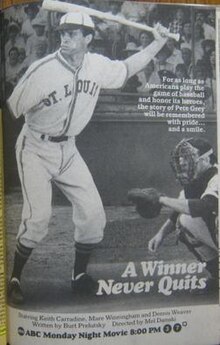
I Watched A Winner Never Quits (1986, dir. by Mel Damski)


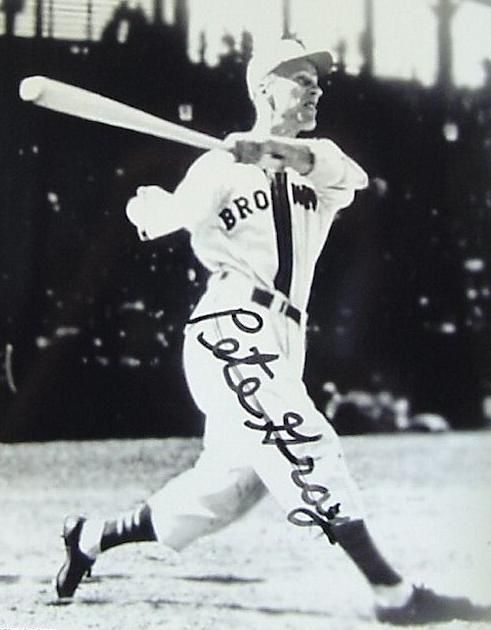
In 1945, Peter Gray made history when he became the first one-armed major league baseball player.  Gray grew up in poverty in Pennsylvania.  His father was a miner and Peter was one of five children.  He was only seven years old when he lost his right arm in a wagon accident but he loved baseball and he wasn’t going to let his disability keep him from playing.  He learned how to bat and catch and throw with his left hand.  He quit school when he was thirteen and worked for a while as waterboy while playing baseball in the local leagues.  Eventually, he made his way up to the minor leagues and, in 1945, he was called up to the majors.  He played one season for the St. Louis Browns.

The media loved the story of the one-armed baseball player but Peter always said that he resented feeling like he was being put on display whenever he took the field.  He was a competitive outfielder who could catch a ball, remove his glove, and then throw the ball to the infield just as quickly as anyone with two hands.  As a hitter, he struggled because pitchers figured out early on that he couldn’t hit the breaking ball.  After the 1945 season, Peter was sent to back to the minors, where he spent the rest of his career.  Though Peter was known for being an angry player who resented anyone pointing out his disability, he still made time to visit amputees in military hospitals to show them that they could still find success and to encourage them to chase after their dreams.

Peter’s story was the basis of A Winner Never Quits, which I watched on YouTube this weekend.  It was a good baseball movie, starring Keith Carradine as Peter.  What I liked is that the movie didn’t make him into a saint.  Carradine played Peter as being angry and with a definite chip on his shoulder.  Peter had every right to be angry and I’m glad the movie acknowledged that.  In both the movie and in real life, Peter was worried that he was just being treated as a sideshow.  In the movie, his attitude improves when he meets a young boy who recently lost his arm and who looks up to Peter.  Peter remained a friend to the boy and his family for the rest of his life.  A Winner Never Quits is about pursuing what you love and never giving up.  That’s what baseball is all about.  A Winner Never Quits is a good and inspiring baseball movie that’s not just for the fans.
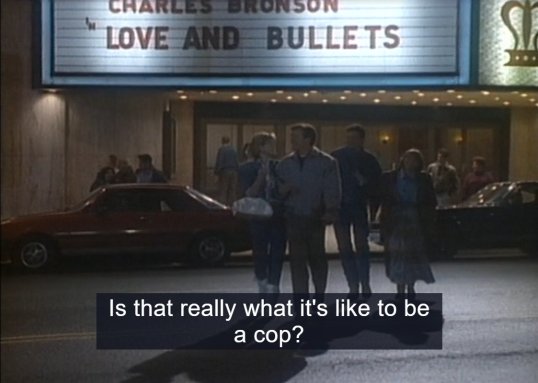
January True Crime: Shoot First: A Cop’s Vengeance (dir by Mel Damski)


Made for television in 1991 and possessing a rather unwieldy title, Shoot First: A Cop’s Vengeance tells the story of two friends in San Antonio in the early 80s.

Farrell Tucker (Dale Midkiff) and Stephen Smith (Alex McArthur) are both cops.  They entered the police academy together, they graduated as a part of the same class, and they both hope to be partners while working to keep the streets of San Antonio safe.  Tucker is laid back and friendly and not one to worry too much about following all of the regulations.  Stephen Smith, on the other hand, is uptight and, at first, by-the-book.  He grew up in a poverty-stricken, crime-riddled neighborhood and it left a definite impression on him.  He hates crime and criminals but what he really can’t stand is a justice system that seems to be more concerned with the victimizers than with the victims.  Tucker and Smith enjoy spending their time together, drinking at the local cop bars and practicing their shooting on the weekends.  Tucker’s not much of a shot, whereas Smith is a sharpshooter who rarely misses.

At first, no one notices or even cares that some of San Antonio’s less upstanding citizens are getting gunned down in the streets.  But when Smith somehow manages to be first on the scene to a series of shootings, it gets the attention of Internal Affairs.  With Sergeant Nicholas (Terry O’Quinn) investigating the possibility of a cop-turned-vigilante and Chief Hogan (G.D. Spradlin) announcing that no one is above the law, Smith starts to get a bit paranoid and Tucker is forced to consider that his friend could very well be a murderer.

And, of course, Tucker’s right!  The first scene features Tucker confronting Smith and then the majority of the film is told in flashback.  Even if not for that narrative choice, one could guess at Smith’s guilt just from the title of the film.  When Shoot First: A Cop’s Vengeance was released on home video, the title was changed to Vigilante Cop, which made Smith’s guilt even more obvious.  Finally, some viewers will guess that Smith is guilty because the film is based on a true story.  Officer Stephen Smith actually did go on a killing spree, gunning down men who he felt had escaped the law and even sending threatening letters to his chief when the latter announced that vigilante activity would not be tolerated.  Officer Stephen Smith went from being a follower of the rules to someone who attempted to write his own rules.  It’s an interesting story for anyone who wants to google it.

As for the film, it’s adequate without being particularly memorable.  Alex McArthur and Dale Midkiff both give good performance as Tucker and Smith and the cast is full of talented people like Terry O’Quinn, G.D. Spradlin, Bruce McGill, and Lynn Lowry.  Observant viewers will even notice a long-haired Jeremy Davies, showing up for a split-second.  I liked the performance of Loryn Locklin, as the waitress who marries Smith and then discovers that her charming husband actually has some very serious issues.  The main problem with the film is that the story moves a bit too slowly for its own good and some of the Texas accents were more than a little dodgy.  If you’re looking for an action film, this won’t be for you, though the shootings are surprisingly graphic for something that was made for television.  Shoot First: A Cop’s Vengeance is a rather routine telling of an interesting story.

Retro Television Review: Long Journey Back (dir by Mal Damski)


Welcome to Retro Television Reviews, a feature where we review some of our favorite and least favorite shows of the past!  On Sundays, I will be reviewing the made-for-television movies that used to be a primetime mainstay.  Today’s film is 1978’s Long Journey Back.  It  can be viewed on YouTube!

I’m one of those drivers who always gets nervous around train tracks.

Perhaps it’s because I watched too many gory movies while I was learning to drive or maybe I’m just being overly cautious but I always have a fear that I’m going to be the driver whose car ends up getting stuck on the tracks while the train comes barreling down.  The fact that it’s apparently impossible to just stop a train without it rolling forward for at least a mile or two adds to my fear.  You get stuck on those tracks and, at the very least, you’re going to lose your car.  At the worst, you’ll lose your life.  Maybe if you’re lucky, you’ll only lose a limb.  Or maybe …. well, you get the point.  Most people make it a point to slow down whenever they hear the sound of a train coming or to stop and wait for those little barrier things to come down on other side of the tracks.  Myself, I always speed up if I see tracks approaching.  I figure that the quicker I drive over them, the quicker I don’t have to worry about getting hit by a train.

The 1978 film Long Journey Back did not do much to cure me of my fear of train tracks.  Within the first ten minutes of the film, a school bus ended up getting stuck on a set of train tracks and, in a genuinely frightening sequence, smashed into by a train.  Most of the students are killed.  So is the driver.  Celia Casella (Stephanie Zimbalist) survives being in the bus but most of her friends don’t.  Celia loses a leg and, when she eventually awakes from her coma, she can neither speak nor remember the accident.  Celia makes remarkable progress but it’s still difficult for her to adjust her post-accident life.

The film spends as much time with Celia’s parents as it does with Celia.  Her mother, Laura (Cloris Leachman), keeps a journal about Celia’s progress and never gives up faith that her daughter will recover.  However, Laura is sometimes so determined to only focus on moving forward that she overlooks the fact that Celia needs time to mourn not only her former life but also the friends that she lost in the crash.  Meanwhile, Celia’s father, Vic (Mike Connors), is a grim realist who, in a moment of emotional exhaustion, admits that he sometimes wonders if Celia wouldn’t have been better off dying in the crash.  Vic is someone who keeps everyone grounded in reality but who sometimes forget that Celia needs to have hope for the future.  Celia is not the only member of the family who has to learn how to live a new life.  From the minute that train hits that bus, everyone’s old life ends and a new one begins.

The film follows Celia’s recovery, her long journey back.  It’s a well-done film, featuring excellent and emotional performances from Zimbalist, Connors, and especially Leachman.  To its credit, the film avoids easy sentiment.  The film celebrates Celia’s strength and her parent’s love while acknowledging that the journey back is not going to be an easy one and it’s possible that Celia might never make it all the way back.  I cried more than a few times while watching Long Journey Back.  It’s a film that earns its tears.

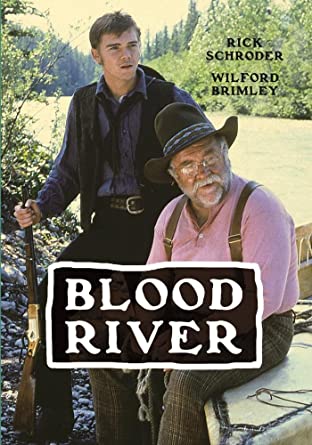
Blood River (1991, directed by Mel Damski)


In the old west, Jimmy Pearls (Ricky Schroder), a seemingly dissolute young man, kills the three men who he hold responsible for the murder of his parents.  Unfortunately for Jimmy, one of those men was the son of powerful rancher Henry Logan (John P. Ryan) and Logan is now determined to track down Jimmy and get some revenge of his own.

Jimmy only his one ally in his attempt to make it to safety and that’s Winston Culler (Wilford Brimley).  In his younger days, Culler was a legend.  He tamed the frontier and he lived with the Indians and everyone knew better than to get in his way.  Now, Winston is older and no one give him the respect that he deserves.  Winston allows Jimmy to stay with him but Winston has more than just Jimmy’s safety in mind.  Winston has his own reasons for wanting to get revenge on Logan and, despite their constant bickering, he and Jimmy are soon working as a team.

Adrienne Barbeau has a cameo as a madam and, while she’s always a welcome sight in any film, I imagine her casting has to do with the fact that this film was actually written by John Carpenter.  Yes, that John Carpenter!  Carpenter actually wrote the script for what would become Blood River in 1971.  When he wrote it, he pictured John Wayne as Winston and either Elvis Presley or Ron Howard as Jimmy.  (The Duke and Elvis in the same film?  That would have been something, regardless of how the film itself turned out.)  Carpenter sent copies of the script to both John Wayne and director Howard Hawks but neither one responded.  It would be 19 years before the script was finally filmed.

Blood River is an amiable western.  It was ultimately produced for television and it first aired on CBS.  Despite the fact that the film was originally written to be a theatrical film, it plays more like a pilot than a film.  You could imagine a weekly series featuring Winston and Jimmy riding from town to town and getting into adventures.  The plot is nothing special but Ricky Schroder and Wilford Brimley make for a good team.  Brimley is especially ornery, even for him.  Blood River may be a simple film but it will be appreciated by those looking for a likable and old-fashioned western.

Back to School #36: Mischief (dir by Mel Damski)


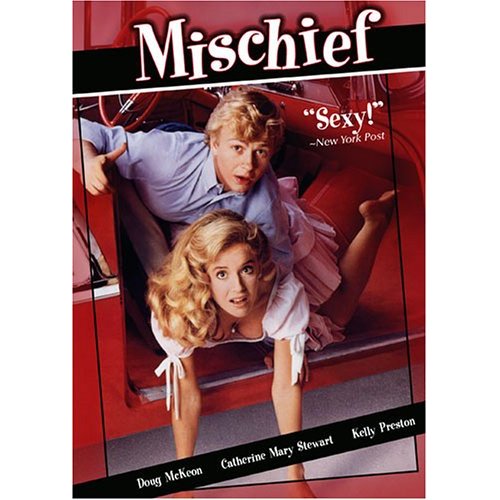
Mischief

Have you ever noticed how, occasionally, a totally obscure film that was made several decades ago will suddenly show up on either Starz or Encore and, the next thing you know, it’s only like every other day?  That was the case a few months ago when, at times, it seemed as if the only thing playing on cable was a teen comedy from 1985 called Mischief.

After I saw it listed in the guide a few dozen times, I thought to myself, “Somebody at that station must really like that movie.”  So, one night, I actually took the time to watch it and discovered why that mysterious person loved this movie.  Mischief may not be as well-known as some of the other films in this series of Back to School reviews but it’s still a pretty good movie.

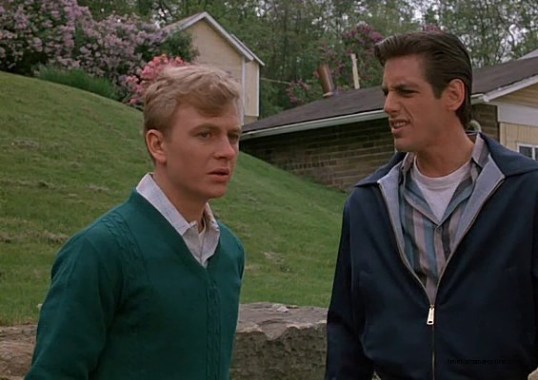
Like so many of the teen films that were released in the 70s and 80s, Mischief takes place in the 1950s.  (I assume that’s because most films about teenagers are made by adults who want to both relive and perhaps change the past.  I suppose that’s one reason why so many films released today are set in the 1990s.  In another ten years or so, all of the new high school films will be set in 2003.)  The very shy and clumsy Jonathan (Doug McKeon) has a crush on the beautiful but unattainable Marilyn (Kelly Preston).  Fortunately, Jonathan is befriended by Gene (Chris Nash) who is the prototypical rebel without a cause.  Gene wears a leather jacket.  Gene rides a motorcycle.  Gene doesn’t get along with his alcoholic, violin-playing father (Terry O’Quinn, in full asshole mode here).  Gene even stands up to the school bully (D.W. Brown) and starts dating the bully’s ex-girlfriend, Bunny (Catherine Mary Stewart).  Most importantly, Gene helps Jonathan finally develop the confidence necessary to ask Marilyn out.

And, for a while, Gene & Bunny and Jonathan & Marilyn make for the perfect foursome.  But, as we all know, perfection can never last in a coming-of-age story.  Jonathan starts to discover that he and Marilyn are not quite as compatible as he originally assumed that they were.  As for Gene, he has to deal with his increasingly violent and drunken father…

That last paragraph probably makes Mischief sound a lot more dramatic than it actually is.  Make no mistake about it — while Mischief does deal with some serious issues — it is primarily a comedy and a pretty good one at that.  McKeon is endearingly clumsy in his initial attempts to get Marilyn to notice him and Nash — even though he’s playing a very familiar character — is likable as well.  Perhaps the smartest thing that Mischief did is that it made Gene cool but it didn’t make him too cool.  The film’s best scenes are the ones where Gene momentarily surrenders his rebel facade and reveals that he’s just as confused as everyone else.  Catherine Mary Stewart and Kelly Preston are well-cast as well, with Preston especially doing a good job at making a potentially unsympathetic character likable.

In many ways, Mischief is a pretty predictable film.  I think it features probably every single cinematic cliché that one would expect to see in a film about the 50s.  But the film itself is so likable and good-natured that it doesn’t matter if it’s predictable.  It’s just a good, enjoyable movie and what’s wrong with that?

(Incidentally, the screenplay for Mischief was written by Noel Black, who also directed the previously reviewed Private School.)

1327550371_1447726