Icarus File #25: 1941 (dir by Steven Spielberg)


In the year 1979, a young Steven Spielberg attempted to conquer comedy in the same way that he previously conquered horror with Jaws and science fiction with Close Encounters of The Third Kind.  Working from a script written by Robert Zemeckis and Bob Gale, Spielberg made a film about the days immediately following Japan’s attack on Pearl Harbor.  The name of the film was 1941 and it remains Steven Spielberg’s only attempt to direct a full-out comedy.  There’s a reason for that.

The film follows a large group of characters over the course of one day and night in 1941.  It’s been six days since Pearl Harbor was attacked and the streets of Los Angeles are full of young men who are preparing to ship out and older man who are paranoid about when the next attack is going to come.  However, Major General Joseph Stilwell (Robert Stack) just wants to see Dumbo at the local theater.  Meanwhile, his womanizing aide (Tim Matheson, giving the same performance here that he did in National Lampoon’s Animal House) just wants to get Stillwell’s aviation-lusting secretary (Nancy Allen) into an airplane.

Elsewhere, Ward Douglas (Ned Beatty) is happy to allow Sgt. Tree (Dan Aykroyd) and his men (including John Candy) to set up on an anti-aircraft gun in his front yard.  Ward’s daughter, Betty (Dianne Kay), is only concerned about entering a dance contest with her friend, Maxine (Wendie Jo Sperber).  Cpl. Sitarski (Treat Williams) and dishwasher Wally Stephens (Bobby D iCicco) both hope to be Betty’s partner and their rivalry leads to a massive (and seemingly never-ending) brawl.

While Ward deals with the gun in his front yard, another concerned citizen — Claude Crumm (Murray Hamilton) — keeps watch from atop of Ferris wheel, along with amateur ventriloquist Herbie Kazlminsky (Eddie Deezen).

But that’s not all!  Susan Backilinie recreates her role from a previous Spielberg film, skinny dipping while the Jaws theme plays in the background and running straight into a submarine that is commanded by Commander Akiro Mitamura (Toshiro Mifune, trying to maintain his dignity).  Mifune decides to attack Hollywood but no one on the submarine is sure where that is.  Christopher Lee appears as an arrogant German who is along for the ride.  Slim Pickens shows up as a lumberjack who is temporarily captured by the Japanese.  John Belushi plays Wild Bill Kelso, who flies his airplane through Los Angeles.  Warren Oates yells and laughs.  Dick Miller, Elijah Cook Jr. and Lionel Stander show up in small roles.

“Since when is Steven funny?”  According to Peter Biskind’s Easy Riders, Raging Bulls, this was the reaction that most of Spielberg’s friends had when he announced that his next film would be a screwball comedy set during World War II.  Watching the film, one gets their point.  The majority of the film’s humor comes from people looking at the camera and screaming.  There’s a lot physical comedy, which would undoubtedly work in small amounts but which grows rather tiring when it’s dragged out to the extent that Spielberg’s drags it out.  (A brawl at a USO show seems like it should be funny but Spielberg allows it to go on for too long and the careful choreography takes away any element of spontaneity.)  The film attempts to duplicate the style of Animal House (and it’s probably not a coincidence that Matheson, Belushi, and director John Landis all have roles in the film) but Spielberg often seems as if he’s trying too hard.  There’s nothing subversive about the humor.  It’s more antic than funny.

A huge problem is that there really isn’t much of a story here.  Spielberg, who is normally one of Hollywood’s best storytellers, attempts to do a loose, Altman-style ensemble film and the result is that none of the characters feel alive and there’s never any sense of narrative momentum.  There are a few performers who manage to make an impression amongst all the explosions and the yelling.  John Belushi has the advantage of not having to share the majority of his scenes with anyone else.  Warren Oates’s manic energy is more than welcome.  Wendie Jo Sperber deserved more screentime.  Murray Hamilton and Eddie Deezen frequently made me laugh.  There’s a wonderful moment where Robert Stack’s intense general cries while watching Dumbo.  But, for the most part, the film never comes together.

That said, 1941 is definitely a Steven Spielberg film.  It received three Academy Award nominations, for Cinematography, Sound, and Visual Effects.  (All three of those categories, not surprisingly, are more associated with spectacle than with comedy.)  The film looks great!  Spielberg’s attention to detail is there in the production design and the costumes.  Watching 1941, you can see Spielberg’s talent while also seeing why he never directed another comedy.

Previous Icarus Files:

  1. Cloud Atlas
  2. Maximum Overdrive
  3. Glass
  4. Captive State
  5. Mother!
  6. The Man Who Killed Don Quixote
  7. Last Days
  8. Plan 9 From Outer Space
  9. The Last Movie
  10. 88
  11. The Bonfire of the Vanities
  12. Birdemic
  13. Birdemic 2: The Resurrection 
  14. Last Exit To Brooklyn
  15. Glen or Glenda
  16. The Assassination of Trotsky
  17. Che!
  18. Brewster McCloud
  19. American Traitor: The Trial of Axis Sally
  20. Tough Guys Don’t Dance
  21. Reach Me
  22. Revolution
  23. The Last Tycoon

A Movie A Day #114: Scavenger Hunt (1979, directed by Michael Schultz)


When game designer Milton Parker (Vincent Price) dies, all of his greedy relatives and his servants gather for the reading of his will.  Parker’s lawyer, Benstein (Robert Morley), explains that Parker is leaving behind a $200 million dollar estate to whoever can win an elaborate scavenger hunt.  Dividing into five teams, the beneficiaries head out to track down as many items as they can by five o’clock that evening.  Among the items that they have to find: a toilet, a cash register, an ostrich, a microscope, and an obese person.  Hardy har har.
The five teams are made up of a who’s who of sitcom and television actors who had time to kill in 1979.  The Odd Couple‘s Tony Randall is Henry Motely, who is Parker’s son-in-law and who works with his four children.  Soap‘s Richard Mulligan plays a blue-collar taxi driver named Marvin Dummitz (because funny names are funny) who teams up with his friend, Merle (Stephen Furst).  The Mary Tyler Moore Show‘s Cloris Leachman (an Oscar winner, no less) gets stuck with the role of Milton’s greedy sister, Mildred.  She works with her conniving lawyer (Richard Benjamin) and her stupid son (Richard Masur).  Maureen Teefy plays Milton’s niece while his nephews are played by Willie Aames and Dirk Benedict.  Cleavon Little, James Coco, Roddy McDowall, and Stephanie Faracy play the servants.

It doesn’t stop there, though.  Avery Schreiber plays a zookeeper.  Meat Loaf plays a biker who beats up Richard Benjamin.  Ruth Gordon, Stuart Pankin, Pat McCormick, and Scatman Crothers all have cameos.  Even Arnold Schwarzenegger makes an appearance as a gym instructor who knocks Tony Randall out of a second story window.

There are a lot of famous people in Scavenger Hunt.  It’s just too bad that the movie itself is barely watchable and not at all funny.  It tries to go for the zaniness of It’s A Mad, Mad, Mad, Mad World but, unless watching Willie Aames steal a clown head from Jack in the Box is your idea of hilarity, the film never comes close to succeeding.  Michael Schultz directed some classic films (like Car Wash) during the 1970s but, unfortunately, he also directed Sgt. Pepper’s Lonely Hearts Club Band and this.

Scavenger Hunt used to show up on a late night television, where it was always advertised as starring Arnold Schwarzenegger.  (He barely has five minutes of screentime.)  It was released on DVD/Blu-ray earlier this year but watching for the cameos is the only reason to take part in this Scavenger Hunt.

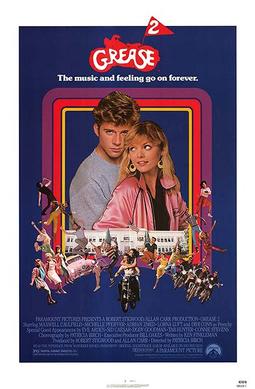
Back to School Part II #14: Grease 2 (dir by Patricia Birch)


Grease_2


So, the whole reason that I watched Grease last week was so I would be prepared to watch the 1982 sequel Grease 2 over the weekend.  As I’ve mentioned many times on this site, I absolutely hate Grease and I know what you’re probably asking yourself:

“But Lisa, if you hate Grease so much, why did you want to see Grease 2?”

Well, there’s a very good answer to that question but I’m not going to reveal it.  I’m going to encourage you to learn to love the mystery.  For whatever reason, I wanted to watch Grease 2.  Perhaps it was because I’ve heard that Grease 2 is the worst sequel ever made.  I really didn’t see how that was possible.  How, I wondered, could a film be any worse than the original Grease?

And, so, I watched Grease 2 on Netflix and yes, it was really, really bad.  But you know what?  It was so bad that it became almost compulsively watchable.  Unlike the first Grease, which is full of slow spots, Grease 2 is oddly exciting in its mediocrity.  I watched much of it in open-mouthed horror, wondering if things could possibly get any worse.  And, with each scene, it did get worse.  It was so overwhelmingly and shamelessly bad and so thoroughly misguided that, strangely enough, I really want to rewatch it.

Grease 2 takes place in 1961.  There’s a whole new gang of students at Rydell High!  Well, actually, Frenchy (Didi Conn) has returned.  You may remember that, in the previous film, Frenchy dropped out of high school and went to beauty school.  (She was also visited by Satan, who came to her disguised as the Teen Angel.)  But now Frenchy is back, trying to pass a chemistry class so she can … well, I’m not really sure what the whole deal with Frenchy was.  I imagine that Didi Conn was probably free for a weekend.

The T-bird and the Pink Ladies are still around but they have a whole new membership.  The head of the Pink Ladies is Stephanie Zinone (played, in her film debut, by Michelle Pfeiffer).  Her boyfriend, Johnny Nogorelli (Adrian Zmed), is the chain-smoking leader of the T-birds.  Actually, Johnny is now her ex-boyfriend.  He cheated on her over the summer.

And there’s a new boy at Rydell!  He’s originally from England and he’s Sandy’s cousin!  His name is Michael Carrington (superhandsome Maxwell Caulfield, who is perhaps fated to always be best known for playing Rex Manning in Empire Records) and, when we first meet him, he’s getting off a school bus and he’s wearing a suit!  Michael really likes Stephanie but you have to be a T-bird if you’re going to date a Pink Lady and…

AGCK!

Sorry, that was a primal scream.  Trying to describe the plot of Grease 2 inspires a lot of primal screams.

Anyway, this is a film is also a musical but apparently, none of the original Grease composers were involved with the sequels.  All the songs kinda sound like something you would hear in a parody of Grease, as opposed to a sequel.  Also adding to bizarre feel of this sequel is that everyone delivers their lines as if they’re appearing in a stage production, projecting to the back of the theater and overenunciating every single syllable.  This may have made sense for Grease, which was adapted from an actual stage show and, despite efforts to open up the action, was still deliberately stagey.  Grease 2, meanwhile, is an adaptation of a stage show that never actually existed.

The film starts with a 7 minute production number called Back To School Again.  As the Pink Ladies and the T-birds and all the other students show up outside of Rydell, they sing, “Woe is me!  The Board of Education took away my parole.”  And the scene just keeps going and going, until you start to wonder if Rydell High is a cult compound.

This is followed by a song about bowling (!) that’s called “Score Tonight.”

And it just keeps getting worse from there.  The film becomes sickly fascinating as you find yourself trying to predict how much more worse it can possibly get.  You may be tempted to give up but you’ll definitely want to stick around for the scene in which Michael discovers that Stephanie wants a “cool rider.”  How does he know that?  She sings a song about it!

Naturally, Michael gets a motorcycle, a helmet, and pair of goggles and he starts to romance Stephanie.  Stephanie doesn’t know who that Michael is the mysterious motorcyclist, despite the fact that Michael is just wearing a helmet and a pair of goggles.  Though you have to admire Pfieffer’s commitment to her role (and she gives a fairly good performance, considering the material she was working with), you can’t help but feel that Stephanie might not be the smart.  Especially after she sings, “Who’s that guy?”

Uhmmm … it’s Michael.  It’s not like he’s dressed up like a bat or wearing the Iron Man armor.  He’s just got a helmet and goggles on.  Add to that, while Maxwell Caulfield doesn’t give a bad performance (he seems to be doing the best he can with what he’s been given to work with), he also doesn’t attempt to act any differently when he’s the mysterious motorcyclist than when he’s Michael.

There are other things going on as well.  The film is full of vignettes about life in 1961, all featuring the students and teachers at Rydell High.  For instance, former teen idol Tab Hunter shows up as a substitute teacher and sings a song about reproduction.

And again, it’s so bad that you can’t look away and you watch knowing that you’ll never get the images and the songs out of your head.  So compulsively watchable is this bad movie that I may have to watch it again after I finish this review.  (Then again, I’ll probably just rewatch the fifth season of Degrassi…)

(That said, I would actually argue that Grease 2 is a better directed film than the first Grease.  Grease 2 was directed by Grease‘s choreographer and, as opposed to the first film, the dance numbers are actually framed with modicum of care.)

(By the way, I’ve always wanted to use the phrase “modicum of care” in a review.)

Anyway, Grease 2 apparently bombed at the box office and, as a result, there have been no further Grease films.  It’s a shame because you so know that Grease 3 would have taken place in 1967 and featured hippies.

Oh well.

We’ll survive…


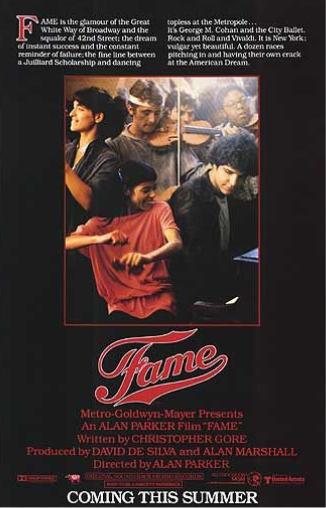
Back to School #23: Fame (dir by Alan Parker)


Fameposter

“Fuck it, if I can’t dance I’ll change to the drama department.” — Lisa (Laura Dean) in Fame (1980)

For nearly a week now, we’ve been taking a chronological look at some of the best and some of the worst films ever made about teenagers and high school.  Yesterday, we finished off the 70s with Rock ‘n’ Roll High School.  Today, we start the 80s by looking at yet another musical set in a high school.  That musical is 1980’s Fame.

Taking place at the High School For Performing Arts in New York City, Fame follows a group of students from the beginning of their freshman year to graduation four years later.  Among those students are Bruno (Lee Curreri), a musical prodigy, Coco (Irene Cara), who thinks that she’s the most talented student at the school, insecure Doris (Maureen Teefy), gay actor  Montgomery (Paul McCrane), talented but functionally illiterate dancer Leroy (Gene Anthony Ray), and self-destructive comedian Ralph Garcia (Barry Miller, giving the best performance in the film).  Over the course of four years, they fight, love, sing, and dance.  They especially do a lot of dancing, which is basically the main reason why I enjoyed the film.

Fame is the perfect film to transition into the 80s with because, in many ways, it’s a perfect combination of the 70s and the 80s.  In its use of ensemble and its emphasis on the gritty lives that the kids live outside of the school, the film is truly product of the 70s.  However, whenever the film follows the students inside of the school, it becomes very much an 80s film, the type where the emphasis is on stylistically hyper editing and emotions are just as likely to be expressed through a musical montage as through dialogue.  With its combination of the kids dreaming in the school and then facing the harsh realities outside, Fame feels like a collision of 70s pessimism and 80s optimism.

(Needless to say, pessimism usually makes for a more realistic film but optimism is a lot more fun to watch.)

Not surprisingly, for a film that made and released 34 years ago, a lot of Fame feels very dated.  (What is surprising is that the 2009 remake feels even more dated.)  It’s difficult not to cringe at the sight of all the leg warmers and big hair on display.  The same can be said for the synthesizer-heavy soundtrack but, to be honest, I like 80s music.  It may be cheesy but you can dance to it and really, what more can you ask from music?  If nothing else, Fame serves as a valuable time capsule of the time that it was made and yes, I know that I’ve been saying that about a lot of movies lately but hey, it’s true!  And I happen to love time capsules.  So there.

And besides, dated as the film may be, Fame does get the big things right.  It captures that feeling that we all had in high school, that feeling that you are destined for greater things and that, as long as you believe in yourself, good things will automatically happen to you.  It captures the wonderful feeling of not only being creative and talented but also knowing that you are talented and creative..

The film is full of hints that the majority of the students at the high school will probably eventually be forced to give up on their dreams.  A popular and handsome student is first seen graduating and full of confidence, just to pop up again an hour later, working as a waiter and looking desperate.  Haughty Coco goes to an audition and ends up in tears after a sleazy producer tells her to undress.  Ralph performs his stand-up comedy and, exhausted after going for days without sleep, ends up bombing.  Leroy is offered a chance to dance professionally but first he has to try to talk his English teacher into giving him a passing grade while she mourns for her husband, who died just a few hours earlier.  It’s actually a pretty dark movie but it’s hopeful too because, by the end of it, you realize that not all of the characters are going to make it but at least they’re going to have a chance to try.