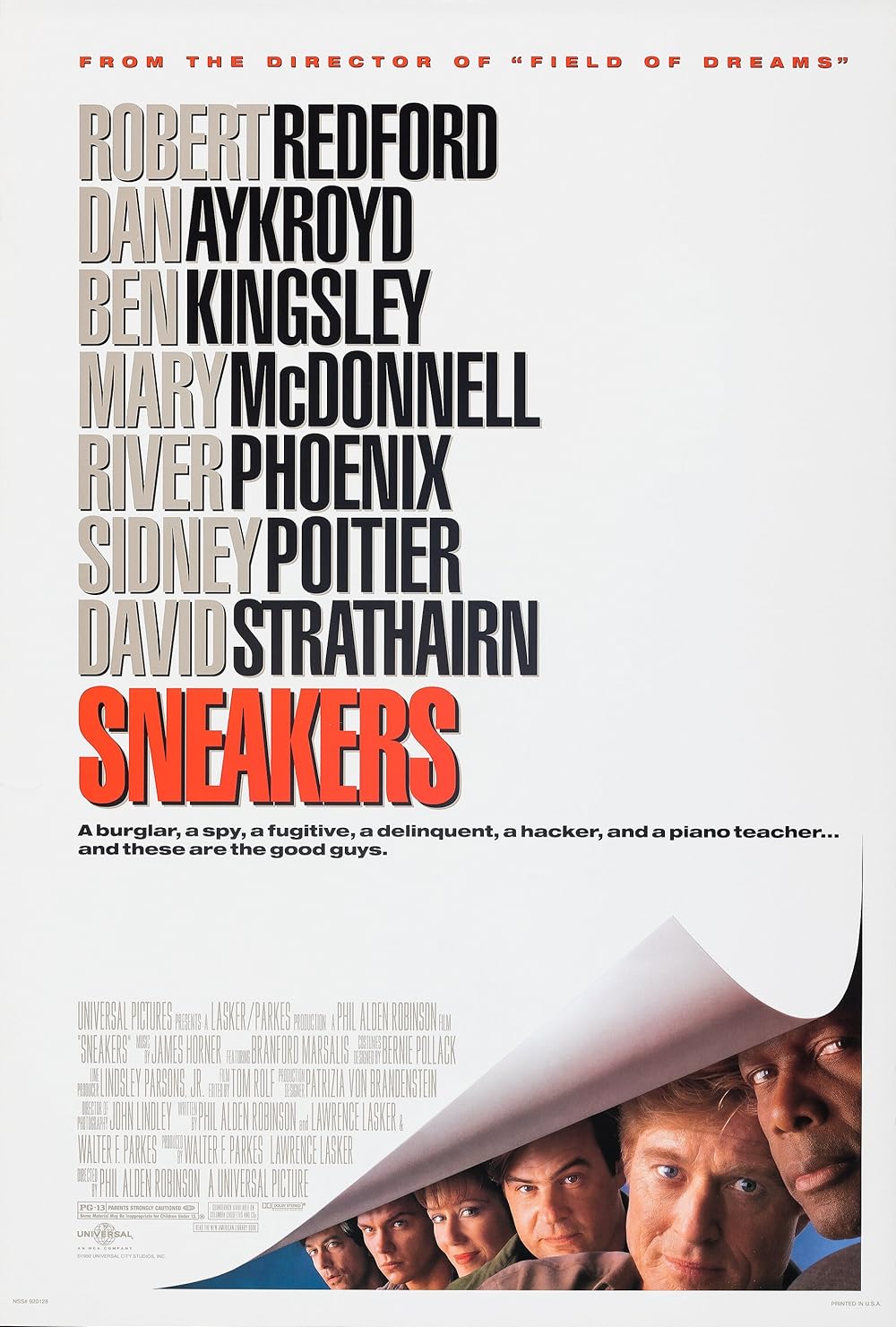
Review: Sneakers (dir. by Phil Alden Robinson)


“The world isn’t run by weapons anymore, or energy, or money. It’s run by little ones and zeroes, little bits of data. It’s all just electrons.” — Cosmo

Sneakers is one of those early-’90s studio thrillers that feels oddly cozy for a movie about global surveillance and information control. It plays like a hangout movie that just happens to revolve around a world-breaking black box, and whether that balance works for you will pretty much decide how much you click with it.

Set in San Francisco, Sneakers follows Martin Bishop (Robert Redford), a one-time radical hacker now leading a boutique team that gets paid to break into banks and corporations to test their security. When a pair of supposed NSA agents lean on him about a skeleton in his past, they strong-arm him into stealing a mysterious “black box” from a mathematician, which turns out to be a codebreaker capable of cracking pretty much any system on Earth. From there, the crew gets pulled into a bigger conspiracy involving shady figures and high stakes, with Martin confronting echoes from his activist days.

The first thing that jumps out about Sneakers is the cast, which is frankly stacked even by modern standards. Redford brings an easy, weathered charm to Bishop; there’s a low-key joke baked into the movie that this legendary leading man is now playing a guy who looks like he spends more time worrying about his back pain than saving the world, and it works. He’s surrounded by a motley crew: Sidney Poitier’s ex-CIA operative Crease, Dan Aykroyd’s conspiracy-addled tech nut Mother, David Strathairn’s blind audio savant Whistler, and River Phoenix’s eager young hacker Carl. Mary McDonnell rounds things out as Liz, Martin’s ex, who gets roped back into his orbit and ends up doing some of the film’s most memorable social-engineering work.

What makes this lineup click—and really shine—is how effortlessly the ensemble works together, especially with Robert Redford and Sidney Poitier anchoring it as the team’s leaders. Redford’s Bishop is the steady, pragmatic brain, always one step ahead but grounded by his regrets, while Poitier’s Crease brings that sharp-edged authority from his CIA days, barking orders with a mix of gruffness and loyalty that keeps everyone in line. Their dynamic is electric: you get these moments where Bishop’s quiet scheming bounces off Crease’s no-nonsense intensity, like when they’re coordinating a break-in and trading barbs mid-scheme, and it sells the years of trust they’ve built. It elevates the whole group, giving the younger or quirkier members—Mother’s wild theories, Whistler’s uncanny ears, Carl’s fresh energy—a solid foundation to riff off, turning what could be chaos into a tight, believable unit. Phil Alden Robinson directs the film almost like an ensemble comedy interrupted by bursts of espionage, so the banter and the little grace notes between jobs end up being as memorable as the heists themselves. There’s a looseness to the way the team bickers, teases, and riffs on each other that sells the idea they’ve been doing this for years, long before the plot kicked in. You feel that especially in scenes where they’re all huddled around some piece of tech or puzzling out a clue; the script allows them to overlap, crack side jokes, and be fallible instead of treating them like slick super-spies who never misstep.

Tonally, the movie walks an interesting line. On one hand, this is very much a tech thriller about the power of information, with the ominous “Setec Astronomy” anagram (“too many secrets”) tying it all together. On the other, this is a film where an extended sequence revolves around tricking a socially awkward engineer on a date so they can steal his voice patterns and credentials, and the whole thing plays like a romantic caper more than anything. Robinson leans hard into suspense in key stretches—most notably toward the end, where tension builds through clever set pieces involving motion sensors, improvised skills, and closing threats—but even then the movie never loses its sense of mischief.

That playfulness can be both a strength and a limitation. The upside is obvious: Sneakers is fun. It’s easy to watch, easy to rewatch, and it rarely drowns you in jargon for the sake of sounding smart. Instead, it abstracts the tech into clear stakes—this box breaks codes, this system controls money and power—so you always understand the “why” behind every scheme even if you don’t follow every “how.” The downside is that, for a movie nominally about the terrifying implications of a universal decryption key, it doesn’t dig as deeply into the horror of that idea as it could. It gestures at themes of privacy, state overreach, and the weaponization of data, but it’s more interested in using those ideas as a playground than as something to rigorously interrogate.

Viewed from 2026, the tech is obviously dated—landlines, old terminals, magnetic cards—but that almost works in the film’s favor now. There’s a retro-futurist charm to seeing characters talk about “ones and zeroes” and the power of information as if they’re whispering forbidden knowledge, when today that conversation is basically the nightly news. At the time, the film was praised for being ahead of the curve on the idea that whoever controls data controls everything, and you can still feel that prescience. The irony is that what was once cutting-edge has softened into a kind of warm nostalgia, which might be why the movie has quietly settled into cult-favorite status rather than staying in the mainstream conversation.

On a craft level, the movie is sturdy across the board. John Lindley’s cinematography keeps things bright and clean rather than shadow-saturated, which reinforces that lighter tone; San Francisco looks lived-in and slightly mundane, not like a glossy cyber-noir playground. James Horner’s score is a big asset: a jazz-inflected, airy sound that gives scenes a sense of cool rather than danger, which again nudges things toward caper more than hard thriller. It’s the kind of soundtrack that sneaks into your head and quietly sets the mood without demanding too much attention, and a lot of fans single it out as one of his more underappreciated efforts.

If there’s a major weak spot, it’s probably in how the film handles its big ideas and antagonists. The central conflict draws on ideological clashes from the characters’ pasts, but it mostly serves as a charismatic foil rather than a fully fleshed-out debate. The story doesn’t push too hard on challenging cautious pragmatism versus radical change, or probe deeply into who benefits from the status quo. For a tale built on “too many secrets,” the moral landing feels predictable rather than revelatory.

The film also shows its age in how it uses certain characters, especially Liz and Carl. McDonnell gets moments to shine—her date with Werner Brandes is a highlight—but Liz is often pushed to the side once the plot machinery gets going, which is a shame given the sparks between her and Redford. River Phoenix’s Carl is similarly underused; he’s the young blood in a team of older pros, and you can see hints of a more emotionally grounded arc there, but the film keeps him mostly in comic-relief mode. It doesn’t derail the movie, but it does contribute to the sense that Sneakers is more interested in being a breezy ensemble hang than in fully developing everyone it introduces.

Still, it’s hard to deny the movie’s overall charm. The central heist beats are cleanly staged, the reversals are satisfying without being overcomplicated, and the script gives almost every member of the team at least one clutch contribution so it feels like a true group effort. The later stretches cleverly tie together the tech setup and character dynamics, ending on a light coda that underscores the film’s affection for its quirky crew over global intrigue.

As for how it holds up, Sneakers isn’t an untouchable classic, but it’s a very easy film to recommend if you have any affection for ’90s thrillers, ensemble casts, or tech-adjacent stories that don’t drown you in circuitry diagrams. Some of its politics feel glib, some of its gadgets are charmingly antique, and its big questions about Information Age ethics are more backdrop than deep dive. But the film’s mix of laid-back humor, light suspense, and grounded, slightly rumpled characters gives it a distinct flavor that a lot of modern, hyper-slick hacker movies lack.

If you go in wanting a serious, hard-edged exploration of cyber-warfare and state power, Sneakers will probably feel like it’s only skimming the surface. If you’re in the mood for a smart, lightly twisty caper that lets you spend two hours with a killer cast tossing around clever dialogue amid escalating capers, it’s still a very satisfying watch.
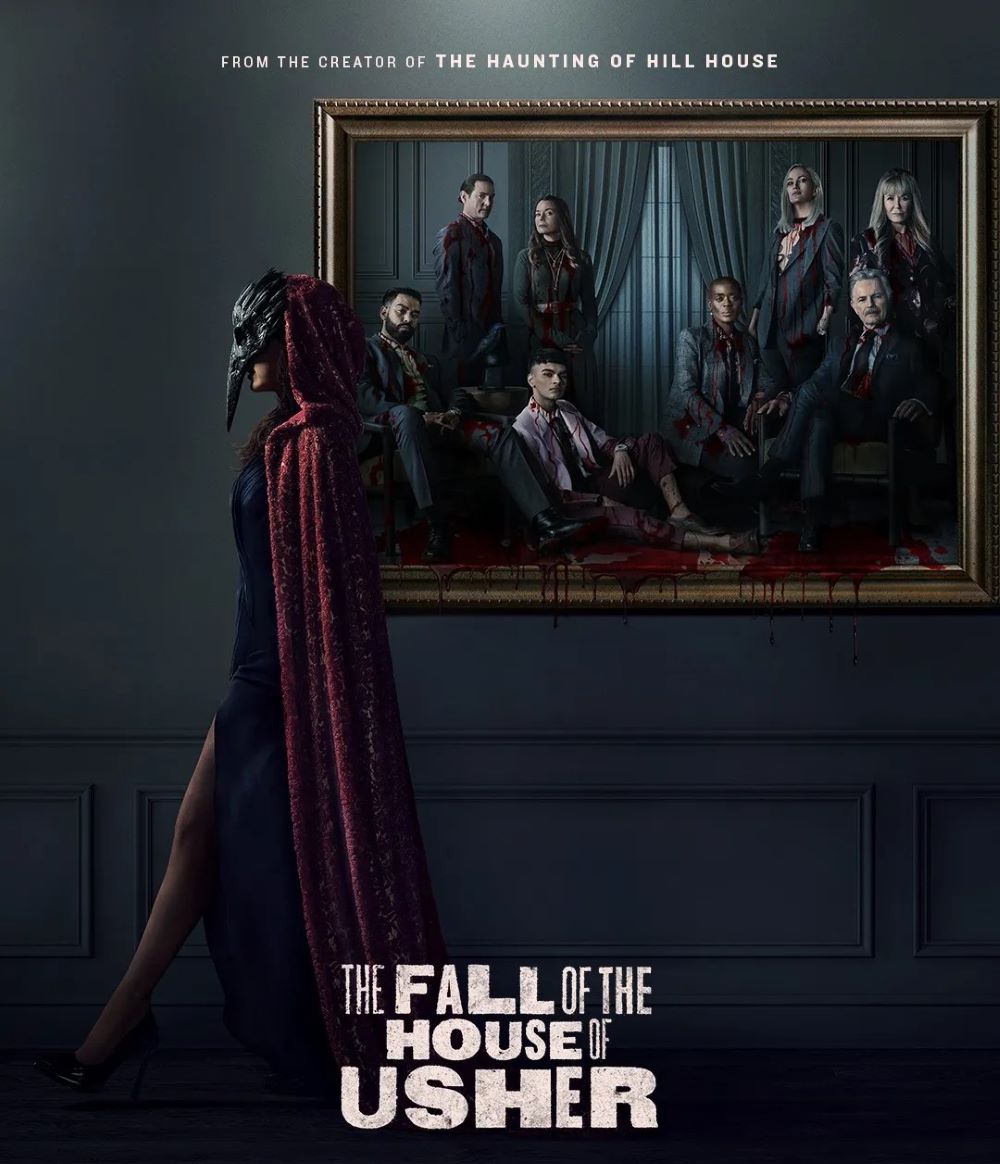
Review: The Fall of the House of Usher (by Mike Flanagan)


“If pain and suffering were the kisses of Jesus, then he kissed the living fuck out of my mother.” — Roderick Usher

The Fall of the House of Usher delivers Mike Flanagan’s signature blend of gothic dread and modern moral reckoning, reimagining Edgar Allan Poe’s tales as a savage family implosion tied to corporate excess. This Netflix miniseries unfolds over eight taut episodes, framing the confessions of a pharmaceutical tycoon as his bloodline meets grisly, poetic ends. It balances sharp satire with emotional undercurrents, though its heavy-handed messaging and repetitive structure occasionally blunt the impact.

Roderick Usher, now a hollowed-out patriarch, recounts his empire’s collapse to a relentless prosecutor in the crumbling family mansion, flashing back to decades of ambition, betrayal, and supernatural intervention. His twin sister Madeline, the brains behind their Fortunato Pharmaceuticals fortune, shares equal narrative weight, their pact with a enigmatic figure sealing a curse that claims each heir in turn. The setup echoes Poe’s original story but explodes it into a sprawling anthology, with every installment riffing on a different work from the author’s macabre catalog. This structure keeps the momentum high, turning personal flaws into fatal traps, yet it risks formula once the pattern of vice-reveal-demise becomes predictable.

A standout early episode channels The Masque of the Red Death, where a debauched heir’s orgiastic gala spirals into carnage, blending excess with infectious horror in a sequence that’s equal parts thrilling and grotesque. Later, Goldbug skewers influencer wellness culture through a sibling’s pyramid-scheme downfall, its tech-glitch kills inventive and on-theme. These Poe-infused vignettes shine when they lean into visceral spectacle—impalements, immolations, animalistic frenzies—elevating routine family feuds into something operatic. However, weaker entries, like those fixated on lab accidents or courtroom paranoia, feel more procedural than poetic, diluting the supernatural menace amid procedural tangents.

Flanagan’s direction thrives in the atmospheric details: opulent sets that rot from within, shadows pooling like guilt, a score that swells with mournful strings underscoring inevitable doom. Performances anchor the excess, with Carla Gugino’s shape-shifting Verna stealing scenes as a devilish facilitator—charming one moment, apocalyptic the next. Bruce Greenwood lends Roderick a defeated majesty, his monologues on greed and legacy landing with gravitas despite their length. Mark Hamill’s fixer adds gravelly comic menace, a cold pragmatist navigating the Ushers’ moral sewer. The younger cast fares variably; some heirs pop as vicious caricatures—the coke-fueled playboy, the ruthless scientist—while others blur into interchangeable privilege.

Thematically, the series wields Poe’s obsessions—entombment, madness, retribution—against Big Pharma’s sins, drawing parallels to real-world opioid scandals without subtlety. Roderick and Madeline’s rise from rags via a addictive painkiller mirrors ethical shortcuts in pursuit of immortality, their “house” both literal estate and dynastic delusion. Verna embodies karmic balance, not mindless evil, her interventions exposing how wealth insulates sin until cosmic debt collectors arrive. This critique bites, especially in rants decrying humanity’s commodification of suffering, but preachy asides can halt the dread, turning horror into TED Talk territory. Flanagan fans will recognize his grief motifs, here twisted into generational poison rather than personal catharsis.

Pacing falters in the midsection, where flashbacks to the Ushers’ origin drag against the ticking present-day trial. The frame narrative, while elegant, withholds twists too long, making early hours feel like setup over payoff. Gorehounds get inventive set pieces, from pendulum blades to heart-pounding pursuits, but scares prioritize irony over outright terror—less Hereditary shocks, more Final Destination comeuppance. For a one-season arc, it wraps tightly, circling back to Poe’s raven as a symbol of unending loss, though the finale’s revelations feel more intellectually tidy than emotionally shattering.

As adaptation, it honors Poe’s spirit over fidelity, cherry-picking motifs from tales like The Tell-Tale HeartThe Black Cat, and The Pit and the Pendulum to fuel a contemporary revenge saga. Purists might chafe at the liberties—Poe’s claustrophobic intimacy traded for ensemble sprawl—but the result captures his misanthropy, updating crumbling aristocracy to cutthroat capitalism. It’s Flanagan’s angriest work, swapping supernatural melancholy for gleeful vengeance, yet retains his humanism: even monsters get poignant final beats, hinting at redemption’s flicker amid ruin.

The Fall of the House of Usher polarizes like much of Flanagan’s output—loved for audacity, critiqued for indulgence. Its ensemble and kills draw praise, but detractors note tonal whiplash between camp and sincerity. For horror enthusiasts craving literary flair over found-footage tropes, it’s a feast; casual viewers may tire of the lectures. Compared to Flanagan’s Hill House or Midnight Mass, it’s less introspective, more punitive, trading tears for dark laughs at the mighty’s tumble.​

Ultimately, the miniseries succeeds as pulpy prestige, a bloody valentine to Poe that indicts modern excess without fully escaping melodrama’s clutches. Its highs—Gugino’s tour de force, baroque deaths, thematic ambition—outweigh the bloat, making it binge-worthy for gothic fans. In Netflix’s crowded horror slate, it stands out for wit and wickedness, a flawed but ferocious reminder that some houses, and legacies, deserve to fall.

Catching-Up With Two Courtroom Dramas: Suspect and 12 Angry Men


As a part of my continuing effort to get caught up with reviewing all of the movies that I’ve seen this year, here’s two courtroom dramas that I recently caught on This TV.

  • Suspect
  • Released in 1987
  • Directed by Peter Yates
  • Starring Cher, Dennis Quaid, Liam Neeson, John Mahoney, Joe Mantegna, Philip Bosco, Fred Melamed, Bernie McInerney, Bill Cobbs, Richard Gant, Jim Walton, Michael Beach, Ralph Cosham, Djanet Sears 

Suspect is a hilariously dumb movie.  How dumb is it?  Let me count the ways.

First off, Cher plays a highly successful if rather stressed public defender.  And don’t get me wrong.  It’s not that Cher is a bad actress or anything.  She’s actually pretty good when she’s playing Cher.  But, in this movie, she’s playing someone who managed to graduate from law school and pass the DC bar.

Secondly, Cher is assigned to defend a homeless man when he’s accused of murdering a clerk who works for the Justice Department.  The homeless man is deaf and mute, which isn’t funny.  What is funny is when he gets a shave and a shower and he’s magically revealed to be a rather handsome and fresh-faced Liam Neeson.  Liam doesn’t give a bad performance in the role.  In fact, he probably gives the best performance in the film.  But still, it’s hard to escape the fact that he’s Liam Neeson and he basically looks like he just arrived for a weekend at Cannes.

Third, during the trial, one of the jurors (Dennis Quaid) decides to investigate the case on his own.  Cher even helps him do it, which is the type of thing that would get a real-life attorney disbarred.  However, I guess Cher thinks that it’s worth the risk.  I guess that’s the power of Dennis Quaid’s smile.

Fourth, the prosecuting attorney is played by Joe Mantegna and he gives such a good performance that you find yourself hoping that he wins the case.

Fifth, while it’s true that real-life attorneys are rarely as slick or well-dressed as they are portrayed in the movies, one would think that Cher would at least take off her leather jacket before cross-examining a witness.

Sixth, it’s not a spoiler to tell you that the homeless man is innocent.  We know he’s innocent from the minute that we see he’s Liam Neeson.  Liam only kills who people deserve it.  The real murderer is revealed at the end of the film and it turns out to be the last person you would suspect, mostly because we haven’t been given any reason to suspect him.  The ending is less of a twist and more an extended middle finger to any viewer actually trying to solve the damn mystery.

I usually enjoy a good courtroom drama but bad courtroom dramas put me to sleep.  Guess which one Suspect was.

  • 12 Angry Men
  • Released 1997
  • Directed by William Friedkin
  • Starring Courtney B. Vance, Ossie Davis, George C. Scott, Armin Mueller-Stahl, Dorian Harewood, James Gandolfini, Tony Danza, Jack Lemmon, Hume Cronyn, Mykelti Williamson, Edward James Olmos, William Petersen, Mary McDonnell, Tyrees Allen, Douglas Spain

The 12 Angry Men are back!

Well, no, not actually.  This is a remake of the classic 1957 film and it was produced for Showtime.  It’s updated in that not all of the jurors are white and bigoted Juror #10 (Mykelti Williamson) is now a member of the Nation of Islam.  Otherwise, it’s the same script, with Juror #8 (Jack Lemmon) trying to convince the other jurors not to send a young man to Death Row while Juror #3 (George C. Scott) deals with his family issues.

I really wanted to like this production, as it had a strong cast and a strong director and it was a remake of one of my favorite films.  Unfortunately, the remake just didn’t work for me.  As good an actor as Jack Lemmon was, he just didn’t project the same moral authority as Henry Fonda did the original.  If Fonda seemed to be the voice of truth and integrity, Lemmon just came across like an old man who had too much time on his hands.  Without Fonda’s moral certitude, 12 Angry Men simply becomes a story about how 12 men acquitted a boy of murder because they assumed that a woman would be too vain to wear her glasses to court.  The brilliance of the original is that it keeps you from dwelling on the fact that the accused was probably guilty.  The remake, however, feels like almost an argument for abandoning the jury system.

A Movie A Day #2: Blue Chips (1994, directed by William Friedkin)


blue_chips_movie_posterBlue Chips is a movie that will always make me think of England.

When I was a kid, I would spend every summer over in the UK.  When I flew over for the summer of ’94, the in-flight movie was Blue Chips.  I can still remember sitting in the back of the plane, trying to watch the movie on that tiny screen.  At the time, I did not pay much attention to Blue Chips.  It was about basketball, which was not something that I was interested in.  It also starred Nick Nolte, who, over the years, starred in a lot of the movies that I saw while flying over the Atlantic Ocean.  Try as I might, I could not understand a word that Nolte was saying.  It was impossible to separate his gravely voice from the drone of the plane’s engines.  I didn’t care much about Blue Chips.

Two months later, I was sitting in the back of my return flight when the flight attendant announced, “Our in-flight movie will be Blue Chips, starring Nick Nolte.”  Still not caring about basketball and still unable to understand a word that Nick Nolte was saying, I sat through Blue Chips for a second time.  What else was I going to do?  Step outside and go for a walk?

Looking back, I can understand why Blue Chips would be shown on a plane.  There’s nothing unconventional or controversial about Blue Chips.  It’s not going to start any fights or leave anyone offended.  Nick Nolte plays Pete Bell, a college basketball coach who, coming off of his first losing season, resorts to unethical measures to recruit three star players.  Ricky Roe (Matt Nover) is a farmboy from Indiana and his racist father wants the college to buy him a new tractor.  Penny Hardaway plays Butch McRae, whose mother (Alfre Woodard) wants a new house.  Neon Bordeaux (Shaq!) doesn’t want anything but still gets a new Lexus.   The corrupt head of the school’s booster club is named Happy and is played by J.T. Walsh.  Other than Happy Gilmore, has there ever been anyone in a movie named Happy who hasn’t turned out to be bad news?

Blue Chips was directed by William Friedkin, though you’d never guess that this by the numbers movie was from the same director who did The French ConnectionThe Exorcistor To Live And Die In L.A.  In his autobiography, The Friedkin Connection, he devoted just a few words to Blue Chips, saying, “It’s hard to capture, in a sports film, the excitement of a real game, with its own unpredictable dramatic structure and suspense. I couldn’t overcome that.”

Friedkin’s right but I’m always happy whenever I come across Blue Chips on cable because it reminds me of that long-ago summer in England.

For tomorrow’s movie a day, it’s another sports-related film that always makes me think about Britain: Alan Clarke’s The Firm.

blue-chips-nick-nolte