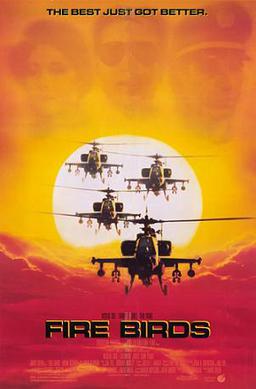
Fire Birds (1990, directed by David Green)


The South American drug cartels have been getting too aggressive so the American government decides to take them out with Apache helicopters.  Missions leaders Tommy Lee Jones and Dale Dye know that these helicopters are the ultimate weapons of death and that things could go terribly wrong if they recruit the wrong pilots.

So, of course, they get Nicholas Cage and Sean Young to fly them.

Fire Birds was an attempt to redo Top Gun with helicopters.  It does actually improve on Top Gun in that it gives the pilots an actual villain to fight.  The drug cartels and the German mercenary (Bert Rhine) that they hire are good B-movie villains and an improvement on the faceless and apparently nationless bad guys who showed up at the end of Top Gun.  What Fire Birds cannot improve on are the flying sequences because fighter planes are just more exciting than to watch than helicopters.

The best thing about the movie is that it brought Nicolas Cage and Tommy Lee Jones together and their acting styles mesh far better than I think anyone would expect.  Sean Young is about as believable as a helicopter pilot as you would expect her to be, which is to say not at all.  There’s a reason why Young’s best performance was as a robot.

“I.  Am.  The.  Greatest!” Nicolas Cage says in the movie and he sounds convinced.  Fire Birds makes the case that Cage is the greatest when it comes to making something bad watchable.  This movie would be thoroughly forgettable if not for his presence and the same can be said about a lot of other movies as well.  But, Tommy Lee Jones can lay claim to the “Greatest” title as well.   Five years after Fire Birds, Tommy Lee Jones would tell Jim Carrey, “I cannot sanction your buffoonery,” and the passage of time has shown that Jones knew what he was talking about.  Nicolas Cage and Tommy Lee Jones should make more movies together.
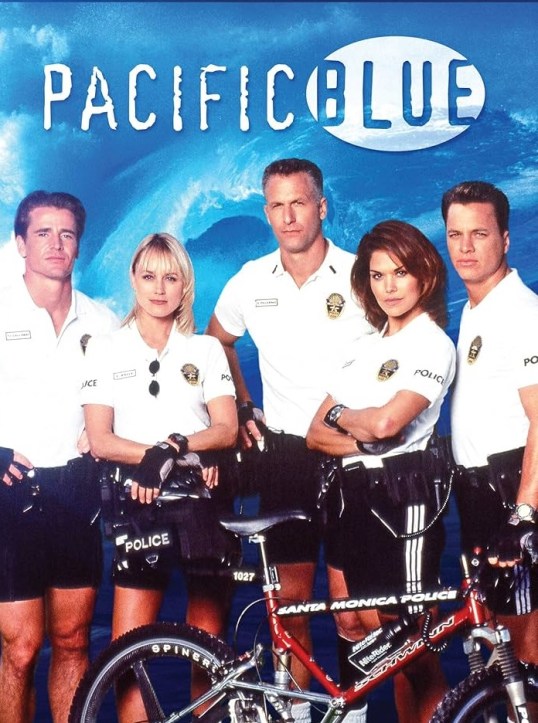
Late Night Retro Television Review: Pacific Blue 2.6 “The Enemy Within”


Welcome to Late Night Retro Television Reviews, a feature where we review some of our favorite and least favorite shows of the past! On Tuesdays, I will be reviewing Pacific Blue, a cop show that aired from 1996 to 2000 on the USA Network!  It’s currently streaming everywhere, though I’m watching it on Tubi.

Okay, let’s do this again.

Episode 2.6 “The Enemy Within”

(Dir by Stephen L. Posey, originally aired on September 28th, 1996)

A group of masked men are breaking into the homes of wealthy Vietnamese immigrants and stealing their money and jewelry.  We are told that the men are specifically targeting the Vietnamese because Vietnamese people do not trust banks or the police.  I have no idea if that’s true or not.  I just know that the show insisted that this is true with a bizarre vehemence.  To be honest, I’m Irish-Italian-Spanish in descent and I don’t trust banks or the police either.  That said, I would be kind of offended if something bad happened to me and the cops responded by going, “Eh.  It’s because she’s Irish-Italian-Spanish, what can you do?”

Kelly Hu, who is not Vietnamese, plays Wendy Trang, the granddaughter of a Vietnamese couple of have been robbed.  Her grandfather does not want to talk to the police so Wendy instead talks to her grandfather and then meets with TC to tell him what her grandfather told her.  From what Wendy tells him (which I think would be considered hearsay in a court of law), TC decides that only one of the thieves is Vietnamese and that the head of the robbery crew is probably an American who served in Vietnam and who harbors resentment towards immigrants.  Seriously, he figures that out from just having one conversation.

(Actually, maybe it was Palermo who figured it out.  Once they get on their bikes and put on their helmets, Palermo and TC are pretty much indistinguishable.)

TC recruits a psychic named Leslie Quint (Ken Weiler) to handle a knife that was left behind at the scene and to pick up on whatever psychic residue has been left behind.  Chris smirks and calls the guy a fraud because, two seasons is, the writers still haven’t bothered to give Chris a personality beyond being bitchy.  The psychic not only reveals that the leader of the gang is a big white guy but he also tells Chris that she needs to go to the dentist because she has a cavity.  (Ewwww!  Brush your teeth, weirdo!)  He also tells Cory that her never-before mentioned brother is involved in some trouble.

The psychic’s right!  Peter McNamara (William Bumiller), Cory’s brother, is a corrupt narcotics cop!

Anyway, things worked out.  The bag guys were captured.  Cory realized her brother wasn’t perfect.  Chris learned a lesson about dismissing secret powers.  TC smirked in that oddly humorless way of his.  As Palermo, Rick Rossovich seemed to be begging someone to remember that he had been in both Top Gun and The Terminator before allowing himself to get sucked into the world of Pacific Blue.

Along with Kelly Hu, this episode featured Cronenberg favorite Robert A. Silverman, playing an eccentric on the beach.  It’s always nice to see Silverman!

Otherwise, this was another stupid episode.  At some point, these characters are going to have to develop personalities beyond riding bikes and getting annoyed, right?


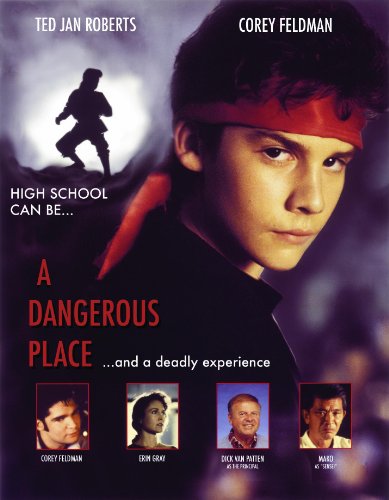
A Dangerous Place (1994, directed by Jerry P. Jacobs)


In A Dangerous Place, a young karate student avenges his brother’s death and Corey Feldman impersonates Christian Slater.

Greg (Dean Cochran) and his younger brother, Ethan (Ted Jan Roberts), are both students of a sensei (Mako) who teaches that sparing an enemy is the best way to make a friend and that true martial artists do not compete in tournaments.  Greg wants more out of karate so he starts hanging out with The Scorpions, a gang led by Taylor (Corey Feldman).  The Scorpions all belong to a dojo owned by Gavin (Marshall R. Teague), who teaches that mercy is a weakness.  When the Scorpions aren’t beating up people at the beach, they’re “scavenging.”  They break into houses and businesses, steal what they can, and claim that homeowners insurance means that they’re actually doing everyone a favor.  When one robbery goes wrong, Greg tries to stop Taylor from killing a homeowner.  Taylor fights back and the end result is Greg falling over a railing and dying.  

The Scorpions leave Greg hanging in the high school gym.  The police think that Greg committed suicide but Ethan knows that his brother would never end his own life.  Ethan knows that the Scorpions are responsible.  He leaves his old dojo and joins Gavin’s dojo.  Ethan now has an in with the Scorpions but, if Gavin and Taylor are going to trust him enough to reveal the truth about what happened to Greg, Ethan is going to have to betray his old sensei and set up a match between the two dojos.  Ethan is going to have to abandon his own peaceful principles about become as bad as the people he is trying to take down.

For a low-budget Karate Kid rip-off, A Dangerous Place is not as bad as it sounds.  Some of the fight scenes are exciting, Mako is a decent stand-in for Pat Morita, and Marshall R. Teague does a passable Martin Kove impersonation as the leader of the bad dojo.  Corey Feldman imitating Christian Slater imitating Jack Nicholson does eventually get old but, since Feldman is playing the bad guy here and we’re not supposed to like him, it actually works to the film’s advantage.  Finally, Dick Van Patten, of all people, has a small role as the high school’s principal.  Mako, Feldman, Van Patten, and karate?  A Dangerous Place is dumb but entertaining.

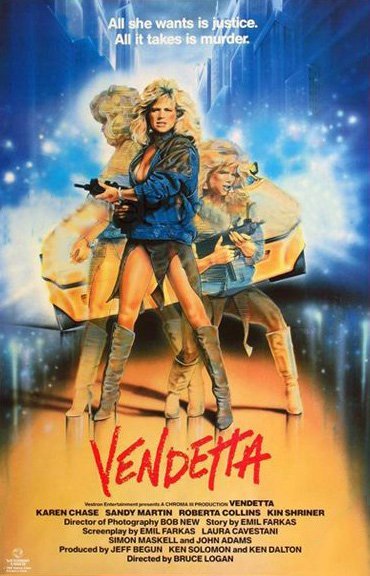
Vendetta (1986, directed by Bruce Logan)


After killing her rapist in self-defense, young and pretty Bonnie (Michelle Newkirk) is sentenced to two years in prison.  It’s one of those tough women’s prisons where all of the inmates dress like they’ve just come back from shooting an 80s music video and where the prisoners only have arcade games, a Olympic-size swimming pool, and a fully stocked gym to help them pass the time.  It’s so tough that, when it comes to conjugal visits, the prisoners have to settle for being driven to a nearby motel.  It’s the toughest prison since Leavenworth.

Because she’s blonde and innocent-looking, Bonnie is targeted by the predatory Kay Butler (Sandy Martin).  After Bonnie rejects Kay’s advances in the public shower room (while all of the other prisoners watch), Kay get her revenge by giving Bonnie a hot dose and then shoving her over a railing.  Even though all the evidence indicates that Bonnie was murdered, the official cause of death is ruled to be suicide.

What no one considered was that Bonnie’s older sister, a Hollywood stuntwoman named Laurie (played by real-life stuntwoman Karen Chase), would want revenge.  Determined to investigate the prison on her own, Laurie steals a judge’s car.  When that same judge attempts to suspend Laurie’s sentence, Laurie attacks him in the courtroom.  (Why would a judge be allowed to oversee a trial that directly involved him as a witness?)  Laurie finally gets her wish and is sentenced to prison.  Having now compiled the type of criminal record that will probably make her unemployable for the rest of her life, Laurie sets out to discover who is responsible for the death of her sister.  Soon, Laurie is tracking down and murdering every member of Kay’s gang, all the while trying to avoid getting caught by the head guard, Miss Dice (Roberta Collins).

In many ways, Vendetta is a typical 80s women-in-prison movie.  It has everything that you would expect to find in one of these movies: predatory lesbians, a victimized innocent, corrupt guards, and a gratuitous shower scene.  What sets Vendetta apart from similar films is that the prison is more of a health club than a prison and, while she’s hardly the world’s greatest actress, Karen Chase looks very credible when she’s beating the other inmates to death.  As a result, the fight scenes are more exciting than they usually are in a film like this and Karen Chase’s Laurie is a stronger heroine.  She can hold her own against anyone who comes at her.  Sandy Martin is also an effective villain and there’s actually some unexpected depth to her character.  She actually gets upset when her gang start to get killed, not just because she’s losing people who are willing to do her bidding but also because she’s losing the only people that she feels close to.  Thanks to Karen Chase’s fight skills and Sandy Martin’s unexpected performance, Vendetta is better the than the average 80s prison flick.

Cleaning Out The DVR: Crime + Punishment in Suburbia (dir by Rob Schmidt)


(Lisa is once again trying to clean out her DVR!  She’s got about 182 films on her DVR and she needs to get them all watched by the end of this year!  Will she make it?  Not if she’s too busy writing cutesy introductions for her reviews to actually watch the movies!  She recorded Crime + Punishment in Suburbia off of Flix on February 25th!)

Oh, dammit.

I have seen some really pretentious movies before but Crime + Punishment in Suburbia is really something else.  As you might be able to guess from the title, the film is supposedly based on the Dosteyevsky novel but it takes place not only in modern times but in suburbia as well.  Oh, and it actually has next to nothing in common with Doteyevsky novel, beyond a murder and occasional religious symbolism.  And by occasional, I mean that there’s a scene where Vincent Kartheiser wears a Jesus t-shirt.

Kartheiser plays Vincent, a teenager who I think we’re supposed to think is dark and disturbed but instead he just comes across like a weird little poser.  I mean, honestly, it takes more than just wearing black clothes to be weird.  I had a closet full of black clothes when I was eighteen and it still never brought me any closer to enlightenment.  Anyway, Vincent is a classmate of Roseanne (Monica Keena) and Roseanne is dating a handsome but dumb jock named Jimmy (James DeBello).  Roseanne’s mother is named Maggie (Ellen Barkin) and Maggie has recently married an abusive drunk named Fred (Michael Ironside).

Fred is a total jerk so Maggie goes out with her best friend, Bella (Conchata Ferrell), to a bar.  It’s at the bar that she meets Chris (Jeffrey Wright), a handsome and charming bartender.  Soon, Chris and Maggie are having an affair and when Fred finds out, he rapes his stepdaughter.  Roseanne convinces Jimmy to help her murder Fred but, after the deed is done, Roseanne finds herself struggling with her conscience.

Now, of course, in Crime & Punishment, the whole point is that the murder itself was largely random and motiveless.  The rest of the book deals with the protagonist’s attempt to come to terms with not only his crime but also with the meaninglessness of it all.  In Crime + Punishment in Suburbia, Roseanne has a good reason for killing Fred.  Fred is such a monster that there’s no real confusion as to why Roseanne did what she did.  One could argue, quite convincingly, that if she didn’t kill Fred, he would have ended up killing her.  That makes the film’s later attempt at moral ambiguity feel rather hollow and empty.

The other problem with Crime + Punishment in Suburbia is that we don’t see the story through Roseanne’s eyes.  Instead, the entire movie is narrated by Vincent.  Now, Vincent Kartheiser is not a bad actor.  Anyone who has seen Mad Men knows that.  And, in this film, he occasionally gets to flash a cute smile that makes the character a little bit bearable.  But the character he plays, Vincent, is so weird and off-putting that you have no desire to spend 100 minutes listening to him portentously talk about his existence.  Considering that Monica Keena actually gives a pretty good performance as Roseanne, the decision to tell her story through Vincent’s eyes feels all the more mistaken.

The only thing more overwrought than Vincent’s narration is Rob Schmidt’s direction.  This is one of those films that uses every narrative trick in the book to tell its story.  Look at the wild camera angles!  Look at the sudden slow motion!  Look at the freeze frame!  This is one of those movies that you watch and you just want to shout, “Calm down!” at the director.

Crime + Punishment in Suburbia is one to avoid.