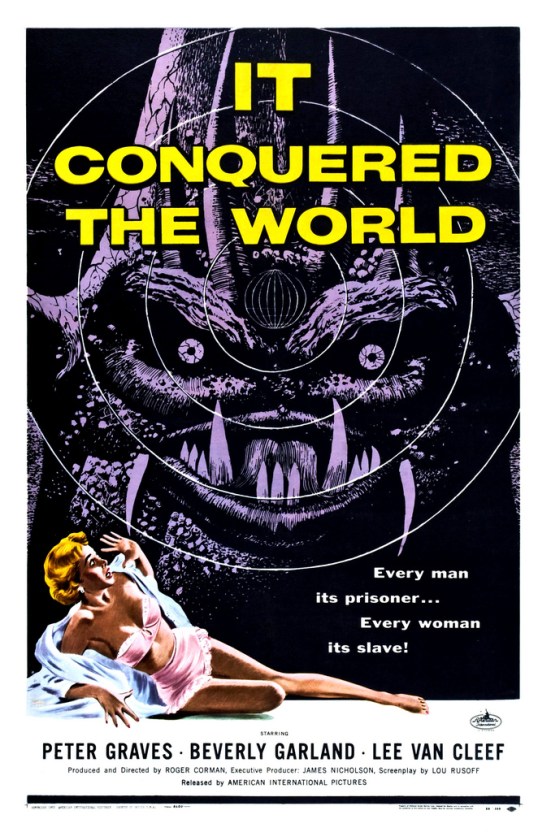
“Man is a feeling creature, and because of it, the greatest in the universe….”
So says scientist Paul Nelson (Peter Graves) towards the end of 1956’s It Conquered The Universe. Paul may be a scientist but he understands the importance of emotion and imagination and individuality. He knows that it’ll take more than just cold logic to save humanity from destruction.
Unfortunately, Paul’s best friend, Tom Anderson (Lee Van Cleef), disagrees. Tom worked at Los Alamos. Tom helped to develop the atomic bomb. Tom is convinced that humanity will destroy itself unless a greater power takes over. Tom feels that he has discovered that greater power. Tom has recently contacted a Venusian and invited it to come to Earth. Upon arriving, the Venusian promptly disrupts all electrical power on Earth. It sends out bat-like creatures that inject humans with a drug that takes control of their minds and turns them into a compliant slaves. Paul tells Tom that robbing people of their free will is not going to save the Earth but Tom remains committed to the Venusian, even as it becomes obvious that the Venusian’s main concern is with its own survival.
It Conquered The World is very much a film of the 1950s. Along with tapping into the era’s paranoia about nuclear war and UFOs, it also features Peter Graves delivering monologues about freedom and the inherent superiority of the human race. When Paul confronts Tom, he not only accuses Tom of selling out the Earth but he also attacks Tom’s patriotism. When Tom’s wife, Claire (Beverly Garland), confronts the alien and orders it to leave her plant along, she does it while wearing high heels and a tight sweater and holding a rifle. The one female scientist (played by Karen Kadler) spends most of her screentime being menaced while wearing a white slip and there’s a platoon of bumbling but unbrainwashed soldiers hanging out in the woods. If one looked up 1956 in the dictionary, there’s a very good chance this film would be the definition.
At the same time, the film’s story feels like a metaphor for modern times. When the Venusian-controlled police turn authoritarian and start threatening to punish anyone who questions their orders, we’re reminded of the excesses of the COVID lockdowns. When the editor of the town’s newspaper is shot by a policeman who says that words are no longer necessary in the new world, it’s hard not to think of all the writers, commentators, artists, and ordinary citizens who have run afoul the online cancellation brigade. When Paul is reduced to riding a bicycle from place to place, it’s hard not to think of the environmental Luddites, with their hatred of anything that makes life more convenient. When Tom rationalizes his activities by saying that humanity must be saved from itself, he’s expressing an opinion that is very popular among several people today. Tom’s embrace of cold logic feels very familiar. Of course, today, people don’t need a Venusian to order them to accept authoritarianism. Instead, they’re more than happy to do on their own.
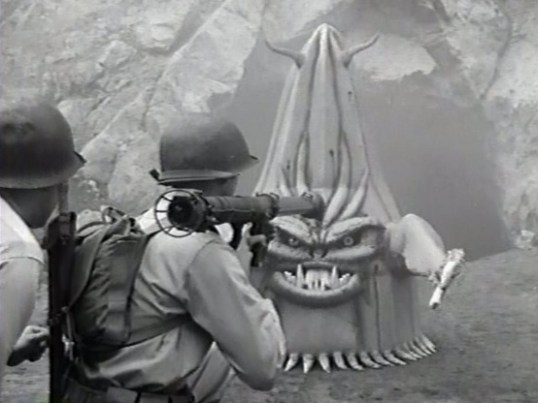
It Conquered The World was directed by Roger Corman. It was his eighth film as a director and it remains one of his most entertaining. As one might expect from a low-budget sci-fi film, It Conquered The World produces it’s share of laughs. It’s hard not to smile at the sight of the extremely serious Peter Graves peddling his bicycle from location to location. (It doesn’t help that Graves never takes off his suit or loosens his tie.) And the Venusian simply has to be seen to be believed:
At the same time, It Conquered The World holds up well. Lee Van Cleef and Beverly Garland both give performances that transcend the material, with Van Cleef especially doing a good job of paying a man struggling to rationalize his bad decisions. It Conquered The World holds up today, as both a portrait of the 50s and 2024.


 Through the Shattered Lens