The TSL Horror Grindhouse: The Beast Must Die (dir by Paul Annett)


You have 30 seconds to decide who is the werewolf.  Is it the professor?  Is it the wife of the big game hunter?  Is it the long-haired hippie who has a history of cannibalism?  Is it the concert pianist?  Is it the diplomat?  Make your guess and then….

This is the challenge that is presented to the viewers of the 1974 film, The Beast Must DieThe Beast Must Die is a werewolf film.  Calvin Lockhart stars as millionaire big game hunter Tom Newcliffe.  Tom has invited a group of people to his English mansion because, according to him, one of them is a werewolf and he plans to hunt down whoever it is.  It’s not a terrible premise and I imagine that, in 1974, it was probably quite revolutionary to cast a black actor as a millionaire with a large British estate.  (In America, the film was marketed as being a blaxploitation film under the title Black Werewolf.)

That said, The Beast Must Die is still best-known for its “Werewolf Breaks.”  At certain points in the film, a stopwatch appears on the screen and a narrator asks us if we’ve figured out who the werewolf is yet.  The viewer is given 30 seconds to make a guess before the film continues.  The “Werewolf Breaks” were apparently added to the film after production was completed and director Paul Annett was not happy about them.  The Beast Must Die is, in many ways, a pretty grim film or, at least, it would be if not for the campy narrator telling us that it’s up to us to solve the mystery.

But you know what?  I like the Werewolf Breaks.  They’re fun and, without them, The Beast Must Die would come across as being a film that takes itself way too seriously.  Calvin Lockhart, who was so good in Melinda, overacts to a tremendous degree as Tom Newcliffe and, as the film progresses, he goes from being merely eccentric to actually coming across as being rather unhinged in his attempts to discover who is the werewolf.  It’s never really clear how he settled on his suspects.  (All of them are described as being in the area of several unexplained deaths but it seems like the same could be said of probably hundreds of other people as well.)  But once he has them at the mansion, he’s determined to keep them there until he figures out which is infected with lycanthropy.  (In this film, the werewolf curse is described as basically being a virus.)

Fortunately, the suspects are played by an interesting gallery of British and American character actors.  Charles Gray plays the shady diplomat.  Malene Clark is Tom’s wife.  Michael Gambon is the pianist while Ciaran Madden plays his wife.  Tom Chadbon plays the hippie cannibal while Anton Diffring shows up as the head of security for the mansion.  Best of all, Peter Cushing plays the professor who is an expert on werewolves.  It’s always a joy to see Peter Cushing in any film.  He’s particularly good here, handling his often overwritten dialogue like the pro that he was.

The Beast Must Die is an uneven film.  The opening sequence, which features Tom testing the mansion’s security systems, seems to go on forever and the plot is full of twists that fall apart if you give them too much thought,  But the Werewolf Breaks made me smile and the supporting cast is a delight.  It’s a fun film to watch during the Halloween season.
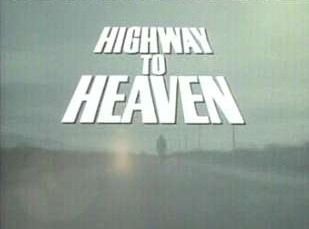
Late Night Retro Television Review: Highway to Heaven 4.4 “The People Next Door”


Welcome to Late Night Retro Television Reviews, a feature where we review some of our favorite and least favorite shows of the past!  On Thursdays, I will be reviewing Highway to Heaven, which aired on NBC from 1984 to 1989.  The entire show is currently streaming on Tubi and several other services!

This week, Jonathan and Mark take on prejudice.

Episode 4.4 “The People Next Door”

(Dir by Michael Landon, originally aired on October 21st, 1987)

Dr. William Martin (David Spielberg) is living a double life.  His family and his neighbors know him as a white doctor who lives in a suburban community and who is a part of the homeowner’s community.  He’s told his wife and his son that his parents died before he met them.

His mother knows him as Dr. Guillermo Martinez, who works at the free clinic in the economically disadvantaged area of town.  Anna Martinez (Mariam Colon) works as a maid and has no idea that her son is married and that she’s a grandmother.

Guillermo changed his name and lied about his ethnicity so that he could get ahead as a doctor and it’s worked for him.  His best friend is Brad Bowman (John Lawlor), the real estate agent who is dedicated to making sure that only “the right people” move into the neighborhood.  But when Jonathan and Mark show up as rival real estate agents and hire Anna to help them clean up the house next door, William/Guillermo is forced to face the truth about who he is.

At the start of this episode, Jonathan tells Mark that their assignment is not only to show William the foolishness of denying his heritage but to also help William’s neighbors become more tolerant.  They definitely help out William but they don’t really seem to have much luck with the neighbors.  Brad Bowman (no relation!) is as much of a bigot at the end of the show as he was at the start.  Jonathan and Mark do arrange for a black family to move into the empty house and then Jonathan and Mark promptly leave the neighborhood.  So, I guess the responsibility for teaching everyone else tolerance is going to be on the new homeowners.  This is one of those episodes where you wish Jonathan had actually gone to extremes to make his point, instead of just arranging for people to run into each other while wandering around the neighborhood.  I know that some people would say, “Well, Brad’s just a bad person,” but wasn’t one the original themes of this show that everyone had the potential to see the light, learn the errors of their ways, and be redeemed?

While the show suggested that there was no hope for Brad to see the error of his ways, it also let Guillermo off way too easy.  His wife was surprisingly understanding about her husband lying to her for years.  And, in the end, his mother was surprisingly forgiving about him lying about the fact that she had a grandson.  Jonathan scolded him briefly but that was pretty much it.  My grandmother, who came to this country from Franco’s Spain, would not have been as forgiving.

This episode was well-intentioned but didn’t quite work.

The TSL Horror Grindhouse: Lord Shango (dir by Ray Marsh)


The 1975 film, Lord Shango, takes place in a small, rural town in the Deep South, where the population appears to be firmly divided between those who worship at an evangelical Christian church and those who follow the Yoruba religion.

(To answer the obvious question, I have no idea how faithful this film is to the realities of the Yoruba religion.)

Jenny (Marlene Clark), who is a waitress at a local restaurant, is a member of the evangelical church, largely because her boyfriend is a member and he thinks that her attending the church will help her to get pregnant.  Her daughter, Billie (Avis McCarther), is in love with Femi (Bill Overton), who is a follower of the Yoruba religion.  One Sunday morning, while all the church people sings hymns, a series of baptisms are held in a nearby river.  When it is time for Billie to baptized, Femi rushes into the water and objects.  After he shoves her out of the river, the men of the church grab Femi and announce that the evil must be taken out of him through what appears to be a forced baptism.  They force him under the water but, with Femi struggling, the end up holding him down for too long and Femi drowns.

Traumatized, Billie sinks into depression and Jenny grows disillusioned with the church, especially when the men who held Femi down refuse to take any responsibility for their actions.  She also learns that her boyfriend, Memphis (Wally Taylor), had sex with Billie after Billie mistook him for being the spirit of Femi.  When she finds Memphis praying in the church, she proceeds to yell and curse at him while he pathetically apologizes.

The next morning, Jenny wakes up to discover that Billie has run away, leaving behind a note that simply reads, “I can no longer live in your house.”  When the men of the church again prove to be insensitive and ineffectual when it comes to finding out where Billie has gone (and instead are more concerned about why Jenny and Memphis has not been coming to the prayer meetings), Jenny turns to Femi’s friend, Jabo (Lawrence Cook).  Under Jabo’s guidance, Jenny offers up a series of sacrifices to the local Yoruba priest (Maurice Woods) and asks for her daughter to return home.

The sacrifices appear to work.  Billie returns home and reveals that she’s pregnant with a baby that she believes to be Femi’s and which Jenny believes to be Memphis’s.  Jenny, now firmly under the control of Jabo, continues to make sacrifices and bad things continue to befall the men that she holds responsible for Femi’s death….

A frequently surreal film, Lord Shango is an interesting, if not always easy-to-decipher, portrayal of the battle of two different belief systems.  While the evangelical Christianity that Jenny first followed could only promise an eventual reward, Jabo’s tribal religion offers her immediate reward and revenge.  (Significantly, even though Billie was in love with Femi and wants to have his child, she has no interest in following his religion.)  The film is often edited to provide a direct contrast between the staged cermonies of evangelical Christianity and the sensuality of the Yoruba religion.  The film is full of Southern gothic atmosphere and is well-acted, particularly by Lawrence Cook and Marlene Clark.  That said, the film is also frequently very difficult to follow.  At times, one gets the feeling that the film is being surreal simply to be surreal and it’s hard to find a coherent message in the film’s collection of odd scenes and strange dialogue.

Lord Shango is a frequently intriguing film, as long as you’re willing to accept a little incoherence.

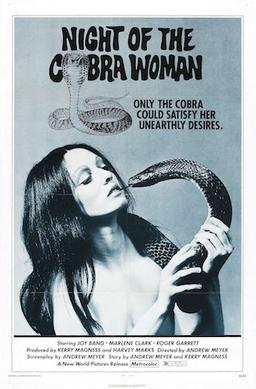
The TSL Horror Grindhouse: Night of the Cobra Woman (dir by Andrew Meyer)


The 1972 film, Night of the Cobra Woman, tells the story of Lena (Marlene Clark).

During World War II, Lena was a nurse assigned to the Philippines.  When she and a friend were attacked in the jungle by a Japanese soldier, Lena’s friend was raped while Lena was bitten by a cobra named Movini.  As the result of being raised by a snake cult, Movini’s super-powered venom conferred eternal youth, beauty, and sexual energy.  It also gave Lena the power to turn into a snake.  After subduing the Japanese soldier and turning him into her slave, Lena made a life for herself in the jungle.  Worshipped by the locals, Lena became known for never aging.

Years later, a young UNICEF worker named Joanna (Joy Bang) is working at a laboratory in the Philippines.  Having heard about Lena’s special snake venom, Joanna heads out to Lena’s compound to ask her how the venom works.  However, Joanna is chased off by Lena’s mute man-servant (Vic Diaz).  Later, Joanna’s boyfriend, Duff (Roger Garrett), decides to head out to the compound himself and see what’s going on.

When Duff doesn’t return, Joanna heads out to the compound a second time.  This time, she brings along Duff’s pet eagle.  Joanna is confronted by Lena, who claims that Duff has been bitten by a cobra and has been recovering at the compound.  After Movini hisses at Joanna, Joanna released the eagle.  The eagle promptly kills Movini.

Now, this sets up a bit of a problem.  Lena needed Movini because it was Movini’s venom that was keeping her young and preventing her from turning into a snake and then not being able to change back.  Now that Movini is dead, Lena has to head into Manila and find men to seduce so that she can live off of their life force.  Helping her out is Duff, who has apparently been brainwashed by Lena and will now do anything to help her, including setting her up with an American serviceman (who is played by an actor named, I kid you not, Slash Marks.)  Duff himself starts to rapidly age and turn into a snake.  Can Joanna save him and, more importantly, why would she want to?  Seriously, Duff left her for another woman.  Joanna doesn’t owe him anything!

Night of the Cobra Woman is a thoroughly incoherent movie, one that feels as if it was made up on the spot while filming was taking place.  Duff’s decision to go to Lena’s compound on his own never makes sense, nor does it really make much sense that Joanna doesn’t seem to be that upset by the fact that he basically just abandoned her to live with the Cobra Woman.  That said, Night of the Cobra Woman does have a cult following because it’s one of the eight films that Joy Bang made during her career.  Bang (and that was her real name, as her husband was named Paul Bang) specialized in playing flighty hippies and, as a result, she’s not exactly believable as an expert in snake venom.  But the fact that she is so miscast adds to the film’s charm.  She has pretty much the same freaked-out reaction to seeing a cobra that I would have, making her a character to whom I could at least relate.

Anyway, Night of the Cobra Woman is not that good but Joy Bang completists will definitely want to check it out.

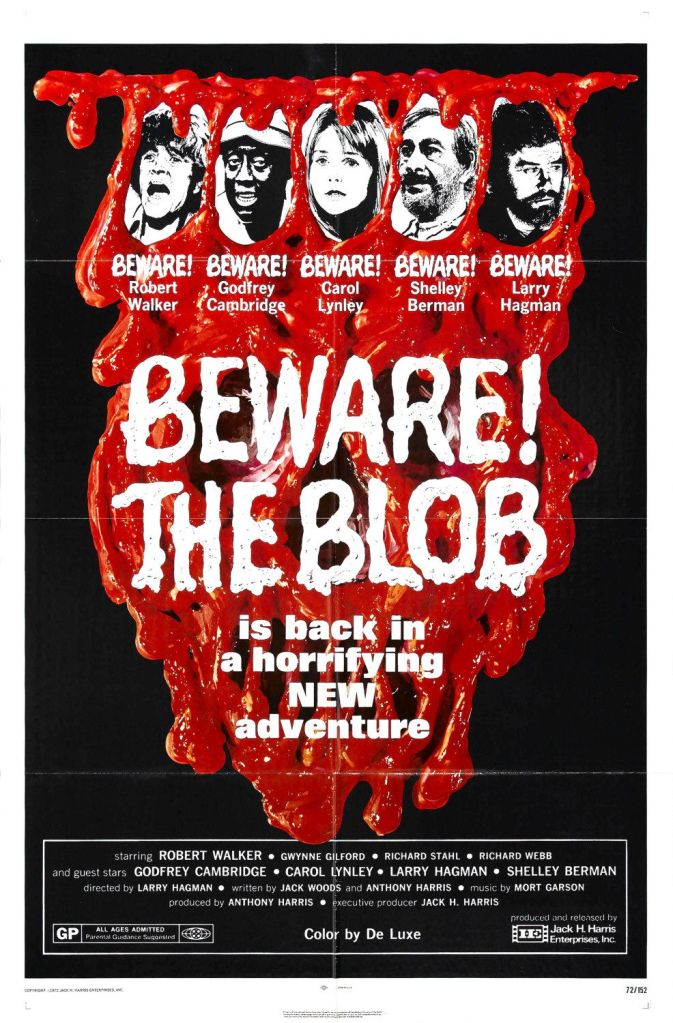
Movie Review: Beware! The Blob (by Larry Hagman)


Everyone has one movie or two that hit them so hard it caused them to develop habits. It could be shaking your shoes to confirm no spiders are in them, counting the seconds after a lightning strike for the thunder, or checking the back seat of your car before you get into it, just in case. Some movies kind of imprint themselves on you in different ways.

Beware! The Blob (or Son of The Blob in some circles) was the most terrifying film I saw as a kid. I watched it in front of my grandmother’s living room tv that had a little alarm clock on the floor beneath it. Unlike Friday the 13th and Halloween, where I could rationalize my fears, Beware! The Blob had me fearing the summer and any open crevice we had. On any visits to our local video store (in the Pre-Blockbuster days), I’d pick out video games to rent and could see the box for the film in the horror section. I’d never walk over there, even in my early teenage years.

Most consider the 1958 original a Classic, and Chuck Russell’s 1988 update often goes toe to toe with John Carpenter’s The Thing on the Best Remakes list. Beware! The Blob will probably never make that list, but it’s not a total loss, given a recent rewatch. The film’s greatest strengths are in the casting and the special effects. From a cinema history/trivia standpoint, the film marks one of the earliest credits for Cinematographer Dean Cundey. Cundey worked as a 2nd Unit Cinematographer for the film, particularly with the animal shots in the opening and later on. That might not sound like much, but Cundey would go on to be picked by Debra Hill to help out on Halloween in 1978. From there, he had The Fog, Halloween II, The Thing, Romancing the Stone, Back to the Future, Big Trouble in Little China, Who Framed Roger Rabbit?, and Jurassic Park, to name a few.

With 14 years since the first film, there were some tech upgrades to how the blob was made. A large plastic balloon was used for some scenes (particularly the bowling alley sequences). Additionally, silicone was added to a drum to allow for the “blob pov” during the bowling alley sequences. In most sequences, a red dyed powder mixed with water was used. To make sure the audience was aware the Blob was close, a high whistle would sound, giving anyone with even the slightest bit of tinnitus some cause to look over their shoulder. Academy Award Winner Tim Baar (The Time Machine) and Conrad Rothmann worked on the effects, along with Cundey.

In his film directing debut, Larry Hagman (TV’s I Dream of Jeannie, Dallas) weaves a tale of horror lurking through a town peppered with parties, hobos, a boy scout team, an angry bowling alley owner, some dune buggy aficionados and a sheriff (Richard Webb, The Phantom Stagecoach) who’s a little confused about some of the events happening in town. To his credit, it’s amazing to see who Hagman assembled here, as he called in some friends to join in on the fun. Comedian Godfrey Cambridge. Cindy Williams, just a few years shy of American Graffiti. Gerrit Graham, about two years before Phantom of the Paradise. Sid Haig (The Devil’s Rejects) is here as well. You can even spot Hagman in the film as one of three hobos squaring off with the Blob. It should be noted that the other two hobos with him are Burgess Meredith (Clash of the Titans) and Del Close (Chuck Russell’s The Blob).

The film flows like it’s namesake, with some chapters having little do to with anything – Dick Van Patten’s boy scouts, while funny, could have had one of their scenes cut for speed. It’s not incredibly terrible, but it’s exactly great, either. Most of the script, written by Anthony Harris, was tossed with ad-libbing done on set. Despite all this, it does looks like the cast enjoyed themselves making the film. It has that going for it, at least.

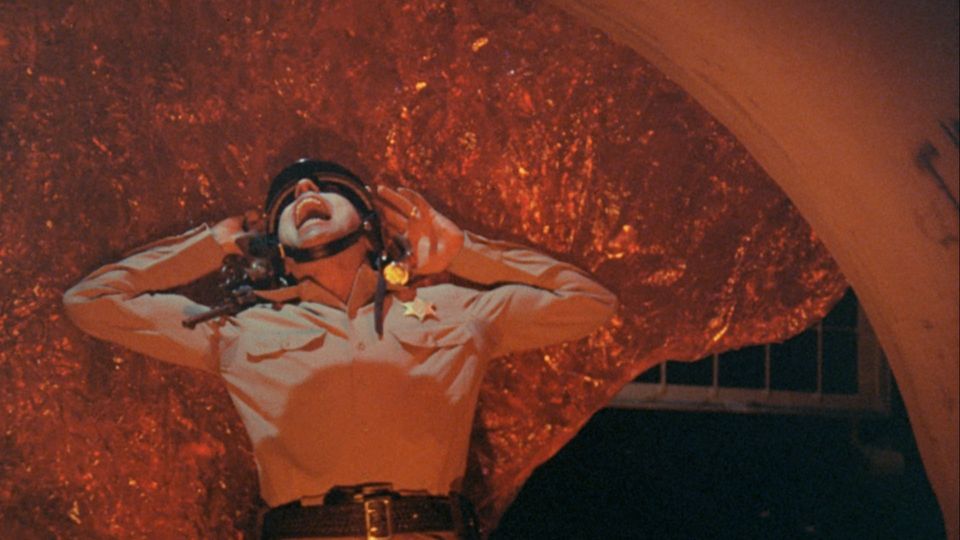
Sid Haig was caught unaware in Larry Hagman’s Beware! The Blob

Chester, A construction worker from the Arctic (Cambridge) is getting his camping gear stowed away when his wife, Marlene (Marlene Clark, The Beast Must Die) discovers a thermos in their freezer. He explains he performed some work and brought home a piece of what the found in the Arctic. Setting it on a countertop, the couple forget about the thermos, which pops open. The newly released blob absorbs a fly and a kitten before moving on to larger prey. Before we know it, Chester is having problems with his TV – which happens to be playing the original 1958 movie – as it slithers into his favorite recliner. It’s a sequence that’s burned into my mind. I always check a chair before sitting in it. Some check for thumbtacks, I check for alien goo.

When Lisa (Gwynne Gilford, Masters of the Universe & actor Chris Pine’s Mom) discovers Chester with his new friend, she dashes out and heads to her boyfriend, Bobby (Robert Walker, Easy Rider). By the time the couple return to Chester’s place, they find the house empty. Can the couple convince the cops and the town of the danger ahead before it’s too late? Most of Beware! The Blob‘s scenes are set up in a way where people are completely oblivious of it until it’s touched them, causing said individual to slip and fall into the camera. The climax of the film takes place in a bowling alley, which is actually impressive for the techniques used, but even with the casting, you might spend more time laughing than anything else. Perhaps that’s my way of rationalizing the film years later.

At the time of this writing, Beware! The Blob is currently available to watch on the Plex streaming service. We’re also labeling this an Incident – out of respect to the kitten – and returning the timer to Zero.

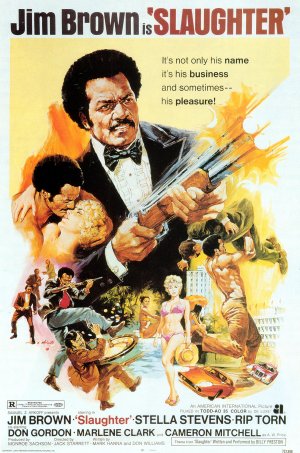
A Movie A Day #156: Slaughter (1972, directed by Jack Starrett)


The Mafia just pissed off the wrong ex-Green Beret.

After his father is blown up by a car bomb, Captain Slaughter (Jim Brown) single handily wipes out the Cleveland mob.  Only one gangster, Dominic Hoffo (Rip Torn), escapes to South America.  The Treasury Department (represented by Cameron Mitchell) sends Slaughter and two other agents (Don Gordon and Marlene Clark) after Hoffo.  Along with being a ruthless gangster, Hoffo is a viscous racist and is convinced that he will be able to easily take care of Slaughter.  Hoffo does not understand how much trouble he’s in.  No one stops Slaughter.

Produced by American International Pictures, Slaughter is one of the classic blaxploitation films. While it may not have the political subtext of some of the best blaxploitation films, Slaughter is a fast and mean action film, directed in a no nonsense manner by B-movie veteran Jack Starrett.  There is not a wasted moment to be found in Slaughter.  It starts and ends with cars exploding and, in between, it doesn’t even stop to catch its breath.

In the 1970s, Richard Roundtree was John Shaft, Ron O’Neal was Superfly, Jim Kelly was Black Belt Jones, Fred Williamson was Black Caesar, and Jim Brown was Slaughter.  Whatever skills Jim Brown lacked as an actor, he made up for with sheer presence.  He commanded the screen.  Whether he was playing football on television or beating down the Mafia in the movies, no one could stop Jim Brown.  Slaughter is Brown at his toughest.  Rip Torn is the perfect villain, screaming out racial slurs even when Slaughter has him trapped in an overturned car.   Jim Brown has said that, of all the films he has made, Slaughter is one of his three favorites.  (The other two were The Dirty Dozen and Mars Attacks!)

Slaughter‘s cool factor is increased by the presence of Stella Stevens, playing the role of Ann, Hoffo’s mistress.  It only takes one night with Slaughter for Ann to switch sides.  Nothing stops Slaughter.

Horror on the Lens: The Beast Must Die (dir by Paul Annett)


For today’s horror on the lens, we have The Beast Must Die.  In this 1974 film, millionaire Tom Newcliffe (Calvin Lockhart) invites a group of people to spend the weekend at his mansion.  Tom explains that one of them is a werewolf and therefore “must die.”

But who is the werewolf?  Tom has come up with several werewolf tests but, actually, it turns out that the easiest way to discover the identity of the werewolf is to just let the werewolf kill everyone who isn’t a werewolf.  Or, at least, that’s the way it seems to me.

The best thing about The Beast Must Die is that it features a 30-second werewolf break where the audience is encouraged to announce who they think the werewolf is before the actual solution is revealed!

Seriously, many movies would be greatly improved with a werewolf break.

Enjoy!

http://www.youtube.com/watch?v=BVuIYlDHkLQ