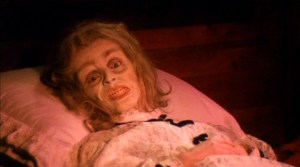
Christopher Lee, R.I.P.


Jinnah

The picture above is Christopher Lee in the 1998 film Jinnah.  In this epic biopic, Lee played Muhammad Ali Jinniah, the founder of modern Pakistan.  Up until yesterday, I had never heard of Jinnah but, after news of Lee’s death broke, Jinnah was frequently cited as being Lee’s personal favorite of his many roles and films.

Consider that.  Christopher Lee began his film career in the 1940s and he worked steadily up until his death.  He played Dracula.  He played The Man with the Golden Gun.  Christopher Lee appeared, with his future best friend Peter Cushing, in Laurence Olivier’s Oscar-winning Hamlet.  He played Seurat in John Huston’s Moulin Rouge.  He appeared in both The Lord of the Rings and the Hobbit trilogies.  He appeared in several films for Tim Burton.  He even had a small role in Martin Scorsese’s Hugo.  He appeared in two Star Wars prequels.  He appeared in the original Wicker Man (and reportedly considered it to be his favorite of his many horror films).  He appeared in Oscar winners and box office hits.  And, out of all that, Christopher Lee’s personal favorite was Jinnah, a film that most people have never heard about.

Unless, of course, you live in Pakistan.  When I did a google search on Christopher Lee, I came across several Pakistani news sources that announced: “Christopher Lee, star of Jinnah, has died.”

And really, that somehow seems appropriate.  Christopher Lee was the epitome of an international film star.  He worked for Hammer in the UK.  He worked with Jess Franco in Spain and Mario Bava in Italy.  He appeared in several movies in the United States.  And, in Pakistan, he played Jinnah.  And I haven’t seen Jinnah but I imagine he was probably as great in that role as he was in every other role that I saw him play.  Over the course of his long career, Christopher Lee appeared in many good films but he also appeared in his share of bad ones.  But Christopher Lee was always great.

It really is hard to know where to begin with Christopher Lee.  Though his death was announced on Thursday, I haven’t gotten around to writing this tribute until Friday.  Admittedly, when I first heard that Lee had passed away, I was on a romantic mini-vacation and had promised myself that I would avoid, as much as possible, getting online for two days.  But, even more than for those personal reasons, I hesitated because I just did not know where to start when it came to talking about Christopher Lee.  He was one of those figures who overwhelmed by his very existence.

We all know that Christopher Lee was a great and iconic actor.  And I imagine that a lot of our readers know that Lee had a wonderfully idiosyncratic musical career, releasing his first heavy metal album when he was in his 80s.  Did you know that Lee also served heroically during World War II and, after the war ended, helped to track down fleeing Nazi war criminals?  Did you know that it has been speculated that Lee may have served as one of the role models for James Bond?  (Ian Fleming was a cousin of Lee’s and even tried to convince Lee to play Dr. No in the first Bond film.)  Christopher Lee lived an amazing life, both on and off the screen.

But, whenever one reads about Christopher Lee and his career or watches an interview with the man, the thing that always comes across is that, for someone who played so many evil characters, Christopher Lee appeared to be one the nicest men that you could ever hope to meet.  Somehow, it was never a shock to learn that his best friend was his frequent screen nemesis, Peter Cushing.

Christopher Lee is one of those great actors who we assumed would always be here.  The world of cinema will be a sadder world without him.

Legends together

Legends together

Here is a list of Christopher Lee films that we’ve reviewed here on the Shattered Lens.  Admittedly, not all of these reviews focus on Lee but they do provide a hint of the man’s versatility:

  1. Airport ’77
  2. Dark Shadows
  3. Dracula A.D. 1972
  4. Dracula Has Risen From The Grave
  5. Dracula, Prince of Darkness
  6. Hercules in the Haunted World
  7. The Hobbit
  8. The Hobbit: Battle of the Five Armies
  9. Horror Express
  10. The Horror of Dracula
  11. Hugo
  12. Jocks
  13. The Man With The Golden Gun
  14. The Satanic Rites of Dracula
  15. Scars of Dracula
  16. Scream and Scream Again
  17. Season of the Witch
  18. Starship Invasions
  19. Taste The Blood of Dracula
  20. The Wicker Tree

Sir Christopher Lee was 93 years old and he lived those 9 decades in the best way possible.  As long as there are film lovers, he will never be forgotten.
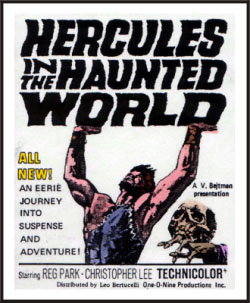
Horror On The Lens: Hercules In The Haunted World (dir by Mario Bava)


Herculesinthehauntedworld

In many ways, 2014 was the year of Hercules.  Or, at the very least, it could have been the year of Hercules.  Neither one of the two Hercules film released this year exactly managed to set the American box office on fire.  Of the two, The Legend of Hercules was memorable largely for being forgettable while the Dwayne Johnson-starring Hercules was far better than any film directed by Brett Ratner has any right to be.

Neither one of them, however, can really hold a candle to the 1961 film, Hercules In The Haunted World.  In this Italian film, Hercules (Reg Park) discovers that his lover Princess Deianira has gone insane so he goes to Hades in order to get the Stone of Forgetfulness, so he can use it to cure her.  The story’s really not that important.  What is important is that this visually stunning film was the first color film to be directed by Mario Bava and that the film’s villain is played by Christopher Lee.

Enjoy!

The First Six Trailers of 2013


Finally!  It’s 2013 and it’s time for another edition of Lisa Marie’s Favorite Grindhouse and Exploitation Film Trailers!

1) The Incredibly Strange Creatures Who Stopped Living and Became Mixed-up Zombies (1966)

With a title that long, how couldn’t this be a good movie?

2) Frankenstein Meets The Space Monster (1965)

3) Frankenstein Conquers The World (1965)

1965 was obviously a busy year for Frankenstein.

4) Charlie and the Hooker (1977)

With a name like Charlie and the Hooker, you know it’s going to be a fun film for the whole family.  And no, this is not a Charlie Sheen biopic.

5) A Taste of Blood (1967)

From the director Herschell Gordon Lewis…

6) Lisa and the Devil 

And finally, in honor of the new year, here is the trailer for one of my favorite films of all time — Mario Bava’s Lisa and the Devil.

What do you think, trailer kitties?

582396_552198271458521_1029447361_n (1)


6 Trailers For The Day Before Halloween


Hi there!  Well, it’s the day before Halloween and that can only mean that it’s time for another edition of Lisa Marie’s Favorite Grindhouse and Exploitation Film trailers!

1) How To Make A Monster (1958)

This movie, which involves the danger of angering a Hollywood makeup artist, seems especially appropriate for Halloween.

2) Halloween 3: Season of the Witch (1982)

This is a movie that generated some debate on this site just a few weeks ago.  I happen to like it but I’m in a minority.  What can I say?  I’m a sucker for any film that features an Irishman destroying the world.

3) Hatchet For The Honeymoon (1970)

This film is from the great Italian director, Mario Bava.

4) The Toolbox Murders (1978)

This film is proof that you should never trust a man with a toolbox.

5) The Initiation (1984)

“They pledged themselves to be young, stay young … and die young.”  Well, I guess that’s one way to stay forever young.

6) Night of the Zombies (1980)

Finally, how can you do a Halloween trailer post and not include at least one zombie film?

What do you think, Trailer Kitties?

6 Trailers From The Girl Who Has Returned Home


Now that I’m back home from my vacation, it’s time for me to post yet another installment in my raison d’être, Lisa Marie’s Favorite Grindhouse and Exploitation Film Trailers!  In keeping with this month’s theme, all of today’s trailers are horror-related.

Enjoy!

1) Virus (1980)

Let’s start things out with the end of the world.  From 1980, it’s the story of what happens when the world gets hit by the “Italian flu.”

2) The Evil of Frankenstein (1964)

It’s just not October without some Hammer horror.

3) Horror of Dracula (1958)

And wherever you have Frankenstein, you have to have Dracula…

4) The Mummy’s Shroud (1967)

As long as we’re taking a look at Hammer horror icons, let’s not forget the Mummy.

5) Baron Blood (1972)

This film is from the great Italian filmmaker, Mario Bava.

6) Invasion of the Blood Farmers (1972)

“They plant the dead and harvest the living!”

6 Trailers For A Happy Memorial Day Weekend


Hi there!

To all of our readers in the USA, Happy Memorial Day Weekend!

To all of our readers elsewhere in the world, happy weekend!

Suddenly, after typing that, I realize that — with typical American arrogance — I have just assigned the majority of the world to elsewhere.  Agck!  Those obnoxious (but cute) German Marxists that I got into all those arguments with when I went to Italy were right!

But you know what?  A weekend like this is a good time to acknowledge that film is an international art form.  Today’s edition of Lisa Marie’s Favorite Grindhouse and Exploitation trailers features an early test run for Captain America, two films from Italy, and two films starring one of my international stars, the late David Warbeck.  (Did you know that Warbeck came close to being cast in the role of James Bond?  Daniel Craig could learn a lot from watching a few Warbeck films.)

Enjoy!

1) Captain America (1990)

What better way to start off this memorial day edition of Lisa Marie’s Favorite Grindhouse and Exploitation Film trailer than by featuring the trailer for Captain America?  No, this is not the trailer for the film that we all went and saw last year.  This, apparently, was that film’s low-budget ancestor.  In this version, Capt. America is played by Matt Salinger, the son of writer J.D. Salinger.

2) The Last Hunter (1981)

This Viet Nam War film from Antonio Margheriti is surprisingly good and features an excellent lead performance from one of my favorite of the old exploitation veterans, David Warbeck.

3) Black Snake (1973)

Speaking of David Warbeck, he’s also featured in this rather uncomfortable trailer for Black Snake, a 1973 film from Russ Meyer.

4) Track of The Moonbeast (1976)

This one is included in my 50 Chilling Classics Boxset from Mill Creek so I’ll probably be watching it sometime next week.

5) Trick Baby (1972)

After I saw this trailer, I called up everyone I knew and I whispered, “Trick baby, trick baby…” to them.  Most of the reactions were positive.

6) Blood and Black Lace (1963)

Finally, what better way to welcome a holiday than with a little Mario Bava?  This is the trailer for his classic giallo, Blood and Black Lace.

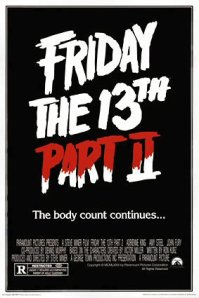
Film Review: Friday the 13th Part 2 (dir. by Steve Miner)


(Spoilers Below)

This the one where the nice guy in the wheelchair gets a machete to the face.

There’s a lot of different ways that you can describe Friday the 13th Part 2.  It’s a horror movie, a slasher flick, and a sequel.  It’s the first Friday the 13th movie to feature Jason Voorhees as the killer.  It’s also one the best installments in the franchise.  However, to me, this will always be the movie where the nice guy in the wheelchair gets a machete to the face.

Originally released in 1981, Friday the 13th Part 2 is, of course, about more than just the nice guy in the wheel chair getting a machete to the face.  The film opens with Alice (Adrienne King), the sole survivor from the first film, struggling to get on with her life a year after the massacre.  She has a small apartment that, in a nice touch, is full of drawings of the disfigured boy who attacked her at the end of the previous film.  One night, Alice’s cat startles her by jumping out of a closet and shouting, “Watch out, there’s a mysterious killer in here.”  Foolishly, Alice ignores her cat and ends up getting an ice pick rammed into her head. 

(If only people listened to their cats…)

Five years later, Camp Crystal Lake is once again reopening, this time under the direction of alpha male Paul Holt (John Furey).  Paul and his annoying sidekick Ted (Stu Charro) tell everyone not to worry about any old rumors about some mysterious murderer killing anyone who goes to Crystal Lake.  Meanwhile, Crazy Ralph (Walt Gorney) is wandering around, going all “You’re all doomed!” and then watching as Paul’s girlfriend Ginny (Amy Steel) undresses in her cabin.  Bad Crazy Ralph!  Luckily, Crazy Ralph then gets strangled with barbed wire.  (Ouch!  I guess he was the one who was doomed, huh?  Get it?  Anyway…)

Paul, Ginny, annoying Ted, and the rest of the counselors decide to head into town so they can spend the night getting drunk.  However, a few counselors decide to remain at the camp.  (Again, this just goes to prove that slasher films are not only about punishing people for having sex and doing drugs.  If the majority of this installment’s victims had simply been willing to go get drunk, they would have survived.)  Remaining at the camp: horny couple Jeff and Sandra (Bill Randolph and Marta Kober),  Terry (Kirsten Baker), who for some reason refuses to wear underwear, Scott (Russell Todd), who is obsessed with Terry but could do so much better, sweet-natured Vicki (Lauren-Marie Taylor), and finally Mark (Tom McBride), the nice guy in the wheelchair.

Anyway, if you’ve ever seen a slasher film than you can guess what pretty much happens.  Jason (played here by Steve Daskawisz) shows up and kills everyone until eventually Ginny and Paul return to the camp.  (Annoying Ted stays behind to keep drinking and somehow manages to survive the film.  It’s an odd slasher film where the nice guy in the wheelchair gets killed but the obnoxious, dorky guy somehow makes it through.)  There’s a big, genuinely exciting final battle with Ginny and Paul on one side and Jason on the other.  Ginny survives, Jason escapes, and Paul … well, who knows?  One moment, Paul’s there and the next he’s gone.  I’m still trying to figure that one out.

Friday the 13th Part 2 is controversial among many horror fans because so many of the killings are identical to the killings from an earlier slasher film, Mario Bava’s brilliant Bay of Blood (a.k.a. Twitch of the Death Nerve).  One especially obvious example is the double impalement of Jeff and Sandra and when I say obvious, I mean that the exact same scene can be found in Bay of Blood.  In Peter M. Bracke’s history of the franchise, Crystal Lake Memories, Part 2’s self-important screenwriter, Ron Kurz, claims to have never heard of Bay of Blood.  And to that, I say, “Whatever, Ron Kurz.  You’re either a liar or you actually don’t know who Mario Bava is.  Either way, you suck.”

Though Friday the 13th Part 2 is obviously a rather derivative film and frequently doesn’t make much sense, it’s also a personal favorite of mine as far as 80s slasher films are concerned.  The cast is likable and attractive (especially Russell Todd, who gets killed way too early as far as I’m concerned) and some of the kill scenes are genuinely well done.  Amy Steel, much like Adrienne King before her, make for a strong heroine and her final battle with Jason is actually pretty exciting.  The true star of the film, however, is director Steve Miner who fills each scene with a sense of genuine menace that goes a long way to making up for Ron Kurz’s sloppy script.  As opposed to Sean Cunningham (who directed the first film), Miner shows a genuinely inventive visual sense.  My favorite shot in the film is a rather minor one of a bunch of cars driving down a shadowy road.  The scene doesn’t really add anything to the story and it almost feels like filler but it’s still effectively eerie.

It could be argued that Friday the 13th Part 2 is the first true Friday the 13th because it’s the first film to actually feature Jason Voorhees killing camp counselors.  The character of Jason makes even less sense in this film than he did when he was just some kid living underwater in the first film.  It’s impossible to watch the film and not wonder how 1) Jason suddenly went from being a 13 year-old living in a lake to a 40 year-old living in a shack in the woods, 2) how Jason managed to track down Alice, 3) how Jason managed to then walk all the way to Alice’s new home and then all the way back to Crystal Lake without anyone noticing him, and 4) why exactly has Jason been hiding in the woods all this time and apparently allowing his mother to believe that he was dead.  That said, I actually think that Jason is probably at his scariest in Friday the 13th Part 2.  A lot of that has to do with the fact that, instead of wearing that famous hockey mask, Jason spends most of the movie with a burlap sack over his head.  As opposed to the hockey mask (which makes Jason look rather Canadian), both the sack and Jason’s odd overalls make him look like a faceless demon that’s sprung, full of fury, out of rural folklore.

Though it made less than the first film, Friday the 13th Part 2 was a financial success.  Audiences ignored the film’s many critics and they flocked to see it.  Not surprisingly, Paramount Pictures immediately called for a sequel.

The end result — Friday the 13th Part 3 — would be one of the worst horror films ever made.

We’ll deal with that tomorrow.   

Film Review: The Woman In Black (dir. by James Watkins)


Taking place in turn-of-the-century England, The Woman In Black tells the story of Arthur Kipps (played by Daniel Radcliffe), a young lawyer who is still struggling to recover from the death of his wife four years previously.  Arthur is sent to an isolated village to settle the estate of a woman named Alice Drablow.  Despite several warnings from the superstitious townspeople, Arthur goes to Alice’s decrepit old mansion and he soon finds himself haunted by fleeting glimpses of a woman in black who seems to be in the house with him.  With each sighting of the woman in black, another child in the village commits suicide.

Despite a few genuinely disturbing scenes (mostly involving children committing suicide), The Woman In Black is, ultimately, a pretty typical PG-13 horror film.  There’s a few good, if predictable, jump scenes (most of which involve the title character popping up in the background) and there’s all the usual Insidious-style tracking shots through the creepy old house.  However, any time that it seems like the film is about to become truly disturbing or scary, it runs smack into that PG-13 rating and it has to pull back.  The end result is that the film is creepy yet oddly bland, like something you might find playing on Chiller around one in the morning.

Of course, The Woman in Black is getting a lot of attention because this is Daniel Radcliffe’s first film since the end of the Harry Potter franchise.  How does Radcliffe do in his first adult role?  Well, he’s okay.  In fact, I would say that he’s better than okay.  He’s perfectly adequate.  I think the main issue I had with Radcliffe’s performance is that he sometimes seems to be trying too hard to make sure that we understand that he’s not playing Harry Potter.  For that reason, he doesn’t shave and he spends almost the entire film with a grim expression on his face.  Radcliffe’s a good actor and I think he’ll have a long career but he’s just miscast here.  Arthur Kipps is a man who has given up on life and Radcliffe is simply too exuberant of a performer to play defeated.  Oddly enough, Ciaran Hinds (who co-stars in this film) would have made the perfect Arthur.

I did enjoy spotting the various references to other horror films that were littered throughout The Woman in Black.  While the film obviously owes its existence to the success of the Paranormal Activity films, both the film’s overall plot and isolated village setting reminded me of Mario Bava’s masterpiece, Kill, Baby, Bill.  Furthermore, the film’s somewhat effective ending reminded me of the end of Lucio Fulci’s The House By The Cemetery.  I’m not sure if any of those homages were intentional but they were still fun to spot.

As a final note, The Woman in Black is the latest PG-13 rated horror film to be advertised with annoying infrared footage of people watching the movie and screaming.   Personally, I think it might be time for a new cliché.

Horror Film Review: Black Sabbath (dir. by Mario Bava)


For my latest horror review, I will be reviewing another classic film from one of my favorite directors, Mario Bava.  Following the suggestion of my twitter friend Tom, I spent last night watching Bava’s 1963 classic Black Sabbath.

Starring Boris Karloff, Black Sabbath is a compilation film that’s made up of three different horror-themed stories.  Originally entitled Three Faces of Fear, Black Sabbath has been released in many different versions over the years.  Depending on which version you seen, the stories may be in a different order than in the order that Bava intended.  The version I watched was the original, uncut, Italian-language version that was released by Anchor Bay.  For those of you who want to truly experience the genius of Mario Bava, this is the version to see.

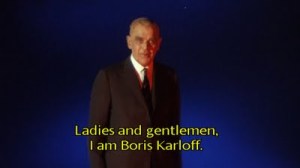
Black Sabbath begins with Boris Karloff playing himself, giving a deliberately over-the-top introduction and informing us that there could very well be vampires and werewolves sitting next to us in the theater.  Yes, it’s silly and yes, it’s campy but it’s also a lot of fun.  A lot of this is because these words are delivered by Karloff, an actor who could make even the silliest of dialogue sound important.  The other part is that, as silly as the introduction may be, it’s beautiful to look at.  Instead of going for the standard spooky narrator in a cobweb-filled library approach, Bava frames Karloff standing against a brilliant dark blue backdrop that establishes that this isn’t just your typical horror host … this is BORIS FREAKIN’ KARLOFF!

After Karloff’s introduction, we move on to the first of Black Sabbath’s three separate stories, The Telephone.

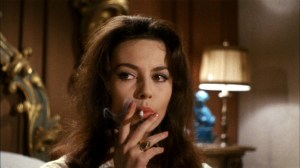
In The Telephone, Michele Mercier plays a Parisian prostitute who returns to her apartment after an evening out.  As she tries to change for bed, her bright red telephone rings.  Every time Mercier opens the phone, she hears a man’s voice taunting and threatening her.  Finally, the caller claims to be Frank, Mercier’s former pimp who has just escaped from prison.  The terrified Mercier calls her estranged lesbian lover (Lydia Alfonsi).  Alfonsi comes over to the basement to comfort Mercier.  However, what Mercier doesn’t realize is that it wasn’t Frank calling her.  It was Alfonsi, pretending to be Frank.  However, needless to say, there’s more twists to come before the night’s over.

Of the three segments, The Telephone is probably the least succesful if just because it has the most pedestrian plot.  At the same time, this segment also show just how good Bava was at creating tension even with so-so material.  Speaking as someone who has been stalked in the past, I can say that both Mercier and Bava perfectly captures the way that one seemingly simple intrusion on your privacy can leave you suddenly feeling very isolated and very alone.  Finally, even after the segment’s over, it’s impossible to forget the sight of that vibrantly red phone sitting like a lurking monster in that artfully drab apartment.

The Telephone is followed by probably the film’s most famous segment, The Wurdalak.

Based on a short story by Tolstoy, The Wurdalak opens with a Russian nobleman (played Italian exploitation mainstay Mark Damon) on a long trip through the Russian wilderness.  He comes across a headless corpse with a dagger plunged into its heart.  Damon takes the dagger as a morbid souvenir of his trip.

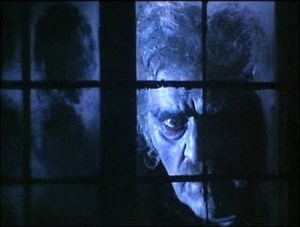
As night falls, Damon comes across a small cottage and asks the family inside for shelter.  Inside the cottage, Damon discovers a wall that is covered with daggers similar to the one he found earlier.  His hosts explain that the daggers belong to the family patriarch, Gorcha (Boris Karloff).  Gorcha left five days earlier to kill a wurdolak (or vampire, by any other name).  As the family waits for Gorcha to return, not knowing whether or not he himself is now a vampire, Damon finds himself falling in love with Gorcha’s daughter.  When Gorcha finally does return, it’s obvious that he’s not the same man he was when he originally left.

Of the three segments, The Wurdolak is probably the most obviously Bavaesque and a whole lot of the same images and themes would later turn up in Bava’s masterwork, Kill, Baby, Kill.  Everything, from the constantly howling wind to the sense of isolation to the well-meaning but ultimately impotent upper-class hero, is classic Bava.  Special mention should also be made of Boris Karloff’s performance here.  Because Karloff was best known for appearing in “monster” movies, he never gets enough recognition for being a pretty good actor.  His performance here, which is full of malice and threat, is just as menacing as his earlier appearance in the introduction was fun and campy.

The final segment of the film is entitled The Drop of Water.

In many ways, The Drop of Water is the simplest segment of the film but for me, personally, it’s also the scariest.  In London, a nurse (Jacqueline Pierreux) is called to a large house to prepare a medium for burial.  While doing this. the nurse notices a large (and, quite frankly, kinda gaudy) ring on the medium’s finger.  The nurse steals the ring and returns to her own apartment.  As soon as she goes to her apartment, she finds herself haunted by increasingly ominous events: a buzzing fly refuses to leave her alone, the sound of water dripping echoes through the apartment, the lights go on and off, and — naturally — a mysterious figure suddenly appears in her bedroom.

Mixing the sense of growing paranoia that characterized The Telephone with Wurdolak’s sense of predestined, metaphysical doom, The Drop of Water is the perfect concluding chapter of Black Sabbath.  It also happened to scare the Hell out of me.  Along with Bava’s usual superb direction, this film was distinguished by some wonderfully creepy make-up work.  Seriously, once that mysterious figure reveals itself, you’ll wish it hadn’t.

I usually don’t enjoy compilation films because, too often, it seems that you’re lucky if you get just one above average story surrounded by a bunch of forgettable filler.  Far too often, the stories themselves don’t seem to go together.  Instead, they just appear to have been tossed together randomly with the weakest of possible connection.  Black Sabbath is an exception and that’s largely because of Mario Bava’s iconic direction.  The stories aren’t linked together by plot as much as their linked together by motif and theme.  Each story — from the emphasis on isolation to the creative use of color to suggest mood and menace — is linked by Bava’s style.  Boris Karloff may have been the name emphasized in the credits but the true star of Black Sabbath is Mario Bava.

The genius of Bava wasn’t in the originality of the stories he told but instead, in the new ways that he found to tell familiar stories.  Usually, I hate it when directors describe themselves as being about “style” as opposed to “substance.”  Too often, it seems like that’s just an excuse to not come up with an interesting story.  However, Bava is one of the few directors about whom the term “style over substance” can be used as a compliment.  Bava knew how to make style into art and he certainly did that in Black Sabbath.

A Quickie Horror Review: Planet of the Vampires (dir. by Mario Bava)


Later tonight, I’m going to watch Mario Bava’s Black Sabbath but before I do, I want to take a few minutes to review another one of Bava’s films, 1965’s sci-fi/horror hybrid Planet of the Vampires.

Taking place in the far future, Planet of the Vampires begins with two space ships receiving a distress call from an unexplored planet.  While landing, the two ships are separated from each other.  As the Argos lands, its crew is possessed by an unknown force and suddenly start trying to kill each other.  Only the ship’s captain (Barry Sullivan, who gives a surprisingly good performance in a role that most actors would have just sleepwalked through) is able to resist and he manages to snap the rest of the crew out of their hypnotic state. 

Once the Argos lands, search parties are sent out to find the other ship.  They find themselves on a barren planet where the surface is obscured by a thick, multi-colored fog.  As they wander through the planet, it quickly becomes apparent that they aren’t alone.  The searchers may have left the ship as human but they return as something else all together.  It all leads up to a surprisingly bleak conclusion.

If the plot of Planet of the Vampires sounds familiar, that’s because it’s probably one of the most influential, if not widely known, films of all time.   The film has been imitated in several other, far more expensive films but few of them manage to capture Planet of the Vampires’ sense of isolation and impending doom.  With this film, Bava again showed that he was one of the few directors wh0 could accomplish so much with so little.  While this isn’t an actor’s film, fans of Italian horror will squeal with delight to see Ivan Rassimov pop up here in a small role.

I’ve mentioned Planet of the Vampires before on this site when I was giving 10 reasons why I hated AvatarTo me, Planet of the Vampires stands as proof that you don’t need a gigantic budget to make an effective horror (or sci-fi film).  In fact, often times, all a huge budget does is shut down the audience’s imagination and quite frankly, nothing on film will ever be as impressive as what the audience can imagine.  With Planet of the Vampires, all that Mario Bava had to create an alien world were two plastic rocks and a smoke machine.  Working without the crutch of CGI, Bava had to pull off most of the film’s special effects “in camera,” and he would later say that one of the benefits of all that smoke was that it helped to obscure just how low budget this film was.  In short, Bava was working under circumstances that James Cameron would refuse to even consider and yet Planet of the Vampires holds up better upon repeat viewings than Avatar ever will.  The low-budget forced Bava to emphasize atmosphere over effects.  Yes, this film has its share of gore (it’s an Italian horror film, after all) but ultimately, this is another example of a horror film that works because of what it doesn’t show.  This is a film that exploits your imagination, working its way into the darker corners of your consciousness.  Bava creates a palpable atmosphere of doom that makes Planet of the Vampires into a surprisingly effective film.