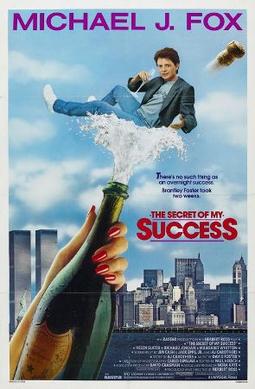
The Secret of My Success (1987, directed by Herbert Ross)


ȋ‚˜é

Brantley Foster (Michael J. Fox) heads to New York City with his business degree from the University of Kansas and the promise of an entry-level job as a financier.  He arrives to discover that the company that hired him no longer exists and that Brantley is out of a job.  New York is a harsh town for someone who is down on his luck and all of out of money.  Brantley eventually gets a job working in the mail room of a company owned by his wealthy uncle (Richard Jordan).  His uncle doesn’t even know who he is but soon, Brantley becomes just as rich and successful as he always dreamed.

What’s the secret of Brantley’s success?

Screwing his Aunt Vera (played by Margaret Whitton).

What’s the other other secret of his success?

Pretending to be named Carlton Whitfield and claiming that he’s a new executive at the corporation.

I remember when Kramer did the same thing on Seinfeld.  It didn’t work out for Kramer.  He got fired after turning in his first report.

“This is gibberish,” his boss said, “It’s almost as if you have no business training at all.  I’m afraid we have to let you go.”

“I don’t actually work here,” Kramer replied.

“That’s what makes this so hard.”

Seinfeld, never topped.

Back to The Secret of My Success, this is the most 80s film ever made, complete with montages of Brantley exploring New York and a saxophone playing on the soundtrack.  Brantley’s all about TCB, taking care of business.  He screws his aunt but falls in love with Christy Wills (Helen Slater).  Brantley doesn’t learn anything but he gets the best office and becomes a success without actually doing any real work.  It’s the ultimate fantasy and, like many fantasies, The Secret of My Success is superficially appealing.  Michael J. Fox is likable as Brantley.  Margaret Whitton is outrageously sexy as Vera.  Helen Slater is pretty and boring, traits that made her the ideal “good” girlfriend for Brantley’s story.

The Secret of My Success is your ticket to the 80s.

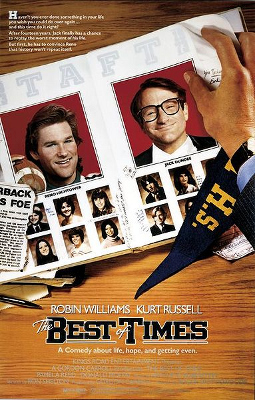
The Best Of Times (1986, directed by Roger Spottiswoode)


For years, banker Jack Dundee (Robin Williams) had been haunted by a pass that he dropped in high school.  The pass was perfectly thrown by quarterback Reno Hightower (Kurt Russell) but Jack couldn’t bring it in and, as a result, Taft High lost to its rival, Bakersfield.  Adding to Jack’s humiliation is that he now works for The Colonel (Donald Moffat), a confirmed Bakersfield fan who also happens to be Jack’s father-in-law.  When Jack visits a “massage therapist” (Margaret Whitton) and tells her about his problems, she suggests that he needs to replay the game.  Getting everyone interested in replaying the game is not easy.  No one wants to be humiliated a second time and Reno, who now fixes vans for a living, fears the he’s lost his edge.  Jack dresses up in the Bakersfield mascot’s uniform and vandalizes the town.  Finally, everyone is ready for the game.  Now, it’s a matter of town pride.

The Best of Times is a likable comedy about getting older and wishing you could have just one more chance to be young again and to have your entire future ahead of you.  Jack is haunted by that one dropped pass, feeling that it has cast a cloud over his entire life.  Reno is still a town hero but he’s struggling financially and in debt to Jack’s bank.  Replaying the game isn’t going to fix their lives but it is going to give them one last chance to relive their former glory and maybe an opportunity to learn that, even if they are getting older, they’re still living in the best of times.  The world that these two men live in is skillfully drawn and believable, with character actors like Moffat, M. Emmet Walsh, R.G. Armstrong, and Dub Taylor adding to the local color.  Jack and Reno’s wives are played by Holly Palance and Pamela Reed and they are also strong and well-developed characters.  Finally, Robin Williams and Kurt Russell are a strong comedic team.  Russell is perfectly cast as the aging jock and Williams gives one of his more restrained performances as Jack, allowing us to see the sadness behind Jack’s smile.

The stakes aren’t particularly high in The Best Of Times.  It’s just a football game between some middle-aged men looking to regain their youth.  But the story sticks with you.

Retro Television Reviews: Miami Vice 1.10 “Glades”


Welcome to Retro Television Reviews, a feature where we review some of our favorite and least favorite shows of the past!  On Mondays, I will be reviewing Miami Vice, which ran on NBC from 1984 to 1989.  The entire show is currently streaming on Tubi!

This week, Crockett and Tubbs leave Miami!

Episode 1.10 “Glades”

(Dir by Stan Lathan, originally aired on November 30th, 1984)

Episode ten opens with the Animals’s “We’ve Got To Get Out Of This Place” playing on the soundtrack and the camera tracking down some of the less glamorous sections of Miami.  This is a far different part of the city than the viewer is used to seeing on Miami Vice.  The sleek art deco architecture has been replaced by vacant lots, run-down apartments, and torn-up streets.  It serves as a reminder that, while some people in Miami are getting very rich, others are still trapped in the cycle of poverty.

Joey Bramlette (Keith Szarabajka) is staying in a  cheap motel room, courtesy of the Vice Squad.  Joey is due to testify in court against his former boss, a Colombian drug lord named Ruiz.  Joey’s testimony is the key to the entire case but, when he receives a mysterious letter, he escapes the safehouse and flees back to his home in the Everglades.  Though it was Zito and Switek who allowed him to escape, Crockett and Tubbs are the ones who head down to the Everglades to find him.

That’s right …. Crockett and Tubbs aren’t in Miami anymore!

As Crockett and Tubbs soon discover, the Everglades is full of rednecks, smugglers, and enforcers.  Safely hidden away from civilization, it’s a place where there is no law.  After a group of rednecks (led by John Pankow) trick Sonny and Tubbs into getting lost in the wilderness (“Moss grows on the north side of a tree!” Crockett announces as he tries to figure out how to return to civilization), the two cops are found by Joey and his wife, Cassie (Margaret Whitton).  Joey reveals that he still wants to testify but that Ruiz’s men have kidnapped his daughter.  Working together with Joey and his family, Crockett and Tubbs have to figure out how to storm Ruiz’s heavily guarded compound and rescue Joey’s daughter.

This episode was a bit of a change of pace but I enjoyed it.  Some of that is because, when I was growing up, I spent a lot of time in the country and I’ve still got a lot of family out there, working on their farms and living in communities much like the one that Crockett and Tubbs visited in this episode.  I may now be a city girl but I’ve still got my country side.  I can still remember what it was like, walking around the tall grass while wearing short shorts and a tank top.  Though I cringed a bit when it first appeared that this episode was going to portray rural Florida as being the equivalent of Deliverance, I was happy to see that it was ultimately a celebration of the resilience of country people.

There was an interesting subtext to this episode as everyone that Sonny and Tubbs met was a smuggler, either working for Ruiz or independently running marijuana into Florida.  Later, one of the older smugglers mentioned that he used to run moonshine, therefore suggesting that there wasn’t much difference between the War on Drugs of the 1980s and the doomed effort at prohibition of the 1920s.  Miami Vice is a cop show that often suggests that it’s sometimes best not to get too hung up on rigidly enforcing the law.  That’s quite a contrast to most other cop shows that I’ve seen.  Even modern cop shows tend to take the attitude that anyone who violates the law has to be punished in some way, whether by incarceration or death.  Miami Vice may have been about law enforcement but its heart belonged to the libertarians.

Next week’s episode of Miami Vice guest stars Burt Young, Michael Madsen, Lenny Von Dohlen, and Terry O’Quinn!

Major League (1989, dir. by David S. Ward) and Major League II (1994, dir. by David S. Ward)


I’m so excited that baseball’s back!

The 2020 regular season of Major League Baseball is going to start on July 22nd and it’s going to last until September 27th.  The teams will play 60 games and the World Series will be held in October.  It’s an abbreviated season but there was no way to avoid that.  I’m just happy that there will at least be some games played this year.

Of course, as excited and happy as I am, I can’t deny that baseball almost always breaks my heart.  Just a few years ago, I was so excited when a Texas team finally won the World Series.  Later, we all found out that the Astros won because they cheated, which will forever taint both the legacy of the team and the MLB.  It breaks my heart to say it but, as far as I’m concerned, no Texas team has yet to legitimately win the World Series.

And then there’s the Rangers.  I’m a Rangers fan.  I love the Rangers.  I was so excited the two times that they made it to the World Series and I’ve never gotten over their loss to the Cardinals.  (Their loss to the Giants I can accept because the Giants were a great team and they earned their wins.  The Cardinals, on the other hand…)  Ever since 2012, though, the Rangers have always broken my heart.  It’s been a while since we’ve had a great Rangers season.  At the start of every season, though, I say, “This is our season!”  And no matter how badly things end, I always say, “Next season, we’re going all the way!”

I guess that’s why I love Major League.
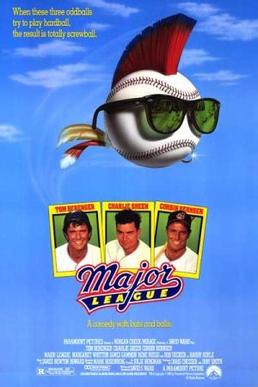
Major League is the ultimate underdog baseball movie.  It’s a film about a fictional version of the Cleveland Indians.  Rachel Phelps (Margaret Whitton), the new owner of the Indians, wants to move the team to Miami but to do that, she’s going to need to have the worst season ever, one where the team plays so badly and breaks so many hearts that even the most loyal fans stop coming to the games.  It shouldn’t be too hard since the Indians have’t even won a pennant in over 30 years.  But to make sure that it happens and that the team only wins 15 games over the entire season, Phelps recruits the worst players she can find.

The team that she puts together is made up of has-beens and never-weres.  Some of them have raw talent but none of them know how to play as a team.  Ex-con Ricky Vaughn (Charlie Sheen) has a killer fastball but is so near-sighted that he’s a danger whenever he steps on the mound.  Catcher Jake Taylor (Tom Berenger) is a veteran team leader but his knees are so bad that he can barely walk.  Willie Mays Hayes (Wesley Snipes) is fast but can’t hit worth a damn.  Pedro Cerrano (Dennis Haysbert) can hit home runs but only if the pitcher throws him a fastball.  Just as Rachel expected, the team struggles at first.  Even when they start to show signs of improvement, she cut back on their budget and sells their equipment, all to try to make winning impossible.  It’s only when their manager, ex-drywall salesman Lou Brown (James Gammon), tells them that Rachel wants them to lose that the team comes together and starts to win.

Everything that’s great about baseball can be found in Major League.  I love all the scenes with the fans slowly coming around to believing that maybe the Indians actually could win it all.  I’ve been through that so many times with the Rangers that I know exactly how they all felt.  I love the interactions between all the players on the team, from the new players eager to win to the veterans who just want to survive another season.  I love the scenes with the play-by-play announcer (Bob Uecker) trying to put a good spin on the way the team plays.  (All together: “Just a bit outside!”)  And mostly, I love that the film treats the game and its players with the respect that they deserve.  So many other films would have turned a character like born-again pitcher Eddie Harris (Chelcie Ross) into a punchline.  Instead, in Major League, he gets a standing ovation after he pitches his last game.  The best thing about Major League is that it loves baseball, both the games and the players.

Since Major League was a success at the box office, it was eventually followed by a sequel, Major League II.

Major League II picks up the season after the first movie ended and it tells the exact same story as the first film, just not as well.  Almost everyone from the first film is back (though Omar Epps takes over the role of Willie Mays Hayes from Wesley Snipes) but the charm and the chemistry from the first movie just aren’t there.  The players have to set aside their egos and learn how to play like a team all over again.  The main difference between the two movies is that it takes a lot longer for the Indians to start winning in the sequel than in the first film.  Plus, the sequel just isn’t as funny.

Even if the sequel is a let down, the first Major League is still one of the best baseball movies ever made.  If the Indians could win the pennant in Major League, maybe there’s hope for my Rangers yet!