Film Review: Voyage of the Damned (dir by Stuart Rosenberg)


In 1939, an ocean liner named the MS St. Louis set sail from Hamburg.  Along with the crew, the ship carried 937 passengers, all of whom were Jewish and leaving Germany to escape Nazi persecution.  The ship was meant to go to Havana, where the passengers had been told that they would be given asylum.  Many were hoping to reunite with family members who had already taken the voyage.

What neither the passengers nor Captain Gustav Schroeder knew was that the entire voyage was merely a propaganda operation.  No sooner had the St. Louis left Hamburg than German agents and Nazi sympathizers started to rile up anti-Semitic feelings in Cuba.  The plan was to prevent the passengers from disembarking in Cuba and to force the St. Louis to then return to Germany.  The Nazis would be able to claim that they had given the Jews a chance to leave but that the rest of the world would not take them in.  Not only would the Jews be cast as pariahs but the Germans would be able to use the world’s actions as a way to defend their own crimes.

Captain Schroeder, however, refused to play along.  After he was refused permission to dock in Cuba, he then attempted to take the ship to both America and Canada.  When both of those countries refused to allow him to dock, Schroeder turned the St. Louis toward England, where he planned to stage a shipwreck so that the passengers could be rescued at sea.  Before that happened, Belgium, France, the Netherlands, and the United Kingdom jointly announced that they would accept the refugees.

Tragically, just a few days after the passengers disembarked, World War II officially began and Belgium, France, and the Netherlands all fell to the Nazi war machine.  It is estimated that, of the 937 passengers on the St. Louis, more than 600 of them subsequently died in the Nazi concentration camps.

The journey of the St. Louis was recreated in the 1976 film, Voyage of the Damned, with Max von Sydow as Captain Schroeder and a collection of familiar faces playing not only the ship’s passengers and crew but also the men and women in Cuba who all played a role in the fate of the ship.  In fact, one could argue that there’s a few too many familiar faces in Voyage of the Damned.  One cannot fault the performances of Max von Sydow, Malcolm McDowell, and Helmut Griem as members of the crew.  And, amongst the passengers, Lee Grant, Jonathan Pryce, Paul Koslo, Sam Wanamaker, and Julie Harris all make a good impression.  Even the glamorous Faye Dunaway doesn’t seem to be too out-of-place on the ship.  But then, in Havana, actors like Orson Welles and James Mason are awkwardly cast as Cubans and the fact that they are very obviously not Cuban serves to take the viewer out of the story.  It reminds the viewer that, as heart-breaking as the story of the St. Louis may be, they’re still just watching a movie.

That said, Voyage of the Damned still tells an important true story, one that deserves to be better-known.  In its best moments, the film captures the helplessness of having nowhere to go.  With Cuba corrupt and the rest of the world more interested in maintaining the illusion of peace than seriously confronting what was happening in Germany, the Jewish passengers of the St. Louis truly find themselves as a people without a home.  They also discover that they cannot depend on leaders the other nations of the world to defend them.

Defending the passengers falls to a few people who are willing to defy the leaders of their own country.  At the start of the film, Nazi Intelligence Chief Wilhelm Canaris (Denholm Elliott) explains that Captain Schroeder was selected specifically because he wasn’t a member of the Nazi Party and could not be accused of having ulterior motives for ultimately returning the passengers to Germany.  Canaris and his fellow Nazis assume that anti-Semitism is so natural that even a non-Nazi will not care what happens to the Jewish passengers.  Instead, Schroeder and his crew take it upon themselves to save the lives of the passengers.  It is not Franklin Roosevelt who tries to save the passengers of St. Louis.  Instead, it’s just a handful of people who, despite unrelenting pressure to do otherwise, step up to do the right thing.  Max von Sydow, who was so often cast in villainous roles, gives a strong performance as the captain who is willing to sacrifice his ship to save his passengers.

Flaws and all, Voyage of the Damned is a powerful film about a moment in history that must never be forgotten.

Film Review: The Man In The Glass Booth (dir by Arthur Hiller)


Who is Arthur Goldman?

That’s the question at the heart of the 1975 film, The Man In The Glass Booth.

When we first meet Arthur Goldman (Maximilian Schell), he is a wealthy businessman who lives in a Manhattan high-rise and who appears to rarely leave the safety of his penthouse.  He is waited on by two assistants, Jack (Henry Brown) and Charlie (Lawrence Pressman), both of whom he talks to and treats as if they are members of his own family.  His most frequent visitor is his psychiatrist, Dr. Weissburger (Robert H. Harris), who frequently stops by and asks Arthur if he’s been taking his medication.

Arthur Goldman is a man who loves to talk.  Indeed, the first hour of the film feels almost like a nonstop monologue on the part of Goldman, with just occasional interjections from the other characters.  Goldman was born in Germany.  He talks about how, when he was young, he and his family were sent to a concentration camp and it was there that he witnessed the murder of his father by the camp’s sadistic commandant, Dorff.  Dorff is one of the many Nazis who disappeared to South America at the end of the war.

When Goldman spots a car that always seems to be parked across the street from his building, he becomes paranoid.  He says that he’s being watched and even suggests that Dorff has come to capture him.  Instead, it turns out that Mossad come for him.  As the agents explain it to Charlie, dental records prove that Arthur Goldman is actually Commandant Dorff.  Goldman/Dorff is taken back to Israel to stand trial for his crimes.

Are Arthur Goldman and Dorff the same man?  Once in Israel, Goldman tells anyone who will listen that he is Dorff and that he feels no guilt for his actions.  He insists on being allowed to wear his SS uniform during the trial.  Because of threats to his safety, a booth made of bullet-proof glass has been placed in the courtroom.  As the trial commences, The Man in the Glass Booth continues to rant and rave and declare his guilt.  However, the prosecutor (Lois Nettleton) comes to doubt that the man is who he says he is.

The Man In The Glass Booth is based on a novel and play by Robert Shaw.  (The same year that The Man In The Glass Booth was released, Shaw played Quint in Jaws.)  The film was produced as a part of an experiment called American Film Theatre, in which well-known plays would be adapted to film and then would be shown at 500 participating movie theaters in America.  Each production would only be shown four times at each theater and subscriptions were sold for an entire “season” of films.  It sounds like an interesting experiment and the type of thing that I would have enjoyed if I had been around back then.  Today, of course, these productions would have just premiered on a streaming service.

The Man In The Glass Booth is a film that very much feels like a filmed play.  There are only three locations — Goldman’s penthouse, his cell, and the courtroom where he is put on trial.  The three act structure is very easy to spot.  Maximilian Schell’s performance is also very theatrical.  In fact, it’s so theatrical that, for the first hour or so, I found myself wishing that he would just stop talking for a few second or two.  He was so dramatic and so flamboyant and so intentionally over-the-top that he became somewhat exhausting.  But, during the second hour, I came to see that all of that “overacting” was actually setting up the film’s final act.  Schell talks so much that, when he finally does find himself unable to explain himself, it’s a shocking moment and one that perfectly captures not just the evil of the Nazis and the Holocaust but also how the legacy of that evil lives on after the fall of the Third Reich and the deaths of the majority of the Holocaust’s perpetrators.  At that moment, I realized that The Man In The Glass Booth never stopped speaking because silence would force him to confront the horrors of the past and the trauma, guilt, and uncertainty lurking in his subconscious.  Maximilian Schell was nominated for an Oscar for his performance here and, by the end of the film, I totally understood why.

The Man In The Glass Booth requires some patience.  Actually, it requires a lot of patience.  However, those who stick with it will discover an intelligent and thought-provoking film about not only the horror of the past but also how those in the present deal with and rationalize those horrors.  Though the film is a bit too stagey for its own good, it’s also one that sticks with you even after the curtain falls and the end credits roll.

Lisa Cleans Out Her DVR: The Girl In the Red Velvet Swing (dir by Richard Fleischer)


(Lisa is currently in the process of cleaning out her DVR!  How long is it going to take?  Forever!  For instance, she recorded 1955’s The Girl In the Red Velvet Swing off of FXM on February 1st and has now gotten around to actually watching and reviewing it.)

The story of Evelyn Nesbit is an interesting one, even if it is now a largely forgotten one.

In 1901, Evelyn Nesbit was a showgirl in New York City.  While she always claimed that she was 16 at the time, there are some historians that think it more likely that she was only 14.  One night, the beautiful Evelyn was introduced to Stanford White.  At the time, White was 47 years old and the most successful and prominent architect in New York City.  White was also a notorious womanizer and Evelyn soon became his latest mistress.  He moved her into one of his many apartments.  Years later, when the details of their relationship became public knowledge, people were shocked to hear that Stanford White kept a red velvet swing in the apartment and that he enjoyed watching Evelyn swing back and forth.  They would be even more scandalized by the news that Stanford also had a “mirror room.”  As Evelyn would later testify, she “entered the room a virgin” but did not come out as one.

Though Evelyn occasionally claimed that she and Stanford were truly in love, she never married him.  (Indeed, Stanford White apparently never married anyone over the course of his life.)  Instead, she ended up meeting and marrying Harry K. Thaw.  Harry was the heir to a 40 million dollar fortune.  He also had a long history of mental illness.  When he learned that, before meeting him, Evelyn had lost her virginity to Stanford White, he was outraged.

(It’s debatable how well Stanford and Harry knew each other.  Some historians claim that they were barely acquainted.  Other accounts claim that Harry and Stanford were business rivals even before Evelyn Nesbit arrived in New York.)

In 1906, Harry and Evelyn ran into Stanford White at Madison Square Garden.  Harry promptly pulled out a pistol and, in front of hundreds of witnesses, shot Stanford dead.

Harry’s subsequent trial was reportedly the first to ever be described as being “the trial of the century.”  Because hundreds of people had seen Harry Thaw shoot Stanford White and the Thaw family was adamant about not publicizing Harry’s history of mental illness, Harry’s defense team attempted to make the trial about Stanford White.  The defense attempted to portray Stanford as being such a depraved predator that Harry really had no other option but to shoot him in cold blood.  Evelyn took the stand and testified to every single detail of her relationship with Stanford White.  The details appeared in every major newspaper in America.

In the end, Harry was found not guilty by reason of insanity and was committed to the  Matteawan State Hospital for the Criminally Insane.  (Reportedly, due to his great wealth, he had the best room in the hospital.)  Meanwhile, Evelyn became one of America’s first reality stars.  Her notoriety led to her appearing in several silent films.  It’s a fascinating story, one that very much feels ahead of his time.  If Evelyn was a star in 1906, just imagine how famous she would be today.

The Girl in the Red Velvet Swing is about Evelyn Nesbit and her relationships with both Stanford White and Harry Thaw.  It’s a shame that the film isn’t as interesting as the real life story.  Ray Milland plays Stanford White.  Farley Granger is Harry Thaw.  Joan Collins is Evelyn Nesbit.  They all give good performances, especially Farley Granger.  But the film itself is just so bland.  Perhaps because it was made in the 1950s, it leaves out the majority of the sordid details that made the story so fascinating to begin with.  For instance, the red velvet swing appears but, in this film, no time is spent in the mirror room.  This true life story is pure tabloid material but The Girl In The Red Velvet Swing is way too respectful for its own good.  By refusing to come down firmly on the side of Harry Thaw or Stanford White, the film feels shallow and a bit empty.  (All good melodramas — even fact-based ones — need a good villain.)  And poor Evelyn Nesbit!  In real life, she was a savvy self-promoter who knew exactly how to manipulate the press.  In this film, she’s just an innocent ingenue.  Considering the facts of the case, the film version is unforgivably dull.

So, I don’t recommend The Girl In The Red Velvet Swing but I do recommend Paula Uruburu’s fascinating 2008 biography, American Eve: Evelyn Nesbit, Stanford White, The Birth of the ‘It’ Girl, and the ‘Crime of the Century.’  It goes into all of the fascinating details that were left out of this film.

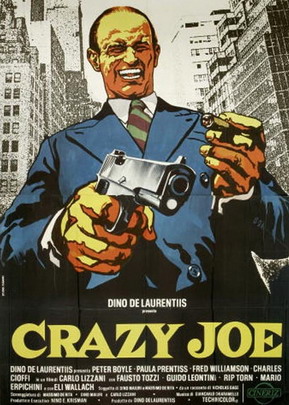
A Movie A Day #147: Crazy Joe (1974, directed by Carlo Lizzani)


Crazy Joe (Peter Boyle) is a gangster with a chip on his shoulder and a self-taught intellectual who can (misquote) Sartre and Camus with the best of them.  Sick of being taken for granted, Joe and his brother, Richie (Rip Torn), attempt to challenge the Mafia establishment.  The mob sets Joe up and gets him sent to prison.  While doing time, Joe befriends a Harlem gangster named Willy (Fred Williamson).  Refusing to associate with the other Italian prisoners, Joe allies himself with the black inmates and even helps to start a riot over the prison’s inhumane conditions.  When he is released, Joe hits the streets of New York with a vengeance, now backed up by Willy and his criminal organization.

Crazy Joe is based on the life of Joey Gallo, who was briefly a New York celebrity, hobnobbing with actors like Jerry Orbach and writers like Norman Mailer before he was gunned down at Umberto’s Clam Shop in Little Italy.  Though the names were changed to protect the guilty, Eli Wallach plays Vito Genovese, Charles Cioffi plays Joe Columbo, and Luther Adler is Joe Profaci.  Fred Williamson’s character is based on the infamous Nicky Barnes.

Crazy Joe is a good and violent mix of the gangster, prison, and blaxploitation genres.  Despite wearing an unfortunate toupee, Peter Boyle is great at putting the crazy in Crazy Joe and Fred Williamson ups the coolness factor of any movie he appears in.  Keep an eye out for Henry Winkler, giving a very un-Fonzie performance as Joe’s right-hand man.

The Movie That Nearly Killed The Godfather: The Brotherhood (1968, directed by Martin Ritt)


Brotherhood_1968Once upon a time, Paramount Pictures released a movie about an Italian-American organized crime family.

It was a self-styled epic that used the Mafia as a metaphor for both business and politics.  The movie mixed scenes of violent death with family and community ceremonies.   The main mafioso was played by a famous actor who was a big box office draw in the 1950s and another character, a war hero who was initially reluctant to get involved in the family business, was played by an up-and-coming young actor.   The majority of the movie took place in New York but there were several scenes that were set in Sicily.

It may sound like The Godfather but actually, it was The Brotherhood, a film that flopped so badly that Paramount executives nearly passed on the chance to make a movie out of Mario Puzo’s bestselling novel.  According to Peter Biskind’s The Godfather Companion, Francis Ford Coppola frequently cited The Brotherhood as being exactly the type of movie that he did not want to make while he was directing The Godfather.

Kirk Douglas, who both produced and starred, plays Frank Ginetta.  Frank, an old-fashioned and honorable mobster, is hiding out in Sicily with his wife, Ida (Irene Pappas).  Frank knows that a rival gangster, Jim Egan (Murray Hamilton), has put a price on his head.  When Frank’s brother, Vinnie (Alex Cord), shows up in Palermo, Frank is overjoyed at first.  But Ida reminds him, “They’re going to send someone.”

Most of the film is taken up with flashback to Frank and Vinnie’s old life in New York.  When Vinnie returns from serving in the army, he marries Emma Bertolo (Susan Strasberg), the daughter of Don Bertolo (Luther Adler who, as a stage actor and director, served as an early mentor to the future Don Corleone, Marlon Brando).  Frank grew up idolizing their Sicilian father and, at first, he is happy when Vinnie announces that he wants to enter the “family business.”  But then Vinnie starts to side with non-Sicilian gangsters like Egan and Sol Levin (Alan Hewitt).

The scenes in Sicily work the best, with Frank unsure as to whether or not Vinnie has arrived to visit or to murder him.  But the scenes in New York are such a mess that it took me a while to realize that they were even supposed to be flashbacks.  It is hard to keep track of how much time has passed from scene to scene and Alex Cord and Kirk Douglas are two of the most unlikely brothers imaginable.

The main problem with The Brotherhood is that it is impossible to watch it without thinking about The Godfather.  The Brotherhood has much in common with The Godfather but it has none of its authenticity and does not come close to matching its epic scale.  Kirk Douglas tries his best and puts a lot of effort into talking with his hands but he is miscast from the moment he first appears.  Robert Evans once said that he chose Coppola to direct The Godfather because he wanted to “smell the pasta.”  The Brotherhood was directed by Martin Ritt and you never smell the pasta.

The Brotherhood is an interesting footnote in the history of The Godfather but ultimately, it’s an offer you can refuse.

1374000145_4

The Fabulous Forties #12: D.O.A. (dir by Rudolph Mate)


DOA1950

The 12th film contained in Mill Creek’s Fabulous Forties box set is the classic film noir D.O.A.  Before I get into reviewing this film, there’s an oddity that I feel the need to point out.  According to the back of the Fabulous Forties box, D.O.A. was released in 1949.  However, according to Wikipedia, imdb, and almost every other source out there, D.O.A. was released in 1950.  In short, it’s debatable whether or not D.O.A. actually belongs in the Fabulous Forties box set but it really doesn’t matter.  D.O.A. is a classic and, along with Night of the Living Dead, it is undoubtedly one of the best B-movies to ever slip into the public domain.

D.O.A. opens with a lengthy tracking shot, following a man named Frank Bigelow (Edmond O’Brien) as he walks through the hallways of a San Francisco police station.  Frank walks with a slow, halting movement and it’s obvious that he is not a healthy man.  When he finally steps into a detective’s office, Frank announces that he’s come to the station to report a murder — his own.

Frank is a small-town accountant who came to San Francisco for a vacation.  After a long night of drinking, Frank woke up feeling ill.  When he went to a doctor, he was informed of two things.  Number one, he was in overall good health.  Number two, he only had a few days to live.  Sometime during the previous night, Frank was poisoned with a “luminous toxin.”  There was no antidote.

The rest of the film follows Frank as he attempts to figure out who poisoned him and why.  It’s an intriguing mystery and I’m not going to ruin it by going into too many details.  Over the course of his investigation, the increasingly desperate Frank comes across a gangster named Majak (Luther Adler).  This leads to a lengthy scene in which Majak’s psychotic henchman, Chester (Neville Brand), repeatedly punches Frank in the stomach.  It’s a scene that, even in our far more desensitized times, made me cringe.  I can only imagine how audiences in 1950 reacted.

(There’s also a shoot-out at a drug store that can stand alongside almost any modern-day action sequence.  Regardless of whether the film was made in 1949 or 1950, it still feels like a movie that could have just as easily been made in 2016.)

But really, the mystery is secondary.  Instead, D.O.A. is truly about Frank and how he deals with the knowledge that he is going to die.  Before being poisoned, Frank is the epitome of complacent, middle-class suburbia.  He’s engaged to Paula (Pamela Britton) but he’s in no hurry to marry her.  He’s got all the time in the world.  When Frank goes to San Francisco, he epitomizes the bourgeoisie on vacation.  He goes to the 1940s equivalent of a hipster nightclub, not because he’s actually interested in what the scene is all about but because he’s a tourist looking for a story to tell the folks back home.  When he checks into his hotel, he leers at every passing woman with a casual sexism that would not be out-of-place on an old episode of Mad Men.  Frank is floating through life, confident in his own complacency.

It’s only after he’s poisoned that Frank actually starts to live.  He goes from being passive to being aggressive.  Knowing that he’s going to die, he no longer has anything to lose.  Only with death approaching does Frank actually start to live.  Frank’s realization that he waited to long to live makes his final line all the more poignant.

D.O.A. is a classic!  Watch it below, you won’t be sorry!