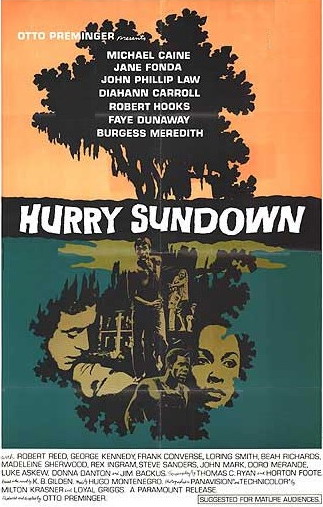
It seems like whenever film bloggers and reviewers are making out a list of the worst films of all time, somebody always mentions Hurry Sundown.
Now, don’t get me wrong. It doesn’t get mentioned as often as Battlefield Earth or Adam Sandler’s latest comedy. And, when it does get mentioned, it’s done with little of the warmth that’s given to Troll 2, The Room, or Birdemic. Instead, one gets the impression that Hurry Sundown is a film so bad that even those of us who appreciate bad films would find little to love about it.
But y’all know me. I’m the type that prefers to judge for herself and I’m also someone who rather enjoys being a contrarian. There’s a reason why one of my most read posts on this site is entitled 10 Reasons Why I Hated Avatar. Add to that, Hurry Sundown was directed by Otto Preminger who also directed one of my favorite films of all time, Anatomy of a Murder. How, I asked myself, could the man who made Anatomy of a Murder possibly also direct one of the worst films of all time? As a result, every time that I saw someone claiming that Hurry Sundown was one of the worst films of all time, I grew more and more determined to someday see the film and judge for myself.
Well, I finally got my chance this weekend. Hurry Sundown was on one of my newest favorite channels, The MOVIES! TV Network. And I proceeded to watch it. I sat through all four hours of this film (that’s including commercials and, oh my God, was I thankful for the distraction that those commercials provided). I watched Hurry Sundown and …. wow. Was it ever bad.
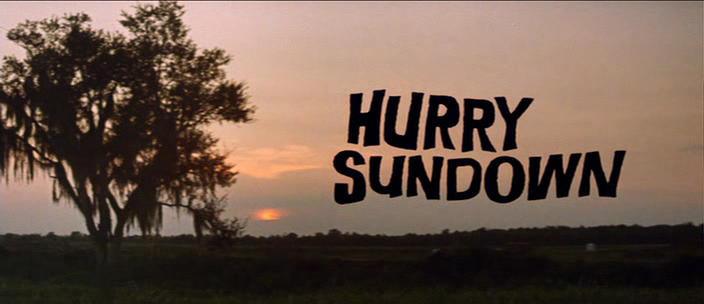 Released in 1967, Hurry Sundown was Otto Preminger’s attempt to take a look at race relations in the deep south. It’s a film full of good, liberal intentions and an apparent lack of knowledge about — well, about everything. As I watched this slow, almost formless blob of a film, I found myself wondering how the director who gave us Laura and Anatomy of a Murder could have possibly directed a film with a gigantic cast but absolutely no interesting characters. I wondered how the director who had been willing to challenge the racist assumptions of 1950s Hollywood by directing Carmen Jones could have been responsible for the corny and subtly condescending look at race relations that was Hurry Sundown.
Hurry Sundown takes place in 1946 and is set in rural Georgia. The war is over, the soldiers are coming home, and nobody in the film can maintain a convincing Southern accent for more than a line or two. (Seriously — I’ve heard a lot of really bad Southern accents in a lot of really bad films but none of those accents were as bad as what I heard in Hurry Sundown.) It’s a brand new world but the South is clinging to the old ways of racism and classism.
Preminger slowly (and clumsily) introduces us to the huge cast of characters who populate the slice of Hollywood Georgia.
There’s the sheriff (George Kennedy) who is so stupid that he can be distracted by an offer of fried chicken. Kennedy actually gives a good comedic performance but his character seems like he belongs in another movie and you have to wonder how civil rights activists in 1967 — many of whom had undoubtedly been arrested and harassed by Southern sheriffs much like this one — reacted to Kenendy’s character being presented as harmless comic relief.
There’s the racist judge (Burgess Meredith) who, much like the sheriff, is presented as being a comedic buffoon as opposed to an actual threat. The judge uses the n-word in every other sentence, which should be shocking and infuriating but, as a result of Meredith’s over-the-top delivery, instead simply comes across as being gratuitous and tasteless.
Then there’s Henry. Henry is a businessman who dodged the draft, cheats on his wife, and who has a son who literally spends the entire movie screaming at the top of his lungs. (Whenever that kid was on-screen, I imagined Preminger standing behind the camera and going, “More! More! Scream more!”) Henry is also a racist, though for some reason he loves jazz and often plays the saxophone. I kept waiting for someone in the movie to point out to him that jazz was created by black musicians but nobody did. (If Henry had appeared in Anatomy of a Murder, someone would have.)
Did I mention that Henry is played by Michael Caine? And did I also mention that Caine is the most cockney-sounding Southerner that I’ve ever heard? Because he totally is.
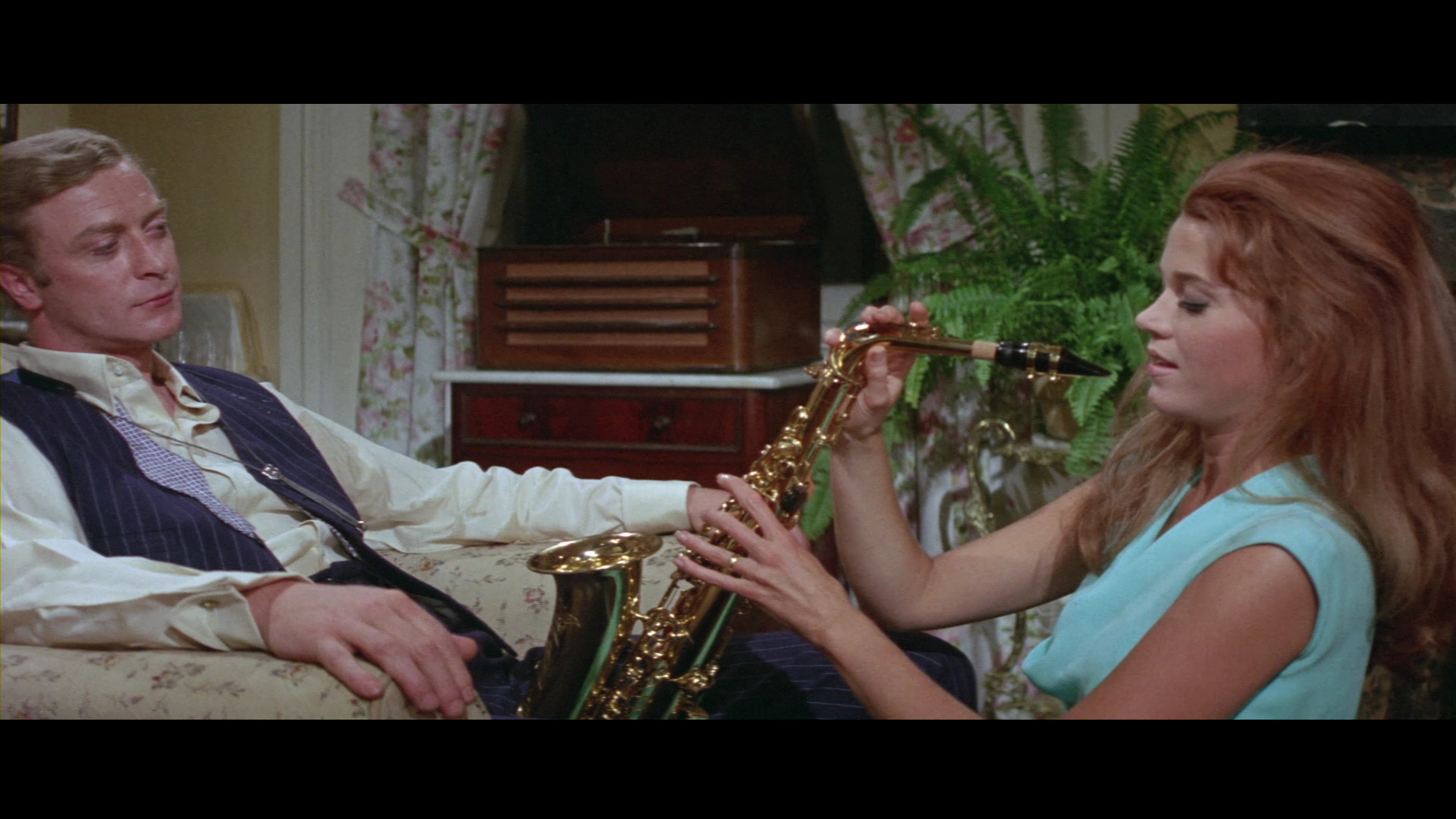
Henry’s wife is named Julie and is played by Jane Fonda. At one point, she suggestively blows on Henry’s saxophone. One can only imagine how audiences in the 60s reacted to that. (Actually, they probably didn’t. They probably just said, “Good thing she’s pretty because she ain’t no musician…”)
 Anyway, Harry wants to buy up some farmland but half of that land is owned by Henry’s poor cousin Rad (John Phillip Law) and Rad doesn’t want to move. Rad has just returned from fighting in the war and he views Harry as being a cowardly draft dodger. Rad is married to Lou (Faye Dunaway) and wow, are they ever a boring couple! Dunaway was under a five-picture contract to Preminger when she made this film and apparently, she had such a terrible time on the set of Hurry Sundown that she sued to get out of ever having to make another movie with Otto. Dunaway’s misery comes through in every scene.
The other half of the farmland is owned by Reeve (Robert Hooks), a black farmer whose mother (played by Beah Richards) is Julie’s former mammy. Julie goes down to the farmhouse to convince Reeve to sell and Reeve’s mother responds by having the most (over)dramatic heart attack in the history of cinema. Saddened by death of his mother, Reeve is definitely not going to sell. When he’s not chastely romancing the local teacher (played by Diahann Carroll, who appears to have wandered over from a different, far more glamorous movie), Reeve is singing sprituals and working out in the fields.
One of the things that Reeve does not do — no matter how many times he gets called the n-word or is treated unfairly — is get mad. Rad gets mad. Julie gets mad. A liberal white preacher (Frank Converse) gets mad. But Reeve and the other black characters in the film are never really allowed to get mad or do anything that might make the film’s white audience feel nervous. Watching a film like Hurry Sundown, you can understand why — in just a few more years — Blaxploitation films would suddenly become so popular. It was probably the first time that black film characters were actually allowed to not only get angry over the way they were being treated but to fight back, as opposed to reacting in the Hurry Sundown-way of passive acceptance.
Anyway, Rad and Reeve come together to protect their land and Henry and the evil judge conspire to cheat them out of their land and — well, let’s just say that Hurry Sundown is one of those films that has a lot of plot and very little action. Preminger directs with a stunning lack of pace or grace, the actors deal with a poorly written script by either engaging in histrionics or going catatonic, and Michael Caine’s attempt at a Southern accent will amuse anyone who has ever been south of the Mason-Dixon.
I have to admit that I was really hoping that Hurry Sundown would turn out to be a sordid and tawdry little masterpiece, the type of overheated misfire that you love despite your better instincts. But, no. Hurry Sundown is just boring. The film is such a misfire that it doesn’t even work as a piece of history. The critics were right. Hurry Sundown sucks.