A Movie A Day #245: The Missouri Breaks (1976, directed by Arthur Penn)


After Tom Logan (Jack Nicholson) and his gang of rustlers (played by Randy Quaid, Frederic Forrest, and Harry Dean Stanton) rob a train, Logan uses the money to buy a small ranch.  Their new neighbor is Braxton (John McLiam), a haughty land baron who considers himself to be an ambassador of culture to the west but who is not above hanging rustlers and hiring gunmen.  One such gunman is the eccentric Robert E. Lee Clayton (Marlon Brando), a “regulator” who speaks in a possibly fake Irish brogue, is a master of disguise, and uses a variety of hand-made weapons.  Braxton hires Clayton to kill Logan and his men, despite the fact that his daughter (Kathleen Lloyd) has fallen in love with Logan.

A flop that was so notorious that it would be five years before Arthur Penn got a chance to direct another film, The Missouri Breaks is best remembered for Marlon Brando’s bizarre performance.  Brando reportedly showed up on the set late and insisted on largely improvising his part, which meant speaking in a comical Irish accent, singing an impromptu love song to his horse, and disguising himself as an old woman for one key scene.  (According to Patrick McGilligan’s Jack’s Life: A Biography of Jack Nicholson, co-star Harry Dean Stanton grew so incensed at Brando’s behavior that he actually tried to rip the dress off of Brando, saying that he simply would not be “killed’ by a man wearing a dress.)  Brando’s later reputation for being a disastrously weird performer largely started with the stories of his behavior on the set of The Missouri Breaks.

I had heard so many bad things about Brando and The Missouri Breaks that I was surprised when I finally watched it and discovered that it is actually a pretty good movie.  For all of his notoriety, Brando does not enter this leisurely paced and elegiac western until after half a hour.  The majority of the movie is just about Jack Nicholson and his gang, with Nicholson giving a low-key and surprisingly humorous performance that contrasts well with Brando’s more flamboyant work.  While Arthur Penn may not have been able to control Brando, he still deftly combines moments of comedy with moments of drama and he gets good performances from most of the supporting cast.  Quaid, Stanton, Forrest, and Nicholson are all just fun to watch and the rambling storyline provides plenty of time to get to know them.  Whenever Brando pushes the movie too close to self-parody, Nicholson pulls it back.   The Missouri Breaks may have been a flop when it was released but it has aged well.

Horror on the Lens: Dementia 13 (dir by Francis Ford Coppola)


(I originally shared this film back in 2011 — can you believe we’ve been doing this for that long? — but the YouTube vid was taken down.  So, I’m resharing it today!)

For today’s excursion into the world of public domain horror, I offer up the film debut of Francis Ford Coppola.  Before Coppola directed the Godfathers and Apocalypse Now, he directed a low-budget, black-and-white thriller that was called Dementia 13.  (Though, in a sign of things to come, producer Roger Corman and Coppola ended up disagreeing on the film’s final cut and Corman reportedly brought in director Jack Hill to film and, in some cases, re-film additional scenes.)

Regardless of whether the credit should go to Coppola, Corman, or Hill, Dementia 13 is a brutally effective little film that is full of moody photography and which clearly served as an influence on the slasher films that would follow it in the future.  Speaking of influence,Dementia 13 itself is obviously influenced by the Italian giallo films that, in 1963, were just now starting to make their way into the drive-ins and grindhouses of America.

In the cast, keep an eye out for Patrick Magee, who later appeared as Mr. Alexander in A Clockwork Orange as well as giving a memorable performance in Lucio Fulci’s The Black Cat.  Luana Anders, who plays the duplicitous wife in this film, showed up in just about every other exploitation film made in the 60s and yes, the scene where she’s swimming freaks me out to no end.

(One final note: I just love the title Dementia 13.  Seriously, is that a great one or what?)

“and then all is madness”: PIT AND THE PENDULUM (AIP 1961)


gary loggins's avatarcracked rear viewer

pit1

How have I ignored Roger Corman here for so long, save for a short “Cleaning Out the DVR” review of THE TERROR ?  The King of the Low Budget Quickies has long been a favorite filmmaker of mine, and has probably had more impact on American cinema than people realize. Well, now that TCM is running its month-long salute to AIP, I’m about to rectify that oversight. (By the way, Corman himself is cohosting the retrospective every Thursday night along with TCM’s own Ben Mankiewicz!)

pit2

American International Pictures scored a hit with 1960’s HOUSE OF USHER, an Edgar Allan Poe adaptation starring Vincent Price and directed by Corman. Studio honchos James Nicholson and Samuel Z. Arkoff looked at the box office numbers and, realizing they had a cash cow on their hands, asked Corman to produce a follow-up.  Rapid Roger decided on PIT AND THE PENDULUM, shot in 15 days for less…

View original post 1,072 more words

Horror on the Lens: Dementia 13 (dir by Francis Ford Coppola)


(I originally shared this film back in 2011 — can you believe we’ve been doing this for that long? — but the YouTube vid was taken down.  So, I’m resharing it today!)

For today’s excursion into the world of public domain horror, I offer up the film debut of Francis Ford Coppola.  Before Coppola directed the Godfathers and Apocalypse Now, he directed a low-budget, black-and-white thriller that was called Dementia 13.  (Though, in a sign of things to come, producer Roger Corman and Coppola ended up disagreeing on the film’s final cut and Corman reportedly brought in director Jack Hill to film and, in some cases, re-film additional scenes.)

Regardless of whether the credit should go to Coppola, Corman, or Hill, Dementia 13 is a brutally effective little film that is full of moody photography and which clearly served as an influence on the slasher films that would follow it in the future.  Speaking of influence, Dementia 13 itself is obviously influenced by the Italian giallo films that, in 1963, were just now starting to make their way into the drive-ins and grindhouses of America.

In the cast, keep an eye out for Patrick Magee, who later appeared as Mr. Alexander in A Clockwork Orange as well as giving a memorable performance in Lucio Fulci’s The Black Cat.  Luana Anders, who plays the duplicitous wife in this film, showed up in just about every other exploitation film made in the 60s and yes, the scene where she’s swimming freaks me out to no end.

(One final note: I just love the title Dementia 13.  Seriously, is that a great one or what?)

http://www.youtube.com/watch?v=NYg-NkYGHtk

The Daily Horror Grindhouse: The Manipulator (dir by Yabo Yablonsky)


Mickey Rooney is ... THE MANIPULATOR!

Mickey Rooney is … THE MANIPULATOR!

Up until recently, I firmly believed that Love and Other Drugs was the most annoying movie ever made.  But then, a few nights ago, I cracked open my Mill Creek 50 Drive In Movie Classic box set and I watched a little film from 1971.  I was just looking for a horror film to review for October.  Little did I know that I would soon be watching the most annoying movie ever made!

The name of that movie?

The Manipulator.

The star of that movie?

Mickey Freaking Rooney.

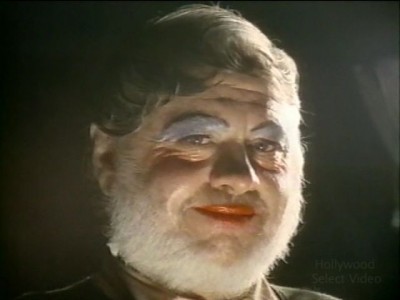
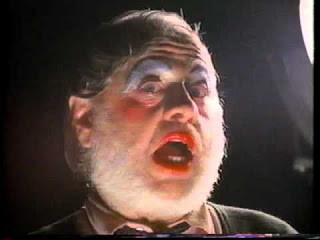
In The Manipulator, Mickey plays B.J. Lang, a former Hollywood makeup artist who has had a mental breakdown.  He now lives in a dusty warehouse, surrounded by old movie props and mannequins.  B.J. spends a lot of time talking to himself and trying on makeup.  Sometimes, he wears a fake nose and pretends that he’s Cyrano de Bergerac.  And then, at other times, he imagines all of his mannequins coming to life and taunting him.  (It’s kind of like the final scene of Maniac, except nobody’s head gets ripped off.)  Occasionally, he has weird flashbacks, which are all about giving the filmmaker an excuse to utilize the fish-eye lens and psychedelic lighting.

Eventually, we learn that BJ (and, as I watched the film, I kept wondering if his name was supposed to make viewers think about oral sex) is not alone in his warehouse.  There’s a woman (Luana Anders) who is being held prisoner.  He has her tied up in a chair and, whenever she begs to eat, he feeds her baby food.  BJ calls her Carlotta, though that’s apparently not actually her name.  The woman yells a lot.  Her first five minutes of screen time consist of her repeating, “MR. LAAAAAAAAAANG” over and over again.

BJ spends most of his time delivering monologues about how Hollywood used to be and occasionally, he demands that Carlotta help him put on a play.  At one point, BJ appears to have a heart attack and this leads to Carlotta going, “DON’T DIIIIIIIIIIIIIIIIIEEEEEE, MR. LAAAAAAAAANG” over and over again.

And then a homeless bum (Keenan Wynn) shows up and wanders about for five minutes before dying.

The problem with writing about a film like The Manipulator is that, just by describing the plot, you make it sound more interesting than it actually is.  You’re probably reading this and thinking, “Wow, this sounds really weird!  I need to see it at least once…”

No, you don’t.  It may sound weird but ultimately, it’s more emptily pretentious than anything else.  This was both director Yabo Yablonsky’s first and final film and there is not a single camera trick that he does not employ.  We get the weird angles, the random moments of slow motion, the even more random moments when the film is suddenly sped up, the extreme close-ups, the sudden blackouts, the ragged jump cuts, and, of course, lots of rack focus and zoom lens use.  Compared to The Manipulator, the direction of Getting Straight appears to be mild and conventional!  The film does feature three talented performers but none of them seem to have the slightest idea what the movie is about or who they are supposed to be playing.  In particular, both Rooney and Wynn seem to be making up their dialogue as they go along.

And really, that’s why The Manipulator is so annoying.  It should have, at the very least, been an insane misfire.  Instead, it’s just boring.

Sorry, Mickey.

Mickey Rooney Again


Horror On The Lens: Dementia 13 (dir. by Francis Ford Coppola)


For today’s excursion into the world of public domain horror, I offer up the film debut of Francis Ford Coppola.  Before Coppola directed the Godfathers and Apocalypse Now, he directed a low-budget, black-and-white thriller that was called Dementia 13.  (Though, in a sign of things to come, producer Roger Corman and Coppola ended up disagreeing on the film’s final cut and Corman reportedly brought in director Jack Hill to film and re-film additional scenes.) 

Regardless of whether the credit should go to Coppola, Corman, or Hill, Dementia 13 is a brutally effective little film that is full of moody photography and which clearly served as an influence on the slasher films that would follow it in the future.  Speaking of influence, Dementia 13 itself is obviously influenced by the Italian giallo films that, in 1963, were just now starting to make their way into the drive-ins and grindhouses of America.

In the cast, keep an eye out for Patrick Magee, who later appeared as Mr. Alexander in A Clockwork Orange as well as giving a memorable performance in Lucio Fulci’s The Black Cat.  Luana Anders, who plays the duplicitous wife in this film, showed up in just about every other exploitation film made in the 60s and yes, the scene where she’s swimming freaks me out to no end.

(One final note: I just love the title Dementia 13.  Seriously, is that a great one or what?)