Film Review: The Man In The Glass Booth (dir by Arthur Hiller)


Who is Arthur Goldman?

That’s the question at the heart of the 1975 film, The Man In The Glass Booth.

When we first meet Arthur Goldman (Maximilian Schell), he is a wealthy businessman who lives in a Manhattan high-rise and who appears to rarely leave the safety of his penthouse.  He is waited on by two assistants, Jack (Henry Brown) and Charlie (Lawrence Pressman), both of whom he talks to and treats as if they are members of his own family.  His most frequent visitor is his psychiatrist, Dr. Weissburger (Robert H. Harris), who frequently stops by and asks Arthur if he’s been taking his medication.

Arthur Goldman is a man who loves to talk.  Indeed, the first hour of the film feels almost like a nonstop monologue on the part of Goldman, with just occasional interjections from the other characters.  Goldman was born in Germany.  He talks about how, when he was young, he and his family were sent to a concentration camp and it was there that he witnessed the murder of his father by the camp’s sadistic commandant, Dorff.  Dorff is one of the many Nazis who disappeared to South America at the end of the war.

When Goldman spots a car that always seems to be parked across the street from his building, he becomes paranoid.  He says that he’s being watched and even suggests that Dorff has come to capture him.  Instead, it turns out that Mossad come for him.  As the agents explain it to Charlie, dental records prove that Arthur Goldman is actually Commandant Dorff.  Goldman/Dorff is taken back to Israel to stand trial for his crimes.

Are Arthur Goldman and Dorff the same man?  Once in Israel, Goldman tells anyone who will listen that he is Dorff and that he feels no guilt for his actions.  He insists on being allowed to wear his SS uniform during the trial.  Because of threats to his safety, a booth made of bullet-proof glass has been placed in the courtroom.  As the trial commences, The Man in the Glass Booth continues to rant and rave and declare his guilt.  However, the prosecutor (Lois Nettleton) comes to doubt that the man is who he says he is.

The Man In The Glass Booth is based on a novel and play by Robert Shaw.  (The same year that The Man In The Glass Booth was released, Shaw played Quint in Jaws.)  The film was produced as a part of an experiment called American Film Theatre, in which well-known plays would be adapted to film and then would be shown at 500 participating movie theaters in America.  Each production would only be shown four times at each theater and subscriptions were sold for an entire “season” of films.  It sounds like an interesting experiment and the type of thing that I would have enjoyed if I had been around back then.  Today, of course, these productions would have just premiered on a streaming service.

The Man In The Glass Booth is a film that very much feels like a filmed play.  There are only three locations — Goldman’s penthouse, his cell, and the courtroom where he is put on trial.  The three act structure is very easy to spot.  Maximilian Schell’s performance is also very theatrical.  In fact, it’s so theatrical that, for the first hour or so, I found myself wishing that he would just stop talking for a few second or two.  He was so dramatic and so flamboyant and so intentionally over-the-top that he became somewhat exhausting.  But, during the second hour, I came to see that all of that “overacting” was actually setting up the film’s final act.  Schell talks so much that, when he finally does find himself unable to explain himself, it’s a shocking moment and one that perfectly captures not just the evil of the Nazis and the Holocaust but also how the legacy of that evil lives on after the fall of the Third Reich and the deaths of the majority of the Holocaust’s perpetrators.  At that moment, I realized that The Man In The Glass Booth never stopped speaking because silence would force him to confront the horrors of the past and the trauma, guilt, and uncertainty lurking in his subconscious.  Maximilian Schell was nominated for an Oscar for his performance here and, by the end of the film, I totally understood why.

The Man In The Glass Booth requires some patience.  Actually, it requires a lot of patience.  However, those who stick with it will discover an intelligent and thought-provoking film about not only the horror of the past but also how those in the present deal with and rationalize those horrors.  Though the film is a bit too stagey for its own good, it’s also one that sticks with you even after the curtain falls and the end credits roll.

Scenes That I Love: Lee Marvin on Point Blank


100 years ago today, Lee Marvin was born in New York City.  One of the great screen tough guys, Lee Marvin played stoic and determined men who you didn’t want to upset.

That was certainly true of his role as Walker in 1967’s Point Blank.  A thief who was double crossed by his partner and the organization to which his partner was in debt, Walker is determined to get back the money that he stole from someone else.  Relentlessly, Walker moves from one mob boss to another and repeatedly, those bosses make the mistake of thinking that they can double cross him again.

Point Blank (1967, directed by John Boorman)

In this scene, which was reportedly considered to be shockingly violent by 1967 standards, Carter (Lloyd Bochner) attempts to fool Walker, just to discover that Walker is smarter and far more ruthless than anyone realizes.

The TSL’s Grindhouse: Satan’s School For Girls (dir by David Lowell Rich)


Have you ever wanted to enroll in a private school so that you could investigate a murder and maybe uncover some sort of occult conspiracy?  Sure, we all have!  Well, don’t worry …. there’s a place for you!  Welcome to Salem Academy, an exclusive all-girl’s college where students learn all the basic subjects, along with taking courses in art and human sacrifice!

Salem Academy is overseen by the feared and intimidating Mrs. Williams (Jo Van Fleet), who keeps a close eye on her students and tries to make sure that they aren’t distracted or corrupted by any outside influences. However, not even Mrs. Williams can keep Martha Sayers (Terry Lumley) from fleeing the school and going to her sister’s house in Los Angeles. When Martha’s sister, Elizabeth (Pamela Franklin), returns home, she discovers that Martha has been hanged. The police say that it was suicide. Elizabeth believes that it’s something else.

So, Elizabeth does what any vengeance-seeking sister would do. Using an assumed name, she enrolls in Salem Academy herself. She meets and befriends three other students (played by Kate Jackson, Jamie Smith Jackson, and Cheryl Ladd). She gets to know two rather suspicious teachers, Prof. Delacroix (Lloyd Bochner) and Dr. Clampett (Roy Thinnes). She also manages to raise the concerns of Mrs. Williams, who doesn’t like the fact that the new girl keeps asking so many questions about why so many students at Salem Academy have died recently.

Still, Elizabeth continues to investigate. Perhaps the secret can be found in a mysterious painting that she comes across, one that appears to be of Martha? Perhaps the teachers and the students know more than they’re telling. But who can Elizabeth trust?

A made-for-television film from 1973, Satan’s School For Girls is frequently as silly as its name.  Fortunately, the film, which was produced by Aaron Spelling and directed David Lowell Rich, seems to understand just how ludicrous it is and it totally embraces both the melodrama and the silliness of its plot. This film is totally product of the time in which it was made, from the dialogue to the hairstyles to the fashions to the ending that you’ll see coming from a mile away. At the same time, that’s also why this film is a lot of fun. It’s such a product of its time that it doubles as a time capsule. Do you want to go back to 1973? Well, go over to YouTube and watch Satan’s School For Girls.  After you’ve watched it, step outside and ask anyone who the president is and they’ll probably say, “Richard Nixon.”  And if you ask them who they’re favorite Brady is, they’ll look at you like your crazy because everyone know that Marcia is the best Brady.  If you even have to ask, it’s obvious that you don’t really watch the show.  After that, you should probably try to find a way to get back to 2021 before you change the future or something.  You know how tricky time travel can be.

As for Satan’s School for Girls, it’s just a really fun movie so check it out and be sure not to be late for class!

Horror on the Lens: Mazes and Monsters (dir by Steven Hilliard Stern)


For today’s horror on the lens, we’ve got the 1982 made-for-TV movie, Mazes and Monsters!

Mazes and Monsters!  Sounds pretty scary, doesn’t it?  Well, have no fear.  Mazes and Monsters is just a role-playing game, one that definitely should not be mistaken for Dungeons and Dragons despite the fact that it’s exactly the same as Dungeons and Dragons.  Except, of course, for the fact that one game takes place in a dungeon and the other takes place in a maze.

A group of rich kids love playing Mazes and Monsters but, when they take it a step too far, it leads to the newest member of their group having a nervous breakdown, fleeing to New York City, and fighting demons that only he can see.  Our delusional hero is played by an actor named Tom Hanks.  Hey, whatever happened to him?

Anyway, Mazes and Monsters is kind of silly.  You’re going to get sick of Chris Makepeace’s hats pretty quickly.  It imagines a world where the most popular and attractive kids on campus just can’t wait to pretend to be clerics and magic users.  And yet, in its own melodramatic way, the film works.  If you’ve ever wanted to see Tom Hanks stab a green demon, this is the film to watch!  This was one of Tom Hanks’s first roles and he already looks a little bit too old to play a college student but his trademark likability is already evident.  When Tom has a moment of clarity and desperately announces that “THERE’S BLOOD ON MY KNIFE!,” it’s impossible for your heart not to ache for him a little.  Finally, as over-the-top as the moral panic about the possibility of LARPers going crazy in New York may be, the ending actually is surprisingly effective.

Enjoy!

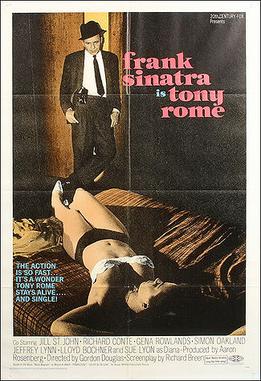
Cleaning Out The DVR: Tony Rome (dir by Gordon Douglas)


The 1967 film, Tony Rome, is about a detective named …. can you guess it?

That’s right! Tony Rome!

Tony works out of Miami and, because he’s played by Frank Sinatra, you can be sure that he’s a tough guy who knows how to throw a punch but who, at the same time, also knows how to have a good time. He’s got a bottle of liquor in the glove compartment. He’s got his own boat. He’s got a snappy quip for every occasion and a properly cynical sense of humor but at the same time, he also cares about doing the right thing. He says what’s on his mind and if that hurts your feelings, tough. Again, none of this should be a surprise, considering that he’s played by Frank Sinatra and Sinatra could play these type of sentimental tough guys in his sleep.

That’s not to say that Sinatra sleepwalks through the role, of course. Far from it. As played by Sinatra, Tony comes across as an authentic tough guy, as someone who has seen it all and who, as a result, understands that importance of stopping to have a drink and appreciate the world around him. Tony Rome might be a Rat Pack-style private investigator but that doesn’t mean he can’t solve the case and, even while Tony’s having a good time, Sinatra never lets you forget that he takes his job very seriously.

As for the film, it’s a story that beings when Tony is hired to drive a passed out rich girl back to her home. This leads to him investigating a jewelry theft and eventually discovering an extortion plot. Sue Lyon plays the rich girl. Gena Rowlands plays her stepmother while Simon Oakland (the psychologist at the end of Psycho) plays her father. Richard Conte, who played bad gangster Barzini in The Godfather, plays Tony Rome’s best friend on the police force. (Every good private eye has a best friend on the police force.) Jill St. John plays Ann Archer, who helps Tony out with his investigation. Ann is recently divorced. Will Tony claim her heart or will she go back to her husband? It wouldn’t be a Sinatra film without a little heartbreak. (To a large extent, St. John’s performance here feels like a slightly more serious version of the performance she would later give as Tiffany Case in Diamonds are Forever, which is perhaps as close as we’ll ever get to a Rat Pack-style James Bond film.)

The story itself is surprisingly easy to follow. This is not one of those detective stories that will leave you shocked over who turns out to be the bad guy. For a film that often takes something of a light-hearted approach to Tony’s efforts to solve the mystery, it’s also a rather violent film. More than a few people get killed. Tony gets kicked in the ribs at one point and the sound of the 50-something Sinatra groaning in pain is disconcerting. Of course, Tony recovers quickly and immediately gets his revenge. When you watch the scene, you think to yourself that anyone who would try to beat up Frank Sinatra has to be a fool. That’s largely because Tony is Sinatra and Sinatra is Tony.

It’s an entertaining film, one that works well as a time capsule of what it was like to cool and swinging and middle-aged in 1967. Tony Rome is smart enough to focus more on Sinatra’s charisma than on trying to impress the viewers with its own cleverness. If I ever have to hire a private detective, I hope he’s like Tony Rome. I hope he gets the job done. I hope he has a good time while doing it. And I hope he comes with his own Nancy Sinatra-sung theme song. That’s not too much to ask, is it?

Horror on the Lens: Satan’s School for Girls (dir by David Lowell Rich)


For today’s horror on the lens, we have a 1973 made-for-TV movie called Satan’s School For Girls.

After her sister turns up dead, Elizabeth (Pamela Franklin) refuses to accept that official conclusion that it was a suicide.  Instead, Elizabeth is convinced that it was murder and that it has something to do with the exclusive school that her sister attended, the Salem Academy for Women.

Well, honestly, the Salem part is a dead giveaway.  I think we can all agree on that.

Anyway, this movie features a Satanic cult, an old school clique, and plenty of early of 70s fashion choices.  It may be silly but it’s also definitely entertaining.

Enjoy!

Horror on TV: The Twilight Zone 3.24 “To Serve Man” (dir by Richard L. Bare)


“It’s a cookbook!”

During the month of October, we like to share classic episodes of horror-themed television.  That was easier to do when we first started doing our annual October horrorthon here at the Shattered Lens because every single episode of the original, black-and-white Twilight Zone was available on YouTube.  Sadly, that’s no longer the case.  In fact, there is exactly one episode of the original Twilight Zone on YouTube.

Fortunately, that episode is a classic.  In 1962’s To Serve Man, an alien (Richard Kiel) comes to Earth and invites people to return to his home planet with him.  He leaves behind a book.  When everyone learns that the title of the book is To Serve Man, they excitedly decide that the book must be an instruction manual on how to help mankind.  The truth, as we learn in the episode’s classic finale, is something a little bit different.

Here’s the episode!  Watch it before YouTube yanks it down.

(This episode originally aired on October 2nd, 1962.  It was directed by Richard L. Bare from a script by Rod Serling.  It was based on a short story by Damon Knight.)

Enjoy!

Horror on the Lens: Crowhaven Farm (dir by John McGreevey)


Sure, inheriting an old New England farm might sound like a fun idea but what are you going to do if it turns out that the farm is haunted by the spirits of a coven of witches?

That’s the question that Hope Lange and Paul Burke have to find an answer for in this enjoyably spooky 1970 made-for-TV horror film!  Lange and Burke both give good performances, generating a lot of sympathy for their unhappily married couple while director John McGreevey does a commendable job of creating and maintaining a nicely ominous atmosphere.

And, of course, John Carradine’s in it!  It’s simply not a rural horror film from the 70s without John Carradine!

Enjoy!

Horror on TV: The Twilight Zone 3.24 “To Serve Man” (dir by Richard L. Bare)


“It’s a cookbook!”

During the month of October, we like to share classic episodes of horror-themed television.  That was easier to do when we first started doing our annual October horrorthon here at the Shattered Lens because every single episode of the original, black-and-white Twilight Zone was available on YouTube.  Sadly, that’s no longer the case.  In fact, there is exactly one episode of the original Twilight Zone on YouTube.

Fortunately, that episode is a classic.  In 1962’s To Serve Man, an alien (Richard Kiel) comes to Earth and invites people to return to his home planet with him.  He leaves behind a book.  When everyone learns that the title of the book is To Serve Man, they excitedly decide that the book must be an instruction manual on how to help mankind.  The truth, as we learn in the episode’s classic finale, is something a little bit different.

Here’s the episode!  Watch it before YouTube yanks it down.

(This episode originally aired on October 2nd, 1962.  It was directed by Richard L. Bare from a script by Rod Serling.  It was based on a short story by Damon Knight.)

Enjoy!


Horror on the Lens: Satan’s School for Girls (dir by David Lowell Rich)


For today’s horror on the lens, we have a 1973 made-for-TV movie called Satan’s School For Girls.

After her sister turns up dead, Elizabeth (Pamela Franklin) refuses to accept that official conclusion that it was a suicide.  Instead, Elizabeth is convinced that it was murder and that it has something to do with the exclusive school that her sister attended, the Salem Academy for Women.

Well, honestly, the Salem part is a dead giveaway.  I think we can all agree on that.

Anyway, this movie features a Satanic cult, an old school clique, and plenty of early of 70s fashion choices.  It may be silly but it’s also definitely entertaining.

Enjoy!