13 for 13: DeathBed (dir by Danny Draven)


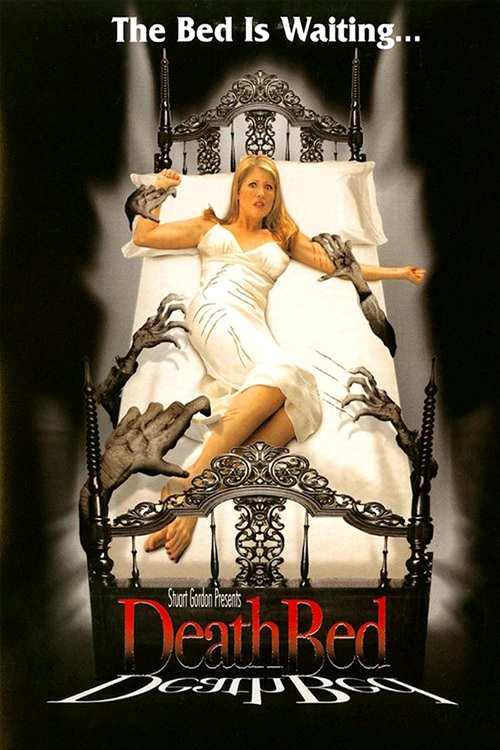
In 2002’s DeathBed, Karen (Tanya Dempsey) and Jerry (Brave Matthews) move into a new apartment.  Karen is an illustrator of children’s books.  Jerry is a professional photographer who occasionally does “nudie stuff.”  Their new landlord and building superintendent is Art (Joe Estevez).

At first, the new apartment seems ideal.  But then, strange things start happening.  Karen starts to have visions of a woman being strangled in the apartment.  She struggles to finish her latest illustration project and instead finds that strange and disturbing pictures have been drawn while she was apparently asleep.  Jerry gets weird at work, telling models to pose as if they’ve been tied down to a mattress.  Jerry and Karen’s sex life gets a bit more adventurous but even that leaves Karen worried.  She feels as if she’s losing control.

Could the apartment be haunted?

Or could it have something to do with the creepy bed that Karen and Art previously found in a hidden room and which Karen decided to make the centerpiece of the new apartment?

Karen starts to do research.  At first, she can’t find any evidence that a murder was ever committed in the apartment but then she discovers that the name of the street was changed in the 40s and that her new apartment actually has a very long and rather macabre history.  Meanwhile, Jerry worries about her sanity.  Deadlines are blown.  Murders are committed.  And the viewer is left asking one question….

Would you rent an apartment from Joe Estevez?

Actually, I’m being way too snarky with that question.  DeathBed is surprisingly effective horror film and Joe Estevez gives a likable performance as Art.  Personally, I still think Karen was way too quick to explore a previously hidden room with him but, otherwise, Art comes across as being a genuinely nice guy.

DeathBed is actually one of the better films that I’ve seen from Full Moon Pictures.  While I wasn’t a huge fan of Danny Draven’s direction of Hell Asylum, he does an excellent job with DeathBed, creating and maintaining an atmosphere of ominous doom and gradual decay.  What makes the film so effective is that Karen and Jerry don’t fall apart immediately.  Instead, it’s a gradual process.  The viewer can see it happening but Karen and Jerry can’t.  Brave Matthews and especially Tanya Dempsey are well-cast as the troubled couple.  Dempsey gives an especially strong performance, playing a woman who has used her art to create the ideal life that she’s never had.

DeathBed has an interesting story and a few creative twists, even if the film’s actual ending what come as a huge surprise to experienced horror fans.  I appreciated that Karen’s visions of the previous murder appeared to carry hints of the infamous Black Dahlia case.  It served to remind the viewer that real life can sometimes be just as terrifying and mysterious as the movies.

Would I rent an apartment from Joe Estevez?

Well, probably not.  Not after seeing what happened with Karen and Jerry.  But I don’t blame Karen and Jerry for wanting the apartment.  It’s a nice apartment.  It’s just that there are times that hidden rooms should definitely remain hidden.
13 for 13: Hell Asylum (dir by Danny Draven)


Would you watch a reality show produced by Joe Estevez?

Of course not!  Reality TV …. hey, that’s the form of entertainment that is destroying our culture and leaving viewers unable to think for themselves!  Reality TV is a pox on our house.  Thanks to reality TV, the Kardashians are more famous than they have any right to be.  Jennifer Welch has become a political pundit despite having all the charm of a sour lemon.  People now feel like they have to live every moment as if there’s a million people watching and as a result, it’s become difficult to connect in any meaningful way…..

Eh.  Actually, I like reality TV more than I should and I probably would watch a reality show produced by Joe Estevez.

I mean, why not?  The best reality shows are always kind of sleazy and there are few actors who are as talented at playing sleazy characters as Joe Estevez.  If Martin Sheen often seems as if he’s auditioning to be the Pope, his brother Joe comes across as if he’s auditioning to be the tabloid reporter who writes a slanderous story about the Pope.  The fact that Joe Estevez looks like a drunk version of his brother only serves to make him all the more effective as someone who you wouldn’t necessarily want to be associated with.  (Unless, of course, he could make you a lot of money….)

In Hell Asylum, Joe Estevez plays Stan, a network television executive.  The movie opens with a show being pitched to him.  The pitch, like many of the scenes in Hell Asylum, goes on way too long.  Basically, a group of models have been recruited to spend the night in a supposedly haunted asylum while being filmed.  The pitch is nothing special but Stan needs a hit.

Of course, it turns out that the asylum really is haunted.  It takes a while but eventually, the models and the television crew end up being stalked by a bunch of mysterious hooded figures.  (Brinke Stevens is credited as being the “Head Spectre.”)  The murders are filmed with a blue tint, which is creepy at first but eventually just hurts your eyes.  There’s some gore, but it’s mostly just some red gloop and rope meant to stand-in for spilled intestines.  It’s not particularly scary but at least it’s only 72 minutes.

Of course, Joe Estevez thinks that he has his hands on America’s hottest new reality show.  At first, I thought the movie was being a bit too cynical but then I thought about all of the real-life deaths that I’ve seen posted to twitter and YouTube and I realized that I was probably being naive.  We actually did have a reality show in which each episode ended with someone pretending to “die.”  Murder in Small Town X was set up like Survivor, except that no one was voted off the island.  Instead, they were voted to meet the killer.  Even though no one actually died, I would have to think it would be more infinitely more traumatic to know that a bunch of people voted for you to be pretend-killed instead of pretend-exiled.  That said, Murder In Small Town X was actually a lot of fun!

I wonder if Joe Estevez produced it.

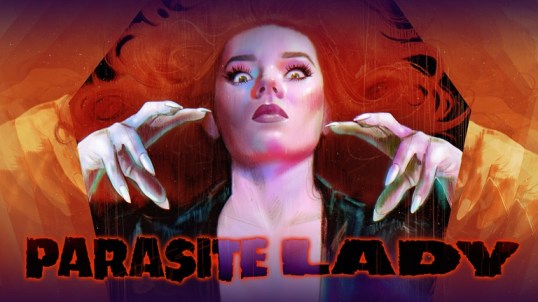
13 for 13: Parasite Lady (dir by Chris Alexander)


2023’s Parasite Lady is a cinematic poem.

Miranda (Arrielle Edwards) awakens in her coffin.  Tall with long red hair, she makes for a haunting figure as she strides across a snowy field and heads to a carnival where she finds her next victim.  Though the film is shot on video, director Chris Alexander still manages to make our real world feel like some sort of otherworldly fantasy, a vision that balances on the line between being a dream and being a nightmare.  Everything about the carnival feels off-center and off-balance.  Even the familiar rides and the posters of 21st century pop cultural icons like Captain Jack Sparrow add to the overall otherworldliness of the location.  Dracula and Sparrow, represented at the same carnival?  The past is meeting the present.

Miranda takes her victims back to a cheap motel, the type of place where everyone has probably spent at least one night.  It’s the type of motel that you see sitting off the side of the road while you’re driving and you think to yourself, “How does that place even stay open?”  But, when it’s late at night and your eyelids are feeling heavy, you’re happy to see it.  It reminded me a bit of the motel where 11 year-old me lived for a few months with my mom and my sisters.  My mom and my two eldest sisters paid for our stay by working as maids.  Me, I spent my days exploring the hallways and listening at the doors.  Every night, I would look out the window of my room and watch a movie playing at a drive-in that sat on the other side of a nearby creek.  I would make up my own stories and dialogue to go along with the images.  Who needs sound when you’ve got imagination?

Much like those drive-in movies that I watched, Parasite Lady is a bit of an enigma.  There’s very little dialogue.  The majority of the 43-minute film features a soundtrack made up of muted music and sound effects.  Instead, it’s all about the imagery.  Much like the vampire films of Jean Rollin, the film plays out like a cinematic dream.  It’s less important to understand why Miranda exists than to just accept that she does.  Why do her victims seem to be instantly drawn to her?  Well, why is anyone drawn to self-destruction?  That’s the world in which we live.  That’s also the world in which Miranda lives, though she doesn’t necessarily want to.  Parasite Lady is drenched in an atmosphere of ennui.

Earlier, I compared the film to the works of Jean Rollin.  I would also compare this film to Jess Franco’s wonderfully atmospheric Female Vampire.  The scenes of Miranda walking through the snow and the carnival bring to mind the lengthy shots of Lina Romay walking through the wilderness in Franco’s film.  Much like Female Vampire, Parasite Lady leaves one wondering if eternal life is really worth all of the angst and the suffering.  Arielle Edwards has a strong physical presence that, much like Lina Romay in Female Vampire, allows her to dominate the screen without having to speak.

Executive produced by Charles Band and released by Full Moon Pictures, Parasite Lady is an unforgettable dream of dark and disturbing things.

13 for 13: The Crater Lake Monster (dir by William R. Stromberg)


1977’s The Crater Lake Monster takes place in a small town in Northern California.

There’s not much to the town of Crater Lake, other than it’s beautiful lake and the dreams of brave residents like Arnie (Glenn Roberts) and Mitch (Mark Siegel).  Arnie and Mitch are convinced that they’re going to get rich by renting boats out to tourists.  “Our boats …. our boats …. our boats,” as Mitch puts it.  Arnie has long hair and a beard.  Mitch is going bald and seems to be a little bit goofy at times.  One gets the feeling that they may have dropped too much acid in the 60s but they still seem like good people.  They’re the type of people who you could only find in a town like Crater Lake.

When a group of scientists explore the caves near the lake, they discover drawings that suggest that cavemen knew about dinosaurs.  The drawings prove that cavemen and dinosaurs existed at the same time!  Take that, Charles Darwin!  However, a sudden meteorite strike causes the cave to collapse.  The scientists manage to escape but what of the drawings?

Actually, the scientists may not need the drawing to prove that men and dinosaurs existed at the same time.  After the meteorite hits, a real dinosaur — perhaps the same one from the drawings — shows up and people start of disappear around the lake.  The local sheriff (Richard Cardella) is skeptical but soon, even he has to admit that a Plesiosaurus has apparently claimed the lake as its own.

At one point, a U.S. Senator (Marv Eliot) rents a boat from Arnie and Mitch so that he can enjoy a peaceful day on the lake.  The Senator gets eaten.  I think something like this would usually be considered a national emergency but no, the National Guard never arrives.  It’s left to the citizens of Crater Lake to deal with their monster.

Oh, how I love this stupid movie.  Don’t get me wrong.  It’s definitely a low-budget affair.  With the exception of Glenn Roberts and Mark Siegel (Arnie and Mitch forever!), the cast is forgettable.  The sheriff looks more like a struggling bass player than a member of law enforcement.  The film moves a bit slowly.  There are some scenes that appear to be way too underlit, though that may have more to do with the bad quality of the uploads that I’ve watched than anything else.  The Crater Lake Monster is one of those films that has appeared in a countless number of Mill Creek Box Sets.

And yet, I can’t help but enjoy the film.  No matter what else you may want to say about the film, the stop-motion dinosaur is a lot of fun to watch and, in a few scenes, it actually does seem to be genuinely menacing.  At its best, the film is an enjoyably goofy tribute to the monster movies of the 50s and, as such, the bad acting and the risible dialogue feels rather appropriate.  That said, it’s still a film of the 70s and the ending is surprisingly bleak.  You’ll be saying, “Our boats …. our boats….” for hours after watching The Crater Lake Monster.

The Crater Lake Monster is a fun, low-budget monster flick.  On this Friday the 13th, it’s a reminder that Jason isn’t the only thing waiting in the wilderness.

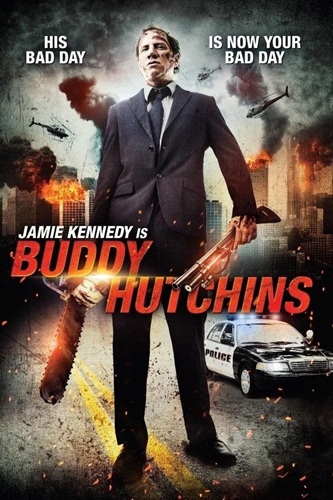
13 for 13: Buddy Hutchins (dir by Jared Cohn)


“His bad day is now your bad day!”

Hey, give it up for 2015’s Buddy Hutchins.  No matter what else one might say about this film, that’s a great tag line.  It not only captures your attention but it’s also honest about the film.  Buddy is having a very bad day.  As a matter of fact, Buddy has several  bad days.  It takes him a while but when he snaps, he makes sure that everyone else has an even worse day.  Whoever came up with that line better have gotten a raise.

Unfortunately, the film itself doesn’t really live up to the tag line.  Jamie Kennedy plays the title character.  Buddy Hutchins used to be a boozer.  Now, he’s just a loser.  He’s unhappily divorced.  He rarely gets to see his young daughter.  He owns a dry cleaning store that no one frequents.  He can’t even afford to pay his one employee.  (“Things are going to pick up!” Buddy says, over and over again.)  He’s just learned that the man he thought was his father isn’t actually his father.  No one has much respect for Buddy.  Not even the cop who is called out whenever Buddy causes a scene in the neighborhood can summon up much sympathy for Buddy.  Buddy spends most of the movie wishing that he could get his old band back together.  When it becomes obvious that isn’t going to happen, he grabs his chainsaw.

Buddy goes on a rampage.  That’s not a surprise.  What is a surprise is how long it takes him to do it.  As played by Kennedy, Buddy is twitchy and obviously unstable from the minute that we first see him.  When the film started, I thought Kennedy was just overacting but, as it progressed, I came to realize that Kennedy was actually very convincing as the type of person who you would dread being stuck in a room with.  At times, I worried that Buddy was going to drown in a deepening pool of self-pity.  Then again, if that had happened, it wouldn’t necessarily have been a bad thing.  It would have saved several lives and it would have also shut him up.

Buddy Hutchins was also released under the title Falling Down Again.  There are definite similarities to Falling Down but there’s quite a few differences as well.  In Falling Down, Michael Douglas plays a burned-out engineer who snaps on a very hot day in Los Angeles and who is eventually stunned to realize that he is now the “bad guy.”  Falling Down‘s D-Fens is not really a sympathetic character but one can still understand what’s happening in his head and mourn the man that once was.  In Buddy Hutchins, Buddy is basically a loser who can’t succeed at life because he’s a moron.  He doesn’t snap because of the frustrations of everyday life in the big city.  He snaps because he’s too much of an idiot to do anything else.

Falling Down is a flawed film but it does at least have the courage of its convictions.  It may end on a sad note but it was really the only way the story could end.   Buddy Hutchins ends with a twist that doesn’t feel at all earned.  The film may end with justice for Buddy but where’s the justice for those of us who just spent 90 minutes watching him?

13 for 13: Witchouse (dir by David DeCoteau)


When I first started writing for Through the Shattered Lens, I wasn’t sure how long my reviews should be.  I went over to Rotten Tomatoes and I read their guidelines for reviews and I discovered that a review should be, at minimum, 300 words long.

300 words? I thought,  I can do that!

Truth be told, sometimes I can’t.  Sometimes, you see a movie where it’s a struggle to even come up with 300 words.  When that happens, I resort to filler.  I’ll tell you about my weekend.  I’ll tell you about a funny thing that happened to me in high school.  I’ll give you a long-winded story about my early days as a TSL reviewer.  I’ll do whatever I need to do to make sure that I can reach at least 300 words.

The importance of filler was clearly on the mind of David DeCoteau when he directed the 1999 film, Witchouse.  (And yes, that’s how the title is spelled.)  Typically, a film has to run a minimum of 65 to 70 minutes for it to be considered a feature film.  Witchouse features three minutes of opening credits, three minutes of closing credits, and a lot of stock footage from a film called Dark Angel: The Ascent.  In fact, the film uses the Dark Angel stock footage not once but twice.  The finished film runs 72 minutes so obviously David DeCoteau and Full Moon Pictures got what they needed out of all that filler.  Fortunately, the audience gets what it needs as well.  Witchouse is a film that announces from the start that it shouldn’t be taken too seriously.

The film takes place at a mansion in Dunwich, Massachusetts on a stormy night.  Elizabeth (Ashley McKinney) has gathered together a group of friends for a party.  When her friends arrived, I assumed they had all gone to high school together.  Imagine my surprise when I learned that the characters were all supposed to still be in high school!  Elizabeth wants to hold a seance so that she can contact the spirit of her ancestor, a witch named Lilith (Ariauna Albright).  Centuries ago, Lilith was burned at the stake.  Elizabeth is hoping to bring Lilith back from the dead and she’s willing to sacrifice her friends to do it.  Her friends, for the most part, just want to have sex in a big creepy mansion and who can blame them?

If this plot sounds familiar, it’s probably because the story itself was largely lifted from Night of the Demonswith the horribly burned Lilith even resembling the decaying Angels from Kevin Tenney’s classic shocker.  Witchouse is never quite as much fun as Night of the Demons.  For instance, there’s nothing in Witchouse that can match the subversive oddness of the lipstick scene from Night of the Demons.  At its best, Witchouse is occasionally atmospheric and it features decent performances from Ashley McKinney and Monica Serene Garnich.  At its worst, the film is kind of boring.

That said, I will give Witchouse credit for totally frustrating my autocorrect.  How does one pronounce Witchouse?

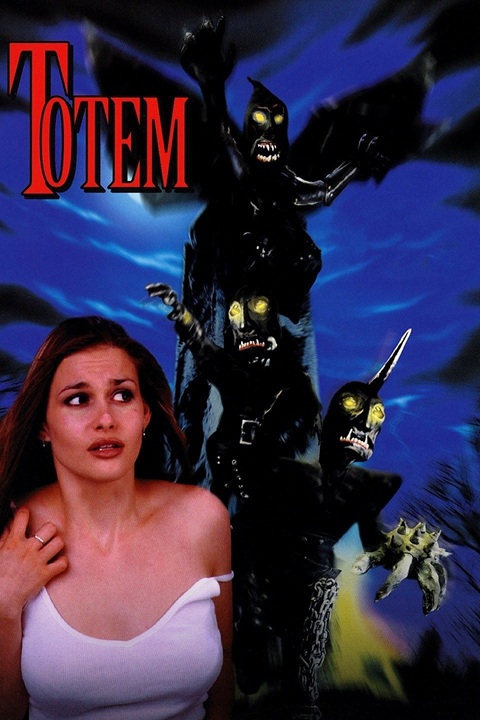
13 From 13: Totem (dir by David DeCoteau)


1999’s Totem opens with a young woman named Alma Groves (Marissa Tait) running through the wilderness.

She runs until she reaches an isolated cabin.  Entering the cabin, she finds five other people have already arrived.  She doesn’t know who they are and they don’t know her.  In fact, she doesn’t even know why she suddenly felt the need to stop eating lunch and to run until she found the cabin.  She’s not even sure how she found herself in the wilderness to begin with.  Everyone else at the cabin has a similar story.  They were all going about their day until, suddenly, an image of the cabin entered their mind and they felt compelled to run until they found it.

At first, Paul (Jason Faunt) comes across as being a chivalrous and friendly jock type.  Leonard McKinney (Eric W. Edwards) is a cocky womanizer who is upset that he was compelled to leave in the middle of having sex (or so he claims).  Robert Cole (Tyler Anderson) is the angry rebel who is reluctant to talk about his past.  As for the other women, Roz (Sacha Spencer) is sarcastic while Tina (Alicia Lagano) is a seemingly innocent high school student.  Along with Alma, the six of them are trapped in the area by an invisible force field.

While trying to determine where the invisible barriers have been placed, the six of them come across a cemetery and three sinister-looking statues.  As the night continues, it becomes clear that, whenever someone dies, one of the statues comes to life.  But why are there six people and only three statues?  “Three to be killed and three to kill!” Robert says.

Directed by David DeCoteau and produced by Charles Band’s Full Moon Pictures, Totem is about as incoherent as you would probably expect from this production team.  However, it’s a cheerful sort of incoherence, one where the confusing story is at least told with some energy and the entire thing has a “make it up as you go along” sort of feel to it.  It’s remarkable how the people in the cabin keep figuring out all of the extra rules that determine how the three killer statues work.  Myself, I sat through all 68 minutes of this film and I’m still not quite exactly sure what was going on.  That said, the confusing nature of the story works to the film’s advantage.  At its best, Totem manages to achieve a sort of dream-like intensity.  Who hasn’t had that dream about finding yourself in the middle of nowhere with absolutely zero clue how you got there or how to get home?

You know what else works to this film’s advantage?  That 68 minute running time.  The film essentially feels like an extended episode of an old horror anthology show.  Think of it as being a bloody episode of something like Night Gallery or Tales From The Crypt.  It’s a piece of gory fun that doesn’t really require too much of the audience.  It’s cinematic junk food and that is definitely meant as a compliment.

13 for 13: The Sleeper (dir by Justin Russell)


Who is the Sleeper and why is he stalking the girls of the Alpha Gamma Theta sorority?

That’s one of the many questions raised by 2012’s The Sleeper, an unexpectedly diverting homage to the classic slasher films of the 80s.  The Sleeper doesn’t really worry too much about answering that question.  This is a film that understands that the old slasher films were effective precisely because they rarely provided any answers.  All one really needs to know about the Sleeper (effectively portrayed by Jason Jay Crabtree) is that he’s got a collection of tools, he’s surprisingly quick on his feet, and he can do a lot of damage with a little hammer.

The Sleeper takes place in 1981, a smart choice for a number of reasons.  1981 was one the biggest years when it came to the American slasher boom and The Sleeper does a good job of recreating the aesthetics of the era, right down to a freeze frame final shot.  Setting the film in 1981 is also an admission that most of the old school slasher films wouldn’t work in an era in which people are not dependent on landline phones.  As if to emphasize this point, the film has the Sleeper calling his victims before attacking.  It’s 1981.  There’s no way to block the number!  By setting the film in 1981, the filmmakers are able to avoid having to come up with an awkward excuse for why no one has their phone with them.  Even better, none of the characters are influencers.  Instead, they’re just college students who are trying to enjoy their night.

For the most part, the potential victims are all likable.  You don’t want to see harm come to any of them, which definitely builds up the suspense once the Sleeper starts doing his thing.  Because the characters are all college students with active social lives, it’s believable that people wouldn’t freak out about them suddenly disappearing.  I remember that, when I was in college, I would go several days without seeing some of my best friends and only occasionally did I suspect that they had fallen victim to a hammer-wielding killer.  I especially liked the character of Ava (Ali Ferda), who was sarcastic and outspoken but who, most importantly, never became a caricature.  Indeed, all of the characters seem refreshingly human and multi-faceted, even if they do conform to certain slasher stereotypes.

This film also wins major points for including a disco line dnace that comes out of nowhere but which is charmingly awkward.  The song playing is definitely more 90s techno than 80s disco but still, watching the cast doing their best on the dance floor was one of the film’s more unexpected treats.

Finally, towards the end of the film, Joe Bog Briggs (credited by his real name, John Bloom) makes a cameo appearance as a doctor and yes, he wears a bolo tie.  It’s impossible not smile at the sight of him.

Bloody but also witty, The Sleeper was a diverting slasher surprise.

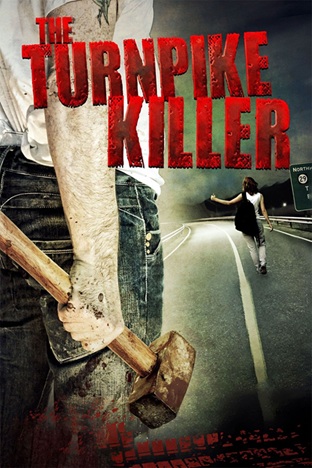
13 For 13: The Turnpike Killer (dir by Evan Makrogiannis and Brian Weaver)


In college, my best friend Evelyn and I came up with the “Extra Person Rule for Road Trips.”

The Extra Person Rule stated that no matter how many people we were traveling with, we would always remember to invite one extra person, someone who was pleasant but to whom we really didn’t really have a particularly close personal connection. That way, if we got kidnapped by a serial killer, we would have someone around who could heroically sacrifice herself while giving the rest of us an opportunity to escape. She needed to be likable so she wouldn’t get on our nerves during the trip but also not someone who we would feel guilty about losing if worst came to worst.  We quickly learned that the secret to making the Extra Person Rule work was to make sure that the extra person didn’t know she was the extra.  As such, you would usually have to invite a decoy extra as well.  It could get complicated.

Fortunately, Evelyn and I never actually got abducted by a serial killer whenever we went on a road trip but it was still something for which we felt we should be prepared. It’s a scary world out there. You have to be ready for anything.

I found myself thinking about the Extra Person Rule while watching 2009’s The Turnpike Killer. Jon Beest (Bill McLaughlin) is the film’s title character, a serial killer from New Jersey who crosses into New York and kills several people over the course of 88 minutes. If I ever ran into Jon Beest, I would definitely want to have an extra person around, though I’m not sure it would have helped.  Jon Beest is about as determined a killer as a big bald man named Beest can be. As for why Jon Beest is known as the Turnpike Killer, he apparently dumps some of his victims’ bodies along the New Jersey turnpike.

What to say about The Turnpike Killer? It’s an odd little film.  It has too much of a misogynistic streak for me to recommend it but, at the same time, I do have to admit that it is effectively filmed and acted.  It creates and maintains a convincing atmosphere of grit and sleaze. The images are grainy and the gore is often disturbingly realistic. There’s a twist at the end that comes from almost out of nowhere and it’s hard not to wonder if that twist is the reason why this otherwise simple film has two credited directors.  Almost despite myself, I appreciated the weirdness of it.

I will give the film unreserved credit for one thing. Bill McLaughlin is absolutely terrifying as Jon Beest and the film wisely does not turn him into a Freddy Krueger-style quip machine. He’s not some clever, erudite man with an amazing, if twisted, brain. Instead, he’s …. well, he’s pathetic. The same can be said of most real-life serial killers. If you look at most real-life serial killers, you’ll see that they’re much more likely to be someone like Jon Beest than Hannibal Lecter. When the film works, it’s because Jon Beest seems like the killer that you actually could find waiting for you on a dark road or in the shadows of a New York apartment.

And if you do run into him, you better hope you have an extra person.

13 For 13: Teacher Shortage (dir by Troy Escamilla)


2020’s Teacher’s Shortage starts off with a genuinely disturbing suicide scene.

In a high school classroom, the teacher hands out the yearbooks.  Everyone, including the teacher, has a good laugh when they see that one of their classmates has been labeled an “ugly skank,” in her class photo.  The only person who doesn’t laugh is the victim of the prank.  She runs from the classroom, hides in a bathroom stall, and eventually smashes a mirror and slits her wrists.

It’s disturbing because this is something that actually does happen.  This is especially true in the age of social media, when it’s so important to fit in and say the right thing and have a certain number of people following you and liking whatever it is that you’re offering up.  With the rise of AI and the increase of people stupid enough to fall for AI, this is something that is only going to get worse.  In our efforts to create a better and more connected world, we’ve actually created a world where there’s even more incentive to be a bully.

The rest of the film never quite duplicates the power of its opening.  It’s a slasher film in which the killer is tracking down and murdering teachers from the high school.  The film was directed by Troy Escamilla, who also did Party Night.  Party Night was a not-bad homage to the slasher films of the 80s.  The main thing that made Party Night work was Escamilla’s obvious love for the genre and it should be noted that the kills in Teacher Shortage are effectively done.  I could have done without the red-tint that the film uses whenever the killer attacks but I can understand what Escamilla was going for.  In those scenes, his love for the genre comes through.

Unfortunately, the non-kill scenes are extremely slow.  I have no doubt that the film is accurate in its portrayal of burned-out veteran teachers and overly earnest rookies but, whenever there’s any scene featuring more than three or four lines of dialogue, the viewer will probably find themselves checking the clock.  This is one of those films that felt far longer than its 86 minutes, largely because the editing (with the exception of the kill scenes) was so poorly realized that every scene just seemed to drag on for an eternity.

The other problem with the film is that I wasn’t particularly shocked by the identity of the killer.  In the best giallo tradition, Escamilla attempts to generate some suspense about who is actually underneath the killer’s mask but it’s not hard to figure out.  By process of elimination, it’s easy to note who is accounted for and who isn’t during each kill.  There was really only one suspect.  I guessed the killer after about 15 minutes of watching and I was hoping that I was wrong.  I was hoping there would be some sort of out-of-nowhere, totally bonkers twist that wouldn’t make any sense but which would at least add some life to the movie.  Unfortunately, there was not.

For horror fans, there’s a lot of blood and there’s also Brinke Stevens.  That said, there’s not a lot of suspense.  This is ultimately a pretty forgettable slasher film.