Lisa Marie’s Week In Review: 5/5/25 — 5/11/25


Films I Watched:

  1. The Amazing Transparent Man (1960)
  2. Cradle Will Rock (1999)
  3. The Dove (1968)
  4. The Five Forty Eight (1979)
  5. I Come In Peace (1990)
  6. Me and Orson Welles (2008)
  7. RKO 281 (1999)
  8. The Texas Chainsaw Massacre (1974)
  9. Truth or Dare — A Critical Madness (1986)
  10. Two (1969)

Click here for last week!

Retro Television Review: Homicide: Life on the Street 3.11 “Cradle to Grave”


Welcome to Retro Television Reviews, a feature where we review some of our favorite and least favorite shows of the past!  On Sundays, I will be reviewing Homicide: Life On The Street, which aired from 1993 to 1999, on NBC!  It  can be viewed on Peacock.
This week, secrets are uncovered and trust is betrayed.

Episode 3.11 “Cradle to Grave”

(Dir by Myles Connell, originally aired on January 13th, 1995)

Police Commissioner James Harris (Al Freeman, Jr.) gives Pembleton a special assignment.  A congressman (Dick Stillwell) claims to have been temporarily abducted by a man in a van but he also says that he doesn’t want to press charges.  Both Harris and Pembleton suspect that the Congressman is lying and that he filed a false police report, which is itself a crime.  Pembleton’s investigation leads to the discovery that the abduction story was actually the congressman’s attempt to cover-up a quarrel between him and his lover (Christopher Glenn Wilson).  Pembleton goes to the congressman and offers to drop the investigation into the abduction so that the congressman’s personal life will not be exposed.  The congressman agrees.

Unfortunately, news of the false police report still gets out and Pembleton is sold out by Harris, who claims that he never gave Pembleton permission to drop the investigation, even though Harris made it clear that he wanted the problem to go away.  Outraged over being sold out by his boss and also by Giardello’s refusal to back him up (Giardello is upset that Pembleton lied to him about the investigation), Pembleton turns in his badge and quits the force.

Meanwhile, Lewis and Much investigate the murder of a biker.  What they discover is that the biker sacrificed his own life after it was discovered that his wife was an FBI informant.  In order to keep the gang from going after his daughter, the victim agreed to be killed in retribution.

And finally, Felton and Howard try to investigate a murder but …. where’s the body!?  It turns out that the body is on the move.  First, it’s accidentally sent to the hospital before Felton and Howard can get a look at it.  Then, it’s returned to the crime scene while Felton and Howard are heading to the morgue.  Apparently, this was based on a true story and I can believe it.  There’s no incompetence like bureaucratic incompetence.

This was not a bad episode.  Andre Braugher did a great job of capturing Pembleton’s pain at being betrayed by his mentor, Commission Harris.  Even the biker stuff was well-handled, with Timothy Wheeler giving a strong performance as the club’s “warlord.”  The biker stuff had an interesting subplot, with one of the bikers revealing himself to be an undercover FBI agent trying to make a RICO case.  As with the case involving the congressman, it helped to create a definite atmosphere of mistrust that ran through the entire episode.  Whether it was the FBI or the congressman or just the EMTs, no one could be trusted and no one knew what they were doing.

It’s a good episode.  I hope Pembleton reconsiders quitting.  The city needs him.
 

Song of the Day: The Twilight Zone Theme by Marius Constant


Technically, the French composer Marius Constant did not set out to write the theme song for The Twilight Zone.  In the 50s, CBS commissioned Constant to compose a number of short pieces for CBS stock music library, basically as musical stingers that could be used for radio shows.  In 1960, when The Twilight Zone needed a theme song, an enterprising CBS employee combined two of Constant’s composition to create the iconic Twilight Zone theme.

Enjoy our short but haunting song of the day.

Scenes I Love: Norman Bates Talks About His Mother In Psycho


Norman Bates, now there’s someone who probably made a big deal out of every Mother’s Day.  Today’s scene that I love comes from 1960’s Psycho and features Hitchcock, Janet Leigh, and Anthony Perkins at their absolute best,

4 Shots From 4 Films: Special Twilight Zone Edition


4 Shots From 4 Films is just what it says it is, 4 shots from 4 of our favorite films. As opposed to the reviews and recaps that we usually post, 4 Shots From 4 Films lets the visuals do the talking!

It’s Twilight Zone Day!  In honor of this site’s favorite anthology show, it’s time for….

4 Shots From The Twilight Zone

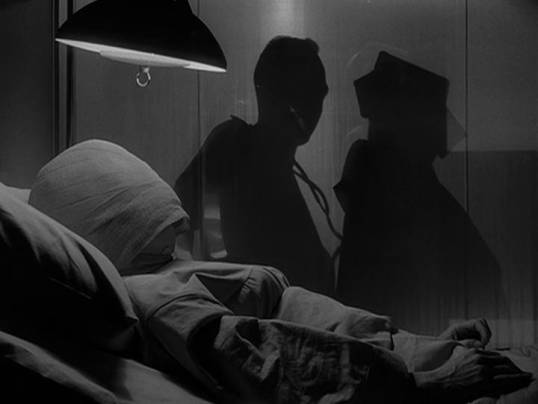
Twilight Zone 1.8 “Time Enough At Last” (1959, dir by John Brahm)

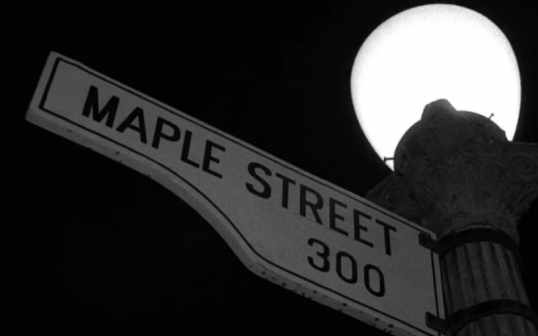
Twilight Zone 1.22 “The Monsters Are Due On Maple Street” (1960, dir by Ronald Winston)

Twilight Zone 2.6 “Eye of the Beholder (1960, dir by Douglas Heyes)

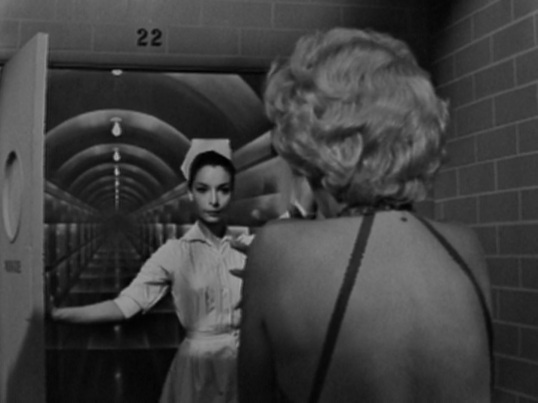
Twilight Zone 2.17 “Twenty-Two (1961, dir by Jack Smight)

Late Night Retro Television Review: Check It Out! 3.16 “My Hero, Mr. Bannister”


Welcome to Late Night Retro Television Reviews, a feature where we review some of our favorite and least favorite shows of the past!  On Saturdays, I will be reviewing the Canadian sitcom, Check it Out, which ran in syndication from 1985 to 1988.  The entire show is currently streaming on Tubi and Peacock!

This week features some adorable kittens!

Episode 3.16 “My Hero, Mr. Bannister”

(Dir by Jayne Schipper, originally aired on January 3rd, 1988)

Stockboy Derek (Andrew Miller) admires Howard and decides that, in order to be like his idol, he’s going to drop out of high school and devote himself to becoming manager of a grocery store.  Howard has to show Derek has stupid that would be.  Fortunately, Derek comes to his senses by the end of the episode.  No one wants to grow up to be Howard.

This was a weird episode, largely because everyone acted as if Derek was a regular member of the cast despite the fact that this was only his second appearance on the show.  (He appeared earlier in the season, in yet another episode that was devoted to his character.)  One of the oddest things about this season is that it keeps introducing characters who seem like they’re going to be regulars — Howard’s brother, the executive from the company that bought Cobb’s — but who then never show up again.  Or in Derek’s case, they showed up on more time.  Seen today, all of these episodes feel like backdoor pilots for shows that were never actually put into production.  That doesn’t mean that they’re necessarily bad episodes, of course.  While Derek’s storyline was a bit forgettable, the third season has still been a marked improvement over the first two.

This episode featured a B-plot about an adorable cat named Marvin who decided to live in the store with “Mrs. Marvin.”  They had kittens!  And the kittens were adorable.  I’m a cat person so I enjoyed that.  Otherwise, this episode was fairly forgettable.

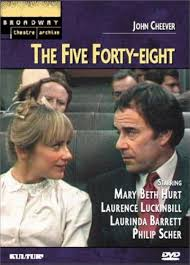
Retro Television Review: 3 By Cheever 1.3 “The Five Forty-Eight”


Welcome to Retro Television Reviews, a feature where we review some of our favorite and least favorite shows of the past!  On Saturdays, I will be reviewing 3 By Cheever, which ran on PBS in 1979.  The entire show can be purchased on Prime and found on YouTube.

This week, we finish up 3 By Cheever with an adaption of one of his best-known short stories.

Episode 1.3 “The Five Forty-Eight”

(Dir by James Ivory, originally aired on James Ivory)

Laurence Luckinbill stars as Blake, a business executive who rides the train into the city for work and then back to the suburbs when it’s time to return to his perfect home.  One day, as Blake heads to his train, he comes to be aware that he’s being followed by his former secretary, Miss Dent (Mary Beth Hurt).  Blake is concerned because Miss Dent made quite a scene when she was fired from her job a little while ago.  Of course, a part of the reason why she was so upset was because Blake had earlier seduced her, something that he has a habit of doing when it comes to his secretaries.  On the train, surrounded by neighbors (including one that Blake can’t stand because of his long hair), Blake finds himself sitting next to Miss Dent.  She explains that she has a gun in her purse.  As the train heads for its destination, Blake’s confident facade crumbles and he is soon as humiliated by his former secretary as she was by him.  And yet, this being a Cheever story, one wonders if Blake is even capable of realizing why any of this is happening to him.

The final episode of 3 By Cheever was an adaptation of one of John Cheever’s best short stories.  As directed by James Ivory, this adaptation can feel a bit overdrawn.  The short story, for instance, opens with Blake on an elevator, already preparing to head home on the train.  Ivory’s adaptation opens with Blake at the start of his day and we see a lot of things — like Blake’s antagonistic relationship with his long-haired neighbor — that Cheever simply mentioned.  It takes a while for Miss Dent to finally sit down next to Blake and Ivory doesn’t do much to build up any sort of suspense while we’re waiting.

On the plus side, the film reveals Ivory’s skill when it comes to working with actors as both Luckinbill and Mary Beth Hurt give excellent performances.  Luckinbill goes from being oily and overconfident to being a neurotic mess by the end of the show while Hurt does the opposite, going from being meek to commanding.  Both the original short story and Ivory’s adaptation succeed in making you wonder what the future could possibly hold for either one of the two characters.  They both seem to reach a point of no return and it’s hard to imagine Blake going back to his suburban home and his train rides and his motel hook-ups but, then again, this is a Cheever story so the implication is that he does just that, untouched by the fact that he nearly lost his life due to his own behavior.  As for Miss Dent, she reclaims her self-respect by going to an extreme.

This was the last episode of 3 By Cheever.  This was an interesting series of adaptations, even if Cheever’s prose does seem to work best on the page than literally translated to film.  Next week, a new series will being in this spot.

Song of the Day: Theme From The Third Man by Alex Karas


Today’s song of the day is the haunting zither theme of The Third Man.  Whenever I hear this music, I immediately think of Orson Welles, emerging from the shadows with that charming smile on his face.  I also think about poor Holly Martins (Joseph Cotten), being chased through Vienna by that little kid who wouldn’t stop yelling at him.  And, of course, there’s that famous final shot….

4 Shots From 4 Films: Special David MacKenzie Edition


4 Shots From 4 Films is just what it says it is, 4 shots from 4 of our favorite films. As opposed to the reviews and recaps that we usually post, 4 Shots From 4 Films lets the visuals do the talking!

Today, the Shattered Lens wishes a happy birthday to Scottish director, David MacKenzie!  It’s time for….

4 Shots From 4 David MacKenzie Films

Young Adam (2003, dir by David MacKenzie, DP: Giles Nuttgens)

Starred Up (2014, dir by David MacKenzie, DP; Michael McDonough)

Hell or High Water (2016, dir by David MacKenzie, DP: Giles Nuttgens)

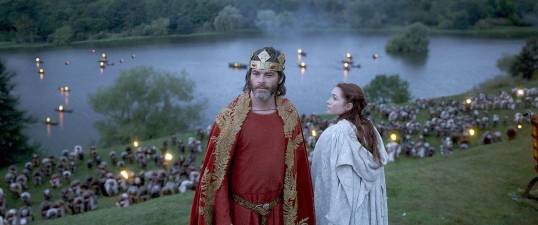
Outlaw King (2018, dir by David MacKenzie, DP: Barry Ackroyd)